
Carnaroli, Arborio, Vialone Nano, Sant’Andrea, Baldo, Roma, Ribe and Balilla: how starch and grain structure guide risottos, soups, timbales and salads. A guide with a summary table, the pages of Pellegrino Artusi, the Cucchiaio d’Argento and La Cucina Italiana.
The Rice is not a neutral ingredient. The variety determines how much starch the grain releases during cooking, how much liquid it absorbs, whether it stays separate or binds into a cream. From this follow the technique, the finishing fat, the serving temperature and the most suitable seasoning. A Carnaroli and a Vialone Nano starting from the same base reach the plate with different results in terms of creaminess, al dente firmness and persistence on the palate. For the chef, the foodservice buyer and the attentive consumer, choosing the variety already means designing the dish.
GIFT has already introduced the legal classification and the labelling of rice: legal designations, traditional varieties, the ‘Classico’ indication and the three geographical indications. The focus now widens to the uses and the pairings of the main Italian varieties, based on Italian gastronomic culture. From Pellegrino Artusi to the Cucchiaio d’Argento, from La Cucina Italiana to Gambero Rosso, to the cookbooks and magazines to which much of the grammar of rice in the kitchen is owed.
Pellegrino Artusi and rice before modern varieties
When Pellegrino Artusi published, in 1891, La scienza in cucina e l’arte di mangiar bene, none of the varieties best known today had yet been developed. Vialone was selected by Ettore De Vecchi in 1903, the Vialone Nano dates back to the Thirties, the Carnaroli to 1945 and the Arborio to 1946. Artusi’s risotto, retraced by GIFT in its culinary journey through the history of Italian risotto, was therefore an exercise in technique rather than in variety. For this very reason it retains a didactic value.
The gastronome from Forlimpopoli (Emilia-Romagna) sets out some gestures that starch science would later explain. The first concerns washing: ‘Rice, as I have already told you on another occasion, should not be washed; it is enough to clean it and rub it inside a cloth’ (Artusi, recipe no. 75, ‘Risotto with peas’). The surface starch, which water would wash away, is in fact the raw material of the mantecatura. The second is the gradual wetting, when he recommends ‘pouring hot water one ladleful at a time’, a principle that still underpins every risotto.
The sequence of Artusi’s risottos (recipes nos. 72-83) is already a map of pairings: clams, tench, cuttlefish Florentine style, peas, porcini mushrooms, tomatoes, three Milanese-style versions, frogs, prawns, fish broth. On risotto alla milanese, Artusi states that he proceeds ‘without any pretension of outdoing the Ambrosian cooks, learned and ingenious in this matter’ (recipe no. 80). In the black risotto with cuttlefish he instead offers a lesson in restraint on pairings: ‘Tuscans, Florentines in particular, are so fond of vegetables that they would like to stick them everywhere’ (recipe no. 74).
Artusi's rice, moreover, is not limited to risotto. The rice fritter soup (no. 30), the risi e luganighe (fresh sausages) of Venetian origin (no. 42), the rice croquettes (nos. 198-199), the rice side dish (no. 245) and the rice mould with sauce garnished with giblets (no. 345) already map out the geography of use that modern varieties would later specialise: soups, fried dishes, side dishes, baked preparations.
Starch, pearl and amylose, the grammar of cooking
Rice starch is composed of amylose, with a linear chain, and amylopectin, which is branched. A study carried out on 25 Italian Japonica-type varieties, with the collaboration of the Ente Nazionale Risi, measured an amylose content of 20.7% in Carnaroli, compared with 14.1% in Arborio, 14.2% in Baldo and 15.2% in Sant'Andrea (Haxhari et al., 2024). The same authors link the ability of risotto varieties to absorb seasonings and release starch to a more porous and less compact endosperm structure.
The opaque portion of the grain, which technicians call pearl, is where this porosity is concentrated. The Pavia Chamber of Commerce describes in Carnaroli a very extensive 'central pearl (part of the grain with a different density of the starchy parenchyma)', associated with a starch rich in amylose, which makes the grain firm and limits losses during cooking. In practice:
- a higher content of amylose promotes al dente firmness and the separation of the grains;
- a content lower, combined with a large bead, gives a creaminess faster and more enveloping but requires greater attention to timing.
The same research found a medium glycaemic index for Carnaroli, equal to about 64 (Haxhari et al., 2024), as GIFT had already highlighted when recounting the eighty years of the Carnaroli, the ‘king of rices’.
Italian varieties and their vocation in the kitchen
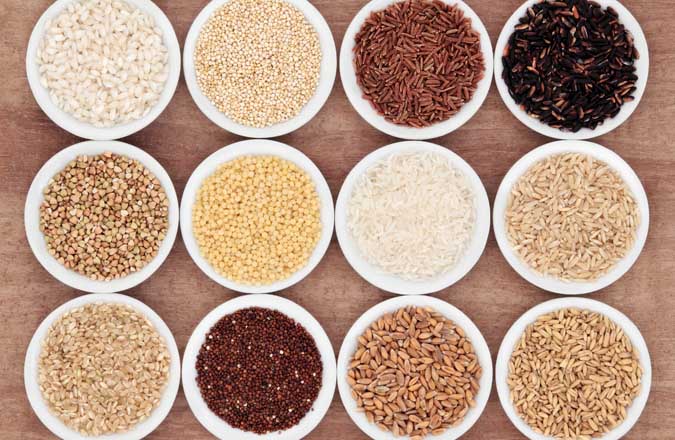
The Carnaroli has a long, firm grain, high cooking resistance and gradual starch release. It is the variety of choice for structured risottos and for long creaming with porcini mushrooms, mature cheeses, truffle or saffron and bone marrow. It also holds up well in timbales, sartù, supplì and arancini. Gambero Rosso, in a dedicated tasting, highlighted its versatility also for rice salads, soups, broths, cakes and desserts.
The Arborio, born in the Vercelli area in 1946 by Domenico Marchetti starting from Vialone, has a large and pearly grain. With a lower amylose it releases starch quickly and gives an immediate creaminess, ideal with seasonal vegetables, fresh cheeses and delicate broths. Gambero Rosso describes it as the variety capable of naturally transitioning from winter soups to risottos and supplì. GIFT has retraced its history in eighty years of the giant.
The Vialone Nano has a medium, rounded and compact grain, able to absorb a lot of liquid without falling apart. It is the rice of wave-style Venetian and Mantuan risottos, from risi e bisi to risotto alla pilota with salami meat, as well as risotto alla certosina with freshwater prawns and peas, recalled by the Pavia Chamber of Commerce. It is also suited to dry dishes and rice salads.
The Sant’Andrea – which takes its name from the basilica of Vercelli (Piedmont) – has a long, compact grain rich in starch. It easily creates the creaminess of wave-style creamed risotto: it is the rice most used for the panissa Vercelli-style, with beans, salam d’la duja and Barbera. It also gives good results boiled, as a side dish.
The Baldo, a younger variety derived from Arborio, shares with it a low amylose and rapid cooking. It is suitable for creamy risottos, baked rice and flans. GIFT delved deeper genetics, PDO and PGI of Baldo, a variety admitted both in Riso di Baraggia Biellese e Vercellese PDO and in Riso del Delta del Po PGI.
The Roma has large, rounded grains, rich in starch, suitable for risottos and soups. The legal designation places it alongside Baldo (‘Riso Roma o Riso Baldo’), as explained by GIFT in the in-depth article on identity and labelling of Roma rice.
The Ribe has fine grains that remain well separated after cooking. It is suitable for boiling, hence for rice salads, timbales and side dishes, as well as for soups; it is also the variety most used to produce parboiled rice (see next paragraph). It is precisely this grain separation that makes it valuable in the rice salad, the Italian recipe of the summer.
The Balilla and the other round rices have small grains, less firmness and a certain stickiness. For this reason they find their vocation in soups in broth, in rice puddings and in timbales. The wholegrain rice, finally, requires longer cooking times and offers a chewier grain, excellent in salads and side dishes, as illustrated by GIFT regarding the value of the whole grain.
Parboiled rice, separate grains that hold up to cooking
The Parboiled rice comes from a hydrothermal treatment applied to paddy rice, before husking. The process consists of three stages: soaking in water hydrates the grain, steam treatment gelatinises the starch and seals the microcracks naturally present in the kernel, and drying restores its hardness (Muchlisyiyah et al., 2023). Only at this point is the rice husked and processed. During drying and storage the gelatinised starch partly retrogrades, re-forming more compact structures.
The result is a vitreous grain, amber in tone, more resistant to processing, with a higher yield of whole grains. In the kitchen it stays separate and barely sticky; it holds up to cooking even if left to stand, a quality appreciated in salads, side dishes, Food service catering.
On the metabolic level, a meta-analysis of five intervention studies found a significant reduction in glycaemic response post-prandial, the parameter on which the glycaemic index is calculated, after consumption of parboiled rice compared with non-parboiled rice, with no significant differences in the insulin response (Amoah et al., 2025).
The protected designations of Italian rice
Three geographical indications recognised and protected at European level link Italian rice to some of its territories:
- The Riso di Baraggia Biellese e Vercellese PDO, in Piedmont, is the only Italian PDO in the sector and covers 28 municipalities and seven varieties: Arborio, Baldo, Balilla, Carnaroli, Sant’Andrea, Loto and Gladio;
- The Riso del Delta del Po PGI concerns Japonica rice of the superfino group grown in municipalities of the provinces of Rovigo (Veneto) and Ferrara (Emilia-Romagna). With the amendment to the product specification published in 2026, the permitted varieties are grouped under three names: Arborio rice (Arborio, Volano, Telemaco), Baldo rice (Baldo, Cammeo), Carnaroli rice (Carnaroli, Karnak, Caravaggio, Keope), with a minimum protein content of 6.60% on dry matter (European Commission, C/2026/844);
- The Riso Nano Vialone Veronese PGI is in turn reserved for Vialone Nano grown on the Verona plain, in Veneto.
PDO and PGI rices follow their respective product specifications and remain outside the scope of the national rules (Legislative Decree 131/2017, art. 1.3). For other types of rice, as has been seen, the only guarantee of varietal purity is offered by the ‘Classico’ indication on the label.
Table of uses and pairings
| variety | Grain and behaviour during cooking | Most suitable uses | Most suitable pairings
|
| Carnaroli | Long, extensive central pearl, higher amylose content; excellent firmness, gradual starch release | Structured risottos with long creaming, timballi, sartù, supplì and arancini, salads | Porcini mushrooms, mature cheeses, truffle, saffron and bone marrow, shellfish; butter and Parmigiano Reggiano PDO |
| Arborio | Large, pearly, low amylose content; quick creaminess, sensitive to overcooking | Creamy risottos, soups, supplì, timballi | Seasonal vegetables (pumpkin, asparagus, peas), fresh cheeses, vegetable and chicken stocks |
| Vialone Nano | Medium, compact; high absorption without falling apart | Wave-style risottos, risi e bisi, risotto alla pilota, dry dishes, salads | New peas, freshwater fish and prawns, cuttlefish, fresh cured meats, meat reductions |
| Sant’Andrea | Long, compact, rich in starch; quick creaminess | Wave-textured risottos, panissa from Vercelli, soups, boiled side dishes | Beans, cured meats preserved in fat, Piedmontese red wines used in cooking, mountain-pasture cheeses |
| Baldo | Long grain, moderate amylose content; quick, creamy cooking | Creamy risottos, baked rice dishes, timbales | Vegetables, soft cheeses, béchamel and white ragù |
| Roma | Large, rounded, rich in starch | Risottos, soups, timbales | Meat broths, pulses, tomato sauces |
| Ribe | Fine, well separated grains; suited to parboiling | Rice salads, side dishes, timbales, soups | Raw and grilled vegetables, fish, dressings based on extra virgin olive oil and citrus |
| Balilla and round rice varieties | Small, more pronounced stickiness, less firmness | Soups in broth, rice desserts, timbales, croquettes | Meat and vegetable broths, milk and citrus in desserts |
| wholegrain rice | Whole grain, longer cooking, chewiness | Salads, side dishes, one-dish meals | Pulses, roasted vegetables, nuts, extra virgin olive oil |
Considered pairings: fats, broths and techniques
In creamy, mantecati dishes creaminess does not come from fat alone. It is the result of the starch released by the grain and of a mantecatura done off the heat, with butter cold and grated cheese. With porcini mushrooms and meat stocks, Carnaroli holds its structure and does not ‘collapse’. With blue cheeses it is best to measure the mantecatura carefully so as not to mask the lactic note. Vialone Nano, more compact, is chosen when you want a wave-textured risotto with a clearly perceptible grain, as in the Milanese version with saffron and marrow, which the Municipality of Milan has recognised with a Municipal Designation.
In seafood cooking grain firmness is decisive, since a grain that breaks down gets lost in the savouriness. Vialone Nano and Carnaroli are the safest choices. With Bottarga, sea urchins, mussels and clams the mantecatura must remain light, with extra virgin olive oil or a little clarified butter. The acidity of white wine or citrus, added during cooking or as a finishing touch, balances the savouriness. Artusi already devoted separate recipes to risotto with wedge clams, to the one with prawns and to the one with fish broth (nos. 72, 82 and 83).
In soups and rice in broth absorption and softness are needed: Balilla, Roma, Ribe and Arborio respond well, provided the broth is added gradually and cooking is stopped before the grain falls apart. For timballi, sartù, arancini and supplì cohesion is needed: Carnaroli, Sant’Andrea and Arborio, with a rich mantecatura and adequate resting, provide the necessary structure. In cold preparations such as rice salads, Ribe and Vialone Nano stay loose and separate; oil and acidity should be added at the last moment, so as not to soften the grain too much.
Rice in twentieth-century cookbooks and magazines
Il Cucchiaio d’Argento was born in 1950, published by Editoriale Domus, from an idea of the publisher Gianni Mazzocchi. The opening line of the first edition, ‘There can be no improvisation in the kitchen’, went on to evoke a culinary art based on measurements, proportions and the balance of the various elements. This is the spirit with which the cookbook brought the technique of risotto and oven-baked preparations into people’s homes. Seventy-five years after its first release, the twelfth edition features two thousand recipes, more than three million copies sold and sixteen translations (Manuelli,2025).
La Cucina Italiana was published in Milan on 15 December 1929. Its founder was Delia Pavoni Notari, who effectively ran the editorial office, while official editorship remained for years with her husband Umberto Notari. The magazine was among the promoters – together with the Collegio Culinario, Casa Artusi and the Accademia Italiana della Cucina – of the nomination that on 10 December 2025 in New Delhi led to the inscription of ‘La Cucina Italiana between sustainability and biocultural diversity’ on the UNESCO Representative List of the Intangible Cultural Heritage of Humanity. For rice, this is a system-wide recognition: risottos, soups and timbales enter the heritage as community practices, linked to territories and varieties.
The Accademia Italiana della Cucina has devoted to rice a volume in the series ‘Itinerari di cultura gastronomica’, La cucina del riso (2014), completed by a booklet of papers and regional recipes. The Gambero Rosso finally offers, with its comparative tastings of Carnaroli (2021) and Arborio (2026), a sensory reading of the varieties that helps to identify a quality risotto rice in terms of firmness, aromatic profile and grain integrity.
Cooking and serving tips
Varieties lower in amylose, such as Arborio and Baldo, reward those who respect cooking times: a few minutes too many and the grain loses its firmness. The mantecatura (final creaming) should be done off the heat, so as not to ‘cook’ the fat and to obtain a stable cream; cheese added over a high flame tends to separate. Excess fat or overly reduced sauces cancel out the perception of the grain, especially with Vialone Nano. Finally, serving must follow the mantecatura immediately, since risotto continues to absorb liquid on the plate.
Guidance for foodservice and the supply chain
Rice experts suggest that restaurateurs should specify on the menu the variety and its function in the various dishes – for example, ‘Carnaroli for structure and creaminess’ or ‘Vialone Nano for separate grains and absorption’ – and offer different varieties for different preparations. Those wishing to list a specific variety on the menu will find a guarantee of varietal purity in the wording ‘Classico’, that is, in the PDO and PGI designations.
For buyer, consistency between variety, package format and intended use (risotto, soup, salad, fried food) reduces waste and improves repeatability in the kitchen. It is also a way to enhance a supply chain that represents - as GIFT has documented, in the analysis on Italian rice on the European market – the leading rice hub of the Union. The variety is not a mere label detail: it is a tool for designing the dish and ensuring the consistency of the menu.
Our team of FARE supports operators from farm to fork in the strategic planning of compliance in food safety and commercial information, in the field of sustainability as well as supply chains, processes and products, including nutrition & health claims. It also provides support for the development of corporate governance systems and operating procedures.
Dario Dongo
Frequently asked questions
Which is the best rice for risotto? Carnaroli for structured risottos and long creaming, Vialone Nano for ‘all’onda’ risottos, Arborio for quick creaminess. Sant’Andrea and Baldo are valid alternatives.
What is the difference between Carnaroli and Arborio? Carnaroli contains more amylose (20.7% versus 14.1%) and holds up better during cooking; Arborio releases starch more quickly and gives an immediate creaminess, but is more sensitive to overcooking.
Should rice for risotto be washed? No. Artusi already advised against washing it: the surface starch is needed for the creaming.
Which rice should be chosen for arancini, supplì and timballi? Carnaroli, Sant’Andrea or Arborio, with a rich creaming and adequate resting before shaping.
Which rice should be used for rice salad? Ribe, Vialone Nano or a parboiled rice, which stay loose and separate; oil and acidity should be added just before serving.
How can a pure variety be recognised on the label? By the wording ‘Classico’ next to the denomination (for example ‘Riso Carnaroli Classico’) or by the PDO and PGI denominations.
References
Classics of gastronomic literature
Artusi, P. (1891). La scienza in cucina e l’arte di mangiar bene (recipes nos. 30, 42, 72-83, 198-199, 245, 345; Liber Liber digital edition). https://linux.studenti.polito.it/static_resources/liberliber/biblioteca/a/artusi/la_scienza_in_cucina_e_l_arte_di_mangiar_bene/pdf/la_sci_p.pdf
Editoriale Domus. (n.d.). Il Cucchiaio d’Argento. https://www.edidomus.it/content/edidomus/en/brand/il-cucchiaio-d-argento.html
Magazines, institutions and gastronomic culture
Accademia Italiana della Cucina. (2014). La cucina del riso. Itinerari di cultura gastronomica. https://accademiaitalianadellacucina.it/sites/default/files/media/AIC_Itinerari%20del%20riso_prot.pdf
Accademia Italiana della Cucina. (2015). La cucina del riso. Relazioni e ricette (Quaderno no. 84). https://accademiaitalianadellacucina.it/sites/default/files/print_pdf/84_quaderno%20la%20cucina%20del%20riso.pdf
Labitalia. (2020, 13 October). ‘Il Cucchiaio d’Argento’ turns 70, the journey continues with the 11th edition. Ecoseven. https://www.ecoseven.net/lavoro/il-cucchiaio-dargento-compie-70-anni-viaggio-continua-con-11ma-edizione/
La Cucina Italiana. (2019, November). Birthday special. Press review of the Accademia Italiana della Cucina. https://www.accademiaitalianadellacucina.it/sites/default/files/la%20cucina%20italiana.pdf
Manuelli, M. T. (2025, 17 September). The Silver Spoon turns 75 and celebrates 2000 recipes and over 3 million copies. Il Sole 24 Ore. https://en.ilsole24ore.com/art/the-silver-spoon-turns-75-and-celebrates-2000-recipes-and-over-3-million-copies-AHcVTtgC
Tastings and stories from Gambero Rosso
Gambero Rosso. (2021, 4 November). Carnaroli rice. In search of the best on the market. https://www.gamberorosso.it/notizie/riso-carnaroli-alla-ricerca-del-migliore-in-commercio
Gambero Rosso. (2026, 22 May). We have chosen the 12 best Arborio rices in the supermarket: the top one costs less than 4 euros. https://www.gamberorosso.it/notizie/rubriche/classifiche/migliori-risi-arborio-supermercato/
Gambero Rosso. (n.d.). The woman who, with a great magazine, made Italian cuisine a cultural phenomenon. https://www.gamberorosso.it/?p=167071
Scientific studies on starch and grain structure
Haxhari, F., Savorani, F., Rondanelli, M., Cantaluppi, E., Campanini, L., Magnani, E., Simonelli, C., Gavoci, G., Chiadò, A., Sozzi, M., Cavallini, N., Chiodoni, A., Gasparri, C., Barrile, G. C., Cavioni, A., Mansueto, F., Mazzola, G., Moroni, A., Patelli, Z., Pirola, M., Tartara, A., Guido, D., Perna, S., & Magnaghi, R. (2024). Endosperm structure and Glycemic Index of Japonica Italian rice varieties. Frontiers in Plant Science, 14, 1303771. https://doi.org/10.3389/fpls.2023.1303771
Scientific studies on parboiled rice
Amoah, I., Cobbinah, J. C., Tawiah, P., Lim, J. J., Yeboah, J. A., & Rush, E. (2025). Glycaemic and satiety responses associated with the consumption of parboiled and braised rice: a systematic review and meta-analysis. Cogent Food & Agriculture, 11(1), 2550070. https://doi.org/10.1080/23311932.2025.2550070
Muchlisyiyah, J., Shamsudin, R., Kadir Basha, R., Shukri, R., How, S., Niranjan, K., & Onwude, D. (2023). Parboiled Rice Processing Method, Rice Quality, Health Benefits, Environment, and Future Perspectives: A Review. Agriculture, 13(7), 1390. https://doi.org/10.3390/agriculture13071390
Technical sources on varieties
Altroconsumo. (n.d.). Rice: how to choose. https://www.altroconsumo.it/alimentazione/riso/come-scegliere
Pavia Chamber of Commerce. (n.d.). Good to know. Rice. https://www.pv.camcom.gov.it/files/ProdottiTipici/BUONO_A_SAPERSI_riso.pdf
Ente Nazionale Risi. (2026, May). Arborio rice celebrates its 80th anniversary. Risi. https://www.enterisi.it/upload/enterisi/gestionedocumentale/RISImaggio2026_784_117148.pdf
Turismo Valsesia Vercelli. (2022). On the rice roads. https://visitvalsesiavercelli.it/wp-content/uploads/2022/08/Sulle_strade_del_riso.pdf
Turismo Valsesia Vercelli. (n.d.). Vercelli rice. https://visitvalsesiavercelli.it/en/?p=12691
Product specifications and European acts
Publication of the communication of an approved standard amendment to a product specification of a geographical indication, ‘Riso del Delta del Po’ (PGI-IT-0712-AM02). OJ C, C/2026/844, 6.2.2026. http://data.europa.eu/eli/C/2026/844/oj

Dario Dongo, lawyer and journalist, PhD in international food law, founder of WIISE (FARE - GIFT – Food Times) and Égalité.


