

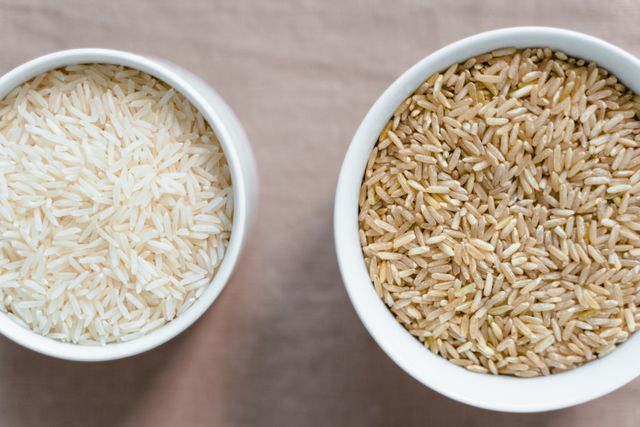
Brown rice is the cereal in its most complete: unlike white rice, it retains the pericarp, germ and aleurone layer, where fibers, B-group vitamins, minerals and bioactive compounds that refining removes are concentrated. This article reconstructs the history, the processing method, the nutritional profile certified by CREA and the latest scientific evidence, with a look at market figures and EU regulatory constraints on contaminants that every supply chain operator should know.
From paddy to whole grain, brown rice
The paddy rice is the raw rice just harvested, covered by the husk. The first processing, the hulling, removes only this outer layer and returns brown rice (or hulled rice): a grain that retains the branbran germ and the aleurone layerIt is only with subsequent whitening and polishing that white rice is obtained, lighter and storable but depleted of some micronutrients.
Historically, brown rice has been the form original of consumption. Its marginalization in the twentieth century, in favor of polished rice, was not painless: in Asian populations that based their diet on rice, the spread of polishing caused epidemics of beriberi, a disease caused by thiamine deficiency (vitamin B1) which is actually concentrated precisely in the outer layers of the grain.
Biochemical profile and nutritional profile
According to the food composition tables of CREA (2019), 100 g of raw brown rice provide on average:
| – Energy | 341 kcal |
| – Proteins | 7.5 g |
| – Lipids | 1.9 g |
| – Carbohydrates | 77.4 g |
| – of which sugars | 1.2 g |
| – Dietary fibers | 1.9 g |
| – Salt | 22.5 mg |
Compared to polished rice, the whole grain offers more fibers (1.9 g versus about 1.0 g), more than double the potassium (214 vs ~92 mg) and phosphorus (221 vs ~94 mg), and almost four times the niacin (4.7 vs ~1.3 mg).
The analysis of the contents of micronutrients in relation to the Reference Nutritional Values established by the Food Information Regulation (EU) No 1169/11 and the conditions established by the Nutrition and Health Claims Regulation (EC) No 1924/06 indicates the possibility of promoting brown rice in the European Union with the following nutritional claims:
- rich in vitamin B1 (thiamine): 0.48 mg per 100 g, equal to 44% of the Nutritional Reference Value;
- rich in phosphorus: 221 mg, equal to 32% of the NRV;
- source of vitamin B3 (niacin): 4.7 mg equal to 29% of the NRV.
The lipid fraction, concentrated in the germ, is about five times higher and is rich in unsaturated fatty acids, in addition to containing vitamin E. The whole grain is also a source of magnesium, manganese and of phytocompounds — γ-oryzanol, tocotrienols, GABA, ferulic acid, lignans and polyphenols — which are instead absent or scarce in refined rice (Kazemzadeh et al., 2014; Xie et al., 2019).
The benefits of brown rice
EFSA (European Food Safety Authority) has not yet had the opportunity to evaluate the health benefits associated with the consumption of brown rice, in the absence of application requests for specific health claim. Scientific research furthermore offers some insights suggesting the usefulness of consuming rice, as well as other cereals, in their whole grain versions.
Prevention of type 2 diabetes. In general terms, the consumption of whole grains, including rice, is associated with a lower risk of diabetes. A dose-response meta-analysis of 10 cohort studies and 37 trials estimated that the intake of 50 g/day By whole grains reduces the risk of type 2 diabetes by 24% and recommends an intake of 150 g/day for preventive purposes (Ying et al., 2024).
Heart and circulation. A dose-response meta-analysis of prospective studies associated the intake of whole grains (90 g/day) with a reduction of risks of coronary heart disease (-16%) and cardiovascular disease (-13%. Aune et al., 2016). A trial on 40 overweight women consuming 150 g/day of cooked brown rice for six weeks showed a reduction of C-reactive protein high sensitivity and improvement of some cardiovascular risk factors (Kazemzadeh et al., 2014).
Weight and inflammation. A crossover study on a whole grain-rich diet found the weight reduction body and inflammation systemic low-grade, although without significant changes in the microbiota in two weeks (Roager et al., 2019); the beneficial effect on the gut is mainly attributed to fiber fermentation and production of butyrate.
Tumors. Whole grains are among the foods that ‘probably protect’ against colorectal cancer: for every 90 g/day the evidence indicates a 17% risk reduction (AICR, 2023; Vieira et al., 2017). A review also documents the inverse association between whole grain consumption and breast cancer incidence, attributing it to grain phytocompounds — γ-oryzanol, tocotrienols, lignans, and polyphenols — active in different phases of carcinogenesis (Xie et al., 2019).
Brown rice and glycemic index
Theglycemic index of white rice ranges, depending on variety and cooking, on medium-high values (≈ 64-73), while the rice tends to be lower, around 55 (Foster-Powell et al., 2002). However, the data must be contextualized: the glycemic response depends on the variety, degree of cooking, presence of resistant starch, and overall meal composition.
A meta-analysis of 7 trials on 417 adults found no significant differences in glycemic response (HbA1c or fasting blood glucose), while noting a reduction in body weight and an increase in HDL cholesterol in subjects who consumed brown rice instead of white rice (Abdul Rahim et al., 2021). The longer cooking times of the whole grain may help reduce the difference between the two types.
Brown rice in the kitchen: cooking and pairings
Brown rice is mainly distinguished from white rice by its sturdier texture and more pronounced flavor:
- the whole grain varieties of Carnaroli, Arborio e Baldo are suitable for Italian risottos rustic (35-40 minutes);
- long grains like Ribe and Thaibonnet are ideal for cold salads, where they do not overcook and remain separate;
- round varieties like Originario, Balilla, and Vialone nano are best expressed in soups and broths.
The pressure cooker reduces the cooking times of brown rice to 12-20 minutes, depending on the variety, with an indicative ratio of two parts water to one part rice, preserving water-soluble micronutrients. The initial toasting and cooking without soaking help maintain structure and aromatic profile.
How to choose and buy Italian brown rice
For those selecting the product, a few essential criteria matter essential:
- Theorigin, preferably from the Po Valley (Piedmont, Lombardy, Veneto, Emilia-Romagna), possibly also certified Baraggia DOP or Po Delta IGP;
- The certification organic, the only codified guarantee for environmental and biodiversity protection;
- the variety suitable for use (whole Carnaroli or Arborio for risottos; long grains for salads) and a traceability transparent.
Since the oils in the germ reduce its shelf life, it is preferable to consume brown rice within 12-18 months of production.
GIFT (Great Italian Food Trade) supports international buyers in the search for certified suppliers, in verifying the supply chain from paddy field to packaging, in export negotiation and logistics, and in choosing the varieties best suited to each target market.
Arsenic and cadmium: EU limits
A data point often overlooked concerns contaminants inorganic. Rice absorbs arsenic and cadmium from the environment, and the brown grain — precisely because it retains the bran — tends to concentrate more arsenic inorganic than polished rice. For this reason, EU law differentiates the maximum levels: with regulation (EU) 2023/465, consolidated in regulation (EU) 2023/915, the limit for non-parboiled (white) processed rice was lowered to 0.15 mg/kg, while for semi-milled/brown and parboiled rice it remains 0.25 mg/kg. For cadmium, regulation (EU) 2021/1323 sets 0.15 mg/kg for processed, brown and parboiled rice (Dongo, 2023).
On a practical level, washing rice and cooking it in abundant water significantly reduces arsenic; on the agronomic level, the National Rice Institute and CREA are conducting experiments with correctives based on calcium to limit cadmium accumulation in the grain (National Rice Institute, 2025). It is good practice, finally, to alternate brown rice with other whole grains to diversify exposure.
Conclusions
Brown rice combines a nutritional profile superior to refined rice, an agronomic history rooted in the Po Valley, and growing market prospects in the health and organic segments. Peer-reviewed evidence from the last decade support its role in cardiovascular, oncological, and metabolic prevention, while advising not to overestimate individual parameters such as the glycemic index.
Dario Dongo
Credit cover MART PRODUCTION
References
Abdul Rahim, A. F., Norhayati, M. N., & Zainudin, A. M. (2021). The effect of a brown-rice diets on glycemic control and metabolic parameters in prediabetes and type 2 diabetes mellitus: A meta-analysis of randomized controlled trials and controlled clinical trials. PeerJ, 9, e11291. https://doi.org/10.7717/peerj.11291
AICR. (2023). Whole grains, wheat and cancer prevention. American Institute for Cancer Research. https://www.aicr.org/cancer-prevention/food-facts/whole-grains/
Aune, D., Keum, N., Giovannucci, E., Fadnes, L. T., Boffetta, P., Greenwood, D. C., Tonstad, S., Vatten, L. J., Riboli, E., & Norat, T. (2016). Whole grain consumption and risk of cardiovascular disease, cancer, and all cause and cause specific mortality: Systematic review and dose-response meta-analysis of prospective studies. BMJ, 353, i2716. https://doi.org/10.1136/bmj.i2716
Confagricoltura. (2025, 20 September). A year of challenges for Italian rice, between growing production and the risk of oversupply. https://www.confagricoltura.it/ita/area-stampa/mondo-agricolo-approfondimenti/un-anno-di-sfide-per-il-riso-italiano-tra-produzione-in-crescita-e-il-rischio-di-eccesso-di-offerta
CREA. (2019). Food composition tables: Brown rice (Code 000110). Council for Agricultural Research and Economics (CREA). https://www.alimentinutrizione.it/tabelle-nutrizionali/000110
Dongo, D. (2023, 3 November). Arsenic in rice, what are the analysis criteria in the EU? Lawyer Dario Dongo answers. FARE (Food and Agriculture Requirements). https://fareagrifood.com/2023/11/03/arsenico-riso-criteri-analisi/
National Rice Agency. (2025). Annual report and data on rice cultivated areas 2025. https://www.enterisi.it/
Foster-Powell, K., Holt, S. H. A., & Brand-Miller, J. C. (2002). International table of glycemic index and glycemic load values: 2002. The American Journal of Clinical Nutrition, 76(1), 5–56. https://doi.org/10.1093/ajcn/76.1.5
Future Market Insights. (2025). Brown rice market size & growth 2025 to 2035. https://www.futuremarketinsights.com/reports/brown-rice-market
Kazemzadeh, M., Safavi, S. M., Nematollahi, S., & Nourieh, Z. (2014). Effect of brown rice consumption on inflammatory marker and cardiovascular risk factors among overweight and obese non-menopausal female adults. International Journal of Preventive Medicine, 5(4), 478–488. https://pmc.ncbi.nlm.nih.gov/articles/PMC4018597/
Mordor Intelligence. (2025). Italy rice market (2025–2030). https://www.mordorintelligence.com/industry-reports/italy-rice-market
Regulation (EU) 2023/915 of the Commission, of 25 April 2023, on maximum levels of certain contaminants in foodstuffs and repealing Regulation (EC) No 1881/2006. OJ L 119 of 5.5.2023. https://eur-lex.europa.eu/legal-content/IT/TXT/?uri=CELEX:32023R0915
Roager, H. M., Vogt, J. K., Kristensen, M., Hansen, L. B. S., Ibrügger, S., Mærkedahl, R. B., Bahl, M. I., Lind, M. V., Nielsen, R. L., Frøkiær, H., Gøbel, R. J., Landberg, R., Ross, A. B., Brix, S., Holck, J., Meyer, A. S., & Licht, T. R. (2019). Whole grain-rich diet reduces body weight and systemic low-grade inflammation without inducing major changes of the gut microbiome: A randomised cross-over trial. Gut, 68(1), 83–93. https://doi.org/10.1136/gutjnl-2017-314786
Sky TG24. (2025, 6 May). Italian rice, +9% exports with 720 million kg in 2024. The data. https://tg24.sky.it/economia/2025/05/06/export-riso-italia-dati
Vieira, A. R., Abar, L., Chan, D. S. M., Vingeliene, S., Polemiti, E., Stevens, C., Greenwood, D., & Norat, T. (2017). Foods and beverages and colorectal cancer risk: A systematic review and meta-analysis of cohort studies, an update of the evidence of the WCRF-AICR Continuous Update Project. Annals of Oncology, 28(8), 1788–1802. https://doi.org/10.1093/annonc/mdx171
Xie, M., Liu, J., Tsao, R., Wang, Z., Sun, B., & Wang, J. (2019). Whole grain consumption for the prevention and treatment of breast cancer. Nutrients, 11(8), 1769. https://doi.org/10.3390/nu11081769
Ying, T., Zheng, J., Kan, J., Li, W., Xue, K., Du, J., Liu, Y., & He, G. (2024). Effects of whole grains on glycemic control: A systematic review and dose-response meta-analysis of prospective cohort studies and randomized controlled trials. Nutrition Journal, 23(1), 47. https://doi.org/10.1186/s12937-024-00952-2

Dario Dongo, lawyer and journalist, PhD in international food law, founder of WIISE (FARE - GIFT – Food Times) and Égalité.


