


The Bergamot of Reggio Calabria – cultivated in the Calabrian province located on the 'toe of the boot' of the Italian peninsula, in front of the Strait of Messina – is the precious citrus fruit responsible for the famous aromas of 'Earl Grey tea' and 'eau de Cologne'.
The Ministry of Agriculture in Italy, after more than two years of investigation, has finally given the green light to register the Bergamot of Reggio Calabria in Brussels as PGI (Protected Geographical Indication), to safeguard the authenticity of the fruit and its derivatives. (1)
Bergamot, botanical description
Citrus bergamia (Risso & Poiteau), bergamot probably derives from the hybridization of bitter orange (Citrus aurantium L. ) and lime (C. aurantifolia (Christm. & Panzer) Swingle). (2) And it is classified botanically as a subspecies of lemon (Citrus limon ssp. Bergamia), in the family of Rutaceae which also includes citron (3,4). The tree has alternate leaves, large and similar in color and shape to those of the lemon.
The white flowers and fragrant bloom in March-April, while the fruits are harvested between December and February. The green fruit can turn yellow at maturity. Its size is medium-small, the shape rounded and slightly flattened. The peel has variable thickness and surface (smooth or rough). The pulp has medium-high consistency, color between green and pale yellow, acidic and bitter taste.
Bergamot cultivation in Calabria
The name ‘bergamot’ It probably derives from the Turkish ‘beg armudi’ (‘Lord’s pear’), although some associate it with the city of Berga in Catalunya, Spain. Its beginning in Calabria – where 90% of global production still takes place – is attributed to a period between the 14th and 16th centuries (Chapot, 1948) and documented from 1750 AD (2.5).
The trees of bergamot, grafted onto bitter orange rootstocks, are pruned to 4-5 meters in height with a leaf coverage of about 5 meters in diameter.
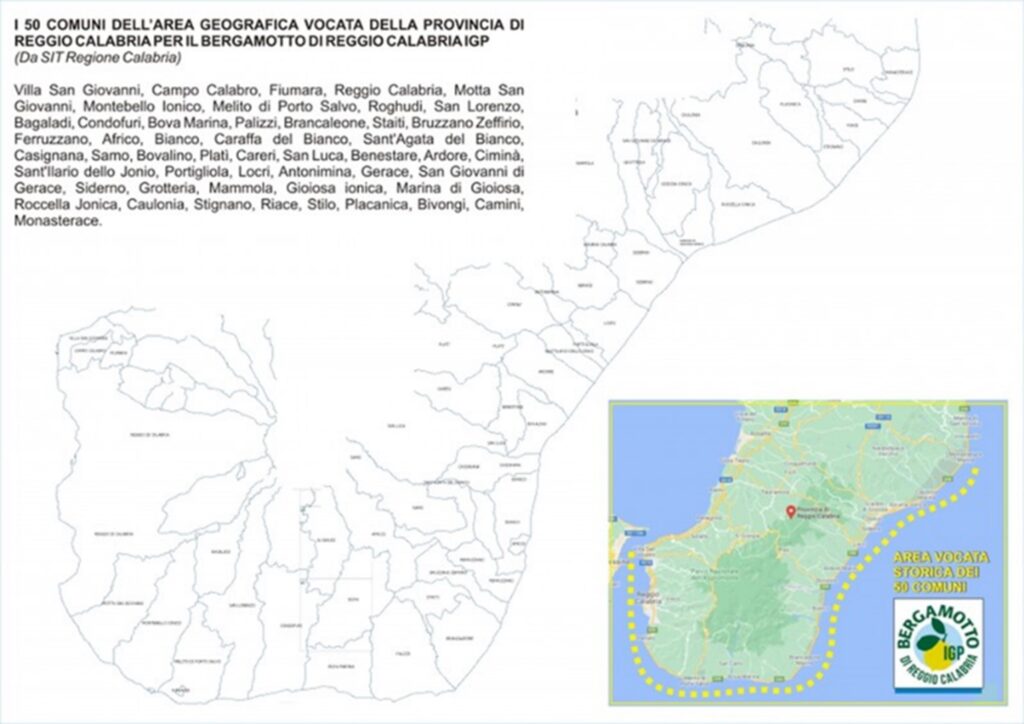
The Reggio coastal strip, from Villa San Giovanni to Monasterace – on the Ionian Sea, facing south – offers bergamot an ideal habitat, protected from northern winds by the Calabrian Alps (Aspromonte, UNESCO protected geopark). Fertile soils and mild climate, widespread solar exposure and an average temperature among the highest in Italy, with minimal day-night oscillations and absence of winter frost.
Nutritional properties
The nutritional properties of bergamot are similar to those of other citrus fruits, as shown in the table below, with a notable presence of vitamins and minerals.

Bioactive compounds and health properties
The abundance of bioactive compounds (phytochemicals) has stimulated research into its properties, a fruit very rich in antioxidant properties, polyphenols, and vitamins (6,7). Below is a brief summary of the most significant research.

Eau de Cologne, Earl Grey tea
The essential oil of Bergamotto di Reggio Calabria, extracted from its peel, contains many aromatic compounds such as limonene, linalool, linalyl acetate, and bergapten. This element distinguishes Calabrian bergamot from that marginally grown in tropical areas, such as the Ivory Coast in West Africa. (3).
Protected Designation of Origin PDO (or PGO, Protected Designation of Origin) for bergamot essential oil, recognized in 2001, but in fact never realized considering the absence of products labeled with the PDO of the essence on the market and the repeated suspensions of the PDO Protection Consortium by the Ministry of Agriculture due to lack of certification.
International fame of bergamot essential oil is linked to its leading role in two products:
- ‘eau-de-Cologne’, created in 1685 in Cologne (Köln, Germany) by the Italian immigrant Giovanni Maria Farina and developed in various formulations. (8) Bergamot essential oil, thanks to its fresh and slightly spicy aroma, still characterizes the composition of high-quality perfumes;
- ‘Earl Grey tea’. Count Charles Grey, Prime Minister of the United Kingdom from 1830 to 1834, received as a gift a tea with bergamot essential oil that later became famous in England and worldwide for its unparalleled elegance of flavor and aroma. (9) However, the uses of bergamot are also others, as will be seen.
Bergamot in cooking and food
In Italian cuisine, the peel and juice of bergamot are used to flavor sweets, liquors, and savory dishes. Bergamot juice is the characteristic ingredient of some fruit juices, including organic ones, and soft drinks, as well as liquors, which have so far not achieved the deserved success.
It is noted in particular Bermé, from the blend of bergamot and apple which make up 20-80% of a truly unique fruit juice. Developed in 2012 by the ingenious friend Nino Manti with the idea of creating a healthy, as well as delicious, beverage thanks to the combination of sour, bitter, and sweet flavors. (10)
Other uses and opportunities
Cosmetics of various types – creams, lotions, and soaps – are made both with the essential oil extracted from the peel and that obtained from the leaves (bergamot petitgrain oil). The natural aroma of bergamot is also used in premium tobaccos.
The circular economy applied to the bergamot supply chain is then expressed in the extraction of pectins, in an upcycling logic that deserves further research and innovation, also with a view to the development of functional foods and active substances with pharmaceutical destination. (11)
The poor enhancement of bergamot pulp – in rural contexts still anchored to subsistence, so far lacking support for scientific research and entrepreneurship – has in fact led to the primary fate of its pulps as raw materials for feed.
Bergamot of Reggio Calabria PGI
The registration of Bergamotto di Reggio Calabria IGP (or PGI, Protected Geographical Indication) is a crucial step to prevent the abandonment of its crops in the Reggio coastal strip and extends to its derivatives, intended for use in the food sector. (12) These in turn must be produced and processed in the geographical area defined by the specification.
The cultivations of Bergamotto di Reggio Calabria IGP currently cover 1500 hectares, to which an additional 300-400 are added where the cultivar they are in the planting phase, and a growth perspective also oriented towards the fresh sector, in fruit and vegetables. To break away from the monopoly of the Bergamot industry of Reggio Calabria - DOP essential oil, used in perfumery and cosmetics. So as to allow everyone, even in distant territories, the opportunity to discover this truly unique and unrepeatable fruit.
Prospects
The market bergamot has encountered a 'bottleneck' in the last two decades, due both to widespread counterfeiting of its essential oil with synthetic chemical replicas, and to the inability to enhance the fruit and extracts of peels and leaves in innovative food and medicinal products. (13)
The challenge of the new PGI is to promote this strategic asset of agriculture in Calabria with appropriate investments that allow obtaining economic benefits with a concrete impact on the rural economy, employment, and the visibility of a wonderful territory.
Thank you, and best wishes also to the friend Rosario Previtera, president of the Promoting Committee for the Bergamot of Reggio Calabria PGI as well as an agronomist engaged in the development of local agri-food systems, (14) and contributor to GIFT (Great Italian Food Trade). (15)
Dario Dongo and Gabriele Sapienza
Notes
(1) Promoting Committee for the Bergamot of Reggio Calabria PGI https://www.bergamia.org/
(2) Chapot, H. 1948. Mission au Maroc. Inst. des Fruits et Agrumes Coloniaux [Paris]. Ann. Rep. 1962. The bergamot tree. Al Awamia [Rabat] 5: 1-27
(3) Citrus bergamia Risso & Poiteau (Rutaceae). World Agroforestry Database 4.0 (Orwa et al., 2009) https://apps.worldagroforestry.org/treedb/AFTPDFS/Citrus_bergamia.PDF
(4) Citrus Aurantium L. δ Bergamia Rutaceae Risso & Poiteau. Acta Plantarum https://www.actaplantarum.org/flora/flora_info.php?id=107272
(5) Chamber of Deputies. Rules for the protection of bergamot and its derivatives. Bill AC 4866, May 13, 1998. http://leg13.camera.it/_dati/leg13/lavori/stampati/sk5000/relazion/4866.htm
(6) Adorisio S, Muscari I, Fierabracci A, Thi Thuy T, Marchetti MC, Ayroldi E, Delfino DV. Biological effects of bergamot and its potential therapeutic use as an anti-inflammatory, antioxidant, and anticancer agent. Pharm Biol. 2023 Dec;61(1):639-646. doi: 10.1080/13880209.2023.2197010
(7) Dario Dongo, Serena Lazzaro. Bergamot and wild thistle useful to reduce hepatic steatosis. Clinical study. Food Times. 18.9.20
(8) Eau de Cologne. Italian Encyclopedia Treccani (1929) http://tinyurl.com/yc8b8xsn
(9) Kit Boey Chow, Ione Kramer. All the Tea in China. China Books (San Francisco, 1990). ISBN 0-8351-2194-1. Pages 180-181. Internet Archive http://tinyurl.com/yr3pxjm3
(10) Bermé https://www.berme.it/azienda/
(11) Dario Dongo, Andrea Adelmo Della Penna. Upcycling of co-products and food waste, brief scientific review. Food Times. 12.1.24
(12) The inability to create a system at the regional level had led to the exclusion of 300 bergamot producers from the possibility of joining the Bergamot Consortium of Reggio Calabria – DOP essential oil, thus risking the survival of these crops as well as the characteristic biodiversity of the local ecosystem
(13) The current prices of the fruits on the wholesale market are around €800/t for bergamot intended for essence production, €1,200/t for fresh product intended for the fruit and vegetable market
(14) Dario Dongo. La piparella, the almond biscuit of the Strait of Messina. GIFT (Great Italian Food Trade). 25.10.20
(15) Dario Dongo, Rosario Previtera. Stockfish, natural delight and health. GIFT (Great Italian Food Trade). 9.12.20

Dario Dongo, lawyer and journalist, PhD in international food law, founder of WIISE (FARE - GIFT – Food Times) and Égalité.

Graduate in Agriculture, with experience in sustainable agriculture and permaculture, laboratory and ecological monitoring.


