
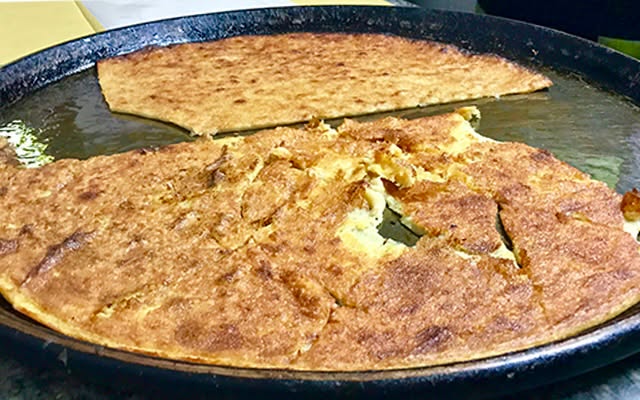
the chickpea farinata is a low, golden savoury cake, oven-baked in tinned copper pans. It is made of four ingredients: chickpea flour, water, olive oil, salt. The name changes at every landing along the sea routes of the upper Tyrrhenian – from the fainâ of Genoa to the cecina in Pisa, the torta in Livorno, and the fainè in Sassari – but the recipe stays the same.
No PDO (Protected Designation of Origin) or PGI (Protected Geographical Indication) covers farinata, nor the Italian chickpeas. Four Regions, however, list it among the Traditional Agri-food Products (PATs). Below are the names, the histories, the processing method, the 2025 data on the raw material, the nutritional profile built on the CREA tables, the usable nutrition claims, and the most interesting scientific studies.
One batter, many names
The geography of the names follows the trade routes of Genoa. The Riviere di Liguria Chamber of Commerce (2015) lists three versions among the region's traditional dishes:
- the farinata made only with chickpeas;
- the white farinata from Savona made with soft wheat;
- the mixed farinata known as turtellassu.
In Tuscany the regional record lists the cecina with the synonyms ‘calda calda’, farinata, ‘cinque e cinque’ (Tuscany Region, n.d.). In Sardinia the fainè from Sassari has abbrusgenti as a synonym (Autonomous Region of Sardinia, n.d.).
| Territory | Name | Distinctive features |
| Genoa, Liguria | fainâ, farinata | chickpea flour, water, oil, salt; in one variant, ground pepper at the end of cooking |
| Savona | white farinata; turtellassu | soft wheat flour; mixed version of wheat and chickpeas |
| Versilia, Pisa | cecina | thickness of about 0.5 cm |
| Livorno | chickpea tart; ‘cinque e cinque’ | served in bread |
| Massa-Carrara | farinata; calda calda | once sold in the street, today also in focaccia |
| Lower Piedmont | chickpea farinata; bela cauda | listed among the PATs of Piedmont |
| Sassari, Porto Torres, Sorso, Alghero | fainè; abbrusgenti | thickness of 0.5-1 cm; fillings with onion, sausage, anchovies, vegetables |
| Carloforte | fainò | community of Ligurian origin |
| Nice | socca | – |
| Gibraltar | calentita | – |
| Argentina, Uruguay | fainá | a dedicated day on 27 August |
Sources: Camera di Commercio Riviere di Liguria (2015); Cori (n.d.); Mugnai (n.d.); Regione Autonoma della Sardegna (n.d.); Regione Toscana (n.d.); Vassallo (2017).
From the same flour, without an oven, come the panissa from Liguria – cooked in a pot, left to firm up, then cut into cubes (Camera di Commercio Riviere di Liguria, 2015) – and the panelle from Palermo, fried.
Seafaring legends and documents
The most widespread account places the birth of farinata in 1284, after the battle of Meloria: on the Genoese galleys returning from Pisa, oil and chickpea flour would have mixed with sea water, and then dried in the sun (Vassallo, 2017). It is a historical legend, repeated with few variations from Genoa to Sassari.
More concrete is the reference to a Genoese decree on the fifteenth century scripilita, the ancient name of farinata: the text banned the use of poor-quality oil. Vassallo (2017) dates it to 1477, other popular accounts to 1447. In Tuscany, the regional record attests to the use of ‘pan di ceci’ as far back as the 13th century, confirming the Ligurian origin and the spread of the recipe as far as Florence (Regione Toscana, n.d.).
A Livorno the tart is eaten in bread. The name ‘cinque e cinque‘ recalls the habit of asking the bakery for five soldi of bread together with five of tart (Regione Toscana, n.d.); the bread is the ‘francesino’, an elongated small loaf, or a round focaccia (Cori, n.d.). In Carrara the name ‘calda calda’ comes from the street vendors who sold it in the street, with the baking tin under their arm (Regione Toscana, n.d.).
A Sassari the sources are mainly oral and date no earlier than the beginning of the twentieth century. The first bakery, in via Usai, was opened by a Genoese entrepreneur nicknamed Baciccia; he was followed by Peppino ‘La Punta-Secca’ and Mario, also Genoese (Turismo Sassari, n.d.). In the 1950s and 1960s the outlets multiplied in the historic centre (Regione Autonoma della Sardegna, n.d.). Fainè is eaten from October to April, in the evening.
With Ligurian emigration farinata crossed the Atlantic between the nineteenth and twentieth centuries, eventually becoming an institution in Argentina (Bassi, 2025). In Argentina, as in Uruguay, it is called fainá and has a day dedicated to it, 27 August; in Nice it is socca, in Gibraltar calentita (Vassallo, 2017).
Resting, tinned copper, wood-fired oven
The regional factsheets describe a common method. The chickpea flour of good quality is dissolved little by little in water to avoid lumps, then salt and oil are added. The batter, rather liquid, rests for 4 to 6 hours in Sassari, for 4 to 8 in Tuscany; the foam that rises to the surface is removed (Autonomous Region of Sardinia, n.d.; Tuscany Region, n.d.).
Cooking takes place in tinned copper pans, shallow, round, with a thick bottom, preferably in the wood-fired oven. In Sassari the diameter ranges from 32 centimetres to one metre and the pan is rotated on special metal rails for 15-20 minutes. The thickness final one is about half a centimetre for Tuscan cecina, between 0.5 and 1 centimetre for fainè.
The quantities are indicative, since each producer guards their own recipe (Autonomous Region of Sardinia, n.d.). The Tuscan factsheet estimates regional cecina production at about 2.5 kt a year, sold directly by the bakeries, with a decline in the summer months (Tuscany Region, n.d.).
Italian and imported chickpeas, the raw material figures
The raw material is the dried chickpea (Cicer arietinum L.), ground. Among the Italian legumes grain legumes, the chickpea ranks third by harvest, after broad bean and pea. The area cultivated with chickpeas has dropped drastically, from 21,000 hectares in 2019 to 14,000 in 2023, with a harvest falling from 35.5 kt to 23.6 kt (Istat, 2024). In 2024 production returned to growth, +10.1% (Istat, 2025).
the demand far exceeds domestic supply. In 2025 Italy imported 59,789 tonnes of dried chickpeas worth 51.3 million euro, 7.4% more than in 2024 and more than double the 25,202 tonnes of 2015 (Eurostat, 2026). Canada is the leading supplier, with 23,869 tonnes, equal to 40% of volumes. Exports stop at 4,016 tonnes worth 6.1 million euro.
The comparison of average values offers a key to interpretation: 0.86 euro per kilo for imported chickpeas, 1.53 for exported ones (GIFT processing of Eurostat data). Italian chickpeas are therefore positioned in a higher price bracket where origin, the organic and local varieties find recognition.
| Indicator | Data | Source |
| Chickpea area in Italy, 2019 | 21,000 ha | Istat (2024) |
| Chickpea area in Italy, 2023 | 14,000 ha | Istat (2024) |
| Chickpea production, 2019 | 35,500 t | Istat (2024) |
| Chickpea production, 2023 | 23,600 t | Istat (2024) |
| Change in production, 2024 over 2023 | +10,1% | Istat (2025) |
| Imports of dried chickpeas (CN 0713 20), 2015 | 25,202 t | Eurostat (2026) |
| Imports, 2024 | 55,693 t | Eurostat (2026) |
| Imports, 2025 | 59,789 t; 51.3 million euro | Eurostat (2026) |
| of which from Canada, 2025 | 23,869 t (40%) | Eurostat (2026) |
| Exports, 2025 | 4,016 t; 6.1 million euro | Eurostat (2026) |
| Average import value, 2025 | €0.86/kg | GIFT processing |
| Average export value, 2025 | €1.53/kg | GIFT processing |
| Tuscan cecina, estimated annual production | 2,500 t | Tuscany Region (n.d.) |
On a global scale a private research company estimates the market for chickpeas in 17.1 billion dollars in 2025, with an average annual growth (CAGR) of 6,5% through to 2035; Europe would be worth 860 million dollars, the flour segment 2.9 billion (Global Market Insights, 2026).
For those producing packaged farinata or flour-based mixes, the origin of chickpeas is also a matter of label. When the origin of the food is declared, for example with the wording Made in Italy, and does not coincide with that of the primary ingredient, the latter must also be indicated, or flagged as different (Regulation (EU) 1169/11, art. 26.3; Regulation (EU) 2018/775, art. 2).
No PDOs and PGIs, four regional PATs
The European register of PDOs and PGIs does not include any denominations for farinata. The same applies to chickpeas, whose Italian biodiversity is expressed in local ecotypes such as the Cece nero della Murgia.
the farinata appears instead in the national list of Traditional Agri-food Products (PATs), which reached its twenty-sixth revision in 2026 (MASAF, 2026). Inclusion certifies methods established for at least twenty-five years, without exclusive rights over the name:
- the Liguria lists chickpea farinata there as well as, as a separate entry, the farinata bianca savonese;
- the Tuscany records the ‘Cecina, calda calda’, with the synonyms farinata and ‘cinque e cinque’, produced in the provinces of Lucca, Pisa, Massa-Carrara and Livorno (Tuscany Region, n.d.);
- the Piedmont lists the ‘Farinata di ceci’ together with the ‘Cece’ among its 345 products (Piedmont Region, 2025);
- the Sardinia recognises the ‘Fainè’ with the geographical name ‘Sassarese’, in the territories of Sassari, Porto Torres, Sorso and Alghero (Autonomous Region of Sardinia, n.d.).
Nutritional profile, from the flour to the farinata
The food composition tables provided by CREA — Research Centre for Food and Nutrition (2019) report, for dried chickpeas, from which the flour is obtained by milling alone, the nutritional values given below. The same tables do not include entries dedicated to chickpea flour or to farinata.
| Chickpeas, dried (CREA, code 004000) | Per 100 g | % NRV |
| Energy | 1,437 kJ / 343 kcal | |
| Fat | 6.3 g | |
| of which saturates | 0.9 g* | |
| Carbohydrate | 46.9 g | |
| of which sugars | 3.7 g | |
| Fibre | 13.6 g | |
| Protein | 20.9 g | |
| Salt | 0.02 g | |
| Thiamine | 0.30 mg | 27% |
| Niacin | 2.5 mg | 16% |
| Folate | 312 µg | 156% |
| Potassium | 881 mg | 44% |
| Calcium | 142 mg | 18% |
| Phosphorus | 415 mg | 59% |
| Magnesium | 130 mg | 35% |
| Iron | 6.4 mg | 46% |
| Zinc | 3.2 mg | 32% |
| Copper | 1.00 mg | 100% |
Notes: (*) estimate based on the percentage composition of fatty acids reported by CREA. NRV: nutrient reference values set out in Annex XIII to Regulation (EU) No 1169/2011.
Farinata adds olive oil and salt to the flour, while the water partly evaporates during cooking. The values per 100 grams of finished product therefore depend on the residual moisture, which must be determined by analysis. It is however possible to calculate the contribution of a portion starting from the ingredients: 50 grams of chickpea flour, 10 grams of extra virgin olive oil, 1 gram of salt (CREA, 2019; GIFT elaboration).
| Farinata, portion made with 50 g of chickpea flour, 10 g of extra virgin olive oil, 1 g of salt | Per portion |
| Energy | 1,095 kJ / 261 kcal |
| Fat | 13.1 g |
| of which saturates | 2.0 g* |
| Carbohydrate | 23.5 g |
| of which sugars | 1.9 g |
| Fibre | 6.8 g |
| Protein | 10.5 g |
| Salt | 1.0 g |
Note: (*) Estimate. GIFT elaboration on CREA data sheets 004000 (Chickpeas, dried) and 009210 (Extra virgin olive oil).
The nutrition claims are verified on the product ready for consumption, under the conditions laid down in the annex to Regulation (EC) 1924/06. In the portion considered, proteins provide 16% of the energy: the farinata could therefore bear the nutrition claim ‘source of protein’, which requires 12% of it. Fibre amounts to 2.6 grams per 100 kcal, above the threshold of 1.5 grams required for the claim ‘source of fibre’; ‘high fibre’ requires 3 grams per 100 kcal or 6 grams per 100 grams, to be verified on the finished product. Monounsaturated fats account for about two thirds of total fats, with almost 30% of the energy, values compatible with the claim ‘high in monounsaturated fat’.
Vitamins and minerals may be declared when they reach 15% of the nutrient reference values set out in Annex XIII to Regulation (EU) No 1169/2011 per 100 grams. In dried chickpeas, thiamine, niacin, folates, potassium, calcium, phosphorus, magnesium, iron, zinc and copper exceed the threshold. In farinata the minerals, which are heat-stable, are diluted by the retained water: copper, phosphorus, iron, potassium are the strongest candidates for a ‘source of’ claim, subject to analysis. Vitamins, which are sensitive to cooking, must instead be measured case by case.
The recipe does not include gluten-containing cereals. Chickpea flour may however encounter gluten at the mill or in the bakery, where wheat flours are processed: the wording ‘gluten-free’ is reserved for products with a content not exceeding 20 mg/kg (Regulation (EU) 828/14, art. 3, Annex), according to the criteria already illustrated for foods naturally gluten-free.
Our team at FARE (Food and Agriculture Requirements) supports operators as well as their representative bodies in enhancing supply chains and products from these as well as other perspectives, in compliance with the regulations in force in the various destination markets, in the European Union as well as in third countries.
The scientific evidence
The literature on chickpeas is extensive. A review published in Nutrients links their habitual consumption to a higher intake of fibre and micronutrients in the diet, as well as discussing their effects on weight control, glycaemic response and cardiovascular health (Wallace et al., 2016).
The most consistent finding concerns the glycaemic response:
- a meta-analysis of randomised controlled trials indicates that chickpeas reduce the incremental area under the glucose curve more than potatoes and wheat (Nam et al., 2023);
- a recent review of 28 studies confirms the attenuation of post-meal blood glucose compared with foods with equal available carbohydrates, largely white bread; the authors nonetheless still rate the overall certainty of the evidence as low (Mah et al., 2025).
the structure of the flour is in turn significant: in a crossover study on 20 healthy adults, replacing 30% of the wheat flour with a ‘cellular’ chickpea flour, obtained by preserving the integrity of the plant cells, reduced by more than 40% the glycaemic response to bread; with 60% there was an increase in the satiety hormones GLP-1 and PYY (Bajka et al., 2023). The result concerns an innovative ingredient, different from the milled flour used for farinata, but it opens up a significant prospect for Italian mills.
In terms of composition, chickpea proteins are a source of bioactive peptides with antioxidant and ACE-inhibitory activity observed in the laboratory, to be confirmed by human studies (Begum et al., 2023).
This evidence supports the interest in pulse flours, alone or combined with protein concentrates, in pulse pasta, in products gluten-free with a low glycaemic index. The Livorno ‘cinque e cinque’, chickpea tart in bread, has for generations put into practice the complementarity of pulse and cereal proteins.
Conclusions
Chickpea farinata combines a four-ingredient recipe with a network of names, ovens and copper pans stretching from Genoa to Sassari, and as far as Argentina. Its nutritional profile – plant proteins, fibre, predominantly monounsaturated fats, minerals – may allow the use of well-founded nutrition claims, to be verified on the finished product. The growth in chickpea imports, which have more than doubled in ten years, measures the room available for Italian supply chains able to add value to origin and variety.
Dario Dongo
Frequently asked questions
What is chickpea farinata? A thin savoury flatbread, oven-baked in tinned copper pans, made with chickpea flour, water, olive oil and salt.
Are farinata, cecina and fainè the same thing? Yes. The recipe is the same; the name, the thickness and the way it is served change: cecina in Pisa, torta di ceci in Livorno, calda calda in Carrara, fainè in Sassari.
Is farinata a PDO or PGI product? No. It is listed among the Traditional Agri-food Products (PATs) of Liguria, Tuscany, Piedmont and Sardinia.
Is farinata gluten-free? The recipe contains no gluten-containing cereals. However, the ‘gluten-free’ claim requires a content not exceeding 20 mg/kg in the finished product, which must be guaranteed against contamination at the mill or in the bakery.
How many calories are there in a portion of farinata? About 261 kcal for a portion made from 50 grams of chickpea flour with 10 grams of extra virgin olive oil, with 10.5 grams of protein along with 6.8 grams of fibre.
Where do the chickpeas used in Italy come from? In 2023 Italy harvested 23,600 tonnes of chickpeas; in 2025 it imported 59,789, 40% of which from Canada.
References
Agricultural statistics and foreign trade
Eurostat. (2026). EU trade since 2002 by CN8 (DS-045409). Comext database, CN heading 0713 20, declarant Italy, years 2015, 2024, 2025. Accessed on 26 November 2026. https://ec.europa.eu/eurostat/databrowser/view/ds-045409/default/table
Global Market Insights. (2026, August). Chickpeas market: size and share 2026-2035 (GMI7216). https://www.gminsights.com/it/industry-analysis/chickpeas-market
Istat. (2024). Italian statistical yearbook 2024. Chapter 13, Agriculture (table 13.2). https://www.istat.it/storage/ASI/2024/capitoli/C13.pdf
Istat. (2025). Italian statistical yearbook 2025. Chapter 13, Agriculture. https://www.istat.it/storage/ASI/2025/capitoli/C13.pdf
Lists of Traditional Agri-food Products
MASAF. (2026). Update of the national list of traditional agri-food products (26A00719). Official Gazette of the Italian Republic, General Series No. 40 of 18.2.2026. Twenty-sixth revision of the list: https://www.masaf.gov.it/flex/cm/pages/ServeBLOB.php/L/IT/IDPagina/24151
Autonomous Region of Sardinia. (n.d.). List of traditional agri-food products. Fresh pasta and bakery, pastry, biscuit and confectionery products (‘Fainè’ record). https://files.regione.sardegna.it/squidex/api/assets/redazionaleras/118166ef-15a1-4eba-969d-cf1c87123b8f/7.-schede-categoria-paste-fresche-e-prodotti-della-panetteria-della-pasticceria-della-biscotteria-e-della-confetteria.pdf
Piedmont Region. (2025). Regional Council Resolution of 22 December 2025, no. 9-2046. 10th update of the List of traditional agri-food products of Piedmont. https://www.regione.piemonte.it/governo/bollettino/abbonati/2025/52/attach/dgr_02046_1050_22122025.pdf
Tuscany Region. (n.d.). Traditional Tuscan products. Product record: Cecina, calda calda. http://prodtrad.regione.toscana.it/LIB_ProdTrad/Prodotto.php?ID=182
European rules on labelling, nutrition claims and gluten
Commission Implementing Regulation (EU) 2018/775 of 28 May 2018 laying down rules for the application of Article 26(3) of Regulation (EU) No 1169/2011 of the European Parliament and of the Council on the provision of food information to consumers, as regards the rules for indicating the country of origin or place of provenance of the primary ingredient of a food. Consolidated text: 09/06/2019. http://data.europa.eu/eli/reg_impl/2018/775/2019-06-09
Commission Implementing Regulation (EU) No 828/2014 of 30 July 2014 on the requirements for the provision of information to consumers on the absence or reduced presence of gluten in food. OJ L 228, 31.7.2014, p. 5-8. http://data.europa.eu/eli/reg_impl/2014/828/oj
Regulation (EC) No 1924/2006 of the European Parliament and of the Council of 20 December 2006 on nutrition and health claims made on foods. Consolidated text: 13/12/2014. http://data.europa.eu/eli/reg/2006/1924/2014-12-13
Regulation (EU) No 1169/2011 of the European Parliament and of the Council of 25 October 2011 on the provision of food information to consumers. Consolidated text: 01/04/2025. http://data.europa.eu/eli/reg/2011/1169/2025-04-01
Food composition tables
CREA. (2019). Food composition tables. Entries 004000 (Chickpeas, dried) and 009210 (Extra virgin olive oil). https://www.alimentinutrizione.it/tabelle-nutrizionali/
History, names and regional recipes
Bassi, L. (2025, 23 February). The arrival of Genoese fainà overseas. Domani. https://www.editorialedomani.it/idee/cultura/lo-sbarco-della-faina-genovese-oltreoceano-wl78e96s
Riviere di Liguria Chamber of Commerce. (2015). List of traditional dishes Liguria Gourmet (rev. 02, 16.4.2015). https://rivlig.camcom.gov.it/sites/default/files/contenuto_redazione/oldsite/iniziativePromozionali/91/9158_CCIAASV_2272015.pdf
Cori, F. (n.d.). Tasting Livorno street food: Chickpea flatbread or Torta di ceci. Visit Tuscany, Fondazione Sistema Toscana. https://www.visittuscany.com/en/ideas/tasting-tuscan-street-food-chickpea-flatbread/
Mugnai, D. (n.d.). Atlas of gastronomic itineraries in Tuscany. Vetrina Toscana, Tuscany Region. https://www.toscanapromozione.it/wp-content/uploads/2025/12/Atlante_food.pdf
Turismo Sassari. (n.d.). Fainè: a delicacy with history and legends. https://turismosassari.it/en/explore/video-of-sassari/item/512-faine-a-delicacy-with-history-and-legends.html
Vassallo, F. (2017, 21 March). Chickpea farinata, the gold on Genoese tables. La Gazzetta del Gusto. https://gazzettadelgusto.it/cibo/farinata-di-ceci-origini-e-storia/
Scientific studies on chickpeas and glycaemic response
Bajka, B. H., Pinto, A. M., Perez-Moral, N., Saha, S., Ryden, P., Ahn-Jarvis, J., van der Schoot, A., Bland, C., Berry, S. E., Ellis, P. R., & Edwards, C. H. (2023). Enhanced secretion of satiety-promoting gut hormones in healthy humans after consumption of white bread enriched with cellular chickpea flour: A randomized crossover study. The American Journal of Clinical Nutrition, 117(3), 477-489. https://doi.org/10.1016/j.ajcnut.2022.12.008
Mah, E., Uffelman, C. N., Blonquist, T. M., Wang, D. D., Rehm, C. D., Goltz, S. R., & Chu, Y. (2025). Chickpea attenuates postprandial blood glucose responses: A systematic review and meta-analysis. Nutrition Journal, 24, 111. https://doi.org/10.1186/s12937-025-01176-8
Nam, T., Kim, A., & Oh, Y. (2023). Effectiveness of chickpeas on blood sugar: A systematic review and meta-analysis of randomized controlled trials. Nutrients, 15(21), 4556. https://doi.org/10.3390/nu15214556
Scientific studies on the composition and bioactive compounds of chickpeas
Begum, N., Khan, Q. U., Liu, L. G., Li, W., Liu, D., & Haq, I. U. (2023). Nutritional composition, health benefits and bio-active compounds of chickpea (Cicer arietinum L.). Frontiers in Nutrition, 10, 1218468. https://doi.org/10.3389/fnut.2023.1218468
Wallace, T. C., Murray, R., & Zelman, K. M. (2016). The nutritional value and health benefits of chickpeas and hummus. Nutrients, 8(12), 766. https://doi.org/10.3390/nu8120766
FARE in-depth articles
Dongo, D. (2025, 27 October). ‘Gluten-free’ outlawed. FARE. https://fareagrifood.com/2025/10/27/senza-glutine-fuorilegge/

Dario Dongo, lawyer and journalist, PhD in international food law, founder of WIISE (FARE - GIFT – Food Times) and Égalité.


