
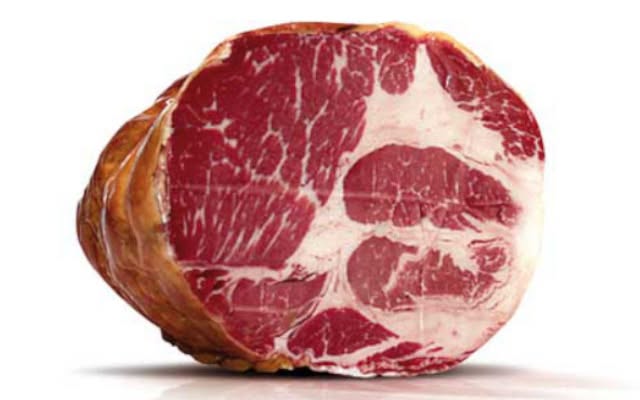
The coppa, called capocollo in Central and Southern Italy, is the cured meat obtained from the neck muscles of the pig. Dry-salted, wrapped in a natural casing, hand-tied and aged whole, when sliced it shows red lean meat streaked with veins of pinkish fat. Four denominations are registered in the European Union: Coppa Piacentina PDO, Capocollo di Calabria PDO, Coppa di Parma PGI, Capocollo di Martina Franca PGI, the latter entered in the European register in October 2026. They are joined by the Traditional Agri-food Products (PATs) listed by the Regions. In 2025 Italy produced 37.6 kt of coppa, worth 348 million euro (ASSICA, 2026). Below are the market data, the history, the product specifications, the nutritional values, the scientific evidence and the uses in the kitchen.
Production and market, the 2025 data
Italian coppa production stood in 2025 at 37.6 kt (-1.1%), worth 348.0 million euro (-0.4%): 3.2% of national cured meat production, equal to 1.173 million tonnes. In 2022 the tonnes were 38,700, worth 325.5 million euro. Over three years the value grew by 2.3% per year, while annual volumes fell by an average of 1.0%: the average production value rose from 8.4 to 9.3 euro per kilogram, about 10% more. The price of trimmed fresh coppa fell by 6.7% in 2025, after the 7.0% increase in 2024 (ASSICA, 2025, 2026).
The customs statistics do not devote a heading to coppa. ASSICA includes it under the boneless hams heading, together with speck e culatelli: 70,264 tonnes exported in 2025 (+1.9%), worth 1,015.8 million euro (+2.8%). Total exports of Italian cured meats, from dry-cured ham to salami, reached 231,645 tonnes worth 2.5 billion euro (+5.3%). Apparent consumption of cured meats in Italy is 16.6 kilograms per capita (ASSICA, 2026).
Data from the protection Consortia make it possible to isolate the designations. The Coppa di Parma PGI closed 2025 with retail sales of 78 million euro, compared with 74 in 2024. Processed meats amounted to 3,500 tonnes, of which 1,800 certified. The pre-sliced product grew by 26%, from 415 to 525 tonnes: trays are worth 30 million euro, 38% of turnover. The export exceeded 30% of sales, with over 700 tonnes; France is the leading market, Canada the leading one outside the European Union. In the first seven months of 2026 pre-sliced product reached 341 tonnes (+24.2%), certified product 1,100 tonnes (+3%) (Consorzio di Tutela della Coppa di Parma IGP, 2026a, 2026b).
The Coppa Piacentina PDO is worth 781 tonnes and 20 million euro at retail, the largest share of the 50 million generated by the three Piacenza cured meats with designation of origin, according to 2023 data from the protection Consortium (CSQA, 2024). The European context is one of moderate growth: a private research company estimates the processed meat market in Europe at 39.6 billion dollars in 2026, with a CAGR of 2.0% through 2031. In 2025 pork accounted for 43.8% of this market, the highest share among species (Mordor Intelligence, 2026).
Table 1: Italian coppa, market data
| Indicator | Quantity | Value | Annual change
|
| Coppa production, 2025 | 37,600 t | €348.0 million | -1.1% quantity, -0.4% value |
| Coppa production, 2024 | 38,100 t | €349.5 million | -3.5% volume, -0.6% value |
| Coppa production, 2022 | 38,700 t | €325.5 million | N/A |
| Exports of boned hams, speck, coppa and culatello, 2025 | 70,264 t | €1,015.8 million | +1.9% volume, +2.8% value |
| Coppa di Parma PGI, certified product, 2025 | 1,800 t | €78 million at retail value | -6% volume, +5.4% value |
| Coppa di Parma PGI, pre-sliced, 2025 | 525 t | €30 million at retail value | +26% volume |
| Coppa Piacentina PDO, 2023 | 781 t | €20 million at retail value | N/A |
Source: ASSICA (2025, 2026), Consorzio di Tutela della Coppa di Parma IGP (2026a), CSQA (2024). N/A = data not available.
From bondiola to the European courts, the documented history
The two names refer to the same cut. Capocollo is a compound of capo and collo (head and neck) (Treccani, n.d.); coppa, explains the Emilia-Romagna Region, owes its name to the cervical region of the pig from which it is obtained (Regione Emilia-Romagna, n.d.a).
The earliest evidence is medieval. In Piacenza two twelfth-century mosaics, in the basilica of San Savino in the city and in the abbey of San Colombano in Bobbio, depict the slaughter of the pig in the month of December. From the fourteenth century city statutes regulated the trade in preserved meats, while in the Parma area the processing of salted meats developed thanks to the salt of Salsomaggiore. In the fifteenth century, shopkeepers in Milan and Lombardy distinguished Piacenza cured meats from the others of the Po Valley, calling them ‘roba de Piasenza’ (European Commission, 2025; Consorzio Salumi Tipici Piacentini, n.d.; Regione Emilia-Romagna, n.d.a).
In Parma, at the end of the Seventeenth century, the documents call the cup ‘bondiola’ or ‘salame investito’, that is, stuffed into a casing. In the early Eighteenth century the Piacenza-born cardinal Giulio Alberoni, who became prime minister at the Spanish court, used Piacenza cured meats as diplomatic gift: in the letters exchanged with him, Queen Elisabetta Farnese asked for supplies. A Parma inventory from 1723 lists cured meats and bondiole among the goods required to join the guild, a shout (announcement from the authority, read in public) from 21 April 1764 expressly names it. In the same century the capocollo of Martina Franca, in the Itria Valley, in the province of Taranto (Apulia), was already known in the Kingdom of Naples: the first written record is an expense note drawn up in Alberobello on 30 May 1797 (European Commission, 2025, 2026; Consorzio Salumi Tipici Piacentini, n.d.; Slow Food Foundation, n.d.).
In 1940 the province of Parma exported 200 coppa products (European Commission, 2025). In the South, capocollo is today a specialty of Calabria and Campania, with chilli variations in Molise as well as in Basilicata (Treccani, n.d.).
The four denominations and their product specifications
The Coppa Piacentina PDO has been registered since 1996 (Regulation (EC) 1263/96), with amendments approved at European level up to 2014 (Regulation (EU) 813/14). The specification in force is the one consolidated by the ministerial decree of 26 November 2025. The pigs come from farms in Lombardy and Emilia-Romagna, are at least nine months old, provide carcasses of weight between 110.1 and 180.0 kilograms. Processing takes place in the province of Piacenza, below 900 metres of altitude. The cervical muscles, weighing not less than 2.5 kilograms, reach the plant within 72 hours. The salting is dry, with 1.5-3.5 kilograms of salt per 100 kilograms of meat, pepper, cinnamon, cloves, bay leaf, nutmeg; brine is prohibited. After at least seven days in the refrigerator, the coppa is massaged, wrapped in porcine parietal diaphragm, tied with twine and dried for at least seven days at 15-25 °C. The ageing lasts at least six months from salting, at 10-20 °C with humidity of 70-90%, partly in cellars or basement rooms. The finished product is cylindrical, weighs not less than 1.5 kilograms and contains from 19 to 34% protein. Slicing and packaging are permitted only within the processing area (MASAF, 2025).
The Coppa di Parma PGI has been registered since 2011 (Regulation (EU) 1118/11). The production area comprises the provinces of Parma, Modena and Reggio Emilia in Emilia-Romagna, as well as Mantua, Pavia and the municipalities along the Po in the provinces of Lodi, Milan and Cremona in Lombardy. The standard amendment approved in 2025 replaced the weight average live weight of the batch, 160 kilograms with a 10% tolerance, with the weight of the individual carcass, from 110.1 to 190.0 kilograms, verified at slaughter; it has also reduced the minimum content of Salt from 2.6 to 2.2% and included slicers in the control system. The pigs are at least nine months old, the meat cannot be frozen. Salting lasts from six to fourteen days, with salt at 2.2-3.5%, natural flavourings, pepper; this is followed by stoving for 8-10 hours, drying for at least fifteen days, and ageing for 60 or 90 days according to weight. The finished coppa is a cylinder 25-40 centimetres long, weighing at least 1.3 kilograms, with protein not below 22%, salt under 5%, pH above 5.7 (European Commission, 2025).
The Capocollo di Calabria PDO has been registered since 1998 (Regulation (EC) 134/98), with an amendment to the specification in 2015 (Regulation (EU) 2015/1285). The pigs are reared exclusively in Calabria, fed with feed made up of at least 50% barley, field bean, maize, acorns, chickpeas, slaughtered from the eighth month with an weight average of not less than 140 kilograms. The cut is the upper part of the loin, boned, weighing 3.5-5.5 kilograms, with a fat layer of 3-4 millimetres. Salting, dry or in brine, lasts from four to fourteen days; the capocollo is then washed with water, moistened with wine vinegar, massaged, seasoned with black pepper or chilli, wrapped in the porcine parietal diaphragm, tied with twine, sometimes with the characteristic slats. The ageing minimum is one hundred days from salting (MIPAAF, 2015). The chilli links it to other Calabrian cured meats, such as ‘nduja.
The Capocollo di Martina Franca PGI is the most recent of the four designations, entered in the European Union register with Regulation (EU) 2026/2293, published on 15 October 2026. The area includes the municipalities of Martina Franca (Taranto), Cisternino (Brindisi), Locorotondo (Bari), in Puglia, above 350 metres in altitude. The cured meat is cylindrical, has a diameter of 10-15 centimetres, weighs from 1.5 to 2.5 kilograms; it is stuffed into natural pork casing, the ‘muletta’. It is distinguished by the cooked wine from Verdeca and Bianco d’Alessano grapes, which gives it its slightly acidic note, and smoking with fragno wood, Quercus trojana (Qualivita, 2026). The fresh cut, never frozen, weighs between 2.5 and 4.0 kilograms. Dry salting lasts twelve days, marinating in cooked wine two hours, drying fifteen days, smoking from 24 to 48 hours. The ageing lasts at least five months from salting (MASAF, n.d.; European Commission, 2026). Outside Italy, the European register includes Coppa de Corse, produced in Corsica from pigs of the nustrale breed (INAO, n.d.).
Table 2: the four denominations compared
| Requirement | Coppa Piacentina PDO | Coppa di Parma PGI | Capocollo di Calabria PDO | Capocollo di Martina Franca PGI
|
| Registration | Reg. (EC) 1263/96 | Reg. (EU) 1118/11 | Reg. (EC) 134/98 | Reg. (EU) 2026/2293 |
| Latest amendment | decree of 26 November 2025 | standard amendment 2025 | Reg. (EU) 2015/1285 | none |
| Processing area | province of Piacenza, below 900 m | provinces of Parma, Modena, Reggio Emilia, Mantua, Pavia; municipalities along the Po in Lodi, Milan, Cremona | Calabria | Martina Franca, Cisternino, Locorotondo, above 350 m |
| Pigs | reared in Lombardy and Emilia-Romagna; carcass 110.1-180.0 kg | carcass 110.1-190.0 kg; at least 9 months | reared in Calabria; at least 8 months, average weight not less than 140 kg | fresh cut 2.5-4.0 kg, never frozen |
| salting | dry, at least 7 days in refrigeration; brine prohibited | 6-14 days; salt 2.2-3.5% | dry or in brine, 4-14 days | dry, 12 days |
| Seasoning mix | salt, pepper, cinnamon, cloves, bay leaf, nutmeg | salt, natural flavourings, pepper | salt, black pepper, chilli pepper, wine vinegar | cooked wine, smoking with Macedonian oak wood |
| Minimum ageing | 6 months from salting | 60 or 90 days depending on weight | 100 days from salting | 5 months from salting |
| Weight of the finished product | at least 1.5 kg | at least 1.3 kg | N/A | 1.5-2.5 kg |
Source: MASAF (n.d., 2025), European Commission (2025, 2026), MIPAAF (2015), Qualivita (2026).
PATs, the coppas of the territories
The national list of Traditional Agri-food Products (PATs), which reached its twenty-sixth revision in 2026 with 5,813 entries, brings together processing methods established for at least twenty-five years and recorded by the Regions (MASAF, 2026). Emilia-Romagna includes two coppas from the province of Piacenza: the Coppa di montagna della Val Nure (Val Nure mountain coppa), in dialect ‘cuppa ad muntagna’, and the Roast coppa, ‘cupa arost’, a cooked preparation of the same cut. Coppa di testa, from the province of Rimini, is instead a different product, obtained from the meat of the head (Emilia-Romagna Region, n.d.b). Inclusion has the value of a historical and cultural record and does not entail a binding specification, nor exclusive rights to the name.
The nutritional profile
The food composition tables published by CREA — Research Centre for Food and Nutrition (2019) attribute to coppa the nutritional values shown below. The second column reports the analyses carried out in 2017 by CREA and the Experimental Station for the Food Preserving Industry on Coppa Piacentina PDO (CREA, n.d.; ISIT, 2017).
Table 3: nutritional values per 100 g
| Values per 100 g | Coppa (CREA, 2019) | Coppa Piacentina PDO (CREA, n.d.; ISIT, 2017)
|
| Energy | 1,674 kJ / 400 kcal | 1,870 kJ / 447 kcal |
| Fat | 31.6 g | 36.4 g |
| of which saturated fatty acids | 11.3 g* | 11.7 g |
| Carbohydrate | traces | 1.2 g |
| of which sugars | N/A | N/A |
| Fibre | 0 g | N/A |
| Protein | 28.9 g | 28.6 g |
| Salt** | 4.9 g | 4.3 g |
| Potassium | 685 mg (34% NRV) | 552 mg (28% NRV) |
| Phosphorus | 231 mg (33% NRV) | 282 mg (40% NRV) |
| Zinc | 3.7 mg (37% NRV) | 4.5 mg (45% NRV) |
| Selenium | 12 µg (22% NRV) | 40 µg (73% NRV) |
| Thiamine | 0.61 mg (55% NRV) | 0.53 mg (48% NRV) |
| Niacin | 6.02 mg (38% NRV) | 7.33 mg (46% NRV) |
| Vitamin B12 | 0.68 µg (27% NRV) | 0.63 µg (25% NRV) |
Note: value estimated from the percentage fatty acid composition reported by CREA. (*)Salt = sodium x 2.5. N/A = data not reported. Vitamins and minerals are indicated when they reach 15% of the nutrient reference values set out in Annex XIII to Regulation (EU) No 1169/2011.
Coppa is a cured meat rich in protein: almost 29 grams per 100, equal to 26-29% of the energy. The fat is predominantly unsaturated, with monounsaturates at 43.9% and oleic acid at 40.4% (CREA, 2019). The fatty acid profile can be further improved on the farm, by supplementing the ration of pigs at the end of fattening with extruded flaxseed or microalgae rich in omega-3, as shown in the previous article on omega-3 pork. The reference portion indicated by CREA is 50 grams: about 200 kcal and 14 grams of protein.
Nutrition claim
The values indicated by CREA suggest the possibility of using the following on labels and in advertising Nutrition claim:
- ‘ high protein content‘, since proteins provide over 20% of the energy;
- ‘high in’ phosphorus, zinc, thiamine (vitamin B1), niacin (vitamin B3), present at over 30% of the reference values;
- Coppa Piacentina PDO is also rich in Selenium, while it is a ‘source of’ Potassium e Vitamin B12. In the generic coppa analysed by CREA (code 110150) potassium exceeds 30%; selenium and vitamin B12 meet the ‘source of’ condition (Reg. EC 1924/06, Annex).
The conditions of use of the above nutrition claims, and of the health claim authorised ones that may accompany them (Reg. EU 432/12), must in any case be verified through analyses on representative samples of the product ready for consumption, with a downward tolerance limited to the measurement uncertainty, according to the European Commission guidelines on the tolerances of the declared values.
Research on ageing
The research in recent years has focused on the ageing of Coppa Piacentina PDO. A study by the Università Cattolica of Piacenza followed the product from fresh to 60, 90, 180 and 240 days, integrating data on metabolites, lipids and volatile compounds, and then subjecting the samples to a simulated digestion in the laboratory. The chemical signs of maturation are not lost during digestion. The extended ageing increases the release of peptide derivatives and lipid metabolites, without increasing total free amino acids; some γ-glutamyl peptides resist gastrointestinal degradation (Froldi et al., 2026).
A second study by the same group combined mass spectrometry, nuclear magnetic resonance and sensory analysis, identifying a lipid fingerprint exclusive to long-aged Coppa Piacentina PDO, also useful for verifying its authenticity (Rocchetti et al., 2025).
Coppa in the kitchen
Coppa is served in thin slices, sliced to order, at room temperature. On the board it is paired with pancetta and other cured meats, with Bread, cheeses and vegetables preserved in oil. In Piacenza it is offered as a starter with local cheeses and Colli Piacentini wines (Emilia-Romagna Turismo, n.d.); in Parma it accompanies torta fritta still warm. Since 2025, pilgrims on the via Francigena arriving on the Emilian bank of the Po have been welcomed with a Coppa Piacentina PDO sandwich, an initiative of the protection Consortium (Gambero Rosso, 2025).
In cooking, a few slices added at the end of cooking add flavour to risottos, filled pasta and velouté soups of Pulses; they are also wrapped around meat and vegetable rolls. Calabrian capocollo and that of Martina Franca bring to the table notes of chilli pepper, cooked wine and smoke. The same cut, fresh, is among the most appreciated of pork for grilling and roasting, as in the roast Coppa of Piacenza.
Conclusions
Italian coppa today has four designations, from Piacenza to the Valle d’Itria, with ageing periods ranging from two to over six months. Volumes are stable, average value is growing, and pre-sliced products and exports are driving geographical indications. Updated product specifications, analytical data and correct nutritional information are the tools for consolidating this result on foreign markets.
Our team at FARE (Food and Agriculture Requirements) supports operators, together with their representative bodies, in enhancing supply chains and products under these and other aspects, in compliance with the regulations in force in the various EU and non-EU destination markets. It also offers support for the development of corporate governance systems and operating procedures.
Dario Dongo
Frequently asked questions
Are coppa and capocollo the same cured meat? Yes. Both names refer to the cured meat obtained from the neck muscles of the pig: coppa in the North, capocollo in Central and Southern Italy.
How many PDO and PGI coppa products are there in Italy? Four: Coppa Piacentina PDO, Capocollo di Calabria PDO, Coppa di Parma PGI, Capocollo di Martina Franca PGI, registered in October 2026.
How long is coppa aged for? At least six months for Coppa Piacentina PDO, one hundred days for Capocollo di Calabria PDO, 60 or 90 days depending on weight for Coppa di Parma PGI, five months for Capocollo di Martina Franca PGI.
How much coppa is produced in Italy? In 2025, 37.6 kt, worth 348 million euros (ASSICA, 2026).
What are the nutritional values of coppa? Per 100 g, coppa provides 400 kcal, 31.6 g of fat, 28.9 g of protein, 4.9 g of salt (CREA, 2019).
What is the difference with coppa di testa? Coppa di testa is a cooked product, made from the meat of the pig's head. It should not be confused with aged coppa.
References
Market data
ASSICA – Associazione Industriali delle Carni e dei Salumi. (2025). Annual report 2024. Economic scenario. https://www.assica.it/wp-content/uploads/2025/06/04.-SCENARIO-ECONOMICO.pdf
ASSICA – Associazione Industriali delle Carni e dei Salumi. (2026). Annual report 2025. https://www.assica.it/wp-content/uploads/2026/06/RAPPORTO-ANNUALE-ASSICA-2025.pdf
Consorzio di Tutela della Coppa di Parma PGI. (2026a, 13 May). Coppa di Parma: pre-sliced boom in 2025, up 26%. Data released via askanews. https://qds.it/coppa-di-parma-in-2025-boom-del-preaffettato-con-26/
Consorzio di Tutela della Coppa di Parma PGI. (2026b, 23 September). Coppa Parma and Salame Felino, pre-sliced up 10.2% on 2025. Data released via askanews. https://qds.it/coppa-parma-e-salame-felino-preaffettato-102-sul-2025/
CSQA. (2024). Piacenza PDO cured meats, €50 million generated locally by certified supply chains. https://csqa.it/en-us/press/salumi-dop-piacentini,-dalle-filiere-certificate-50-milioni-€-sul-territorio
Mordor Intelligence. (2026). Europe processed meat market analysis. Updated 23 July 2026. https://www.mordorintelligence.com/industry-reports/europe-processed-meat-market
European registrations of the denominations
Commission Regulation (EC) No 1263/96 of 1 July 1996 supplementing the Annex to Regulation (EC) No 1107/96 on the registration of geographical indications and designations of origin under the procedure laid down in Article 17 of Regulation (EEC) No 2081/92. OJ L 163, 2.7.1996, p. 19. http://data.europa.eu/eli/reg/1996/1263/oj
Commission Regulation (EC) No 134/98 of 20 January 1998 supplementing the Annex to Regulation (EC) No 1107/96 on the registration of geographical indications and designations of origin under the procedure laid down in Article 17 of Regulation (EEC) No 2081/92. OJ L 15, 21.1.1998, p. 6. http://data.europa.eu/eli/reg/1998/134/oj
Commission Implementing Regulation (EU) No 1118/2011 of 31 October 2011 entering a name in the register of protected designations of origin and protected geographical indications (Coppa di Parma (PGI)). OJ L 289, 8.11.2011, p. 8. http://data.europa.eu/eli/reg_impl/2011/1118/oj
Commission Implementing Regulation (EU) No 813/2014 of 23 July 2014 approving non-minor amendments to the specification for a name entered in the register of protected designations of origin and protected geographical indications (Coppa Piacentina (PDO)). OJ L 222, 26.7.2014, p. 3. http://data.europa.eu/eli/reg_impl/2014/813/oj
Commission Implementing Regulation (EU) 2015/1285 of 23 July 2015 approving non-minor amendments to the specification for a name entered in the register of protected designations of origin and protected geographical indications (Capocollo di Calabria (PDO)). OJ L 198, 28.7.2015, p. 13. http://data.europa.eu/eli/reg_impl/2015/1285/oj
Commission Implementing Regulation (EU) 2026/2293 of 8 October 2026 on the registration of the geographical indication Capocollo di Martina Franca (PGI) in the Union register of geographical indications pursuant to Regulation (EU) 2024/1143 of the European Parliament and of the Council. OJ L, 2026/2293, 15.10.2026. http://data.europa.eu/eli/reg_impl/2026/2293/oj
Production specifications
European Commission. (2025). Communication of approval of a standard amendment (Article 24 of Regulation (EU) 2024/1143). ‘Coppa di Parma’, PGI-IT-0602-AM01. OJ C, C/2025/2941, 23.5.2025. http://data.europa.eu/eli/C/2025/2941/oj
European Commission. (2026). Publication of an application for registration of a name pursuant to Article 50(2)(a) of Regulation (EU) No 1151/2012 of the European Parliament and of the Council on quality schemes for agricultural products and foodstuffs. ‘Capocollo di Martina Franca’. OJ C, C/2026/3344, 22.6.2026. http://data.europa.eu/eli/C/2026/3344/oj
INAO – Institut national de l’origine et de la qualité. (n.d.). Coppa de Corse ou Coppa de Corse – Coppa di Corsica. https://www.inao.gouv.fr/produit/coppa-de-corse-ou-coppa-de-corse-coppa-di-corsica-4270
MASAF – Italian Ministry of Agriculture, Food Sovereignty and Forestry. (n.d.). Product specification of the Protected Geographical Indication ‘Capocollo di Martina Franca’. https://www.masaf.gov.it/flex/cm/pages/ServeAttachment.php/L/IT/D/1%252F7%252F4%252FD.804408abad80725c452b/P/BLOB%3AID%3D3335/E/pdf?mode=download
MASAF – Italian Ministry of Agriculture, Food Sovereignty and Forestry. (2025). Decree of 26 November 2025, Standard amendments to the product specification of the Protected Designation of Origin (PDO) ‘Coppa Piacentina’. Gazzetta Ufficiale, General Series No 284 of 6 December 2025. https://www.gazzettaufficiale.it/eli/id/2025/12/06/25A06495/sg
MIPAAF – Italian Ministry of Agricultural, Food and Forestry Policies. (2015). Measure of 31 July 2015, Amendment of the product specification of the designation ‘Capocollo di Calabria’ registered as a protected designation of origin under Regulation (EC) No 134 of 20 January 1998. Gazzetta Ufficiale, General Series No 199 of 28 August 2015. https://www.gazzettaufficiale.it/eli/id/2015/08/28/15A06342/sg
Qualivita. (2026, 15 October). Capocollo di Martina Franca PGI – Italy. https://www.qualivita.it/news/capocollo-di-martina-franca-igp-italia/
European legislation on nutrition information and claims
Commission Regulation (EU) No 432/2012 of 16 May 2012 establishing a list of permitted health claims made on foods, other than those referring to the reduction of disease risk and to children’s development and health. Consolidated text: 20/08/2025. http://data.europa.eu/eli/reg/2012/432/2025-08-20
Dongo, D. (2023, 29 June). Nutrition and health claims, what tolerances apply to declared values? Food Times. https://www.foodtimes.eu/it/consumatori-e-salute/nutrition-health-claims-tolleranze-valori-dichiarati/
Regulation (EC) No 1924/2006 of the European Parliament and of the Council of 20 December 2006 on nutrition and health claims made on foods. Consolidated text: 13/12/2014. http://data.europa.eu/eli/reg/2006/1924/2014-12-13
Regulation (EU) No 1169/2011 of the European Parliament and of the Council of 25 October 2011 on the provision of food information to consumers. Consolidated text: 01/04/2025. http://data.europa.eu/eli/reg/2011/1169/2025-04-01
Traditional Agri-food Products
MASAF – Ministry of Agriculture, Food Sovereignty and Forestry. (2026). Twenty-sixth revision of the list of traditional agri-food products. https://www.masaf.gov.it/flex/cm/pages/ServeBLOB.php/L/IT/IDPagina/24151
Emilia-Romagna Region. (n.d.b). Regional list of traditional agri-food products of Emilia-Romagna, twenty-sixth revision. https://agricoltura.regione.emilia-romagna.it/dop-igp/altri-regimi-di-qualita/prodotti-tradizionali/elenco-regionale-dei-prodotti-agroalimentari-tradizionali-ventiquattresima-revisione/@@download/file
Nutritional sources
CREA – Research Centre for Food and Nutrition. (2019). Food composition tables. Coppa (code 110150). https://www.alimentinutrizione.it/tabelle-nutrizionali/110150
CREA – Research Centre for Food and Nutrition. (n.d.). Coppa Piacentina PDO. Chemical composition per 100 g of edible portion. https://portale-test.crea.gov.it/documents/59764/0/COPPA+PIACENTINA+DOP.pdf
Dongo, D. (2026, 16 November). Omega-3 pork: functional meats and cured meats with flaxseed and microalgae. GIFT (Great Italian Food Trade). https://www.greatitalianfoodtrade.it/carni-salumi-e-uova/il-maiale-omega-3-grassi-buoni-nella-carne/
ISIT – Institute of Protected Italian Cured Meats. (2017). Italian cured meats: new values, new value. Addendum 2017. https://www.isitsalumi.it/wp-content/uploads/2019/08/Addendum-nutrizionale_ITA.pdf
Scientific studies on Coppa Piacentina PDO
Froldi, F., Rocchetti, G., Leni, G., Giuberti, G., Sigolo, S., & Prandini, A. (2026). Linking integrative omics-based data fusion to in vitro gastrointestinal digestion reveals ripening-driven chemical signatures in Coppa Piacentina PDO. Food Bioscience, 80, 108969. https://doi.org/10.1016/j.fbio.2026.108969
Rocchetti, G., Leni, G., Errico, M., Sigolo, S., Lolli, V., Scansani, A., Froldi, F., Rebecchi, A., Caligiani, A., Bertuzzi, T., Lucini, L., & Prandini, A. (2025). An integrated approach based on UHPLC-HRMS, 1H-NMR and sensory analysis reveals the exclusive lipid fingerprint of long-ripened protected designation of origin Coppa Piacentina. Food Chemistry, 469, 142612. https://doi.org/10.1016/j.foodchem.2024.142612
Historical and gastronomic sources
Consorzio Salumi Tipici Piacentini. (n.d.). Pancetta Piacentina, Salame Piacentino, Coppa Piacentina. Google Arts & Culture. https://artsandculture.google.com/exhibit/gQdfzUto
Emilia-Romagna Turismo. (n.d.). PDO Coppa Piacentina. https://emiliaromagnaturismo.it/en/food-valley/pdo-coppa-piacentina
Fondazione Slow Food. (n.d.). Capocollo di Martina Franca. https://www.fondazioneslowfood.com/it/presidi-slow-food/capocollo-di-martina-franca/
Gambero Rosso. (2025, 30 September). Here is where pilgrims on the Via Francigena can eat the sandwich with coppa piacentina. https://www.gamberorosso.it/notizie/attualita/panino-coppa-piacentina-via-francigena/
Regione Emilia-Romagna. (n.d.a). The PDO and PGI products of Emilia-Romagna. https://agricoltura.regione.emilia-romagna.it/dop-igp/pubblicazioni/prodotti-dop-igp-emilia-romagna/@@download/publicationFile
Treccani. (n.d.). Capocollo. Online vocabulary. https://www.treccani.it/vocabolario/capocollo/

Dario Dongo, lawyer and journalist, PhD in international food law, founder of WIISE (FARE - GIFT – Food Times) and Égalité.


