

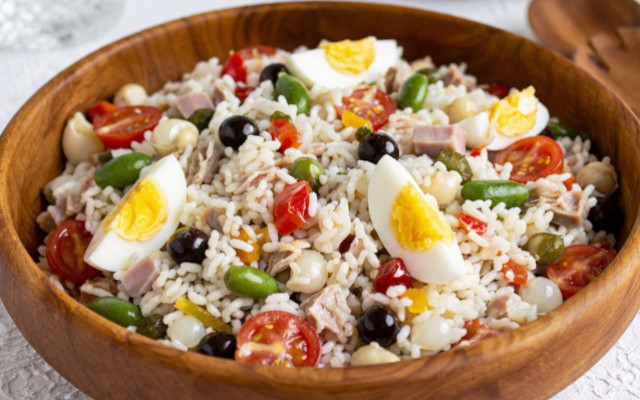
Fresh, colourful, infinitely adaptable: therice salad It is the symbol dish of the Italian summer, the alternative to risotto. Its strength is the absence of a single recipe: a basic grammar — separated grains, fresh and preserved ingredients, balanced seasoning — that each family interprets in its own way.
In essence, rice salad is a preparation cold based on boiled and chilled rice, dressed raw with extra virgin olive oil, vegetables, preserves in oil or vinegar, proteins (tuna, eggs, cheese), and aromatic herbs. It is served at room temperature or cold, as a main dish or side dish.
Origins and evolution of the dish in the habits of Italian families
The first evidence of rice salad dates back to the late 1920s. The talisman of happiness by Ada Boni, a reference recipe book for generations of Italian families, reported the 'shrimp and rice salad', among the appetizers, and the 'rice and cauliflower salad‘ in the chapter dedicated to salads (Boni, 1929).
Mass affirmation came in the post-war period, when rice became affordable and preserves preserves in oil and vinegar. The Silver Spoon, published in 1950 defines the canon: boil the rice in plenty of salted water, drain it al dente and cool it separating the grains.
How to choose the right variety of rice to have well separated grains
The success of the dish depends on choice of rice: the grains must remain firm and separated after cooking and cooling. The decisive factor is the content of amylose, the linear fraction of starch. Other factors being equal, higher amylose is associated with grains that are firmer, less sticky and hold their shape better; low amylose, conversely, makes rice softer and stickier (Kimura, 2025).
Among Italian varieties, superfine and semi-fine rice are suitable: the Carnaroli, appreciated for its staying power when cooked; the'Arborio, with large and pearly grains; the Vialone Nano, round and compact; less suitable the Rome and the Bold, though excellent for risottos, because of the low amylose content. The rices integral and the pigmented (Venus, Ermes) offer alternatives with a naturally firmer grain.
Guide to the ingredients that characterize the recipe
If rice is the canvas, the other ingredients are the colors: choosing authentic, quality Made in Italy products is what transforms a simple dish into a work of art.
Extra virgin olive oil. The king of oils, in Mediterranean culture, is distinguished for its organoleptic as well as nutritional properties. Oils containing at least 5 mg of polyphenols (hydroxytyrosol and derivatives) per 20 g can claim on labels and advertising, in the European Union, their contribution to protection blood lipid from oxidative stress (Regulation EU no. 432/2012). For rice salad it is better to choose monocultivar Italian and oils with a light fruitiness, which do not overpower other flavors.
Tuna and anchovies. The tuna in oil is the classic protein contribution, preferably preserved in olive oil. Anchovies add savoriness; in liquid form, the Colatura di Alici di Cetara DOP — obtained from the slow maturation in salt of anchovies from the Amalfi Coast — is an amber condiment with an intense flavour, perfect for adding flavor without weighing it down.
Tomatoes. Datterino and cherry tomatoes are the most suitable for sweetness and firmness. Among the Geographical Indications stand out the Pachino PGI tomatoes (Sicily), the Piennolo del Vesuvio DOP tomato and the San Marzano tomato from Agro Sarnese-Nocerino DOP. The tomato is also the main food source of lycopene, an antioxidant carotenoid associated with beneficial cardiovascular and metabolic effects (Shafe et al., 2024).
Table olives. Each territory has its cultivar: the Taggiasca Ligurian, small and with a delicate taste; theGaeta DOP olive (Lazio), suitable both in black and green; the Nocellara del Belice DOP (Sicily, first table olive to obtain the PDO in 1998), fleshy and fruity; the Apulian Bella from Cerignola, large and crunchy.
Capers. Few and selected, like the Pantelleria Capers PGI which is particularly rich in flavonols (rutin, quercetin and kaempferol derivatives), compounds with high antioxidant activity (Lo Bosco et al., 2019).
Cheeses. The Buffalo Mozzarella Campana DOP diced brings creaminess and sweetness; try it, scamorza are excellent alternatives. The mozzarella must be squeezed to avoid excessive release of whey.
Vegetables in oil and pickle. Artichokes, peppers, aubergines, or a giardiniera (mixed vegetables such as carrots, celery, cauliflower and gherkins, pickled) add colors and flavours, texture and balanced acidity.
Boiled eggs. Nothing better to increase the texture of the dish with proteins of very high biological value. The choice of organic eggs offers the best guarantees of sustainability and animal welfare.
Aromatic herbs. The Genoese Basil PDO perfumes the dish, parsley and oregano can complete the bouquet, in regional variations.
The preparation
The excellence of an Italian rice salad depends first of all, as seen, on the choice of quality Made in Italy ingredients, and on the balance in their combination. The rice preparation in turn must follow some precise criteria:
- boil the rice in plenty of salted water and drain it al dente;
- cool it quickly, spreading it on a tray, to stop the cooking and separate the grains;
- combine the ingredients fresh and preserved and dress with extra virgin oil, salt and aromatic herbs;
- leave rest in the refrigerator for at least 1-2 hours before serving.
Rice salad vs. pokes, what differences?
The dish apparently most similar toItalian rice salad traditional today is the poke, of Hawaiian origin, which is also enjoying extraordinary success in Italy thanks to food service chains such as I Love Poke:
- both dishes share versatility, practicality, freshness and balance in nutritional profiles, thanks to the combination of boiled rice, proteins and vegetable fats;
- the rice salad Italian stands out for the characteristic ingredients of the Mediterranean diet (extra virgin olive oil, vegetables in oil and pickled, olives and capers, mozzarella and/or other cheeses, basil) and for the absorption of their flavors in the rice, thanks to their inclusion before refrigeration;
- The poke is instead composed at the time of service, at the request of the guests who choose its seasoning, and therefore preserves the flavors of the different ingredients — which include more or less exotic flavors, from seaweed to soy sauces — clearly distinct.
Cooked and cooled rice: resistant starch and glycemic index
From a nutritional point of view, cooled rice after cooking has a lower glycemic index compared to freshly cooked rice. The phenomenon is well documented, though its extent varies according to circumstances:
- at the base there is starch retrogradation. During cooking the starch gelatinizes; with subsequent cooling the amylose chains re-associate into crystalline structures that resist digestion, giving rise toresistant starch of type 3 (RS3). It behaves like a dietary fiber, as it is not absorbed in the small intestine and is fermented by colon bacteria (Bojarczuk et al., 2022);
- the impact on glycemic response is all the more evident the less the body can compensate for it. In people with type 1 diabetes, rice cooled at 4 °C and then reheated significantly reduced the glycemic peak compared to freshly cooked rice (Strozyk et al., 2022). In healthy individuals, however, the same effect may go almost unnoticed, as an efficient insulin response masks the slight slowdown in sugar absorption (Wolever et al., 2021).
THE'extent of the benefit also depends on how much resistant starch actually forms, depending on the rice variety (particularly its amylose content) and refrigeration times. Therefore, cooled rice is a useful measure, especially for those who need to control blood sugar, albeit with effects that vary from case to case.
A dish that showcases Italian ingredients
The rice salad demonstrates how Italian cuisine is able to express itself, combining simplicity and imagination, thanks to the quality of the ingredients. Cooking and cooling rice in the correct way not only serves to present a visually perfect dish, but also helps to make it lighter and more digestible for our body. By choosing authentic raw materials, such as local oils and preserves, this dish is transformed into a real lesson in food education, capable of bringing to the table the history, biodiversity and well-being typical of the Italian lifestyle.
From Ada Boni’s cookbooks to the tables of the economic boom, rice salad has spanned a century remaining faithful to its non-coding: no official recipe, but an open structure. Precisely for this reason the difference is made by the raw materials — a rice rich in amylose that stays grainy, extra virgin olive oil rich in polyphenols, tomatoes, olives, capers and cheeses. Carefully chosen, they transform a ‘poor’ dish into a small ambassador of Made in Italy.
Dario Dongo
References
Bojarczuk, A., Skąpska, S., Mousavi Khaneghah, A., & Marszałek, K. (2022). Health benefits of resistant starch: A review of the literature. Journal of Functional Foods, 93, 105094. https://doi.org/10.1016/j.jff.2022.105094
Boni, A. (1929). The talisman of happiness. Editions of the Preziosa magazine.
Frisina, M., Bonacci, S., Oliverio, M., Nardi, M., Vatrano, T. P., & Procopio, A. (2023). Storage effects on bioactive phenols in Calabrian monovarietal extra virgin olive oils based on the EFSA health claim. Foods, 12(20), 3799. https://doi.org/10.3390/foods12203799
The Silver Spoon. (1950). Domus editorial.
Kimura, E. (2025). Detailed analysis of amylose content of rice grains and its relation to the physical properties of cooked rice. Bioscience, Biotechnology, and Biochemistry, 89(7), 1006–1014. https://doi.org/10.1093/bbb/zbaf053
Lo Bosco, F., Guarrasi, V., Moschetti, M., Germanà, M. A., Butera, D., Corana, F., & Papetti, A. (2019). Nutraceutical value of Pantelleria capers (Capparis spinosa THE.). Journal of Food Science, 84(8), 2337–2346. https://doi.org/10.1111/1750-3841.14718
Manuelli, M.T. (2026, June 13). I Love Poke, 10 years after its birth continues its expansion plan. Il Sole 24 Ore. https://www.ilsole24ore.com/art/i-love-poke-10-anni-nascita-continua-piano-expansion-AIK8GUeD
Shafe, M. O., Gumede, N. M., Nyakudya, T. T., & Chivandi, E. (2024). Lycopene: A potent antioxidant with multiple health benefits. Journal of Nutrition and Metabolism, 2024, 6252426. https://doi.org/10.1155/2024/6252426
Strozyk, S., Rogowicz-Frontczak, A., Pilaciński, S., LeThanh-Blicharz, J., Koperska, A., & Zozulińska-Ziółkiewicz, D. (2022). Influence of resistant starch resulting from the cooling of rice on postprandial glycemia in type 1 diabetes. Nutrition & Diabetes, 12(1), 21. https://doi.org/10.1038/s41387-022-00196-1
Wolever, T. M. S., El-Sohemy, A., Ezatagha, A., Zurbau, A., & Jenkins, A. L. (2021). Neither low salivary amylase activity, cooling cooked white rice, nor single nucleotide polymorphisms in starch-digesting enzymes reduce glycemic index or starch digestibility: A randomized, crossover trial in healthy adults. The American Journal of Clinical Nutrition, 114(5), 1633–1645. https://doi.org/10.1093/ajcn/nqab228

Dario Dongo, lawyer and journalist, PhD in international food law, founder of WIISE (FARE - GIFT – Food Times) and Égalité.


