

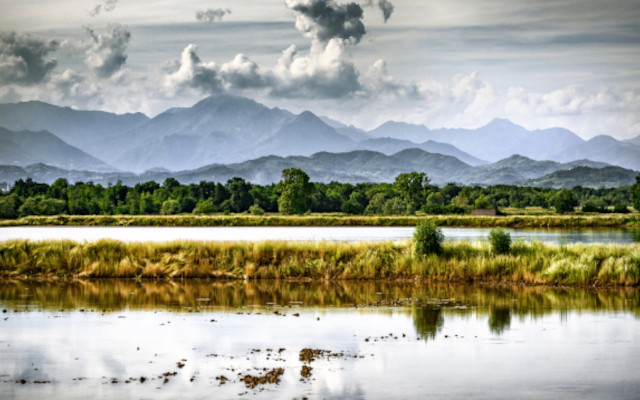
the arborio rice is the most internationally known Italian rice variety. Characterized by very large, pearly, and starch-rich grains, it has become in many countries the very synonym of ‘risotto rice‘, a fame and reputation that no other Italian cultivar has reached. Like Carnaroli in 2025, Arborio celebrated its eighty years.
History: a giant grain born in the Baraggia
Domenico Marchetti was born in 1903 into a family of small farmers in Arborio, a small town in the heart of the Baraggia Vercellese. After learning the basics of genetic improvement at the Experimental Rice Station of Vercelli — the very structure that, a century ago, introduced the hybridization technique to Italy — he independently started his own activity of varietal selection (Bosso, 2026; Riso Italiano, 2026).
His bet was to combine the variety Vialone Nero — appreciated for the quality of the grain — with Lady Wright, introduced to Italy from the United States in 1925 and characterized by a longer grain compared to the Italian standards of the time. From the crossbreeding, after years of experimentation, was born in 1946 a variety with an unusually large grain, which Marchetti named after the name of his hometown.
In addition to Arborio, Marchetti left a varietal catalog of great respect: S. Domenico, Giovanni Marchetti, Arborio Precoce, Arborio Gigante, Pierina Marchetti and Rosa Marchetti, the latter dedicated to his wife and released in 1972.
Production and market: 2025 data
TheItaly is the leader European in rice production, estimated at about 1,439,047 tons for 2025, equal to about 50% of EU production. In 2025 the total area planted with rice reached 235,450 hectares, with an increase of about 9,300 hectares compared to 2024: almost three thousand more hectares for the Arborio group alone (+17.2%. National Rice Authority, 2025).
On the front of domestic consumption, l‘Arborio ranks in second place, with 11.6% of volumes, after Carnaroli at 17.1% (ISMEA, 2025). At the level of export, Arborio remains instead at first place among Italian rice varieties, with strong demand in Germany, France, United Kingdom, North America and Japan.
The authenticity issue: Arborio Classico and the Volano question
A crucial — and often silenced — element concerns the real spread of the historic cultivar. About 95% of rice grown and marketed as Arborio in Italy actually belongs to various species of the 'Arborio group' developed over the decades to increase agronomic yield and reduce susceptibility to diseases, especially rice blast. In 1968 the variety Volano, which had wide diffusion until the advent of the Clearfield CL388 and CL510 varieties in the last decade.
TheArborio Classico — that is, the cultivar selected by Marchetti in 1946 — today represents barely the 0,62% of the cultivated areas in the Arborio group. Those interested in purchasing it can choose products so labeled:
- the wording 'Classico' on the label, introduced by Legislative Decree 131/2017 (art. 5.5), which guarantees the purity and traceability of the original cultivar;
- the Baraggia Biellese and Vercellese Rice PDO, first and only Italian PDO rice, whose regulations always impose varietal authenticity (Baraggia Rice Consortium, 2026).
Botanical characteristics
Arborio belongs to the species Oryza sativa L. and to the commercial group of superfine long grain rices A. Its main characteristics are:
- very large grain, the bulkiest among all Italian risotto varieties;
- central pearl extended, which gives the typical opalescent appearance;
- low content of amylose, resulting in high starch release during cooking;
- excellent ability to absorb liquids, up to five times its own weight.
Arborio and Carnaroli: two risotto philosophies compared
Arborio and Carnaroli are both rices superfine long grain A, born in the same decade in the same geographical area — the Po Valley between Vercelli and Pavia — yet they express two distinct approaches to risotto preparation.
The fundamental difference lies in the amylose content: high in Carnaroli, low in Arborio:
- in the Carnaroli starch is released progressively and controlled during cooking, ensuring prolonged al dente firmness and greater resistance to overcooking;
- in theArborio starch release is more abundant and rapid, producing a creamier texture but a narrower cooking window.
From an agronomic and commercial viewpoint:
– the Carnaroli — with its historic cultivar actually cultivated on a large scale, unlike the original Arborio almost disappeared from the fields — is considered the preferred choice ofhigh-end catering;
– theArborio, thanks to its higher productivity and immediately recognizable gastronomic yield, on the other hand dominates the international mass markets and is the most exported variety in the world under the Italian name of risotto.
Territory, cultivation and sustainability
Arborio finds its ideal habitat in the Baraggia Vercellese and Biellese, territory located at the northern limit of Italian rice cultivation, where harsher climatic conditions — marked temperature variations, greater exposure to rice blast — have historically challenged and hardened varietal selection.
Cultivation takes place in flooded rice fields, with sowing between April and May and autumn harvest. Some rice farms have started paths of sustainable agriculture, including the adoption of precision farming platforms: for example, Riso Gallo has developed with xFarm Technologies the Gallo4Farmers platform, active in 2025 on about 60 companies in the supply chain. There is also growing interest in organic production certified, supported by the structural expansion of Italian organic farming, which in 2024 reached 20.2% of the national Utilized Agricultural Area (UAA).
Production process
The production process of Arborio rice follows the same stages as the main Italian superfine varieties:
- cultivation and harvesting of paddy rice;
- drying controlled;
- cleaning from impurities and plant residues;
- hulling to obtain brown rice;
- whitening and refining progressive;
- optical selection and grading;
- packaging, with mandatory varietal identification and indication of origin.
For producers of DOP Baraggia, the processing phases are subject to additional regulatory constraints: drying by indirect heat, prohibition of nitrogen fertilizers, internal moisture of the paddy not exceeding 14% at the time of processing (Consorzio Riso di Baraggia, 2026).
Nutritional profile
Based on the CREA Food Composition Tables (2019), 100 g of polished rice raw provide on average:
- energy: 334 kcal;
- carbohydrates: 80.4 g, of which sugars 0.2 g;
- proteins: 6.7 g;
- fats: 0.4 g;
- fiber: 1.0 g.
Among the micronutrients are noted:
- selenium: 10 μg per 100 g, equal to 18.2% of the Nutrient Reference Value (55 μg) established in Annex XIII to Regulation (EU) No 1169/11;
- copper: 0.18 mg equal to 18.0% of the NRV (1 mg).
the brown rice is favorably characterized as follows:
- energy: 341 kcal;
- carbohydrates: 77.4 g, of which sugars 1.2 g;
- proteins: 7.5 g;
- fats: 1.9 g;
- fiber: 1.9 g.
Above all, brown rice stands out for the richness and/or presence of:
- vitamin B1 (thiamine): 0.48 mg per 100 g equal to 43.6% of the NRV (1.1 mg);
- phosphorus: 221 mg per 100 g equal to 31.6% of the NRV (700 mg);
- vitamin B3 (niacin): 4.7 mg per 100 g equal to 29.4% of the NRV (16 mg).
In the kitchen
Arborio rice is universally associated with the preparation of risotto italianoThe high release of starch produces a natural creaminess that envelops the ingredients, making it particularly suitable for risottos with a rounded taste. It is also used in timbales, arancini, and supplì, rice salads and soups.
Tips for buyers
To ensure the highest quality, it is advisable to favor certified products such as:
- Baraggia Biellese and Vercellese Rice PDO, the only Italian rice DOP, which guarantees varietal authenticity and origin from the Baraggia territory according to its regulation;
- organic, where available, to guarantee compliance with the highest environmental and biodiversity protection standards.
The team of GIFT (Great Italian Food Trade) provides specialized expertise to support international buyers in identifying reliable producers, evaluating certifications, and developing commercial partnerships along the entire Italian agri-food supply chain.
Conclusions
Eighty years after its origin in Baraggia Vercellese, Arborio rice remains the most recognizable face of Italian rice cultivation in the world. The current challenge is to preserve theauthenticity of the original cultivar — today almost disappeared from fields in favor of more productive substitutes — and enhance it through available regulatory tools, from the 'Classico' designation to the Baraggia DOP. The 2025 data — a +17.2% increase in area, solid domestic demand, exports driven by the global reputation of Italian risotto — confirm the vitality of a variety that, unlike many others, has turned its name into an international brand.
Dario Dongo
Credit cover Consortium for the Protection of the DOP Baraggia Biellese and Vercellese Rice
References
Bosso, E. (2026). Arborio turns 80. Riso Italiano. https://www.risoitaliano.eu/buon-compleanno-arborio/
European Commission. (December 2024). EU agricultural outlook 2024–2035. Directorate-General for Agriculture and Rural Development & Joint Research Centre. https://agriculture.ec.europa.eu/media/news/eu-agricultural-outlook-2024-35-resilient-sector-adapts-climate-change-sustainability-concerns-and-2024-12-11_en
Consortium for the Protection of Baraggia Biellese and Vercellese DOP Rice. (2025). The varieties of DOP Baraggia. https://www.risobaraggia.it/en/projects/1-i-risi-della-baraggia/
Council for Agricultural Research and Economics Analysis (CREA). (2025). Food composition tables (code 000100 – Polished rice). Food and Nutrition Research Center. https://www.alimentinutrizione.it/tabelle-nutrizionali/000100
CREA – Council for Agricultural Research and Economics Analysis. (2019). Food composition tables – Polished rice. Rome: CREA – Food and Nutrition Research Center. https://www.alimentinutrizione.it/tabelle-nutrizionali/000100
CREA. (2019). Food composition tables – Brown rice. Rome: CREA – Food and Nutrition Research Center. https://www.alimentinutrizione.it/tabelle-nutrizionali/000110
Legislative Decree August 4, 2017, no. 131. Provisions concerning the internal rice market. Normattiva (last update to the act published on 03/28/2018). https://www.normattiva.it/uri-res/N2Ls?urn:nir:stato:decreto.legislativo:2017-08-04;131
National Rice Authority. (2025). Definitive surfaces 2025 by varietal group. https://www.enterisi.it/servizi/notizie/notizie_fase02.aspx?ID=40015
Il Casalingo di Voghera. (2026, May 5). Arborio rice turns 80 years old but is nearly extinct in the fields. https://www.ilcasalingodivoghera.it/il-riso-arborio-compie-80-anni-ma-e-quasi-estinto-nei-campi/
ISMEA. (2025, September 11). Rice consumption: ISMEA presentation at Risò 2025. https://www.ismeamercati.it/flex/cm/pages/ServeBLOB.php/L/IT/IDPagina/13595

Dario Dongo, lawyer and journalist, PhD in international food law, founder of WIISE (FARE - GIFT – Food Times) and Égalité.


