

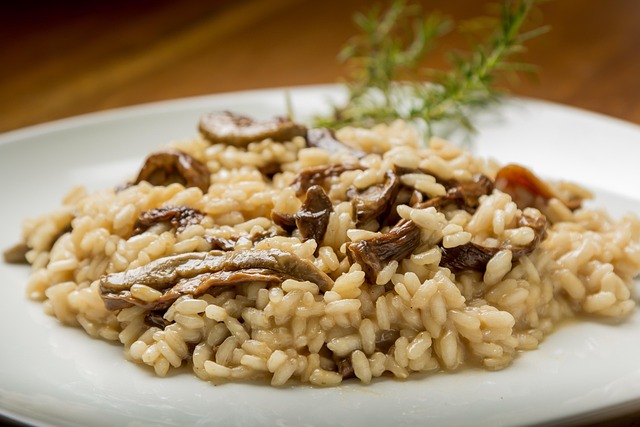
The Italian risotto expresses the ability of the Bel Paese to transform simple ingredients into gastronomic creations of great refinement. Attention to raw materials – starting with the rice varieties specifically developed in Italy in the twentieth century – and the preparation method, from sautéing to creaming, are at the base of the most famous recipes. Without limits to imagination, to develop risottos distinguished by creamy consistency 'plant-based' and variously complex aromatic profiles.
The roots of rice in Italy: a millennial journey
The history of risotto is inseparably linked to that of rice cultivation in the Peninsula. Although rice was known in Italy since ancient times as precious spice and medicinal product — documents from the 1300s attest to its use in the sweets of the court of the Dukes of Savoy, and Milanese customs tariffs of 1340 classify it as ‘a spice that came from Asia, via Greece’ — its systematic cultivation began only in 15th century (Ente Nazionale Risi, 2012).
According to some sources, the Cistercian monks of the Abbey of Santa Maria di Lucedio, founded in 1123 in the Vercellese area, were among the first to introduce rice cultivation in the Po Valley around the middle of the 15th century, exploiting the water characteristics of the territory (Rivista Natura, 2025).
The decisive turning point came when the humid climate and the availability of water of the Po Valley proved ideal for this crop. In 1475, a letter from Galeazzo Maria Sforza documents the export of twelve sacks of rice from the Duchy of Milan to Ferrara, evidence of the established spread of Lombard rice cultivation (Strada del Riso Piemontese, n.d.). From that moment, the cultivation rapidly spread in the provinces of Vercelli, Novara, Pavia, and Alessandria, transforming the landscape and economy of Northern Italy.
From boiled rice to modern risotto: the art of culinary transformation
For centuries, rice in Italy was mainly consumed boiled in plenty of water, in a preparation closer to a soup than to modern risotto. The risotto technique — with toasting the grain, gradual cooking in broth and the final creaming — represents a relatively recent innovation in the history of Italian cuisine.
The first records of rice-based preparations approaching the concept of modern risotto are found in 18th and 19th century works. Already in the 1779, in ‘The Macerata Cook’ by Antonio Nebbia, there is a recipe for rice sautéed in butter and cooked with broth, a significant step compared to the traditional cooking in cold water. Nebbia describes a preparation where the rice is ‘sautéed in butter’ and then ‘cooked with broth’, a method that foreshadows the risotto technique (Nebbia, 1779).
In the 1829, Giovanni Felice Luraschi in ‘New economical Milanese cook’ defines the recipe for ‘yellow Milanese risotto’, complete with fat, beef marrow, saffron and nutmeg (Luraschi, 1829). It is precisely in this period that the use of deglazing the toasted rice with wine, whose acidic note balances the high fat component typical of the cuisine of the time.
Pellegrino Artusi: the codifier of bourgeois cuisine
No history of Italian risotto could be complete without mentioning Pellegrino Artusi and his masterpiece ‘The science in cooking and the art of eating well' (1891). Artusi dedicates to Risotto alla milanese particular attention, proposing three variants:
- a basic recipe with rice, butter, onion, and saffron;
- a richer one with beef marrow and white wine;
- a third with the addition of Marsala.
Key ingredients and preparation method: the alchemy of taste
The preparation of risotto is divided into precise phases, each contributing to the final result. The canonical method provides:
- The soffritto: onion or shallot sweated in butter or in a mix of butter and extra virgin olive oil. Even better using clarified butter, an emulsion of water and oil, to prevent exceeding the smoke point;
- the toasting: the rice is poured into the soffritto and 'toasted' over high heat for a few minutes, until the grains become transparent at the edges. This phase is fundamental to seal the surface starch and preserve the grain's texture;
- the deglazing: the possible addition of white wine (or red, in Piedmont variants), whose alcohol evaporates during cooking, gives acidity and aromatic complexity to the dish;
- the gradual cooking: the broth, already prepared and kept hot, is added ladle by ladle, to allow the rice to gradually absorb the liquid and release the starch that will form the characteristic cream;
- the mantecatura: when cooking is finished, off the heat, cold butter (or extra virgin olive oil) and grated cheese (typically Parmigiano Reggiano o Grana Padano), stirring vigorously to achieve the final velvety consistency.
The broth: the soul of risotto
The broth represents the distinctive element that gives risotto its identity. Vegetable or meat broth, chicken or fish, depending on the ingredients that will be added to the risotto. Milanese tradition favored ossobuco broth, while seafood preparations require a fumet rich in crustaceans and mollusks.
Regional risottos: a mosaic of Italian flavors
Lombardy: the heart of risotto
- Risotto alla milanese: the most famous of Italian risottos, the undisputed symbol of the city of Milan. Although the first written recipe dates back only to 1829, the risotto alla milanese received only in 2007 the Municipal Designation which officially confirms its recipe with roast fat and marrow, establishing the deep connection with the territory.
- Risotto alla monzese: variant of the Brianza tradition that enriches saffron risotto with monzese luganega, a typical sausage of the territory. It represents an example of how similar ingredients can generate distinct culinary identities in geographically close areas.
- Risotto alla pilota: typical of the Mantua tradition, this dish stands out for its 'absorption' cooking technique and for the use of salami paste (pisto or pestume) as a seasoning. The name derives from the 'piloti', workers in charge of rice hulling in the ancient rice mills. The recipe has recently been valorizied with the Municipal Designation of Origin (De.C.O.) in Castel d’Ario.
Piedmont: elegance and depth
- Risotto with Barolo: specialty of the Langhe that combines two Piedmontese excellences — the rice and the Barolo wine PDO. The recipe, popularized in the 1960s by restaurateur Gian Bovio from La Morra, involves deglazing the rice with the prestigious red wine, giving the dish a characteristic ruby color and elegant tannic notes. There is a variant in the Asti Monferrato with Barbera.
Veneto: flavors of land and sea
- Risi e bisi: celebratory dish of the Venetian tradition, historically served to the Doge on April 25th, the feast of Saint Mark. The recipe, registered at the Venice Chamber of Commerce in 2013, requires the use of Vialone Nano rice e fresh peas, with a consistency halfway between a soup and a risotto. Tradition holds that the quantity of rice and peas is equivalent — ‘each rice a pea’ — and that the pods are also used, following the principle of reducing food waste, to prepare a dense and aromatic broth.
- Risotto with cuttlefish ink: specialty of the Venetian lagoon and coastal tradition, characterized by the use ofcuttlefish ink which gives the dish its unmistakable black color and an intense taste of the sea. The recipe originated as a recovery dish, using ink sacs — traditionally considered waste — to flavor the rice.
Other national variants: the versatility of risotto
- Risotto with porcini mushrooms: widespread in the woodland areas of Northern Italy, it exploits the mycological richness of mountainous and hilly territories.
- Pumpkin risotto: dish with peasant roots, particularly appreciated in Lombardy, Veneto and South Tyrol, where the pumpkin has been a staple of autumn nutrition for centuries.
- Seafood risotto: found along all Italian coasts, represents the adaptation of risotto technique to maritime traditions.
- Black truffle risotto: specialty of central and northern regions where the valuable black truffle (Tuber melanosporum) finds its natural habitat.
The crucial role of Italian rice varieties: golden grains for signature risottos
The quality of a risotto depends significantly on the rice variety used. Italy, the leading European rice producer with about 1.3 million tons annually, has developed specific cultivars optimized for risotto preparation throughout the twentieth century. Below are some of the most famous.
Carnaroli: the ‘king of rices’
The Carnaroli – a variety developed in 1945 by crossing Vialone Nano with Lencino (or Leoncino) – has a long and slender grain that remains perfectly al dente even after long cooking. It is ideal for preparations requiring precision and elegance, such as saffron risotto.
Arborio: the creamy universality
L’Arborio is the most internationally famous Italian rice variety, obtained in 1946 by crossing Vialone and Lady Wright. The large, rounded grain releases abundant surface starch during cooking, generating a immediate and enveloping creaminess. The lower structural stability compared to Carnaroli requires attention in managing times and liquids, but makes it ideal for rich and full-bodied risottos, such as mushroom ones.
Vialone Nano: the creamed tradition
Forerunner of modern prized varieties, born in the 1930s from the cross between Vialone and Nano. The small and rounded grains have a remarkable capacity for liquid absorption and release starch quickly, creating creamy risottos in a short time. It is the variety traditionally used for Venetian risi e bisi and Mantuan pilota risotto, as well as preferred for 'all’onda' preparations, soft and well bound.
The choice among these varieties is not merely technical but represents a true declaration of culinary style: Carnaroli for elegance and precision, Arborio for generous creaminess, Vialone Nano for versatility and the connection with history.
Conclusions: risotto, a mirror of Italian gastronomic identity
Italian risotto is the story of territory, innovation and history intertwined with the very identity of the country. From the first cultivations in the 15th century in the marshes of the Po Valley, through Renaissance courts and 19th century taverns, to contemporary tables, this dish has passed through centuries of evolution while maintaining intact its ability to embody the Italian gastronomic spirit.
Its strength lies in the balance between technical rigor e creative freedom: the technique of toasting, gradual cooking, and creaming is unchanging, but the broth, seasoning, wine, and rice variety offer infinite customization possibilities. In this sense, risotto is a perfect example of how Italian cuisine can reconcile innovation and respect for the raw material.
The protection of rice varieties — Carnaroli, Arborio, Vialone Nano — and the recognition of municipal denominations for historical recipes such as Milanese risotto and riso alla pilota testify to the awareness of the need to preserve this culinary heritage. A heritage that, as history has shown, knows how to renew without betraying its roots.
Dario Dongo
Credit cover Jeferson Urias Urias from Pixabay
References
Municipality of Milan. (n.d.). Register of food products Municipal Designation (De.Co.). Municipality of Milan. https://www.comune.milano.it/amministrazione/food-policy/risorse-e-materiali-di-approfondimento
National Rice Authority. (2012, May 15). The history of rice. https://www.enterisi.it/servizi/menu/dinamica.aspx?ID=17304
Luraschi, G. F. (1829). New economical Milanese cook. Milan.
Nebbia, A. (1779). The Macerata Cook. Macerata. Digital version available at https://www.mori.bz.it/gastronomia/Nebbia%20-%20Il%20cuoco%20maceratese%20-%201820.pdf
Natura Magazine. (2025, July 26). Lucedio: where Italian rice is born, between history and nature. https://rivistanatura.com/lucedio-dove-nasce-il-riso-italiano-tra-storia-e-natura/
Piedmont Rice Road. (n.d.). The history of rice in Vercelli. https://www.stradadelrisopiemontese.it/sai-di-riso/la-storia-del-riso-nel-vercellese.html

Dario Dongo, lawyer and journalist, PhD in international food law, founder of WIISE (FARE - GIFT – Food Times) and Égalité.


