
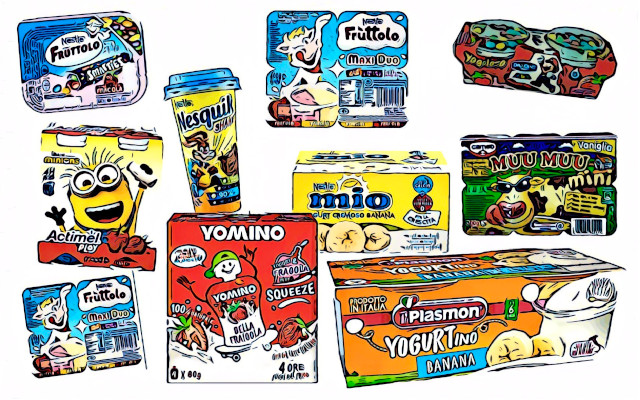
Milk snacks are a constant in the shopping of families with children. Shelf proposals are numerous and varied among ‘sweet cheese with (…)’, ‘milk snack’ and ‘yogurt with (…)’. We selected 10 to examine their nutritional profiles and the appropriateness of ingredients, including food additives. Without neglecting the correctness – often controversial – of labels and consumer information.
Milk snacks that catch kids
The packages are almost always decorated to attract children's attention. Colorful figurines and prize contests to win toys are still the tool of marketing – in some cases ‘predatory’, according to UNICEF (2020) – more practiced to retain young consumers. Following are the claims, aimed at adults, declaring the absence of undesirable substances or the presence of elements useful for growth and health. But what is inside?
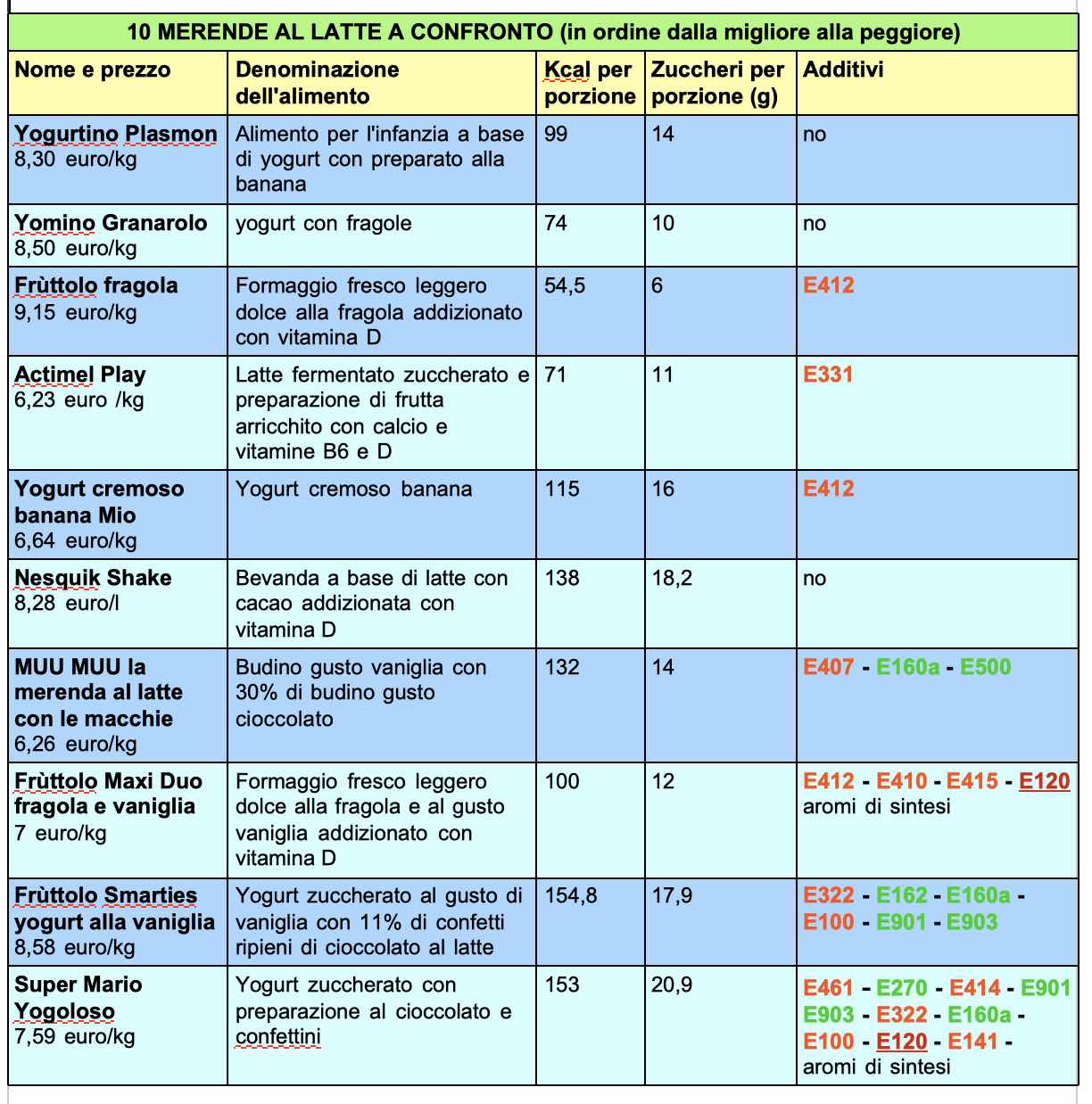
The broad category of ‘milk snacks’ includes very different products, although apparently similar and placed in the same supermarket fridge space. At prices ranging from 6 to over 9 euros per kg (or liter) there are more or less creamy yogurts, blends of fresh cheese and fruit or cocoa puree, puddings. In some cases, chocolates are even added. In 4 cases vitamin D is added to support the immune system (see table).
The comparison
The comparison focuses on some parameters:
– the energy value, which in the 10 products ranges between 54 and 154.8 kcal per serving,
– the amount of sugars, included in a range from 6 to 20.9 grams,
– the addition of additives, very often problematic especially for children. Later we will see in detail the additives present in the 10 milk snacks.
Consumer information is also considered. Taking into account the origin of the milk, which is not declared and is presumably foreign in 7 out of 10 cases, as revealed by the ‘health stamp’ (see image below). In addition to noting some omissions on the composition of the primary ingredient and claims of doubtful legitimacy.

The various Frùttolo
The most famous brand and advertised for decades is undoubtedly Frùttolo. The cheese and fruit mix was launched in Italy by Nestlé in 1984. Today it is marketed by Lactalis Nestlé Prodotti Freschi Italia Srl, a joint venture European between Lactalis and Nestlé specialized in ultra-fresh products that also manages fresh products under the brands Zymil, Parmalat, Kyr, and Malù. In addition to the Mio brand, included in our selection.
Under the name Frùttolo actually very different products travel. From a light fresh cheese mix to a sweetened yogurt. In all cases, however, the indication of the components of the main ingredient is missing. Although the site web corporate, but not the label either, highlights ‘with live lactic ferments‘.
Another anomaly on the label is the denomination ‘Light fresh cheese’ justified by the indication ’20% fat content calculated on dry matter’. (1)
Unsuitable for children under 4
I claims on the label speak for themselves. In the 'standard' Frùttolo, the absence of preservatives, colorings, and gluten is claimed. In the 'DUO' version, which instead contains the debated carmine coloring (E120), in addition to various thickeners, the claims decrease. In the three Frùttolo products, calories range from 54 to 155 per serving, sugars from 6 to 18g. Additives are always present and the origin of the milk is always foreign.
For younger children Frùttolo with Smarties is unsuitable. In addition to the widespread presence of additives, the inclusion of chocolates poses a serious risk. The company protects itself with an illegible warning, printed in small characters in a curved text, which reads:
‘Young children (under 4 years old) have limited chewing ability and could choke on small-sized foods’.
A pudding as a snack
The consumers less accustomed to industrial extravagances might find the idea of consuming a pudding as a snack rather than as a dessert unusual.
Yet ‘MUU MUU the milk snack with spots’ breaks every tradition. The product is by Cameo, from the German Oetker group. It contains various additives, thickeners and artificial flavors. 132 calories and 14 g of sugar per serving. The origin of the milk is not specified, but the health mark refers to processing in Germany.
Super Mario. Yogurt, sugar and chocolates
Super Mario Yogoloso is the milk snack from the French multinational Danone. It is a sweetened yogurt combined with chocolates similar to smarties. An imitation of Frùttolo that adds the more renowned Nestlé Smarties. The presence of 'confettini' involves a nice mix of additives, including the feared dye E120. Besides the choking risk for the little ones, as already mentioned.
Also in this case, no information on the country of origin of the milk. The 'health mark' instead indicates processing in Spain. 153 kcal and 20.9 grams of sugar per serving.
Yomino by Granarolo
Nutritional profile rather balanced (74 calories and 10g sugars per serving) and fairly clear label – aside from boasting common features of its category – characterize the Yomino yogurt by Granarolo well.
Without preservatives, colorants, flavors and thickeners, the yogurt of the very Italian Bolognese group Granarolo, active for 60 years, is made with milk made in Italy. With the additional plus of preservation for 4 hours outside the refrigerator.
Plasmon, the yogurt for early childhood
As per tradition the Plasmon yogurt, a brand of the American Kraft-Heinz group, is additive-free. 99 kcal and 14g of sugar per serving, with Italian milk and durability of 4 hours outside the fridge. It is suitable for children from 6 months onwards.
The infant food industry with a plant in Latina, Lazio, does not need contests or comics on the label. It is the only one, in the sample always declared gluten-free, to carry the brand gluten free with the crossed grain certified by AIC (Italian Celiac Association). And the quality of the ingredients is guaranteed by the historic Plasmon standard ‘Oasi nella crescita’.
Mio, the snack for infants with additive
Another yogurt which is advertised as suitable for infant nutrition is Nestlé's Mio. With 115 calories and 16g of sugars it is presented in claims on the label as ‘100% ingredients of natural origin’. However, it adds an additive in the recipe, guar gum E412.
As with other products of the same multinational, the yogurt composition is unknown, as well as the origin of the milk, evidently foreign.
Actimel Play, fermented milk of unknown origin
The sweetened fermented milk Danone's Actimel Play is without colorants and preservatives, but with an additive (E331). It provides 71 calories and 11g of sugars per serving and contains added probiotics.
The origin of the milk, as usual, is unknown. The health stamp reports the origin, Belgium or Spain. It can be stored up to 4 hours outside the fridge.
Nesquik shake, calories and sugars in abundance
Another snack based on milk with cocoa is Nestlé's Nesquik Shake. The drink is rather caloric: 138 kcal and 18.2g of sugars per serving.
Without additives can be stored up to 4 hours outside the fridge. Milk origin unknown.
A load of additives
The additives are added in 7 out of 10 products. Some of them – although authorized in the EU for the intended uses – are debated in the scientific community. Particularly regarding their intake in children who, through various food matrices, may approach the acceptable daily intake (ADI) where established.
The evaluation of the additives is based on information reported by Altroconsumo's database and the opinions of the European Food Safety Authority (EFSA). Synthetic flavors, present in two products (Frùttolo Maxi Duo and Super Mario Yogoloso), are instead without evaluation.
For two additives – guar gum and carob seed flour – there is an additional risk: possible contamination by ethylene oxide, a mutagenic, carcinogenic and reproductive toxic pesticide, at the center of a global emergency, as we have seen.
E461 methylcellulose
Methylcellulose It is used as a thickener, gelling agent, stabilizer or even as a coating agent. It thickens liquids and forms a gel when heated. It allows ice creams to melt more slowly. Excessive consumption may cause intestinal discomfort such as diarrhea. It is added in Super Mario Yogoloso.
E412 – Guar gum
In high doses, guar gum can cause intestinal disorders (bloating, flatulence, laxative effect). Rare allergic reactions have been reported (mainly asthma and rhinitis). As with carob seed flour, some studies suggest a reduced absorption of vitamins and minerals that would be trapped by the viscous network formed by guar gum polysaccharides. Conversely, other studies have suggested a positive effect on reducing blood cholesterol levels. It is added to Frùttolo milk snacks and inYogurt cremoso Mio.
E410, carob seed flour
In relation to consumption Cases of allergic reactions (mainly asthma and rhinitis) have been reported for E410. At high doses of consumption, they cause intestinal disorders (bloating, flatulence, laxative effect). Some studies finally suggest a reduced absorption of minerals that would be trapped by the viscous network formed by carob seed flour. Particular attention should be paid to children and infants with gastroesophageal reflux. These children should indeed follow a specific diet and tend to be more exposed to theundesirable effects mentioned above (diarrhea, flatulence). It is found in Frùttolo Maxi Duo.
E415 – Xanthan gum
As with other gums, gastrointestinal discomfort can be caused by high consumption or combination with other gums (bloating, flatulence, laxative effect). It is found in Frùttolo Maxi Duo.
E120 – Carmine acid, carmine
This dye is obtained from cochineal (Dactylopius coccus costa), a parasitic insect of cacti. Scientific literature indicates some risks associated with allergenic extraction residues (protein materials from the insect). It can well be avoided and EFSA itself recommends limiting its consumption due to the possible risk of respiratory and food allergies. E120 is also suspected to promote hyperactivity in children. It is added in Frùttolo Maxi Duo and Super Mario Yogoloso milk snacks by Danone
E407 – Carrageenan
Several studies show a link between degraded carrageenans and the onset of colon cancer. The International Agency for Research on Cancer (IARC) classifies degraded carrageenans as possibly carcinogenic (group 2B). It is added in MUU MUU the milk snack with spots.
E322 – Lecithins
Lecithins are mainly extracted from soy. People sensitive to this allergen should avoid consuming soy lecithins, as the possibility that they are contaminated with soy protein fractions cannot be excluded. Sunflower lecithins are added in Frùttolo Smarties, soy lecithins in Super Mario Yogoloso.
E100 – Curcumin
Curcumin is a natural yellow dye widely used by the food industry in drinks, sweets, or snack products. For children, it is possible to exceed the acceptable daily intake (ADI) of 3 mg/kg of body weight. It is found in Frùttolo Smarties and Super Mario Yogoloso.
E414 – Arabic gum
As with other gums, rare allergies have been observed. Similarly, gastrointestinal discomfort can be caused by high consumption or combination with other gums (bloating, flatulence, laxative effect). It is present in Super Mario Yogoloso.
E141 – Complexes of chlorophylls and chlorophyllins with copper
The European Authority for food safety (EFSA) considered that the toxicological data provided during the re-evaluation of E141 were too limited to define an acceptable daily intake (ADI). The Authority also hopes that chlorophyll-based additives will be better characterized, as some of their components are undesirable.
The chlorophylls prepared from alfalfa could be rich in compounds with potential allergenic and estrogenic properties, for example, and more generally the raw material is not regulated regarding maximum levels of possible contaminants, such as pesticides, mycotoxins, and other toxic elements (arsenic, lead, mercury, and cadmium), EFSA pointed out in its 2015 opinion. (1) E141 is used in Super Mario Yogoloso.
E331 – Sodium citrates
It is produced by controlled fermentation of a fungus (Aspergillus niger). È un regolatore di acidità comunemente usato nelle bibite analcoliche. Il suo consumo può causare reazioni allergiche nelle persone sensibili alle muffe, ma tali reazioni sono rare. Tuttavia va ricordato che Aspergillus niger it can produce mycotoxins.
This additive also damages teeth, especially among heavy consumers of soft drinks, children first and foremost. E331 is added to the milk snack Actimel Play
Marta Strinati
Notes
(1) Fruttolo, light fresh cheese? Lawyer Dario Dongo answers. FARE (Food and Agriculture Requirements). 19.9.21, https://www.foodagriculturerequirements.com/archivio-notizie/domande-e-risposte/fruttolo-formaggio-fresco-leggero-risponde-l-avvocato-dario-dongo
(2) EFSA Panel on Food Additives and Nutrient Sources (ANS). Scientific Opinion on the re-evaluation of chlorophylls (E 140(i)) added to Food as food additives. European Food Safety Authority (EFSA), Parma, Italy 2015. https://efsa.onlinelibrary.wiley.com/doi/pdf/10.2903/j.efsa.2015.4089

Professional journalist since January 1995, she has worked for newspapers (Il Messaggero, Paese Sera, La Stampa) and magazines (NumeroUno, Il Salvagente). Author of investigative reports on food, she published the book 'Reading labels to know what we eat'.


