

Proteins proteins they are essential macronutrients for the growth and maintenance of the body, and their dietary intake must be evaluated in terms of both quantity and quality. In foods, proteins also play a technological role that depends on the source and the structure, whether native or modified by the treatments undergone. The choice of protein ingredients therefore affects both the nutritional value and the success of the formulations.
I legume protein concentrates – obtained in particular from yellow pea and cannellini bean – are today the ingredients with the highest potential in the 'plant-based' sector in terms of functional value and availability of raw materials in the Old Continent.
Compared to soy isolates, which have dominated the vegetable protein market for decades, in fact offer more delicate - even natural - production processes and a composition closer to that of the seed of origin (Mancabelli et al., 2025). In addition to the possibility of developing national and European supply chains - also in agronomic practices, with organic or integrated production certification - controlled starting from the non-GMO genetic identity, which the European consumers can appreciate: one quarter of those who are aware of the issue indicate genetically modified ingredients among their food safety concerns (Strinati, 2025).
Concentrates and isolates, two different ingredients
Proteins legume proteins they are acquiring an increasingly important role on the market, thanks to the nutritional and technological properties that allow their use in numerous formulations. They allow us to create innovative products such as meat analogues (meat analogues) and to reduce or replace animal proteins, or other plant proteins such as soy, in products intended for vegetarian and vegan diets and sustainability-conscious consumers (Zambe Azevedo et al., 2025).
The protein isolates achieve a higher degree of purity, approximately 80-90% protein, but the removal of starch, fiber and other constituents modifies their functional properties. The protein concentrates, with a protein content varying depending on the products between 50% and 70%, instead retain part of the seed matrix and may better lend themselves to different formulation needs. Greater purity therefore does not coincide with superior quality (Asen et al., 2023).
A comparison conducted at the University of Parma on two commercial pea ingredients offers a concrete example. The concentrate - obtained by dry fractionation, with physical processes only - provided 59.3% of proteins and 10.9% of fiber, without added salt; the isolate, wet extract, 70% proteins, 7% fibers and 2.2 g of salt per 100 g (Mancabelli et al., 2025).
The production processes
Isolates and concentrates are obtained through processes that are partly similar, which include classical dry or wet fractionation methods and innovative technologies integrated with the former – such as ultrasound and enzymes – aimed at improving yields and technological properties. The choice depends on the expected results and the behavior of the raw material, which varies according to the legume species (Asen et al., 2023).
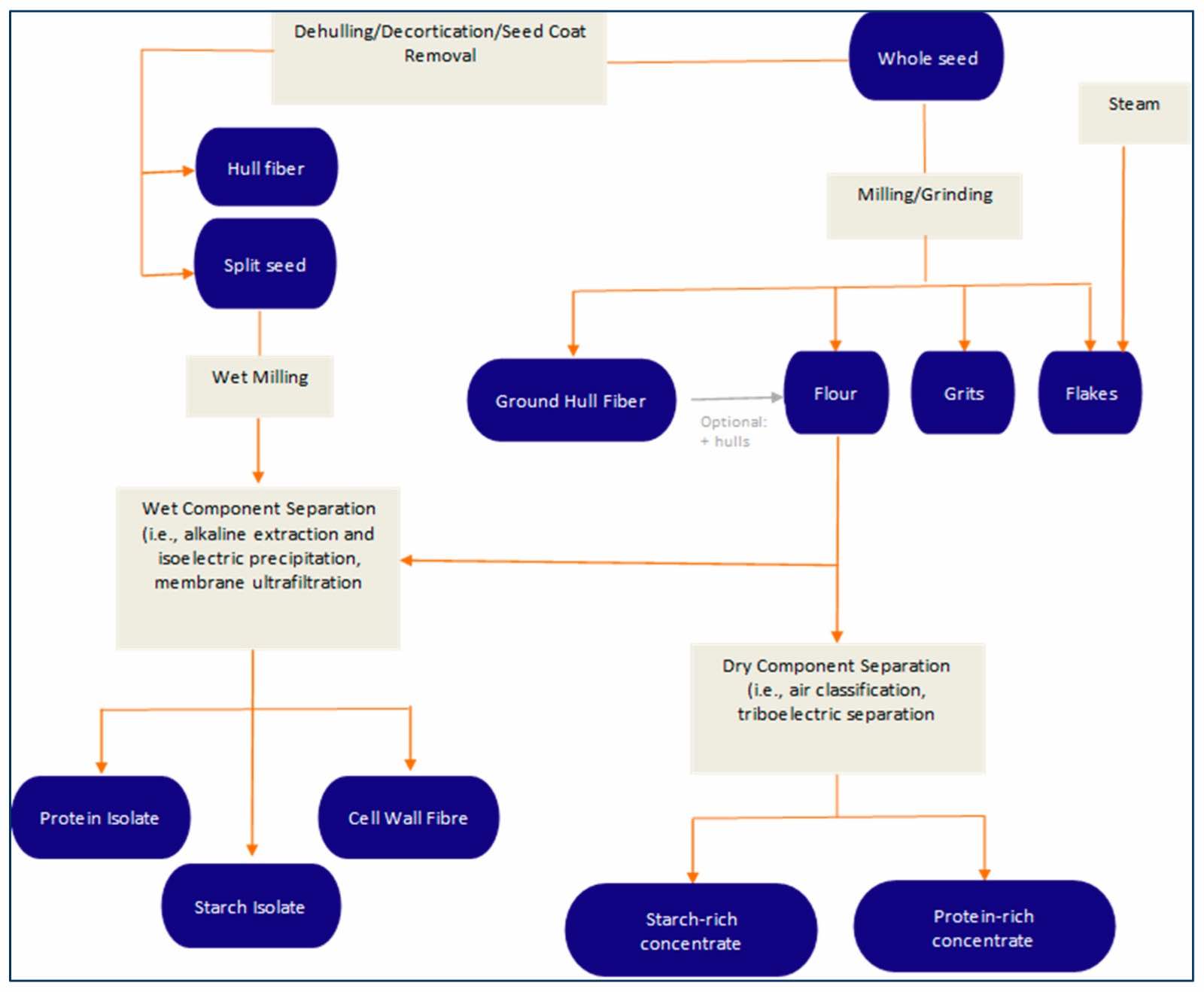
The dry fractionation (dry fractionation) involves seed dehulling and grinding, followed by air classification, which separates protein-rich particles from starch-rich ones. This is the path leading to concentrates: it requires neither water nor chemical reagents, it complies with the requirements of ISO/TS 19657:2017 technical specification to declare the ingredient as natural in business-to-business relations (Dongo, 2019; ISO, 2017) and proves more sustainable due to lower water and energy consumption (Asen et al., 2023). It also avoids aggressive conditions that can partially denature proteins (Mancabelli et al., 2025).
The wet fractionation (wet fractionation), used for isolates, adds water to better separate the fractions. The most widespread method is alkaline solubilization, at pH 8-11, followed by acidification at pH 3-6 up to the isoelectric point, at which the positive and negative charges of the proteins balance and the proteins precipitate. It guarantees purity and high yields but the use of alkalis, acids, salt and temperatures can reduce the functionality of the proteins, in the face of high consumption of water and energy (Asen et al., 2023; Mancabelli et al., 2025).
There are also more delicate (mild) wet techniques. THE'ultrafiltration separates proteins based on molecular weight with membranes with pores of 0.001-0.1 micrometers – without heat or chemical reagents – and maintains their native structure; diafiltration, with the addition of water, improves its efficiency. There micellar precipitation extracts proteins in saline solution at neutral pH and recovers them by dilution in cold water, in the form of micelles. THE'salt extraction with dialysis it exploits the solubilization and subsequent concentration of proteins. Extraction in water alone preserves the structure of the legume well, but its yields are still low. Finally, enzymatic extraction uses Cellulases and Proteases to degrade cell walls and release proteins, with minimal chemical residues but high operating costs (Asen et al., 2023).
In all cases the final ingredient is dried in powder form, by freeze-drying or spray-drying, so as to facilitate its preservation and transport.
The technological functions of pea and cannellini bean
Yellow pea e cannellini bean (white beans) are, after soy, among the most studied and used species to produce protein ingredients. The interest derives from their technological properties and the less allergenicity: soy is in fact among the substances that cause allergies or intolerances, to be highlighted on the label (EU regulation 1169/2011, Annex II), while pea and bean are not included (Asen et al., 2023; Mancabelli et al., 2025; Zambe Azevedo et al., 2025). Furthermore, genetically modified varieties of these legumes are almost absent: in the European Union the only genetically modified crop grown for commercial purposes is MON 810 maize (Bertho et al., 2020) and at a global level no genetically modified peas are authorized, while for the common bean there is only one event, approved in Brazil (ISAAA, n.d.).
Proteins technological properties they can be improved with physical (thermal treatment, ultrasound, high hydrostatic pressure, hydrodynamic cavitation, cold plasma), chemical (glycation, phosphorylation, conjugation) and biological (fermentation, germination, enzymatic hydrolysis) pre-treatments. The most relevant are described below.
The solubility depends on the charge and surface hydrophobicity of the proteins and varies with pH. Cannellini bean concentrate – less hydrophobic than soy and pea proteins – has minimum solubility around pH 3, its isoelectric point, and high values at neutral and alkaline pH; salt and sugars such as glucose further modulate their behavior (Zambe Azevedo et al., 2025).
The water holding capacity (water-holding capacity) and oil retention (oil-holding capacity) express the quantity of water and oil that 1 g of protein retains and influence consistency, mouthfeel and aroma retention. Cannellino bean concentrate excels in bind the oil, while pea and soy proteins retain water better (Zambe Azevedo et al., 2025).
The foaming capacity indicates the speed with which the proteins form a film around the air bubbles, the stability and duration of the foam over time; both impact products such as ice creams and meringues. At neutral pH, the cannellino bean concentrate surpassed both the soy isolate and the pea concentrate in foaming capacity, and retained approximately 80% of the foam after 60 minutes, compared to approximately 17% for the pea. In an acidic environment, at pH 4, soy and pea instead formed more foam (Zambe Azevedo et al., 2025).
Proteins emulsifying properties – essential in vegetable drinks, yogurt, creams and soups – consist in the ability to reduce tension at the water-oil interface and stabilize the emulsion. Cannellino bean concentrate forms stable emulsions (Zambe Azevedo et al., 2025). In pea proteins, functionality can be reduced by denaturation due to the more severe processing conditions, typical of isolate production (Mancabelli et al., 2025).
The gelling determines the consistency of many foods and is measured by gel strength and by the minimum gelation concentration, i.e. the lowest protein concentration capable of forming a stable gel. The white bean concentrate formed a weak gel at 16% and a solid gel at 20%, with structures more rigid than those of soy and pea, useful in systems requiring mechanical resistance (Zambe Azevedo et al., 2025).
To improve these functions are intervened on the pH, on the conjugation with polysaccharides such as guar gum or with physical treatments such as dry heat and ultrasound, which modify the conformation of the proteins and the exposure of the hydrophilic and hydrophobic regions. Research, long focused on isolated people, is now also aimed at pea concentrates obtained by air classification (Sharifi et al., 2026).
Nutritional value
The protein quality depends on the content of essential amino acids and digestibility, measured using the indices PDCAAS (Protein Digestibility-Corrected Amino Acid Score) and DIAAS (Digestible Indispensable Amino Acid Score). Pea proteins cover the adult requirement for essential amino acids indicated by FAO, the World Health Organization and the United Nations University, with methionine and cysteine as limiting amino acids, and in animal model studies have shown an ileal digestibility comparable to that of soy (Asen et al., 2023). Pairing with cereals, as in legume pasta or in baked products, completes the amino acid profile.
I anti-nutritional factors, such as protease inhibitors, can on the other hand limit the nutritional value of legumes. Pre-treatments and production operations, starting from decortication, reduce its content or activity, and an adequate formulation must take this into account.
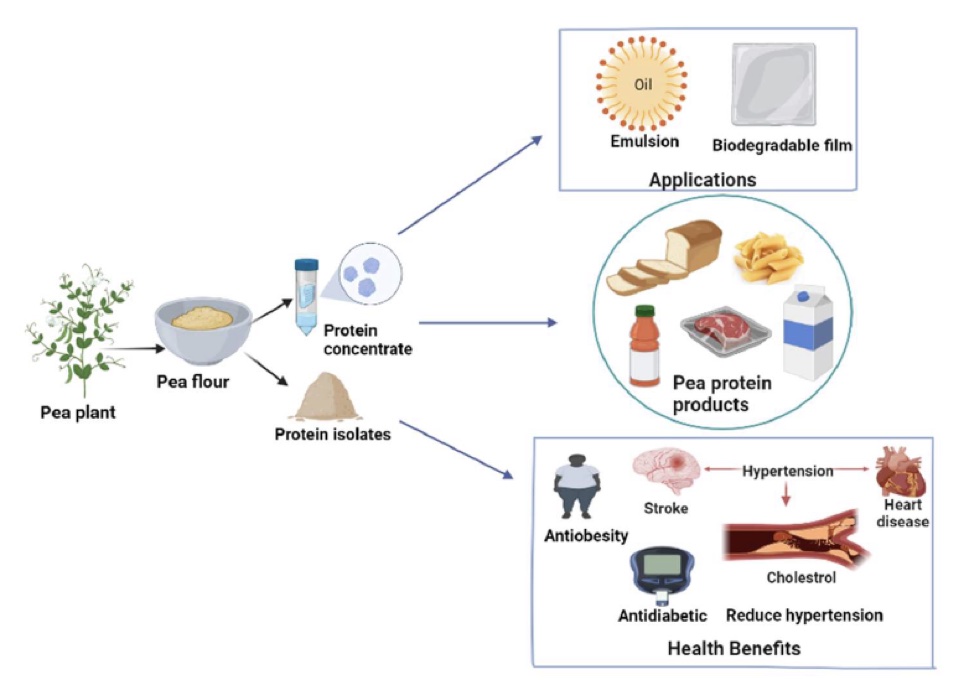
Pea proteins are also studied for the bioactive peptides which are formed with controlled hydrolysis or during digestion and through interaction with the gut microbiota (Wang et al., 2022):
- literature reviews report antioxidant, antihypertensive and hypocholesterolaemic properties, a possible role in reducing cardiovascular disease and diabetes risk, in satiety and in postprandial glycaemic control (Shanthakumar et al., 2022);
- a recent study from the University of Parma observed in vitro that pea proteins, particularly when used as concentrates, selectively stimulate intestinal bacteria such as Bacteroides thetaiotaomicron and various species of Bifidobacterium (Mancabelli et al., 2025). Furthermore, this is preliminary evidence, to be explored further also in the interaction with the other foods in the meal, not yet the subject of studies notified to EFSA in view of the authorization of specific health claims pursuant to Regulation (EC) no. 1924/2006.
Uses in food
Protein concentrates and isolates can replace, in whole or in part, conventional ingredients such as flours and meats, or improve nutritional profiles and functional properties of processed products. Applications include pasta, bread and baked goods, also gluten-free, extruded snacks (e.g. rice cakes) and breakfast cereals, protein and sports beverages, meat products and plant-based meat and dairy analogues (Shanthakumar et al., 2022).
Pea proteins are also used in microencapsulation of bioactive ingredients, such as fatty acid omega-3 DHA and riboflavin intended for fortification of foods and beverages, and in the production of edible films biodegradable and biocompatible (Shanthakumar et al., 2022).
Novel food status
Before placing a protein ingredient on the market, the operator must check whether it falls within the definition of novel food (EU regulation 2015/2283, art. 4). Novel foods are those not used to a significant extent for human consumption in the European Union before 15 May 1997 and belonging to at least one of the established categories. For legume protein ingredients, the following are particularly important: foods with a new or deliberately modified molecular structure; those consisting of, isolated or produced from plants, unless they have 'a history of safe use as food in the Union'; those resulting from a new production process that involves significant changes in the composition or structure, such as to affect the nutritional value, metabolism or content of undesirable substances (EU regulation 2015/2283, art. 3.2, letter 'a').
The European novel food status catalog reports the outcome of three consultations on pea (Pisum sativum) ingredients, all concluded with the status of 'not novel'. In 2020, the Irish Food Safety Authority excluded the novelty of pea and soy protein hydrolysates, obtained by mild acid hydrolysis from the isolates, due to a history of consumption in the Union prior to 1997 and a consolidated processing technique, which does not significantly alter the amino acid composition.
In 2024 the Polish Health Inspectorate ruled on a pea protein concentrate high purity (75-85% on dry matter basis), obtained by grinding, purification, concentration and membrane filtration: pea concentrates were already consumed before 1997, in sports nutrition and in vegetarian and vegan products, and scientific literature documents their production at least from 1975. In 2026 the Ministry of Health evaluated a protein concentrate from pea sprouts, with approximately 60% protein and 20% fiber, intended solely for food supplements and obtained with methods ofestablished processing, which do not create new molecular structures or significantly modify composition and nutritional value.
These results do not exclude that other isolates or concentrates – in terms of degree of purity, nutritional characteristics or process – may be qualified as novel foods. For concentrates obtained with conventional processes they nevertheless offer a useful reference for case-by-case evaluation.
Conclusions
Legume protein concentrates, in particular yellow peas and cannellini beans, offer the food industry a concrete alternative to soy isolates. These are ingredients with a more favorable allergenic profile, obtainable with more delicate processes and with lower water and energy consumption, on supply chains that can take root in Europe. If the foreseen conditions are met, these advantages can also be enhanced with environmental claims (Dongo & Della Penna, 2026).
The greater purity of isolates, conversely, does not entail superior quality. An isolate may simply serve to increase the protein content of a food with smaller doses. A concentrate, depending on how it is produced, can instead improve the technological and functional properties of the product thanks to fibre and other seed constituents, limit the use of additives and contribute to its overall nutritional value. The combination of legume flours and protein concentrates thus paves the way for formulations with natural ingredients and simpler ingredient lists.
Companies that develop and/or market products based on legume protein concentrates can avail themselves of the consultation of FARE for verifying the status of novel food and for the strategic planning of commercial information compliance, from environmental and sustainability assertions on supply chains, processes and products to nutrition & health claims, also with support for the development of governance corporate and operational procedures.
Dario Dongo and Andrea Adelmo Della Penna
Credit cover: MartinoRossi S.p.A., Nativa Pro 60 white pea
References
European Union regulatory sources
Regulation (EC) No 1924/2006 of the European Parliament and of the Council of 20 December 2006 on nutrition and health claims made on foods. Consolidated text: 13/12/2014. http://data.europa.eu/eli/reg/2006/1924/2014-12-13
Regulation (EU) No 1169/2011 of the European Parliament and of the Council of 25 October 2011 on the provision of food information to consumers. Consolidated text: 01/04/2025. http://data.europa.eu/eli/reg/2011/1169/2025-04-01
Regulation (EU) 2015/2283 of the European Parliament and of the Council of 25 November 2015 on novel foods, amending Regulation (EU) No 1169/2011 of the European Parliament and of the Council and repealing Regulation (EC) No 258/97 of the European Parliament and of the Council and Commission Regulation (EC) No 1852/2001. Consolidated text: 27/03/2021. http://data.europa.eu/eli/reg/2015/2283/2021-03-27
Institutional publications
European Commission (2020, 11 June). Pea (Pisum sativum) Protein Hydrolysate and Soy (Glycine max) Protein Hydrolysate. Consultation process on novel food status. Ref. Ares(2020)3024498. https://food.ec.europa.eu/document/download/c30e6119-4b20-4321-ad64-da062146684a_en?filename=novel-food_consult-status_pph-sph.pdf
European Commission (2024, 12 March). High purity pea (Pisum sativum) protein concentrate. Consultation process on novel food status. https://food.ec.europa.eu/document/download/65a2f4ad-1776-4b08-bf18-8517ed3c40b7_en?filename=novel-food_consult-status_high-purity-pea.pdf
European Commission (2026, 9 February). Vegetable protein concentrate from Pisum sativum sprouts (PISUMGERM). Consultation process on novel food status. https://food.ec.europa.eu/document/download/959ce7c4-4b01-4e7d-9f60-9e4122bd75f6_en?filename=novel-food_consult-status_pisumgerm.pdf
ISAAA (N/A). GM Approval Database. International Service for the Acquisition of Agri-biotech Applications. Accessed 13 November 2026. https://www.isaaa.org/gmapprovaldatabase/
ISO (2017). ISO/TS 19657:2017. Definitions and technical criteria for food ingredients to be considered as natural. International Organization for Standardization. https://www.iso.org/standard/65717.html
Scientific literature
Asen, N.D., Aluko, R.E., Martynenko, A., Utioh, A., & Bhowmik, P. (2023). Yellow field pea protein (Pisum sativum L.): Extraction technologies, functionalities, and applications. Foods, 12(21), 3978. https://doi.org/10.3390/foods12213978
Bertho, L., Schmidt, K., Schmidtke, J., Brants, I., Fernández Cantón, R., Novillo, C., & Head, G. (2020). Results from ten years of post-market environmental monitoring of genetically modified MON 810 maize in the European Union. PLOS ONE, 15(4), e0217272. https://doi.org/10.1371/journal.pone.0217272
Mancabelli, L., Milani, C., Longhi, G., Lugli, G.A., Tarracchini, C., Turroni, F., & Ventura, M. (2025). Disclosing the effects of pea-derived proteins on the human gut microbiota. Microbiome Research Reports, 4(4), 42. https://doi.org/10.20517/mrr.2025.77
Shanthakumar, P., Klepacka, J., Bains, A., Chawla, P., Dhull, S.B., & Najda, A. (2022). The current situation of pea protein and its application in the food industry. Molecules, 27(16), 5354. https://doi.org/10.3390/molecules27165354
Sharifi, A., Ahmadi, F., Ng, K., Maharjan, P., Walker, C., & Suleria, H. (2026). Comparative impacts of physical and chemical modifications on pea protein concentrate: Effects on physicochemical properties. Food Research International, 235, 119198. https://doi.org/10.1016/j.foodres.2026.119198
Wang, J., Kadyan, S., Ukhanov, V., Cheng, J., Nagpal, R., & Cui, L. (2022). Recent advances in the health benefits of pea protein (Pisum sativum): Bioactive peptides and the interaction with the gut microbiome. Current Opinion in Food Science, 48, 100944. https://doi.org/10.1016/j.cofs.2022.100944
Zambe Azevedo, P., Granato Costa, J.E., da Silva Matos, J., Rodrigues de Souza, B., Rodrigues, S., Fernandes, F.A.N., Silva, V.M., Teixeira Ribeiro Vidigal, M.C., Stringheta, P.C., Martins, E., & Campelo, P.H. (2025). Techno-functionalities of white bean protein concentrate: A comparative study with soy and pea proteins. Macromol, 5(1), 3. https://doi.org/10.3390/macromol5010003
Further insights
Dongo, D. (2019, January 11). Natural ingredients, the ABC according to ISO standards. FoodTimes. https://www.foodtimes.eu/it/consumatori-e-salute/ingredienti-naturali-labc-a-norma-iso/
Dongo, D. (2026a, April 17). Italian peas: human health and soil health. Great Italian Food Trade. https://www.greatitalianfoodtrade.it/legumi/piselli-italiani-proprieta-nutrizionali-sostenibilita/
Dongo, D. (2026b, September 15). Beans, the most sold legume in preserves. Great Italian Food Trade. https://www.greatitalianfoodtrade.it/legumi/fagioli/
Dongo, D., & Della Penna, A.A. (2023a, August 30). Microalgae, protein digestibility. The #ProFuture study. Food Times. https://www.foodtimes.eu/it/ricerca/microalghe-digeribilita-delle-proteine-lo-studio-profuture/
Dongo, D., & Della Penna, A.A. (2023b, November 21). Novel foods, the state of the art in the European Union. FoodTimes. https://www.foodtimes.eu/it/ricerca/novel-foods-lo-stato-dellarte-in-unione-europea/
Dongo, D., & Della Penna, A.A. (2026, May 15). Environmental claims and unfair commercial practices. Food Times. https://www.foodtimes.eu/it/consumatori-e-salute/direttiva-asserzioni-ambientali-pratiche-sleali/
Strinati, M. (2025, October 1). Eurobarometer 2025 on food safety. Food Times. https://www.foodtimes.eu/it/consumatori-e-salute/eurobarometro-2025-sicurezza-alimentare/

Dario Dongo, lawyer and journalist, PhD in international food law, founder of WIISE (FARE - GIFT – Food Times) and Égalité.

Graduated in Food Technology and Biotechnology, qualified food technologist, he follows the research and development area. With particular regard to European research projects (in Horizon 2020, PRIMA) where the FARE division of WIISE S.r.l. benefit society participates.


