
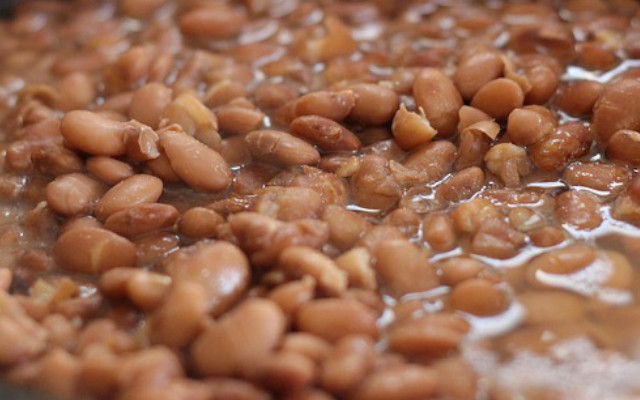
Rich in protein and fiber, tasty, economical and filling, beans are the leading product in the Italian vegetable preserves sector, net of tomato derivatives: in Italy, an average of about three kg per capita is consumed annually. We compared 69, between cannellini and borlotti, from industrial brands to distributor brands, from discount to organic.
A preview of the comparison results: preserves can contain salt quantities that vary by more than one hundred times; additives are present in one product out of three; three major operators present the unit price including the weight of the brine; the origin of the legume is indicated only when Italian. Unfortunately, inaccurate indications about the possible presence of food allergens are also present.
The bean market in numbers
The Italian legume preserves sector closed 2025 with a turnover of over 1.2 billion euros, up 3% on 2024. Exports are worth about 700 million, 58% of the total, with an increase of about 4% both in value and volume.
In the domestic market, retail sales — hypermarkets, supermarkets, self-service and discount — exceed 177 thousand tons for a value of about 420 million euros. The associated companies generate over 60% of the sector's turnover and about 70% of exports (Anicav, February 9, 2026).
Excellent source of plant proteins
All examined bean references exceed the 20% threshold of the energy provided by proteins, and can therefore be presented as products ‘high in protein’. The protein content – generally excellent in the legume, as we have seen, ranges from 4 to 8.4 grams per 100 grams, but the energy (kcal/100 g) varies in parallel, and the ratio between the two (calculated by us) remains above the threshold in all references examined.
Some companies already declare it on the label. Coop writes ‘naturally rich in proteins and high in fiber’ on cannellini and borlotti in brick packs; the Vivi Verde line reports ‘high in protein’ on Italian organic cannellini; Bonduelle uses ‘rich in protein’; Valfrutta talks about ‘high protein content’ and defines its borlotti as a ‘valid alternative to meat’; Sarchio uses ‘rich in protein’ on 360 gram borlotti.
We asked Dario Dongo, lawyer and journalist, founder of GIFT and FARE, to explain the conditions of use of these indications.
‘The nutritional claims ‘source of protein’ and ‘high protein content’ have specific usage conditions: the first requires that at least 12% of the energy value of the food comes from proteins, the second at least 20% (Reg. EC 1924/06, annex). The most often misunderstood point is another, and it is decisive: the nutritional claims refer to foods ready to be consumed according to the manufacturer’s instructions (Reg. EC 1924/06, art. 5.3), therefore to the product as it arrives on the plate, not to thedry raw material from which it derives. In canned beans the higher threshold is widely exceeded, because the brine dilutes both energy and proteins and leaves the ratio between the two substantially unchanged. This is an opportunity that operators can enhance, subject to analytical verification on representative samples and in compliance with applicable tolerances’.
One recipe for three
The ideal ingredient list of canned beans consists of three items: beans, water and salt.
Regarding the origin of legumes, beans are Italian in 20 cases out of 69. Among the six geographical indications, there are only two: the borlotti from Piedmont and the Lamon from Veneto, on three references.
Almost all of the products examined use rehydrated beans, a minimal part those processed from fresh and an equally tiny fraction cooks the legumes by steaming, instead of immersion.
In only two cases we found other ingredients: the sugar in Esselunga's brick-pack beans and the lemon juice in Alce Nero's organic borlotti, serving a function elsewhere entrusted to an additive.
Salt, the widest variable
In canned foods it is always appropriate to check the amount of Salt added. Beans are no exception: among the 69 products compared, the amount of salt per 100 grams varies more than a hundredfold, from 0.02 to 1.10 grams.
With the same brand and plant, borlotti are almost always saltier than cannellini, as evident in the tables below.
Additives
More than one third (25) of the 69 products examined contain one or more of the following four additives:
– E 300, ascorbic acid. This additive acts as an antioxidant and prevents browning of vegetables. It naturally occurs in foods and is known as vitamin C, which is synthetically produced industrially;
– E 330, citric acid. Another antioxidant, acidity regulator, often used together with E 300. This natural acid is found in many fruits (citrus primarily), but in industrial production it is obtained from fermentation of a fungus (Aspergillus niger);
– E 509, calcium chloride. Preserves the integrity of canned vegetables, in this case beans;
– E 385, calcium disodium EDTA, a chelating agent that binds metals, preserves color and clarity of the preserving liquid.
Drained weight and actual price
For foods presented in a preserving liquid, the drained net weight must be indicated On the label (EU Reg. 1169/2011, Annex IX, point 5). This information is essential to understand how many beans are being purchased. The formats are standardized, as shown in the following tables.
The Drained net weight is the parameter on which the price per unit of measure (€/kg) must be indicated (Consumer Code, article 15, paragraph 3). It seems obvious, as the value of the beans is different from that of the preserving liquid, although the latter can be used in cooking. However, three major operators deviate from this rule.
For all branded canned beans Conad (except organic), Eurospin e D'Amico the price is in fact referred to as the 'net weight', that is, net of the tare (container) but including the preserving liquid. As a result, the displayed prices appear lower than the actual price, with a difference that can exceed 1 euro/kg. An approach that does not seem correct towards consumers and competitors, whose products thus appear more expensive per unit of measure.
Canned beans from branded industry
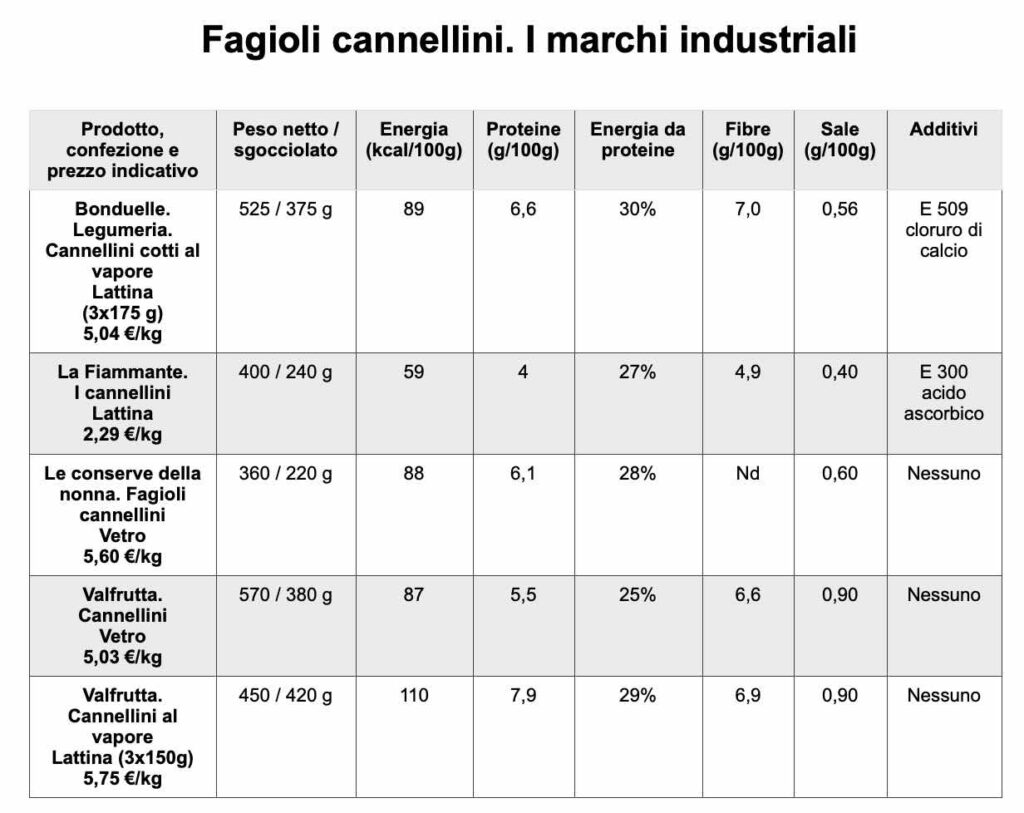
Among the 5 canned cannellini beans from the branded industry, the highest percentage of energy from proteins belongs to the two cooked products of value from Bonduelle and Valfrutta.
The latter brand adds the highest amount of salt: 0.90%.
Bonduelle and La Fiammante each add an additive. No one specifies the origin of the legumes.
Borlotti beans from industrial brands
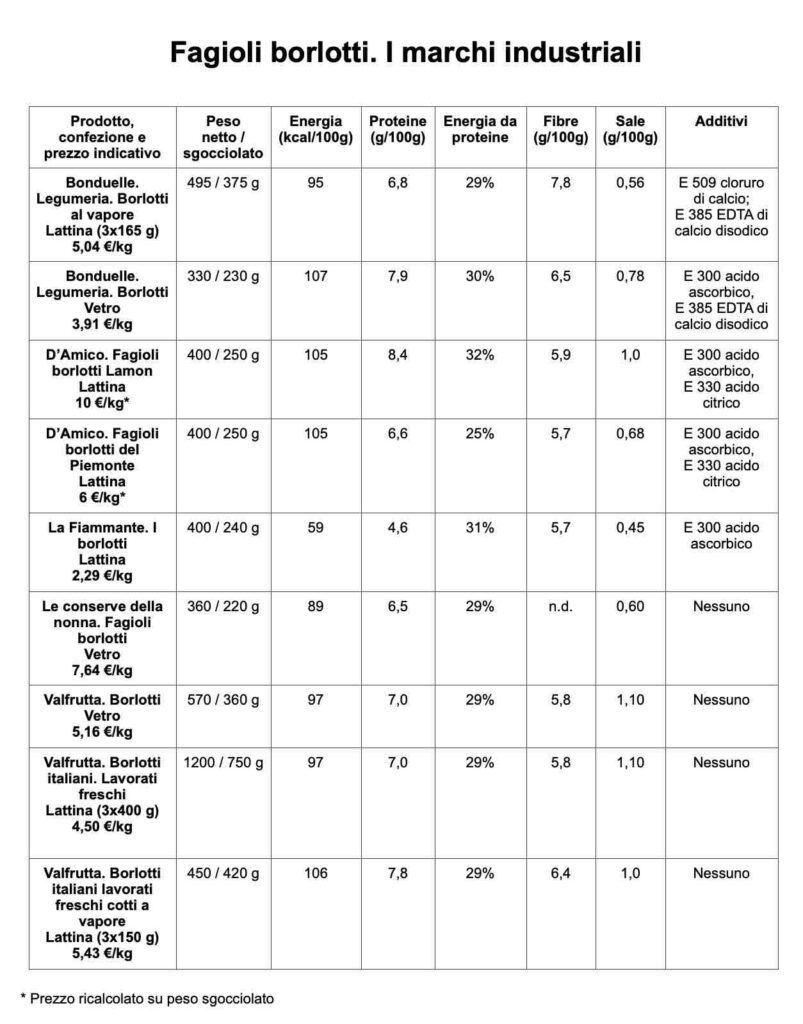
In the largest selection of 9 canned borlotti beans from the branded industry, four references contain Italian beans: two from Valfrutta and two from D'Amico, which offers beans from Piedmont and Lamon beans (Veneto). The latter product stands out with 32% energy from proteins.
D'Amico distinguishes itself from the rest of the industry brands by omissions and errors in consumer communication. Sul suo sito ecommerce l’operatore omette sia il prezzo per unità di misura (€/kg), sia il peso sgocciolato, due informazioni obbligatorie nell’ecommerce as in the physical sales point, which we have nonetheless recovered and entered in the table. Furthermore, on its ecommerce site, it reports the price per net weight and not drained net weight: consequently, its Lamon Borlotti Beans in the 400 g (net) can cost 10 €/kg, instead of the indicated 6.25 €/kg.
Bonduelle, D’Amico and La Fiammante are the three brands that use additives. The level of Salt reaches the maximum of the entire sample with 1.10 grams per hundred in the two Valfrutta borlotti.
Cannellini beans from distributor brand
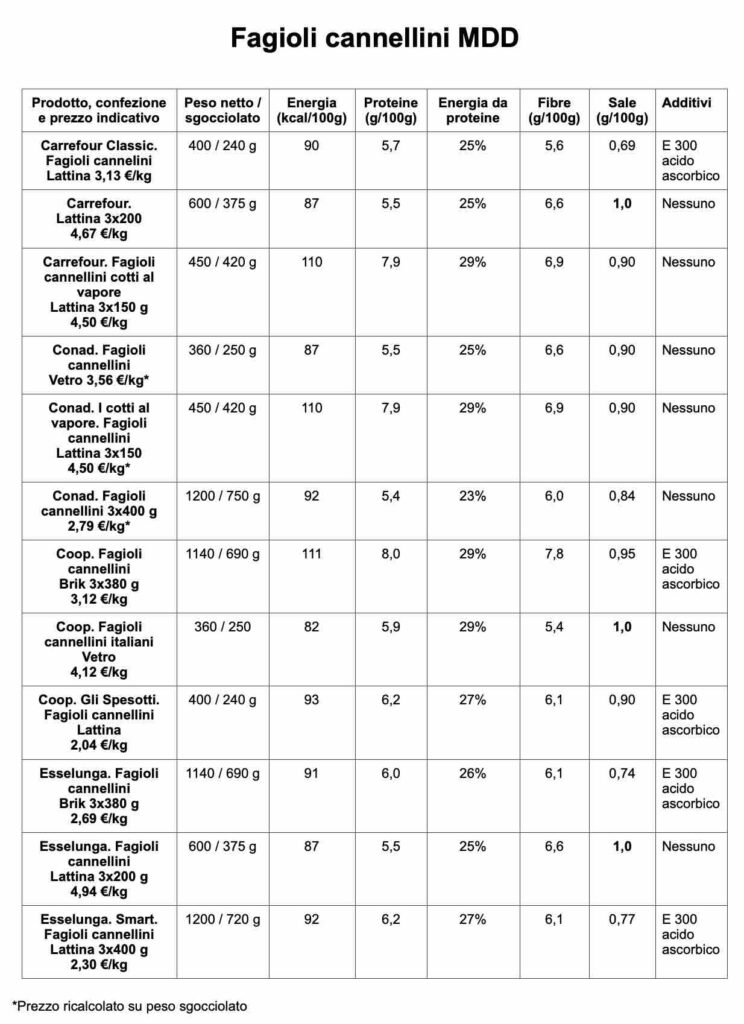
Among the 12 canned cannellini of the distributor brand, only Coop offers Italian legumes in the 250 gram drained jar.
Protein energy ranges from 23 to 29%. Salt reaches the maximum point of 1% three times (one can each from Carrefour and Esselunga, and Italian cannellini in Coop glass jars). The minimum level remains at 0.69%.
Only two references are steam cooked: Carrefour and Conad. For the latter, it is worth noting that the listed price has been recalculated by us on the net drained weight, as required by regulation.
Additives appear in one of the two Carrefour cans and in paper (Brik) packages as well as in the low-cost lines of Coop (Spesotti) and Esselunga (Smart).
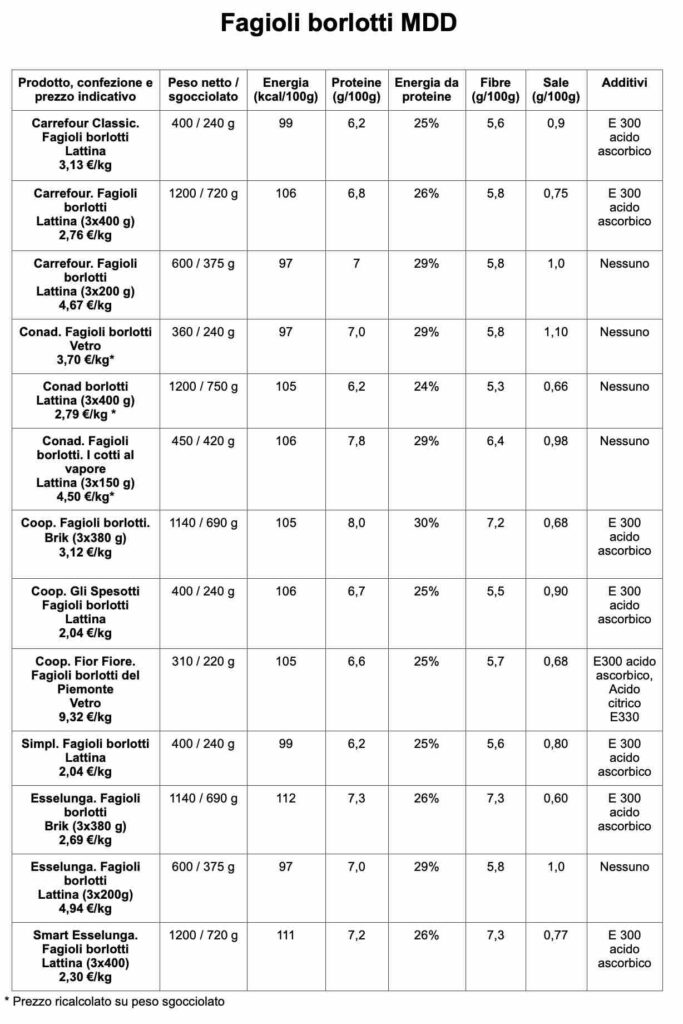
MDD borlotti beans
In only one of the 13 products examined theorigin of the legume is Italian. These are the Piedmont borlotti in glass jars of the Fior Fiore Coop brand. Additives are added in this and seven other preserves.
The maximum peak of Salt is in the Conad glass borlotti (1.10 g per 100 grams). This brand is also the only one with a steam-cooked borlotti preserve and with the unit price recalculated by us on the net drained weight.
Protein energy reaches 30% in Coop borlotti in Brik and marks the minimum (24%) in one of Conad's canned borlotti.
Discount preserves
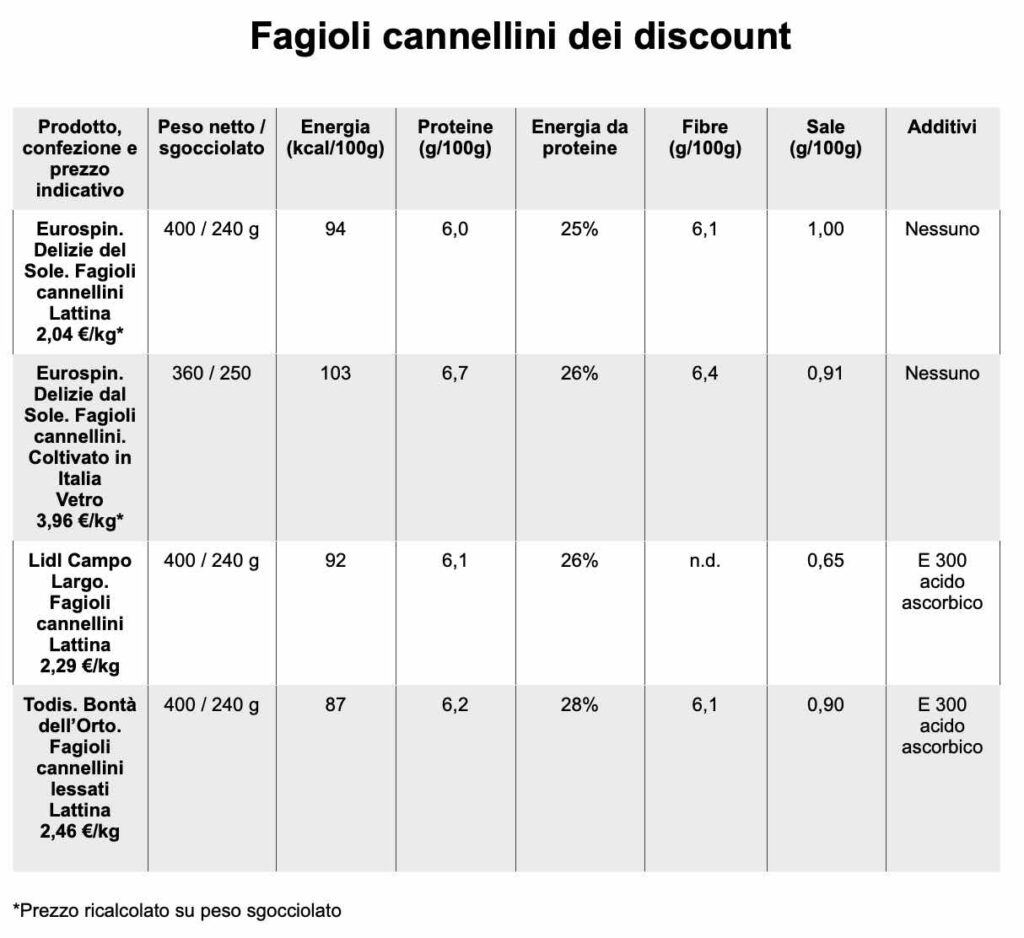
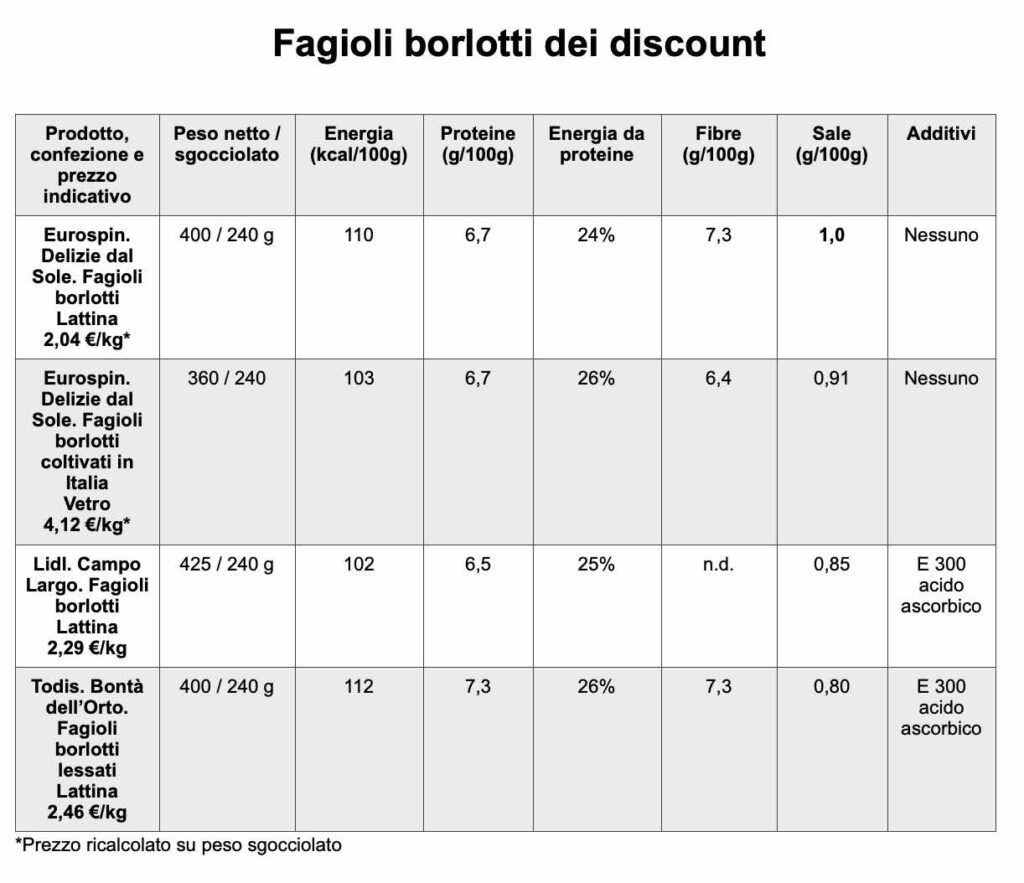
Of the three discount brands considered, only Lidl and Todis add additives in both cannellini and borlotti.
In both types of canned legumes, the maximum salt dose is added by Eurospin (1%).
The top protein energy is concentrated in Todis cannellini (28%) and Todis and Eurospin borlotti (16%)
Eurospin stands out for two elements: it is the only discount to offer beans ‘cultivated in Italy’ and the only one to follow the bad example of Conad in indicating the price per kg on net weight (including water) instead of the drained weight. Consequently, the real price per sales unit is higher than the one shown.
The organic oasis, cannellini beans
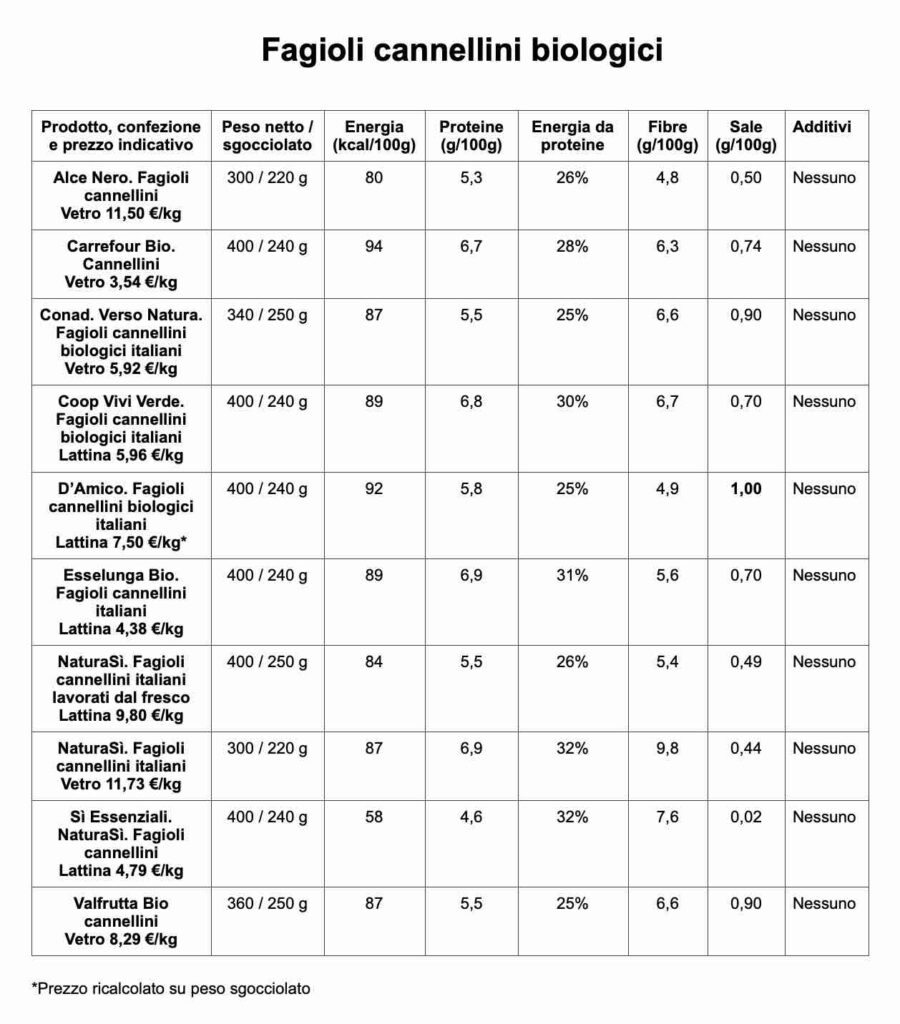
Of the ten organic canned cannellini beans, six are Italian. None use additives and in one case (NaturaSì) the legume is processed fresh.
The Salt reaches the maximum (1%) in the D’Amico can (which also omits information here and misprices), the minimum (0.02) in the Sì Essenziali can, the line created by NaturaSì in 2023 to make bio products consistent with the brand values.
The highest protein energy (32%) belongs to two of the three NaturaSì references.
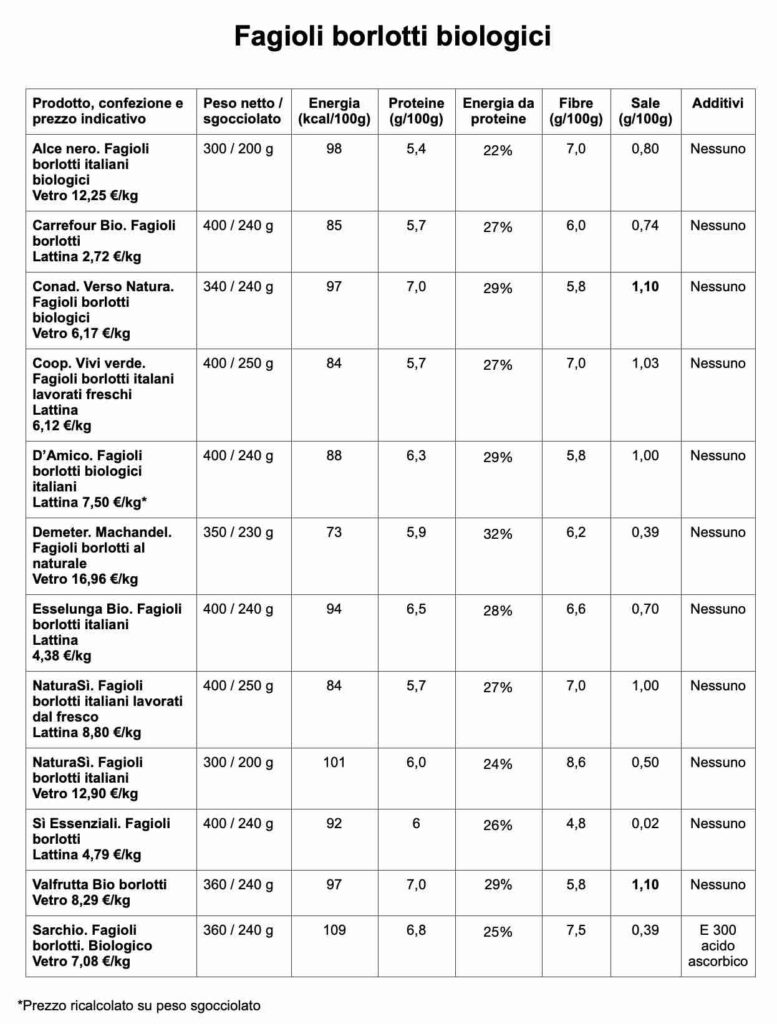
Organic borlotti beans
Exactly half of the 12 organic canned borlotti beans are Italian and in two cases (Coop and NaturaSì) processed fresh.
The Salt reaches the maximum of the entire sample at 69 products in the Conad Verso Natura borlotti (this time with the price correctly indicated on the drained weight) and in those of Valfrutta: 1.10 grams per 100 grams. The minimum level (0.02) is confirmed in the Sì Essenziali line by NaturaSì.
The highest protein energy level belongs to the Dutch canned product with the biodynamic brand Demeter: producer's name? 32% (and only 0.39% salt).
Sarchio is the only brand that adds ascorbic acid, while Alce Nero uses the 'natural' version, lemon juice.
What to look for, in order
In summary, the analysis we carried out reflects the basic information easily comparable at the time of purchase, namely:
- the proteins, which in this category are a common strength: every reference of only beans examined exceeds the threshold of‘high content’;
- The salt per 100 grams, which is the most relevant difference between one product and another and must be compared between references of the same variety, because borlotti are systematically saltier than cannellini;
- the ingredient list, where three items are the standard and two express the height of sobriety;
- The drained weight, which is the denominator of the real price and must be compared with the calculation basis exposed by the sign;
- theorigin of raw material, which is shown on ‘100% Made in Italy’ products;
- The container, to be chosen for what it is: transparent and reusable glass, light and recyclable aluminum.
Allergens, inaccurate indications
Finally worthy of note, an observation on the superficiality with which the possible presence of food allergens is reported on the label. Some examples:
- ‘Le conserve della nonna’ (Fini group) states on the label of cannellini beans that the product is made ‘in a plant that uses celery, milk, soy, nuts, fish and shellfish’;
- Bonduelle warns that the preserve ‘May contain soy, cereals containing gluten’;
- Eurospin, on canned cannellini, instead warns that the food ‘May contain traces of cereals containing gluten, eggs, fish, milk, nuts, celery, mustard, sulfites’. The more the merrier.
‘Precautionary labeling on the possible presence of allergens due to cross contamination must above all be specific’, explains lawyer Dario Dongo. ‘It is not possible to designate individual allergens with the name of the category ‘cereals containing gluten’according to Regulation (EU) No. 1169/11, Annex VII, Part B. And it is not permissible to refer to the operating conditions of establishment, since the information must be related to the product and it is the operator's responsibility to carefully perform an effective risk analysis of possible accidental contaminations’.
Conclusions
Canned beans are a solid product from every point of view: only three basic ingredients, no preservatives in any reference, a mature technology, and a nutritional profile that in all examined versions allows the indication ‘high in protein’, in most cases also that ‘high fiber content’. They are, for price and practicality, one of the most accessible ways to bring plant proteins to the table.
Differences between one label and another exist and are measurable. They lie in the salt, which varies by over a hundred times; in the drained weight, which determines how much you really pay; in the origin, which remains the least available data on the best-selling references; and in organic, which in this product category is also available at prices aligned with conventional ones and at the same time offers a series of advantages, for ecosystems and all their protagonists.
Marta Strinati
References
European Union regulatory sources
Regulation (EC) No 1924/2006 of the European Parliament and of the Council of 20 December 2006 on nutrition and health claims made on foods. Consolidated text: 13/12/2014. ELI: http://data.europa.eu/eli/reg/2006/1924/2014-12-13
Regulation (EU) No 1169/2011 of the European Parliament and of the Council of 25 October 2011 on the provision of food information to consumers. Consolidated text: 01/04/2025. ELI: http://data.europa.eu/eli/reg/2011/1169/2025-04-01
Commission Regulation (EU) 2024/3190 of 19 December 2024 on the use of bisphenol A (BPA) and other bisphenols and bisphenol derivatives with harmonised classification for specific hazardous properties in certain materials and articles intended to come into contact with food, amending Regulation (EU) No 10/2011 and repealing Regulation (EU) 2018/213. OJ L, 2024/3190, 31.12.2024. ELI: http://data.europa.eu/eli/reg/2024/3190/oj
Institutional publications and databases
ANICAV — National Association of Vegetables Food Preserving Industries. (2026, 10 February). International Day of Pulses [press release]. https://anicav.it/wp-content/uploads/2026/02/CS-giornata-internazionale-legumi-2026.pdf
ANICAV. The products — Pulses [production process and market data]. https://anicav.it/i-prodotti/legumi/
Assovetro. 2025 data on Italian production of glass packaging, taken from Alimentando, 25 March 2026. https://www.alimentando.info/packaging-in-vetro-nel-2025-crescono-produzione-4-ed-export-8/
EFSA — European Food Safety Authority. Call for data for the re-evaluation of Calcium disodium EDTA (E 385) as food additive. https://www.efsa.europa.eu/en/call/call-data-re-evaluation-calcium-disodium-edta-e-385-food-additive
Eurostat. Comext — EU trade since 1988 by CN8, dataset DS-045409, items CN 0713 33 and CN 2005 51, Italy, 2024-2025. https://ec.europa.eu/eurostat/api/comext/dissemination
RICREA — National Consortium for Recycling and Recovery of Steel Packaging. (2024, 12 April). Record steel packaging recycling: Italy reaches 87.8%. https://www.consorzioricrea.org/2024/04/12/riciclo-degli-imballaggi-in-acciaio-da-record-litalia-raggiunge-l878-largamente-superato-lobiettivo-europeo-per-il-2030/
Labels and product sheets consulted
Alce Nero. Organic boiled cannellini, borlotti and black-eyed beans. https://www.alcenero.com/products/fagioli-borlotti-lessati-biologici-ll846
Bioitalia. Boiled borlotti beans. https://www.bioitalia.it/it/legumi-lessi-bio/86-fagioli-borlotti-lessi.html
Bonduelle Italia. The beans. https://www.bonduelle.it/prodotti/p/borlotti-in-vetro/03083680020398
Conad. Branded products, cannellini and borlotti beans, base lines and Verso Natura Bio. https://spesaonline.conad.it/p/conad-verso-natura-fagioli-borlotti-biologici-340-g–401783
Coop Italia. The Coop product, preserved vegetables and legumes natural, Coop lines, Vivi Verde, Fior Fiore and Gli Spesotti. https://www.coop.it/il-prodotto-coop/vivi-verde/…
D’Amico. Legumes and cereals. https://www.damico.it/en/7-legumes-and-cereals
Il Nutrimento. Cooked legumes natural. https://shop.probios.it/prodotti/legumi-e-semi-oleagi/legumi-cotti/fagioli-borlotti-al-naturale-400g.html
Open Food Facts. Product sheets of the Esselunga, Lidl Campo Largo, Eurospin Delizie dal Sole and MD Gustato references. https://it.openfoodfacts.org/
Sarchio. Organic products, legumes. https://www.sarchio.com/prodottibio/
Selex. Branded products, boiled beans and Natura Chiama line. https://www.prodottiselex.it/prodotto/8003100852588
Todis. Bontà dell’Orto, boiled borlotti and cannellini beans. https://todisacasa.it/prodotto/bonta-dell-orto-fagioli-borlotti-lessati-1247086
Valfrutta. Preserved vegetables and legumes e Organic Line. https://www.valfrutta.it/it/prodotti/verdure-e-legumi-conservati
Insights
Alimentando. (2023, April 4). NaturaSì, for the low price line Sì Essenziali, the brand renounces margin. https://www.alimentando.info/naturasi-per-la-linea-a-basso-prezzo-si-essenziali-linsegna-rinuncia-alla-marginalita/
Green Planet. (2023, April 5). NaturaSì launches Sì Essenziali, a new range of 50 products at the right price. https://greenplanet.net/naturasi-lancia-i-si-essenziali-una-nuova-gamma-di-50-prodotti-al-giusto-prezzo/

Professional journalist since January 1995, she has worked for newspapers (Il Messaggero, Paese Sera, La Stampa) and magazines (NumeroUno, Il Salvagente). Author of investigative reports on food, she published the book 'Reading labels to know what we eat'.


