

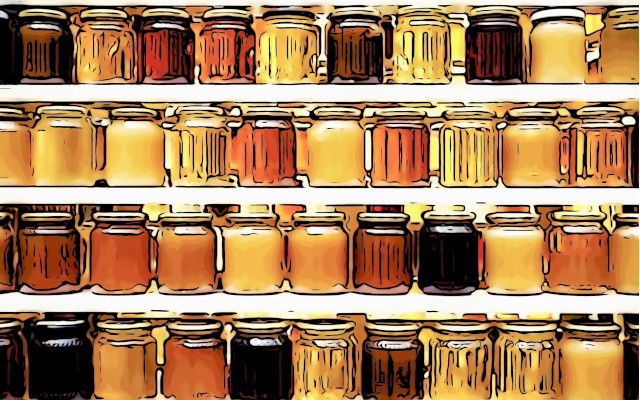
Italy is the fifth largest honey producer in the Old Continent, which the European Commission estimates to be the second ‘honey production area’ on the planet, after China. (1) Italian honey production reflects the broad biodiversity of a country that stretches from the Mediterranean to the high peaks of the Alps, with a rare variety of marine, hilly, and mountainous ecosystems.
The numerous honeys in Italy, both unifloral and polyfloral, are characterized by specific organoleptic profiles in terms of color and consistency, flavors and aromas. A plurality of nectars to which much research has been dedicated, starting from the Middle Ages, to study their qualities and beneficial properties. A brief insight.
Italian unifloral honeys
The main honeys Italian unifloral (monofloral) honeys were classified in 1986 through the 'Characterization sheets of Italian honeys', developed by the Experimental Institute for Agricultural Zoology (ISZA), now merged into the Council for Agricultural Research and Economics (CREA). The sheets include 18 main honeys and 39 less common honeys, with the respective descriptions regarding:
– botanical species from which the honey originates, (2)
– palynological data (i.e. pollen),
– organoleptic properties,
– main analytical parameters required by legislation (mean values and standard deviation),
– other analytical parameters not required by legislation (sugar profile, specific rotation, proline, etc.),
– notes related to typical and distinguishing elements,
– general information about the composition, (3)
– applied analysis methods. (4)
The analytical data and technical-scientific data are essentially aimed at sector operators – beekeepers, packers, retailers – who must ensure that products comply with the composition requirements established in Annex II of the Honey Directive 2001/110/EC. The botanical origin and sensory aspects are also useful to consumers to identify different honeys and appreciate their characteristics.

Sensory analysis
Sensory analysis of honey – as for other food categories – follows a scientific approach, subject to specific International standards. (5) With the primary objectives of identifying the botanical origin(s) of honeys, the absence of defects (e.g., fermentation), and consumer acceptance. In addition to evaluating the organoleptic qualities of honey, based on predetermined parameters.

Study groups and training for ‘panel tests’ have been established in Italy, thanks to the teachings and first experiences of Michel Gonnet, in France. This led to the formation of the National Register of Experts in Honey Sensory Analysis. (6) To date, the ‘Three Golden Drops’ is the main national competition in the sector, organized by the National Honey Observatory, whose expert tasters are registered in the Register. (7)
Nutritional properties
The nutritional profile average Italian honey is characterized by the prevalence of carbohydrates (80%), in the form of glucose and fructose. Followed by water (about 18%), vitamins, minerals and bioactive substances (i.e., polyphenols), about 1%. Traces of proteins (
The great variety of honeys in Italy also deserves further study, case by case, to verify the nutritional profiles of each and their respective health benefits. (5) Further studies could also evaluate variations in the glycemic index of honey.
Italian honey, the UNI standards
Five honeys In Italy, they are subject to voluntary standards, published by UNI (Italian Standardization Body), which define for each of them the quality requirements and the analysis methods to be applied to verify the authenticity of the product. The Italian standards pertain to the honeys of:
– acacia (Robinia pseudoacacia), UNI standard 11382:2010, (9)
– citrus (Citrus spp.), UNI 11384:2010, (10)
– chestnut (Castanea sativa), UNI 11376:2010, (11)
– honeydew (from forest), UNI 11375:2010, (12)
– eucalyptus (Eucalyptus spp.), UNI 11383:2010. (13)
Preliminary conclusions
All Italian honeys deserve to be considered and appreciated, without falling into the prejudice that honey from every country is always the same. Orography, ecosystems, and microclimates are indeed very different, even within individual regions and provinces.
Dario Dongo and Andrea Adelmo Della Penna
Notes
(1) Agriculture and rural development. Honey. European Commission https://agriculture.ec.europa.eu/farming/animal-products/honey_en
(2) Il ministero dell’agricoltura italiano ha dapprima interpretato la ‘direttiva miele’ riferendo alla ‘fonte’ anziché alla ‘pianta’. Su tale base, è stata ritenuta accettabile la dicitura ‘millefiori’ a completamento della denominazione di vendita ‘miele’ (circolare MIPAF 8 marzo 2005, n. 1). Salvo poi indicare che non è possibile utilizzare la denominazione ‘millefiori’ per le miscele di mieli monoflora. Il ‘millefiori’ non può perciò derivare da una esclusiva (monoflora) o precisa (fiori/nettare o melata) origine botanica (circolare MIPAF 31 maggio 2012, n. 4)
(3) The circulars reported in note 2, together with the circular dated July 12, 2007, no. 3, indicated as ‘not suitable’ the denominations ‘mountain honey’, ‘meadow honey’ and ‘forest honey’, admitting only the latter expression as a synonym of ‘forest honeydew honey’. The obligation of geographic origin imposed by the directive is considered fulfilled with the wording ‘Italian honey’
(4) Italian unifloral honeys http://profilomieli.albomiele.it
(5) Dario Dongo, Andrea Adelmo Della Penna. Honey, a universe to discover. Food Times. 10.10.23
(6) The National Register of Experts in Sensory Analysis of Honey in Italy, established by decree of the Ministry of Agriculture dated May 28, 1999 no. 21547, is managed by CREA (Council for Agricultural Research and Economics Analysis). See http://www.albomiele.it/
(7) See https://www.informamiele.it/concorso-tre-gocce-doro-grandi-mieli-ditalia
(8) CREA. Food composition tables. Honey. https://www.alimentinutrizione.it/tabelle-nutrizionali/210010
(9) UNI 11382:2010. Acacia honey (Robinia pseudacacia L.) – Definition, requirements, and analysis methods. https://store.uni.com/uni-11382-2010
(10) UNI 11384:2010. Citrus honey (Citrus spp.) – Definition, requirements, and analysis methods. https://store.uni.com/uni-11384-2010
(11) UNI 11376:2010. Chestnut honey (Castanea sativa Miller) – Definition, requirements, and analysis methods. https://store.uni.com/uni-11376-2010
(12) UNI 11375:2010. Honeydew or forest honey – Definition, requirements, and analysis methods. https://store.uni.com/uni-11375-2010
(13) UNI 11383:2010. Eucalyptus honey – Definition, requirements, and analysis methods. https://store.uni.com/uni-11383-2010

Dario Dongo, lawyer and journalist, PhD in international food law, founder of WIISE (FARE - GIFT – Food Times) and Égalité.

Graduate in Food Technologies and Biotechnologies, qualified food technologist, follows the research and development area. With particular regard to European research projects (in Horizon 2020, PRIMA) where the FARE division of WIISE S.r.l. benefit company participates.


