

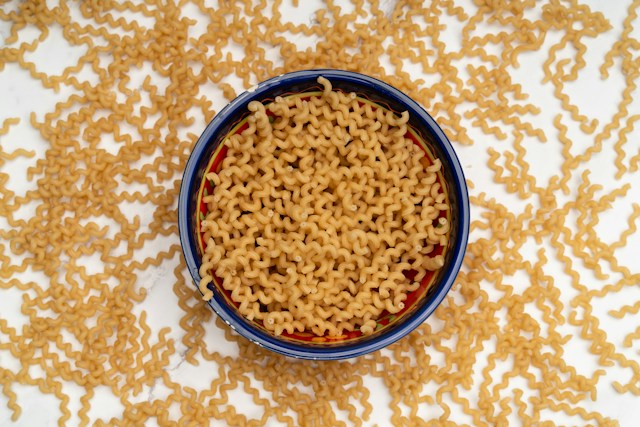
Durum wheat pasta, and not only. To gluten-free cereals, such as rice and corn, are added ancient grains now in the spotlight and various others (e.g. barley, oats, soft wheat). And also legumes, even better if Italian. The ABC on the label.
Durum wheat semolina pasta, egg pasta and special types. The denominations in Italy
The Presidential Decree 187/2001 regulates the production and sale on the national market of a series of food products. (1) Soft wheat flours (whole and types 2, 1, 0, 00), durum wheat milled products (semolina, semolina flour, whole, flour). And some pastas (made from wheat semolina, durum wheat semolina flour, special pastas, egg pastas, fresh and stabilized fresh pasta). The production and composition requirements, as well as the characteristics that each of these products must meet to use the aforementioned denominations, are defined. (2)
The measure in question has not, however, ever been submitted – in the two decades now passed – to the required notification to the European Commission. (3) Therefore it is without effect, according to established case law of the EU Court of Justice. Its rules – in the sole parts where the characteristics of foods associated with the various denominations are defined – thus apply under the title of ‘use and custom’. (4)
‘Pasta of… (different cereals and/or legumes)’
Any reference to the generic term ‘pasta’ should be understood as allowed without exclusions, in light of the above, on condition of:
- respecting the process and product requirements associated only with the types of pasta whose denominations are indicated in DPR 187/01,
– inform the consumer with unequivocal clarity, regarding the raw material used in each different pasta (e.g. rice, corn, spelt, buckwheat, lentils, chickpeas, etc.)
– specify the QUID of the characteristic ingredient, if it is not exclusive.
'Gastronomic specialty'
'Gastronomic specialty' is the descriptive name that can be used to exclude the risk of misleading the consumer regarding the essential characteristics of products that appear only superficially similar. (5) The use of this name is particularly useful in cases of:
– pasta made (in whole or in part) with soft wheat. According to local traditions in some regions of Northern Italy, where soft wheat was the only available type,
– composite products, with innovative and in any case distinctive ingredients (e.g. egg white, wheat gluten, dietary fibers from various sources, seaweed, etc.).
Transparent labels
Both terms ‘pasta of… (cereal(s) and/or legume(s))' and 'gastronomic specialty' qualify, in the hierarchy of food names indicated by the Food Information Regulation, as descriptive names.
The descriptive name is the one 'that describes the food and, if necessary, its use and is sufficiently clear so that consumers can determine its real nature and distinguish it from other products with which it might be confused'. (6)
It is therefore essential to specify the peculiar characteristics of the product. Alongside the name, but also in the main visual field of the label and in advertising, depending on the case, with the precise aim of preventing any possible confusion of the consumer about the product offered for sale.
Dario Dongo
Notes
(1) D.P.R. 9.2.01, n. 187 (as amended by law 1.3.02, n. 39). Regulation for the revision of the legislation on the production and marketing of flours and pasta products
(2) Regarding dry pasta in particular, attention is paid to moisture content, ash, proteins, and acidity
(3) Pursuant to Dir. 98/34/EC and subsequent amendments (most recently, EU Dir. 2015/1535). The Constitutional Court, in turn, clarified the right of food sector operators to manufacture and sell in Italy different ‘pasta’ (sentence 443/1997)
(4) Uses and customs, although qualified as secondary sources of law, are indeed relevant for the food naming. See the previous article https://www.greatitalianfoodtrade.it/etichette/denominazione-dell-alimento
(5) The Ministry of Agricultural, Food and Forestry Policies in turn resorted to the ‘gastronomic specialty’ to designate some particular pasta (e.g. Maccheroncini di Campofilone, MiPAAF provision 18.11.13)
(6) Cf. EU Reg. 1169/11, articles 17 and 2.2.p.

Dario Dongo, lawyer and journalist, PhD in international food law, founder of WIISE (FARE - GIFT – Food Times) and Égalité.


. E pure i legumi, meglio ancora se italiani. L’ABC in etichetta.)