


Two-thirds of the most popular protein bars contain less protein than declared on the label. Up to 25% less. Our market investigation, with laboratory analysis on some of the best-selling products in Italy.
Protein bars, our investigation
Sampling was carried out on bars with medium (30-40%) and high (50%) protein content. A total of 12 products, from 8 different brands (Enervit, Equilibra, Matt, Named, Pro Action, Pro Nutrition, Ultimate, Watt).
The analyses, commissioned to the accredited laboratory BioChemie Lab, measured the actual amount of protein in each of the analyzed samples.
Then proceeded to compare the analytical values of each product with the claims nutritional claims on their respective labels.
The results show a clear distinction of operators and products in three categories. Those to trust, those moderately reliable, and those illegal.




Real proteins
One third of the bars analyzed, 4 out of 12, contain an amount of protein equal to or greater than the declared values.
Green color – excellent rating – is given to the following products, listed in order of fidelity between actual content and declared value:
– Enervit Protein Deal Bar Crispy Cookie 55g, (proteins 36%), exact compliance,
– Enervit Gymline Muscle Bar almonds 60g, (proteins 50%) +2%,
– Matt Sport Iperprotein power chocolate 35g, (protein 30%) +3%
– Pro Action Protein Sport cioccolate coconut 35g, (protein 30%) +8%.
Almost compliant proteins
Yellow color – average judgment – assigned to 4 products whose actual protein contents are lower, between 2 and 7%, than those stated on the label:
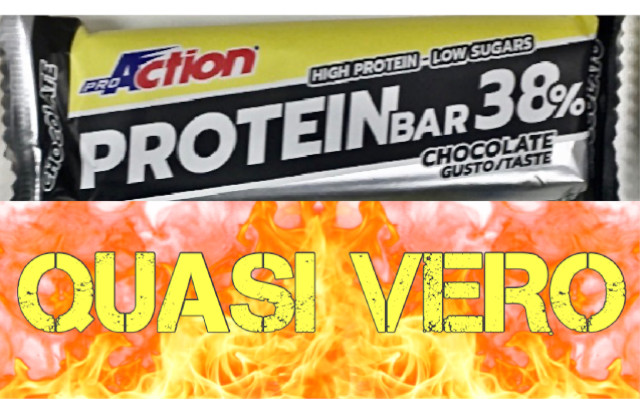
– Pro Action Protein Bar 38% Chocolate flavor 80g, (38% protein) -2%,
– Equilibra Sport&Fit Line Protein milk chocolate 35g, (protein 31%) -2%,
– Ultimate Sport, protein bar coconut flavor 40g,(protein 33%) -5%,
– Equilibra Sport&Fit Line Protein 35% Dark Chocolate flavor 45g, (protein 35%) -7%.
Poor proteins
Red color – negative judgment – applies instead to 4 bars whose actual protein content is significantly lower than declared.
– Watt Big Bar 30% coconut flavor 80g, -11%,
– Pro Nutrition HydroLyzed Bar 50%, Dark Chocolate Zero Coconut 55g, -12%.
– Named Super Protein bar 45% coconut flavor 70g (45% protein, in theory), -18%,
– Named Protein bar 35% Wild Berries flavor 50g (35%), instead falls to -25%.

claims nutritional. The allowed tolerances (and the prohibited ones)
The regulation Nutrition & Health Claims regulates at the European level the use of nutrition and health claims related to food products (Reg. EC 1924/06).
‘‘Nutritional indication’ is ‘any indication that states, suggests or implies that a food has particular beneficial nutritional properties, due to:
a) the energy (caloric value) it provides, provides at a reduced or increased rate, or does not provide, and/or
b) the nutrients or other substances it contains, contains in reduced or increased proportions, or does not contain‘ (Reg. EC 1924/06, art. 2.2.4).
The guidelines The European Commission on official public controls regarding nutritional declarations and indications then offers Member States the criteria to follow to verify the compliance of labels. (1)
If the products carry nutritional indications (nutrition claim) and/or related to health (health claim), the tolerances on any discrepancies between the actual values and those declared on the label vary depending on the protein content of individual foods:
–
– 10-40 g protein per 100 g product, +40% tolerance
– >40 g protein per 100 g food, +16 g tolerance. (2)
Please note that these tolerances are only allowed in excess (+) and not in deficit (+, -). That is to say, an actual protein content higher, never lower, than the declared one can be accepted.

Preliminary conclusions
The results of the analyses of laboratory tests lead to consider that in a lively and growing market, such as the one under examination, there coexist serious operators, more or less rigorous, and some 'tricksters'.
The value actual and perceived of these products is indeed closely linked to the protein content, which represents the main appealing element and is generally proportional to the price. But if the real value is lower – and not by little – than the declared one, it is a scam.
Further analyses should be carried out, including by the competent authorities, to verify the possible existence of offenses deserving administrative and criminal penalties. (3)
The boom of protein bars
The consumption of protein bar is estimated to correspond to 230-280 million euros of total expenditure in the European Union. Only in Germany, England, France, and Italy consumers bought these products for 211.5 million euros in 2018. And it is expected they will reach 258 million euros in 2020 (Euromonitor).
The boom of bars protein is linked to the experience of athletes who, over the years, have introduced them to the general public. And it is easy to explain. Since these are ‘on the go’, easy to store and carry with you, to be used as snack or even as a substitute for meals away from home, depending on size/quantity and nutritional intake. Thanks to generally balanced nutritional profiles, which allow you to integrate the daily protein requirement also with essential amino acids, easily assimilated.
The importance of proteins
The role of proteins is central to health and well-being. As explained by the Harvard T.H. Chan School of Public Health, ‘proteins are found throughout the body, in muscles, bones, skin, hair, and practically every other part or tissue of the body. They make up the enzymes that power many chemical reactions and hemoglobin, which carries oxygen in the blood. At least 10,000 different proteins make you who you are and keep you that way.
Proteins are made up of more than 20 basic elements called amino acids. Since we do not store amino acids, our bodies produce them in two different ways: from scratch or by modifying others. Nine amino acids – histidine, isoleucine, leucine, lysine, methionine, phenylalanine, threonine, tryptophan, and valine – known as essential amino acids, must come from food.'
Dario Dongo and Marta Strinati
Notes
(1) European Commission (2012). GUIDANCE DOCUMENT FOR COMPETENT AUTHORITIES FOR THE CONTROL OF COMPLIANCE WITH EU LEGISLATION ON:
Regulation (EU) No 1169/2011 of the European Parliament and of the Council of 25 October 2011 on the provision of food information to consumers, amending Regulations (EC) No 1924/2006 and (EC) No 1925/2006 of the European Parliament and of the Council, (…) and Directive 2002/46/EC of the European Parliament and of the Council of 10 June 2002 on the approximation of the laws of the Member States relating to food supplements with regard to the setting of tolerances for nutrient values declared on a label. On https://ec.europa.eu/food/sites/food/files/safety/docs/labelling_nutrition-vitamins_minerals-guidance_tolerances_1212_en.pdf
(2) See document in note 1, paragraph 5.1 and table 3
(3) Legislative Decree 27/17, article 515 penal code. For more information on the sanctions to be applied, see the free ebook ‘1169 Penalties. EU Reg. 1169/11. News on foods, controls and sanctions’, on https://www.greatitalianfoodtrade.it/libri/1169-pene-e-book-gratuito-su-delitti-e-sanzioni-nel-food
(4) Harvard T.C. Chan, School of Public Health. The Nutrition Source, https://www.hsph.harvard.edu/nutritionsource/what-should-you-eat/protein/

Dario Dongo, lawyer and journalist, PhD in international food law, founder of WIISE (FARE - GIFT – Food Times) and Égalité.

Professional journalist since January 1995, she has worked for newspapers (Il Messaggero, Paese Sera, La Stampa) and magazines (NumeroUno, Il Salvagente). Author of investigative reports on food, she published the book 'Reading labels to know what we eat'.


