
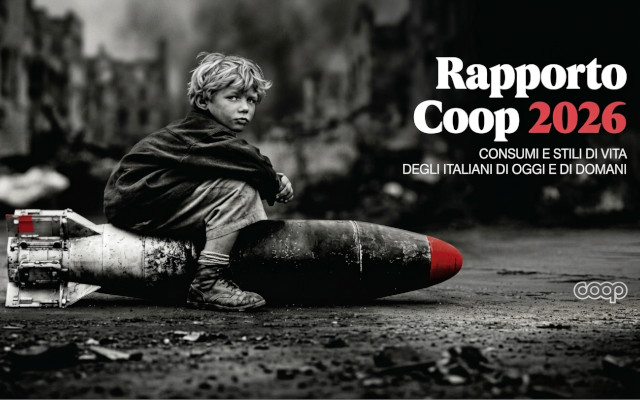
Incomes stagnant for twenty years, expenses reduced to essentials and a shopping cart rewritten item by item. The Coop Report 2026 on consumption and lifestyles of Italians, presented on September 10, 2026, confirms food as the last expense that Italians do not intend to negotiate.
A country that earns less than twenty years ago
The disposable income of Italian families, net of inflation, in 2025 remains 6% lower than that of 2007. In the same period it has instead grown by 22% in France, by 21% in Germany, by 15% in Spain. Only Greece performs worse than Italy, with -15%.
I consumption follow the same flat curve. At constant prices, the spending of Italian families in 2025 is 0.3% lower than in 2007, while Germany and France have gained over 17 points. Within this stagnant balance, the share of food expenditure has barely increased, from 15.1% to 15,5%, compared to a jump in housing from 20.8% to 23.1%.
The resulting malaise is widespread but uneven. The 67% of Italians declare they experience at least one condition of discomfort, that is to be below a level considered minimally acceptable in at least one of the analyzed areas: discomfort concerns travel and holidays for 30% of the sample, home maintenance and personal care for 23%, food for 6% (among the last places, along with education and technology).
(De)consumption becomes a choice
The 65% of Italians declare themselves favorable to reduction of consumption and waste, with substantially identical percentages across generations and social classes. A fact that the Coop Report 2026 interprets as cultural change rather than as an effect of poverty: 38% of those who have reduced consumption interpret it as responsible behavior, 36% as a balanced and frugal choice, while only 20% recognize it as a sign of lower economic means.
The saving strategies most widespread:
– avoiding major or particularly expensive purchases, 88%;
– repairing objects instead of replacing them, 85%;
– canceling or choosing cheaper versions of subscriptions and services, 72%;
– buying used or refurbished products, 45%.
Possession gives way to experience. 51% of respondents point to life experiences among the elements defining their identity, compared to 9% for what one owns and can afford.
Food, the last non-negotiable expense
In the year ending June 2026 sales of packaged fast-moving consumer goods reach 101.9 billion euros, with an increase of 1.9% in value and 1.0% in volume. Compared to 2019, value has grown by 31.8%, volume by 5.6%.
It is one of the very few sectors on which Italians say they want to focus their budget. Asked about domestic food spending intentions for the next 12-18 months, 21% expect to increase it, 71% to keep it stable, only 8% to reduce it. Out-of-home dining shows opposite intentions.
Between 2019 and 2026 thefood inflation Italian remained at 29.7%, compared to 34.0% for the EU27 average, 37.9% for Spain and 40.5% for Germany. A differential that the Coop Report 2026 quantifies as 6 billion euros saved by Italian families.
This does not change that the food prices in Italy have increased by over 30% compared to the pre-Covid era and that the perception of inflation by Italian families exceeds the real one by over two points, the widest gap in Europe. Also due to wage reductions, as has been seen.
The hybrid diet of Italians
The UNESCO recognition of Italian cuisine, registered in the Representative List of the Intangible Cultural Heritage on December 10, 2025, came at a time when the country's food identities are mixing.
Italians who identify with a food model exclusively traditional fall to 20%, six points less than in 2024. But the opposite front also retreats, that of those who have abandoned any identity reference, falling from 30% to 24%. Growing by nine percentage points, up to 42%, is the area ofhybridization between old and new.
They are Baby Boomers leading this mix, with 53%, while the Generation Z holds the record for both pure innovation, 28%, and the absence of any food identity, another 28%.
Among the declared styles, the Mediterranean diet rises to 40%, six points more than in 2024, followed by Italian cuisine with 30% and by zero kilometer with 23%. However, diets that dominated the debate in recent years fall back: gluten-free at 4%, hyper-protein at 4%, vegetarian at 6%, ketogenic at 2%.
Weight control, between sports and medications
The 63% of Italians declare they keep under control their own weight body. The figure rises to 67% among men and to 74% in the upper class, drops to 58% among women and to 59% in the lower class, indicating how physical fitness has become a social marker.
The prevailing strategies remain sport, 43%, and the change of dietary regimen, 36%, while only 23% rely on a diet prescribed by a doctor or nutritionist.
The chapter on agonist drugs of the GLP-1 deserves attention. 4% of respondents declare using them, 15% would like to try them, with peaks of 25% among Generation Z. 38% do not think it is right to resort to drugs, 23% fear side effects. One Italian manager out of five in the food & beverage indicates the spread of these drugs among the factors most likely to transform the mass consumption scenario in the next three to five years.
The fine tuning of the cart
The metamorphosis of purchases no longer goes through category change, but rather through replacement within the same category. The Coop Report 2026 records it reference by reference, on volumes at constant prices of the year ending in June:
– the eggs from free-range hens grow by 11.6%, those from caged farming lose 18.6%;
– fourth range salad gains 10.6%, loose romaine lettuce collapses by 37.1%;
– the drinkable kefir advances by 33.1%, partially skimmed fresh milk drops 5.7%;
– oat plant-based drinks rise by 18.3%, UHT soy drops by 7.8%;
– the dark chocolate increases by 4.5%, milk chocolate with hazelnuts decreases by 9.1%;
– tuna fillets in glass jars increase by 14.1%, prepared dishes with sides decline by 5.4%.
Over the long term, 2019-2026, the sectors that gained the most in volume are ethnic specialties, +186.5%, and vegetable substitute gastronomy, +147.3%, followed by fresh eggs, +43.2%. At the bottom of the ranking are key items of the Mediterranean diet: the Pasta loses 10.1%, the Wine 9.7%, the tomato derivatives 6.1%, milk and fresh cream 18.7%. The largest contraction, -25.6%, concerns the sector that includes oil, vinegar, and lemon juice.
Fresh products struggling
I fresh products are worth 56.8 billion euros and grow by 2.8% in value, but lose 1.4% in volume. Prices, therefore, support sales.
The dividing line runs between packaged and loose. Fresh products with fixed weight gain 0.4% in volume, those with variable weight lose 2.4%. Fruit and vegetables, fishmongery, and cold cuts decline, also penalized by the hot summer, which in the reading of the Coop Report 2026 pushed up the prices of fruit and vegetables.
Sustainability, the gap between saying and doing
There are 16 million Italian families for which sustainability counts 'in words', meaning those who declare themselves sensitive to the issue. It drops to 10.4 million those who actually buy sustainable products, and to 7.5 million those who show consistency between what they say and what they do.
What discriminates is the income, which the Coop Report 2026 identifies as the main factor in selecting sustainable food. But the nature of the expected benefit. Products that are good for the person are considered important by 73% of respondents and 57% declare willing to pay more for them. Percentages fall to 63% and 45% for products that are good for the community, 61% and 42% for those good for the environment.
Consistently, absence claims that justify a premium concern the consumer before the planet:
- without additives, 40%,
- without added sugars, 39%;
- without colorants, 34%;
- organic, 23%.
Eating out in retreat, the supermarket's comeback
In 2026 spending eating out grows by 1.5% in value but visits drop by 0.6%. 62% of Italians say they have reduced outings and 51% reserve them for special occasions. Attendance at restaurants at least once a month drops from 64% to 59%, that of bars from 73% to 70%. The 36% of respondents believe that the ready food from the supermarket is a good alternative to the restaurant.
In distribution, after years of growth of discount, the center of gravity returns towards the supermarket, which holds the 37,7% of sales of packaged fast-moving consumer goods against 22.6% of discount. At equal sales network, i.e. net of new openings, supermarkets grow by 2.4% and the discount of 0.5%. Thee-commerce, which accounts for 2.8% of the market, gains 15.2%.
The Italians confirm themselves among consumers less loyal in Europe, with 7.6 distribution groups and 11.3 brands visited on average in a year, compared to 4.6 groups of the French.
The private label reaches 31,9% of sales by value, over three points more than in 2019. And the cart rises less than the price lists: in the face of a price increase of 1.3%, the price actually paid at the checkout increases by 0.9%, thanks to a shift in choices towards cheaper references, brands, and formats worth 376 million euros.
Finally, the relationship between Italians and artificial intelligence applied to shopping. The 74% of Italian consumers declare using it, the highest value among the surveyed countries, ahead of the United States, 68%, and the United Kingdom, 67%. And 28% would entrust a humanoid robot with the task of cooking and preparing meals, with a peak of 52% among Generation Z.
The food economy, who retains the value
The most interesting preview of the Coop Report 2026 concerns a study conducted with the University of Parma on the distribution of the value chain along the supply chain. On 284 billion euros of food consumption by Italians, including domestic, out-of-home spending and import-export balance:
– 143.7 billion, 51%, constitute the added value retained by the operators in the agri-food chain;
– 112.2 billion, 39%, are absorbed by the induced sector, i.e. the ancillary goods and services necessary for the functioning of the chain, starting with energy and utilities, 22.7 billion, and transport and logistics, 17.5 billion;
– 28.4 billion, 10%, are indirect taxes on consumption.
The agri-food supply chain in Italy employs 2,869,486 people in full-time equivalent units. Catering absorbs 33%, professional agriculture 26%, food industry 15%.
The Value added per employee, net of tax and social security burdens, however, tells a different hierarchy: the food industry generates 66,856 euros per employee, wholesale and intermediation 58,678 euros, food retail 39,367 euros, professional agriculture 39,098 euros, catering 23,259 euros.
That wholesale and intermediation, whose role should be limited to the connection between the various production sectors, retain per employee a value share higher than that of agriculture and retail is the data that the Coop Report 2026 itself signals as surprising. On the financial side, in 2025 the operating profitability of large-scale food distribution rises, with an EBITDA (gross operating margin) that goes from 4.8% to 6.5% of net turnover, while the food industry remains at 7.8%.
Marta Strinati
References
Coop Report 2026. Consumption and lifestyles of Italians today and tomorrow. Digital preview, September 10, 2026, https://italiani.coop/rapporto-coop-2026-anteprima-digitale-2/. The Report is curated by Albino Russo, head of the Ancc-Coop Study Office, and coordinated by Carlo Romagnoli, carried out with the scientific collaboration of Ref Ricerche, University of Parma and University of Milan-Bicocca, the analytical support of NielsenIQ and contributions from Circana, GfK, Mediobanca Study Office, Altroconsumo, TradeLab and Sylla.
Marta Strinati. Coop Report 2025, good food remains the passport. GIFT (Great Italian Food Trade). 2025, https://www.greatitalianfoodtrade.it/notizie/rapporto-coop-2025-il-buon-cibo-resta-il-passe-partout/
Italian National Commission for UNESCO. Italian Cuisine inscribed on the Representative List of the Intangible Cultural Heritage of UNESCO, December 10, 2025, https://unesco.cultura.gov.it/news/la-cucina-italiana-iscritta-nella-lista-del-patrimonio-culturale-immateriale-dellumanita/

Professional journalist since January 1995, has worked for newspapers (Il Messaggero, Paese Sera, La Stampa) and magazines (NumeroUno, Il Salvagente). Author of journalistic investigations on food, she has published the book 'Reading labels to know what we eat'.


