
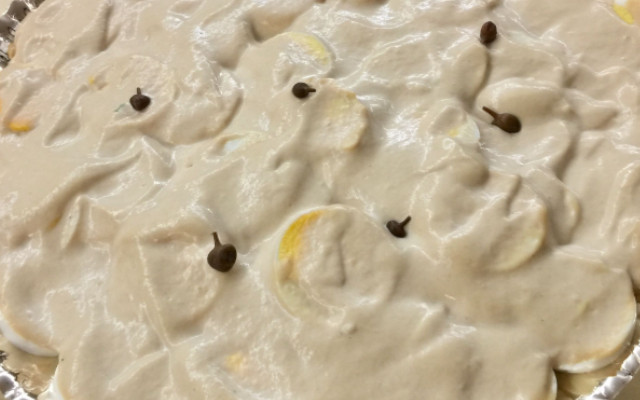
Vitel Tonné is one of the most refined preparations of Italian cuisine: meat of veal boiled in aromatic broth, thinly sliced and covered with a creamy sauce made of tuna in oil, anchovies and capers. A cold dish that smells of conviviality, always associated with the festive tables of Northern Italy. Its history rooted in Piedmont is three centuries long and crosses dialects, borders and industrial revolutions.
The birth in Savoyard land: the myth of the French influence clarified
The first documented traces of Vitel Tonné date back to 18th century in the province of Cuneo, in Piedmont. Its oldest written codification appears in the famous anonymous cookbook The Piedmontese cook perfected in Paris, published in Turin in 1766 (Anonymous, 1766). The work, which counted over twenty editions between the 18th and 19th centuries and was partly based on Cuisinière bourgeoise by Joseph Menon (Paris, 1746), represents the first systematic synthesis of Savoyard cuisine, with ingredients and techniques adapted to local taste and raw materials.
The name ‘vitel tonné’ does not derive from the French language but from the Piedmontese dialect, where:
- ‘vitel’ means ‘veal’, in Piedmontese (while in French it is ‘veau’)
- ‘tonné’ does not derive from ‘thon’ (tuna in French) but from the French term ‘tanné’, learned in Piedmont under the Kingdom of Savoy, which means ‘prepared’.
This referred to a veal meat boiled or roasted flavored with a sauce – composed of salted anchovies, capers, and oil, emulsified with the cooking juices – which in eighteenth-century recipes was more similar to a flavorful vinaigrette rather than the cream of the modern recipe. Tuna was indeed absent.
The nineteenth century and canned tuna: the industrial turning point that changed the recipe
Tuna appears in the Vitel Tonné recipe only in the second half of the nineteenth century, and not by chance: it is in those years that the Italian fish canning industry was born. Around 1860, the Turin merchant Gaetano Valazza opened in Sardinia at Porto Torres one of the first factories for canned tuna in oil in tin boxes according to the Appert method. In 1874, Ignazio Florio acquired the tuna fishery of Favignana, in Sicily, initiating industrial production on a large scale and presenting his innovative tins with key openings at the Palermo National Exhibition of 1891–92 (ANCIT/Tonno360, n.d.). It is precisely in this context — canned tuna accessible to the northern market — that the fish ingredient enters the Savoy dish, transforming the ‘seasoning sauce’ into a true protein emulsion.
The first written codification with tuna as an explicit ingredient is due to Pellegrino Artusi, who in the Recipe no. 363 — classified in the section ‘Cold Dishes’ of Science in the kitchen and the art of eating well (1891) — wrote literally:
‘Crush 100 grams of tuna in oil and two anchovies; crumble them well with the blade of a knife or, better, pass them through a sieve adding fine oil abundantly little by little and the sour of a lemon or even more, so that the sauce is liquid; finally mix in a handful of capers squeezed from vinegar. Serve the veal with tuna sauce with its sauce and lemon wedges‘ (Artusi, 1891, p. 208).
The meat — ‘milk-fed veal in the thigh or the rump‘ — was larded with anchovies, boiled in water flavored with onion, bay leaf, celery, carrot, and parsley, then infusion hold in the sauce for one or two days. No mayonnaise: the Artusian sauce is a simple mechanical emulsion of tuna, oil, and lemon.
I egg yolks enter the recipe only during the twentieth century, influenced by mayonnaise in French bourgeois cuisine, and is adopted by Il Cucchiaio d’Argento starting from its first edition in 1950 (Cucchiaio d’Argento, 2016).
Preparation technique: critical points
Veal cooking
The indicated cut of meat — topside (topside) or knuckle — is a lean long-fiber muscle that requires gentle and prolonged cooking. The technical parameters are:
- start in cold water with ‘aromatics’ (carrot, celery, onion studded with cloves, bay leaf, whole peppercorns);
- addition of dry white wine once boiling;
- boiling at low heat, covered, for 60–75 minutes for an 800 g piece;
- internal temperature target: 70°C (measured with a probe);
- complete cooling in the cooking liquor. A crucial step, as the gradual cooling in the broth prevents protein contraction and keeps the meat juicy.
The meat should not be sliced hot: the resting in the refrigerator for at least 4 hours consolidates the structure and allows thin slices, preferably obtained with a slicer.
Tonnato sauce: Artusi's version and the modern one
Traditional version (without egg yolks): canned tuna in oil, anchovies, desalted capers, and lemon juice are crushed or blended with extra virgin olive oil in a thin stream until a smooth emulsion is obtained, adjusted with cold cooking broth. The consistency should be fluid, not spreadable.
Contemporary version: fresh egg yolks contribute to the emulsion, making the sauce more stable and thicker. The ratio codified by Il Cucchiaio d’Argento (2016) provides 3 yolks for 800 g of veal, with oil poured in a very thin stream to promote the emulsion which might otherwise separate.
Ingredients for 6 people:
For the veal:
- 800 g of eye round or knuckle veal, tied;
- 1 carrot, 1 celery stalk, 1 golden onion studded with 2 cloves;
- 2 bay leaves, 10 black peppercorns;
- 1 glass of dry white wine;
- coarse salt to taste
For the tonnato sauce (modern version):
- 200 g of tuna in oil of quality, drained;
- 4–6 fillets of salted anchovy, desalted and deboned;
- 3 fresh egg yolks;
- 200 ml of mild extra virgin olive oil;
- 20 g of salted capers, desalted;
- juice of half a lemon;
- cold cooking broth, to adjust the consistency.
Assembly and resting
The veal slices are arranged overlapped on a serving plate and covered with abundant sauce. The resting in the refrigerator for at least 3–4 hours — preferably overnight — is an essential technical step, as it allows the sauce to penetrate the fibers and blend the flavors. Garnish with whole capers and, optionally, with a julienne of lemon zest.
Raw materials: quality parameters
Veal. Commission Regulation (EU) No 566/2008 defines 'veal' as cattle under 8 months old (Article 3.1.a, Category V). Its meat is distinguished by its light pink color and fine grain. The ideal cut is the topside or the knuckle, characterized by very low collagen content and absence of nerves, to ensure uniform cooking and ease of slicing. Prefer meat from sustainable farms, such as those certified according to the Italian SQNZ protocol.
Tuna. Quality is assessed based on muscle firmness, absence of metallic odor, and aromatic profile. The most common commercial species in the premium segment are yellowfin tuna (Thunnus albacares) and the skipjack tuna (Katsuwonus pelamis), strictly preserved in olive oil or extra virgin olive oil to maintain an aromatic profile consistent with the flavors of Italian cuisine recognized by UNESCO.
Anchovies. The salt-cured anchovies — preferably from Cetara (Salerno, Campania) — have a distinctly higher aromatic complexity than those in oil, thanks to lactic fermentation during aging. The desalting process (immersion in cold water for 20–30 minutes) is essential to rebalance saltiness.
Extra virgin olive oil. For tuna mayonnaise, an oil with low fruity intensity (Taggiasca, Casaliva del Garda, Peranzana cultivars in delicate versions) so as not to overpower the tuna. An oil that is too grassy, bitter, or pungent would compromise the balance of the sauce.
Eggs. The yolks are not cooked: it is imperative to use extra-fresh Category A eggs, preferably from organic farming, within 7 days of laying.
Conclusion
Vitel Tonné is a dish that encompasses three centuries of evolution in Italian cuisine: from the dressing sauce without tuna of the anonymous cookbook of 1766, passing through the Artusi’s codification of 1891 with its fluid emulsion and infusion maceration, up to the contemporary version with egg yolks. Each evolution corresponds to a specific economic and technological change — the industrialization of canned tuna, the spread of bourgeois French cuisine, the democratization of kitchen appliances. Knowing its history is the most effective way to understand and implement the technical choices that make this dish extraordinary, whether with historic recipes or the current one.
Marta Strinati
References
Italian Academy of Cuisine. (2005). Traditional recipe book. Recipes of Italian cuisine. Bolis Editions.
ANCIT/Tonno360. (n.d.). A bit of history. https://www.tonno360.it/un-po-di-storia/
Anonymous. (1766). The Piedmontese cook perfected in Paris. B.A. Re. https://www.iris.unina.it/handle/11588/985579
Artusi, P. (1891). Science in the kitchen and the art of eating well (1st ed.). Salvadore Landi Printing House.
Commission Regulation (EC) No 566/2008 of 18 June 2008 laying down detailed rules for the application of Council Regulation (EC) No 1234/2007 as regards the marketing of the meat of bovine animals aged 12 months or less. Consolidated text: 01/07/2013. http://data.europa.eu/eli/reg/2008/566/2013-07-01
Silver Spoon. (2016). The Silver Spoon. The great book of Italian cuisine (10th ed.). Editoriale Domus.
Iacolare, S. (edited by). (2024). The Piedmontese Cook Perfected in Paris. Critical text according to the Turin edition of 1775 and glossary. Olschki. https://en.olschki.it/libro/9788822269621
La Cucina Italiana. (2019). La Cucina Italiana. The 1000 best recipes of the month. 1929–2019. Condé Nast.

Professional journalist since January 1995, she has worked for newspapers (Il Messaggero, Paese Sera, La Stampa) and magazines (NumeroUno, Il Salvagente). Author of journalistic investigations on food, she published the book 'Reading labels to know what we eat'.


