
Water, fruit juice, sugar or sweeteners, thickeners, colorings or natural ‘colored’ ingredients, synthetic or natural flavors. The recipe of popsicles sold in Italian supermarkets revolves around this scheme.
Differences are observed in amounts of fruit juices, presence of added sugars, and use of additives for coloring and sweetening.
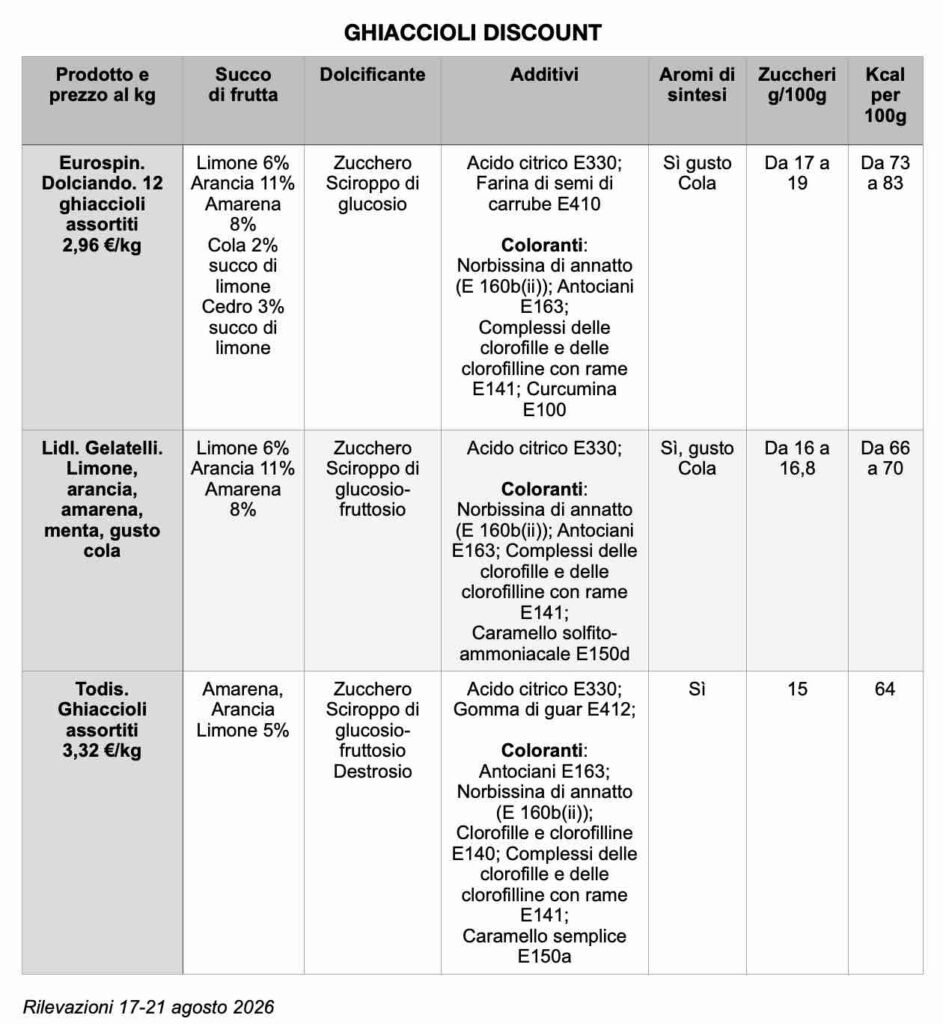
We compared 17 popsicles — where possible selected from multi-flavor packs — among industrial brands, distributor brands, and discount brands.
The cold sweet
Three quarters of the popsicles examined (13 out of 17) contain sugar (sucrose) and glucose-fructose syrup in amounts ranging from a minimum of 14 to a maximum of 19 grams per 100 grams. Equivalent to 1-1.5 tablespoons of sugar, levelled.
Four of the seventeen popsicles examined are without added sugars:
- the first is the organic pasteurized liquid preparation Bio Ice Multifruits, which owes the presence of sugars (19 g per 100 g) to their natural content in the fruit juice composing more than a quarter of the popsicle;
- the second is sweetened with xylitol and stevia (Sammontana);
- the remaining two (Coop BeneSì and Indianino) are instead sweetened with sucralose.

Fruit juice in popsicles
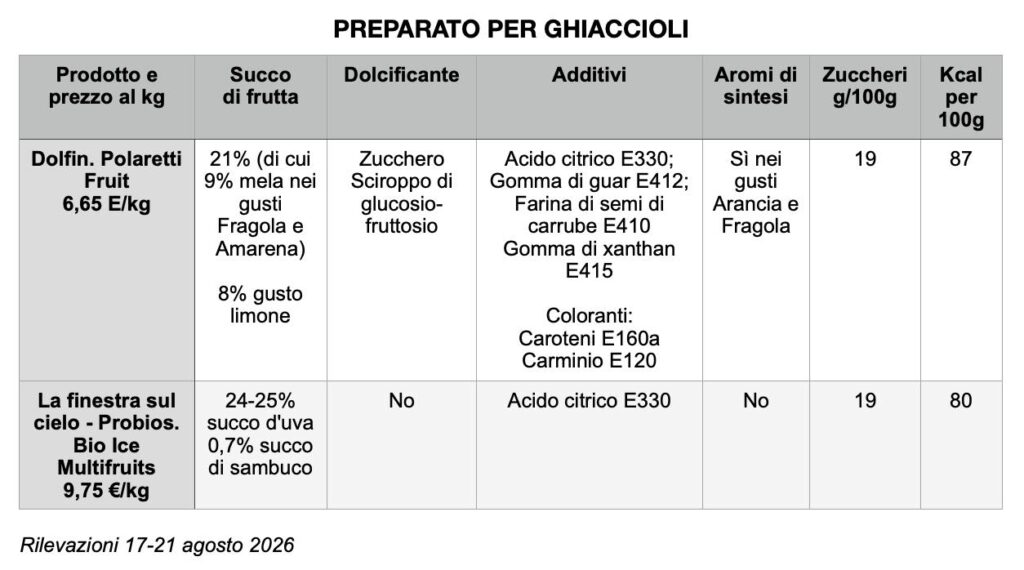
The amount of fruit juice highest (25.7%) is found precisely in the category of popsicle preparations (to freeze at home):
- the already mentioned organic product of La Finestra sul Cielo (Probios), sold by NaturaSìstands out for a ‘clean label‘ emblematic of organic farming: without additives or colorants or synthetic flavors;
- the liquid preparation Polaretti Fruit under the Dolfin brand in turn contains a considerable amount of fruit juices: 21%, with the sole exception of lemon flavor (8%). The Polaretti recipe is similar to that of other ‘conventional’ popsicles, as it contains sugar and glucose-fructose syrup, thickeners, synthetic flavors, and colorants.
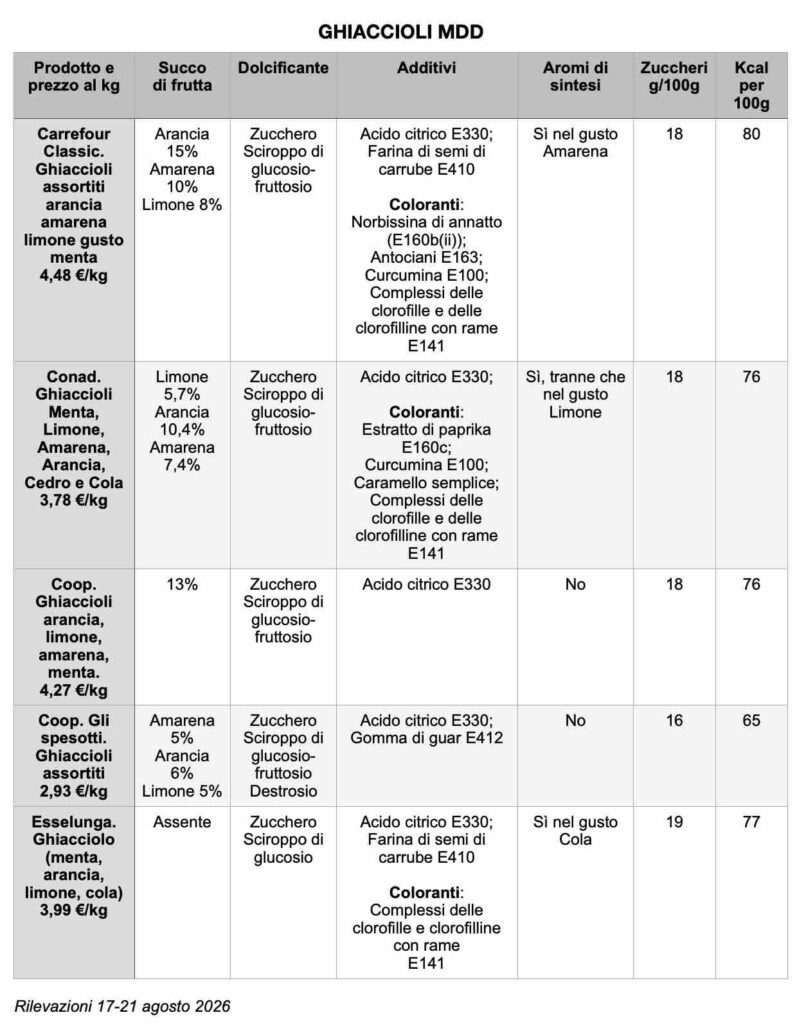
Among the popsicles with private label (PL), the amount of fruit juice varies between 5 and 15%. At the extremes of comparison among five we find Coop, which dominates with 13% juice, and Esselunga, which contains none at all.
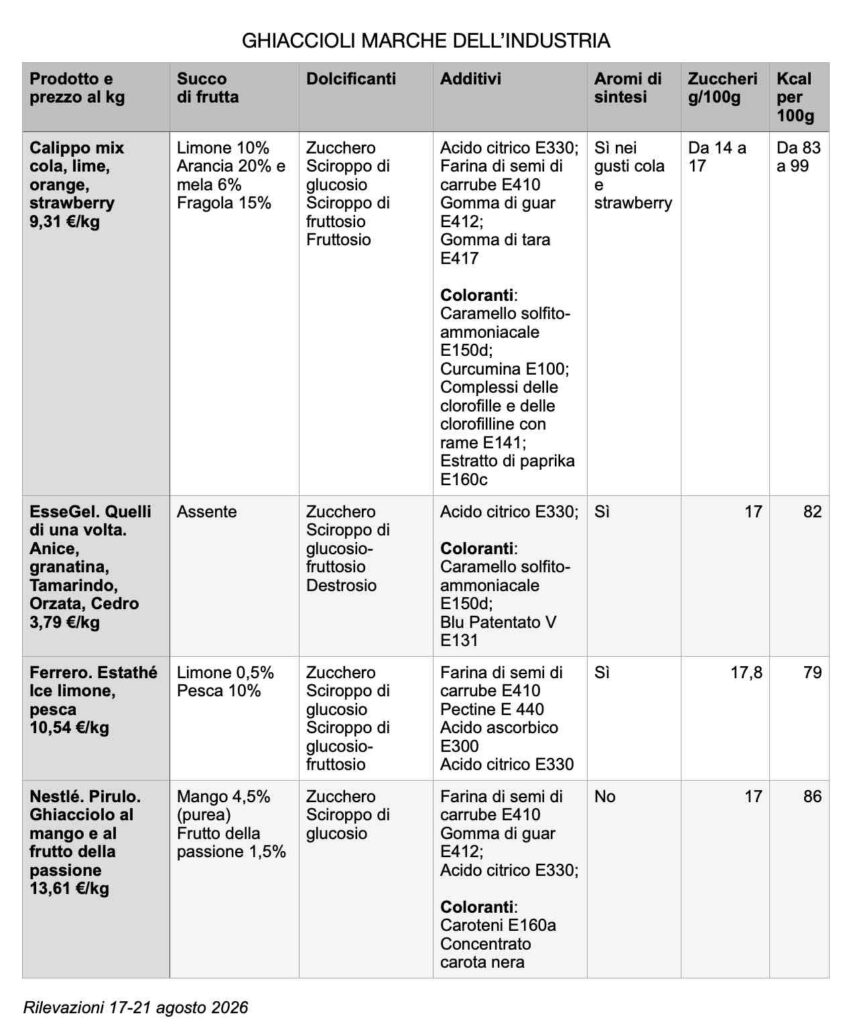
Among the popsicles of thebranded industry (BIM), Calippo orange flavor reaches a maximum peak with 20% of citrus juice to which 6% apple juice is added; 15% in strawberry flavor — where unfortunately synthetic flavor appears — and 10% in lemon flavor. EsseGel at the bottom of the list, without any juice but with synthetic flavors in every variant.
The three popsicles without added sugars different from the only organic product do not exceed 2.5% juice. Among those offered in the discount, infine, Eurospin e Lidl raggiungono il picco massimo di categoria con il succo di arancia (11%).
Flavors, synthetic or natural or ‘naturally from…’
The taste of the popsicles can come from fruit juice – always from concentrate – or from natural flavors (as indicated in the ingredient list) or also from synthetic flavors (simply labeled as ‘flavors’ on the packaging).
The cheapest synthetic flavors are added always, in ogni gusto, nei ghiaccioli di EsseGel, Ferrero Estathé, Indianino, Conad (salvo che per il gusto Limone), Todis:
- they often simulate the flavor of ‘small berries‘, as in the cases of strawberry of Calippo, sour cherry from Coop BeneÌ, Carrefour Classic and Polaretti Dolfin (which also use it in the orange flavor);
- the synthetic flavors are then always present nel gusto ‘cola’, con eccezione di Coop che negli Spesotti usa estratto di malto d’orzo. Al di fuori di questo unico ‘gusto’, Esselunga, Eurospin e Lidl impiegano soltanto aromi naturali.
Gli aromi naturali sono invece sempre impiegati nei diversi gusti dei ghiaccioli Coop, Coop Spesotti, La Finestra sul Cielo (bio), Sammontana Levia, nel Pirulo di Nestlé.
‘Quando la dicitura ‘aroma naturale’ è accompagnata dal riferimento a un alimento (ad esempio, aroma naturale di… limone)‘ – spiega l’avvocato Dario Dongo, Ph.D. in diritto alimentare europeo – ‘il componente aromatizzante deve invece venire ottenuto esclusivamente o almeno per il 95% in peso dall’alimento indicato come materiale di base, ai sensi del regolamento (CE) n. 1334/08, articolo 16, comma 4‘.
Natural ‘colored’ ingredients and coloring additives
Il colore dei ghiaccioli viene attribuito sempre più spesso con ingredienti naturali (Dongo & Della Penna, 2022). Estratti e concentrati di spirulina, cartamo, barbabietola rossa, carota, per citarne alcuni, hanno maggiori costi e talora minore efficacia ma incontrano il favore dei consumatori, sempre più attenti alla ‘clean label‘.
Negli ultimi mesi – dopo che l’attuale Segretario alla Salute negli Stati Uniti Robert F. Kennedy Jr. aveva dichiarato battaglia ai ‘coloranti artificiali’, nell’ambito della sua campagna MAHA (Make America Healthy Again), annunciando con FDA l’eliminazione dei coloranti sintetici di origine petrolifera dagli alimenti statunitensi entro la fine del 2026 (U.S. Food and Drug Administration, 2025) – Nestlé USA ha completato la rimozione dei coloranti FD&C (Food, Drugs and Cosmetics) dal proprio portafoglio statunitense e WK Kellogg ha annunciato di eliminarli da tutti i suoi cereali entro la fine del 2026, con un anno di anticipo sull’impegno assunto. Sull’altra sponda dell’Atlantico, Coop Italia persegue dagli anni Settanta del secolo scorso una politica di riduzione degli additivi nei prodotti a marchio, che oggi esclude del tutto gli additivi coloranti, inclusi quelli di derivazione naturale.
La transizione dagli additivi coloranti alle fonti vegetali o algali colorate è dunque segnata, ma non tutti sono riusciti a completarla. Così tra i ghiaccioli esaminati si riscontra ancora la presenza di alcuni additivi controversi, sebbene il loro impiego sia autorizzato in Unione Europea – a determinate condizioni ed entro precisi limiti – sulla base delle valutazioni dei rischi eseguite da EFSA (European Food Safety Authority). Among these:
- patented blue V (E 131). Synthetic dye from the triphenylmethane group. EFSA has redefined the ADI from 15 to 5 mg/kg body weight per day. At the maximum permitted use levels, exposure estimates exceed the ADI in young children and high-consuming children (EFSA ANS Panel, 2013). It is found in EsseGel ice lollies anise flavor;
- carmine red (E 120). It is not synthetic in origin as it derives from the insect Dactylopius coccus, and is therefore not compatible with vegetarian and vegan diets (Dongo, 2022). EFSA has confirmed the acceptable daily intake (ADI) of 5 mg/kg body weight per day. Regulation (EU) No 231/2012 also defined a maximum protein content in the purity specifications in view of documented allergic reactions (EFSA ANS Panel, 2015b;). It is still present in some ice lollies to prepare Polaretti by Dolfin;
- sulphite ammonia caramel (E 150d). May contain traces of 4-methylimidazole (4-MEI), a by-product of the Maillard reaction classified by IARC as ‘possibly carcinogenic to humans‘ (group 2B). EFSA has furthermore excluded that caramel colorings are genotoxic or carcinogenic, has established a group ADI of 300 mg/kg of body weight per day and, after reviewing the literature on 4-MEI, has concluded that the highest level of exposure related to consumption of foods with E 150c and E 150d does not raise concerns, considering the maximum limit set in the purity specifications, equal to 250 mg/kg on an equivalent color basis, as adequate (EFSA ANS Panel, 2011; EU Regulation No. 231/2012).Among the examined popsicles, E 150d appearsamong the ingredients of EsseGel Tamarind flavor, Calippo and Gelatelli Lidl for the cola flavor;
- annatto norbixin (E 160b(ii)). Natural coloring extracted from the seeds of a tropical tree (Bixa orellana L.). EFSA derived an ADI of 0.3 mg/kg body weight per day for norbixin (EFSA ANS Panel, 2016), concluding that the estimated exposure levels do not pose a health concern, although approaching the ADI in young children with high consumption in a single country (EFSA FAF Panel, 2019). It is found in Carrefour Classic, Eurospin Dolciando and Todis ice lollies.
Two other coloring additives attract attention:
- curcumin (E 100). The risk is linked to its widespread use in processed foods and the consequent ease, for children, of exceeding the ADI of 3 mg/kg body weight per day, established by EFSA based on a reproductive toxicity study over two generations. Average exposure estimates remain below the ADI in all population groups, which is only reached in high consumption estimates in young and older children (EFSA ANS Panel, 2010; EFSA, 2014);
- copper complexes of chlorophylls and chlorophyllins (E 141). EFSA concluded that available data on absorption, genotoxicity, chronic toxicity, carcinogenicity and reproductive toxicity are insufficient to evaluate its safety, and therefore recommended revoking the existing ADI (EFSA ANS Panel, 2015a). The position was reaffirmed even in an attempt to authorize the use of this colorant in table olives. Both are found in Calippo, Conad and Eurospin ice lollies.
Citric acid and thickeners
Among other additives stands out the omnipresence ofcitric acid E 330. It is an acidity regulator and prevents browning of foods. Almost the entire sample then contains thickeners of the gum type, linked by the potential risk of causing intestinal disorders in case of excessive consumption: guar gum E 412, locust bean gum E 410 (both also associated with allergic reactions), xanthan gum (E 415) and tara gum (E 417).
The alternative thickeners than gums and considered free of 'side effects' are instead less widespread:
- thesodium alginate E 401 appears among the ingredients of Indianino and Coop BeneSì, both without added sugars and with sucralose;
- the pectins E 440. In the industrial sector they are extracted from dried apple residues or the dried peel of various fruits. They are found only in Estathé by Ferrero.
An innovative choice is made by Sammontana which includes in the recipe (in second place, between water and sweeteners) the polydextrose, a synthetic glucose polymer that acts as an indigestible fiber, useful to the intestinal microbiota, and also suitable to perform the function of thickener. The Sammontana popsicle thus stands out among all for its richness in fiber, equal to 8.3%.
The abused ‘gluten-free’ and the ‘sulfites’ possibly absent
Almost all of the popsicles examined are qualified as ‘gluten-free’. The labels of two products also report the possible presence of food allergens: the Milk in Calippo and the sulfites in the lemon juice of Sammontana. Some observations in this regard from our lawyer Dario Dongo:
- l'indication ‘gluten-free’ on a product typically free of gluten because made with water, fruit juice and sugar unfortunately expresses inattention to the current rules and constitutes an unfair information practice, as seen. Law 75/2026 has furthermore increased the administrative penalties for violations of such rules up to 3% of annual turnover, even if within the limit of 100,000 euros;
- the declaration of possible presence of sulfites in a popsicle derives in turn, most likely, from an oversight in the revision of thelabel. The presence of sulfites is not in fact subject to doubtful indications such as 'may contain': their concentration in the finished product must instead be measured (or calculated) and their presence cited only if it is higher than 10 mg/kg, or 10 mg/L in beverages (Regulation (EU) No 1169/2011, Annex II, point 12). And it is unlikely that the sulfite content in a citrus juice widely diluted in water, before freezing, can reach such a threshold‘ (Dongo, 2025b).
Conclusions
The sector of ‘Made in Italy’ popsicles, as it appears from the market survey conducted on the sample of the 17 most widespread products on the shelves of Italian supermarkets, is overall appreciable from a nutritional point of view, also considering that these are indulgence products whose consumption is reserved for the hottest months of the summer season.
The organic choice proves to be winning, due to the absence of added sugars and a recipe of utmost simplicity. The other popsicles meet various needs: from the reduced energy intake of products with sweeteners, where the fruit juice is also scarce — with the added functionality of fibers from polydextrose only in ‘Levia’ by Sammontana — to the more classic ones.
Reading the label is always useful, even in this last case, to favor products with a higher amount of fruit juice, those without coloring additives (if anything with ‘colored’ ingredients) and above all with natural flavors instead of synthetic ones. Coop Italia sets an example. And conscious consumption can encourage virtuous choices by operators even on these products.
Marta Strinati
Credit cover Anita Austvika on Unsplash
Notes
Insights into food law
Dongo, D. (2022, June 10). Cochineal, E 120. A coloring additive suitable for vegetarians and vegans? Lawyer Dario Dongo answers. FARE (Food and Agriculture Requirements). https://www.foodagriculturerequirements.com/notizie/domande-e-risposte/cocciniglia-e-120-un-additivo-colorante-adatto-per-vegetariani-e-vegani/
Dongo, D. (2025a, October 27). ‘Gluten-free’ illegal. FARE (Food and Agriculture Requirements). https://fareagrifood.com/2025/10/27/senza-glutine-fuorilegge/
Dongo, D. (2025b, June 13). Sulfites in the ingredient list of non-alcoholic beverages. FARE (Food and Agriculture Requirements). https://fareagrifood.com/2025/06/13/solfiti-bevande-analcoliche/
Dongo, D. (2026, January 14). ‘GMO-free’ and ‘gluten-free’ milk and cheese? FARE (Food and Agriculture Requirements). https://fareagrifood.com/2026/01/14/latte-formaggio-senza-ogm-senza-glutine/
Dongo, D., & Della Penna, A. A. (2022, December 24). Food colorings and their extracts. Ingredients or additives? FT (Food Times). https://www.foodtimes.eu/it/ricerca/alimenti-coloranti-e-loro-estratti-ingredienti-o-additivi/
Regulatory sources of the European Union
Commission Regulation (EU) No 231/2012 of 9 March 2012 laying down specifications for food additives listed in Annexes II and III to Regulation (EC) No 1333/2008 of the European Parliament and of the Council. Consolidated text: 18/08/2026. http://data.europa.eu/eli/reg/2012/231/2026-08-18
Regulation (EC) No 1334/2008 of the European Parliament and of the Council of 16 December 2008 on flavourings and certain food ingredients with flavouring properties for use in and on foods. Consolidated text: 16/02/2026. http://data.europa.eu/eli/reg/2008/1334/2026-02-16
Regulation (EU) No 1169/2011 of the European Parliament and of the Council of 25 October 2011 on the provision of food information to consumers. Consolidated text: 01/04/2025. http://data.europa.eu/eli/reg/2011/1169/2025-04-01
Italian regulatory sources
Law 21 April 2026, No. 75. Sanctioning provisions for the protection of Italian food products. Normattiva. Latest consolidated version: 29/05/2026. https://www.normattiva.it/uri-res/N2Ls?urn:nir:stato:legge:2026-04-21;75
Scientific literature
EFSA (European Food Safety Authority). (2014). Refined exposure assessment for curcumin (E 100). EFSA Journal, 12(10), 3876. https://doi.org/10.2903/j.efsa.2014.3876
EFSA Panel on Food Additives and Flavourings (FAF). (2019). Scientific Opinion on the safety of annatto E and the exposure to the annatto colouring principles bixin and norbixin (E 160b) when used as a food additive. EFSA Journal, 17(3), 5626. https://doi.org/10.2903/j.efsa.2019.5626
EFSA Panel on Food Additives and Nutrient Sources added to Food (ANS). (2010). Scientific Opinion on the re-evaluation of curcumin (E 100) as a food additive. EFSA Journal, 8(9), 1679. https://doi.org/10.2903/j.efsa.2010.1679
EFSA Panel on Food Additives and Nutrient Sources added to Food (ANS). (2011). Scientific Opinion on the re-evaluation of caramel colours (E 150 a,b,c,d) as food additives. EFSA Journal, 9(3), 2004. https://doi.org/10.2903/j.efsa.2011.2004
EFSA Panel on Food Additives and Nutrient Sources added to Food (ANS). (2013). Scientific Opinion on the re-evaluation of Patent Blue V (E 131) as a food additive. EFSA Journal, 11(3), 2818. https://doi.org/10.2903/j.efsa.2013.2818
EFSA Panel on Food Additives and Nutrient Sources added to Food (ANS). (2015a). Scientific Opinion on re-evaluation of copper complexes of chlorophylls (E 141(i)) and chlorophyllins (E 141(ii)) as food additives. EFSA Journal, 13(6), 4151. https://doi.org/10.2903/j.efsa.2015.4151
EFSA Panel on Food Additives and Nutrient Sources added to Food (ANS). (2015b). Scientific Opinion on the re-evaluation of cochineal, carminic acid, carmines (E 120) as a food additive. EFSA Journal, 13(11), 4288. https://doi.org/10.2903/j.efsa.2015.4288
EFSA Panel on Food Additives and Nutrient Sources added to Food (ANS). (2016). The safety of annatto extracts (E 160b) as a food additive. EFSA Journal, 14(8), 4544. https://doi.org/10.2903/j.efsa.2016.4544
Press releases and cooperative magazines
Consumers. (2018, February 1). Coop product, 70 years of quality and innovation. Consumers. https://consumatori.coop.it/mondo-coop/prodotto-coop-70-anni-qualita-innovazione/
Consumers. (2026, February 9). For Coop products, only natural colorants. Consumers. https://consumatori.coop.it/mondo-coop/per-i-prodotti-coop-solo-coloranti-naturali/
Coop Italy. (n.d.). Coop and the environment: our commitment to the earth. Coop. https://www.coop.it/storie-e-impegno/ambiente/impegno-terra
Unicoop Florence. (n.d.). The consumerist campaigns (1978-1997). Our history. https://www.coopfirenze.it/storia/articoli/Le-campagne-consumeriste
Nestlé USA. (2026, June). Delivering on our promise to consumers: We’re out of FD&C colors. https://www.nestleusa.com/stories/delivering-our-promise-out-fdc-colors
U.S. Food and Drug Administration. (2025, April 22). HHS, FDA to phase out petroleum-based synthetic dyes in nation’s food supply. https://www.fda.gov/news-events/press-announcements/hhs-fda-phase-out-petroleum-based-synthetic-dyes-nations-food-supply
WK Kellogg Co. (2026, August 6). WK Kellogg Co will eliminate artificial colors in all cereal manufacturing by the end of 2026. PR Newswire. https://www.prnewswire.com/news-releases/wk-kellogg-co-will-eliminate-artificial-colors-in-all-cereal-manufacturing-by-the-end-of-2026-302844951.html

Professional journalist since January 1995, she has worked for newspapers (Il Messaggero, Paese Sera, La Stampa) and magazines (NumeroUno, Il Salvagente). Author of investigative reports on food, she published the book 'Reading labels to know what we eat'.


