
Less than half of Italians regularly use iodized salt, even though this supplement is recommended by national health authorities. Commercially available salt containing a small dose of potassium iodate is widely available, in both rock salt and sea salt forms. But be careful: the iodine can be lost during cooking unless certain precautions are taken. This is a good opportunity to compare 15 brands of iodized salt.
The Benefits and Limitations of Iodized Salt
The Iodized salt is salt to which potassium iodide has been added. In Italy, the consumption of iodized salt is recommended for the general population to prevent endemic goiter and other iodine-deficiency disorders.
According to surveys conducted by the PASSI public health system—coordinated by the Istituto Superiore di Sanità (ISS)—covering the 2023–2024 period, 78% of respondents use iodized salt, with 47% using it all the time and 15% using it often. The heaviest consumers are women, the wealthiest and most educated groups, and Italians compared to foreign residents in Italy.
Salt: no more than 5 grams per day
Whether iodized or not, according to the World Health Organization (WHO), salt intake should not exceed 5 grams per day, which corresponds to about 2 grams of sodium. Excessive salt intake increases the risk of cardiovascular diseases related to high blood pressure, as well as other chronic degenerative diseases, such as cancers of the digestive system—particularly stomach cancer—osteoporosis, and kidney disease.
In Italy—as in Europe and around the world—salt intake levels are still far below the recommended amounts, but more than 5 out of 10 people (57%) are mindful of or try to reduce the amount of salt they consume at the table, when preparing food, and when eating processed foods.
The Instability of Iodized Salt During Cooking
By Decree No. 562/95, the ministry of Health (now of Health) has authorized the sale of iodized salt with a level of iodine supplementation sufficient to ensure an ionic iodine content of 30 mg per kg of product. Nearly all of the salts tested contain exactly this amount, while two exceed it. The real question, however, is another: how much iodine remains on the plate, and how much is lost?
The stability The stability of potassium iodate varies depending on how the iodized salt is used. It generally remains stable below 300 °C—the temperature used for baking or boiling—but the heat resistance decreases dramatically when it comes into contact with certain foods:
– up to 100–150 °C when in contact with foods rich in vitamin C (ascorbic acid), such as lemon juice, tomato sauce, citrus fruits, bell peppers, and vinegar;
– up to 160–180 °C for prolonged cooking and frying in olive oil or vegetable oil;
– up to 200–220 °C when baking foods high in moisture and sugar, such as bread and pizza dough and other baked goods.
Unfortunately, this clarification never appears on labels, and no one suggests that Add iodized salt after cooking. In three cases, however, there is a note regarding the heat resistance of iodine.
The claim “Protected Iodine”
The most striking example comes from the company Caber, which in 2006, in collaboration with the University of Bologna, patented a innovative technology capable of protecting iodine from the aforementioned risks of degradation. The use of this technology is highlighted on the label with the claim ‘Protected Iodine'.
The claim appears on products PreSal from Caber, which we found in large-scale retail only in the small package with a shaker—and was therefore excluded from the comparison—and on the brand-name iodized sea salt Coop BeneSì Plus (also manufactured by Caber).
The Rise of Cuor di Sale
A less assertive statement about the ‘High stability and persistence, even during cooking"Iodine" is also listed on the packaging of iodized sea salt Heart of the Sea e Salino, Puglia, two Atisale brands whose raw material is sourced primarily from the historic saltworks in Margherita di Savoia, in Puglia.
In this case, however, the cutting-edge techniques consist of spraying of salt crystals in motion with an aqueous solution of potassium iodide. This process improves the distribution of iodine throughout each granule, but it does not create protective physical barriers, as is the case with the PreSal process.
Anti-caking additives
Salt often contains additives that act as anti-caking agents:
– E 536, potassium ferrocyanide: Its mechanical purpose is to prevent salt crystals from clumping together and forming compact blocks (coagulation) by absorbing moisture from the environment. Its use is permitted only in salt and salt substitutes. It is not permitted in organic products;
– E 535, sodium ferrocyanide: same family as the previous one;
– E 504, magnesium carbonates.
The Origin of Salt
The origin of the salt is rarely indicated. But it's easy to determine based on the manufacturer:
– CIS – Italian Salt Company (Gemma di Mare) is part of the French Salins Group. At its plant in Porto Viro, in the province of Rovigo, it packages imported salt (primarily from French salt flats) and Italian salt, following the acquisition of Atisale, the company that manages the Margherita di Savoia salt flats in Puglia (the largest in Europe) and those of Sant’Antioco in Sardinia: both of these origins are listed on the label. The salt is transported by sea and packaged in Porto Viro, a strategic location for northern markets. On CIS salt labels, it is common to see the origin listed as “Mediterranean Sea,” which seems to suggest the French salt flats;
– Italkali (Sale di Sicilia) extracts natural rock salt from the underground mines in Petralia (Palermo), Racalmuto, and Realmonte (Agrigento). With the acquisition of the historic Conti Vecchi Salt Flats in Cagliari, Italkali It also produces sea salt domestically. The salt is packaged in Sicily and shipped by sea to markets in the north.
Fine, iodized sea salt
A comparison of the 6 brands of Fine, iodized sea salt It highlights the consistent presence of anti-caking additives. The iodine concentration is always 3 mg/100 g, with the exception of Coop BeneSì Plus (the one with “Protected Iodine”), which contains 4 mg.
The salt is Italian 4 out of 6 times.
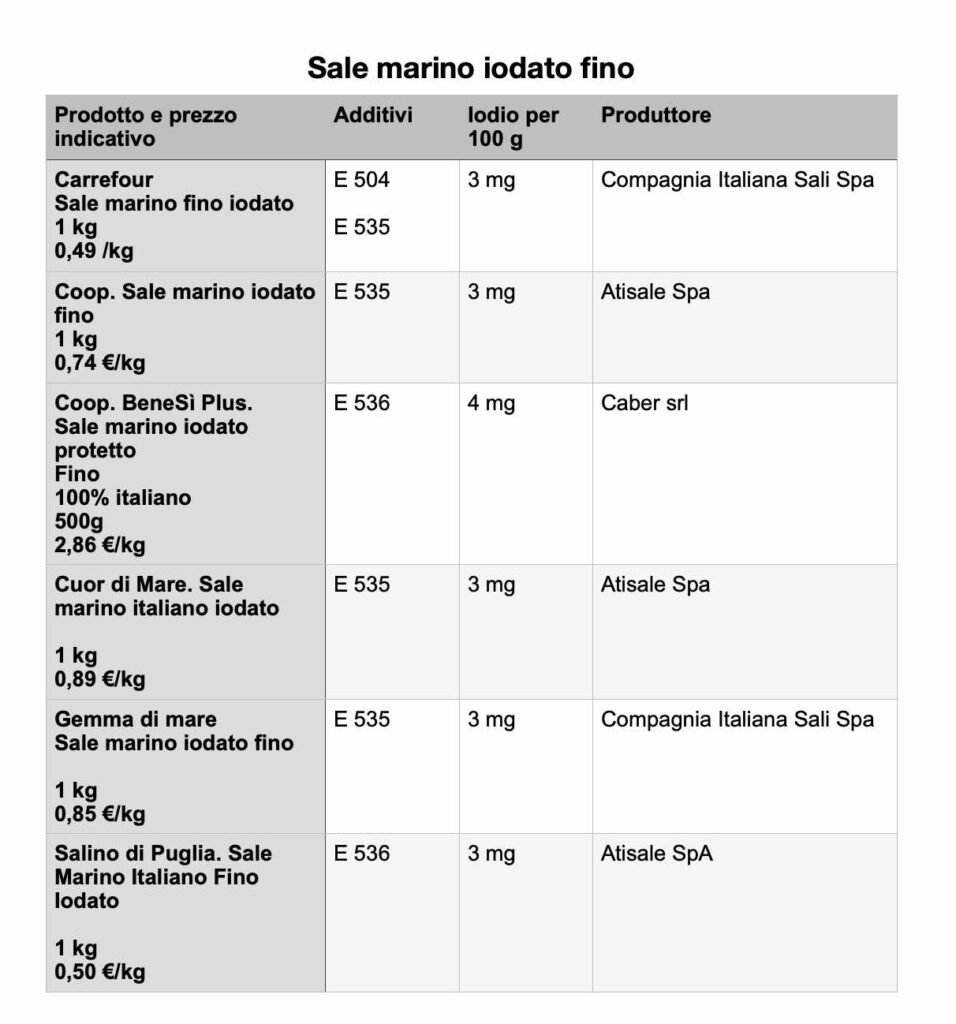
The Salino di Puglia (Atisale) label deserves special mention, as it states, ‘Contains no fat, cholesterol, or sugar'. 'An entry that needs to be corrected’ — spiega l’avvocato Dario Dongo, fondatore di GIFT (Great Italian Food Trade) — ‘poiché il regolamento (UE) n. 1169/11 vieta espressamente di attribuire a un alimento caratteristiche comuni ai prodotti che appartengono alla stessa categoria. Lo stesso regolamento ha inoltre vietato qualsivoglia richiamo al tenore di colesterolo negli cibi, per evitare di confondere i consumatori circa possibili effetti sui livelli di colesterolo ematico, in assenza di correlazione tra i due valori‘.
Iodized rock salt
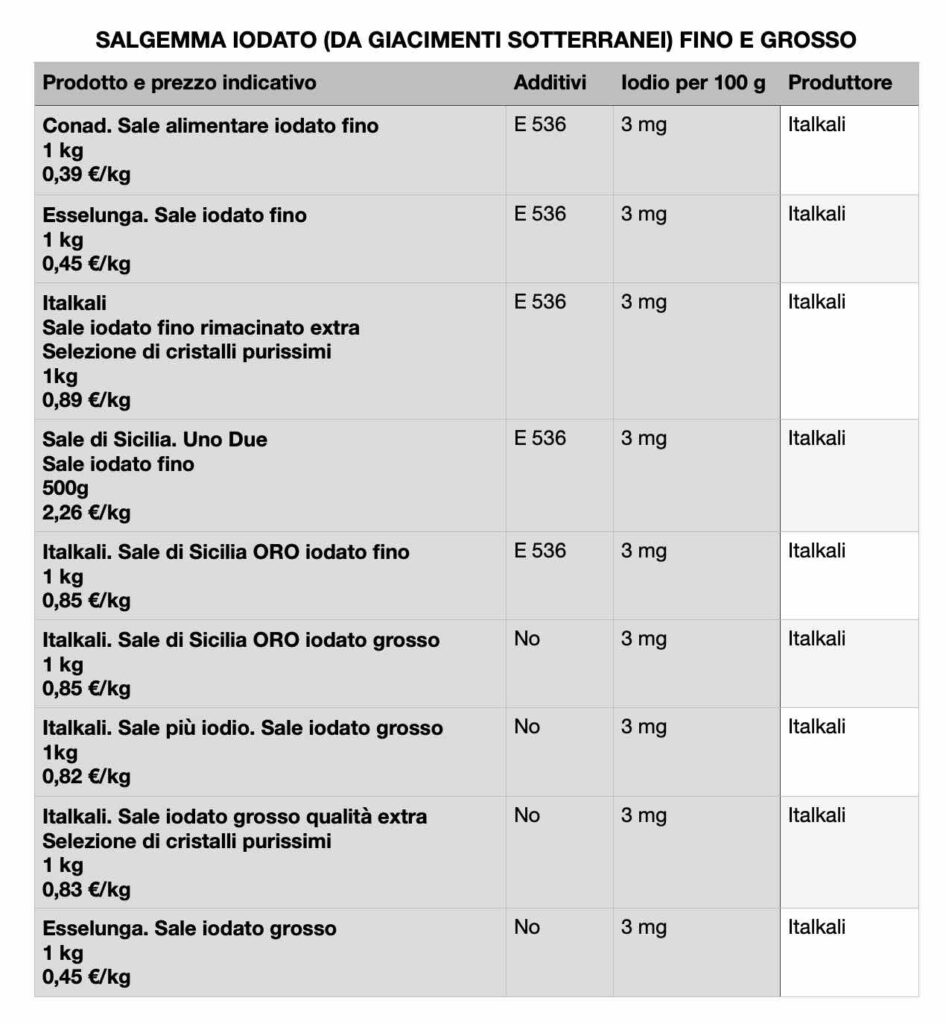
When it comes to rock salt, extracted from salt mines, Italkali has no competition in Italy.
Anti-caking additives are found only in fine table salt; the iodine content is always 3%. Prices follow marketing trends, which promote “premium” versions of salt extracted from the same mines.
Marta Strinati
References
National Institute of Health. PASSI Surveillance (Progress of Health Authorities for Health in Italy). 2023–2024. Salt intake https://www.epicentro.iss.it/passi/dati/sale
Legislation. Law No. 55 of March 21, 2005. Provisions aimed at preventing endemic goiter and other iodine-deficiency disorders. https://www.normattiva.it/uri-res/N2Ls?urn:nir:stato:legge:2005:55
Normattiva. Ministry of Health. Decree No. 562 of August 10, 1995. Regulations concerning the production and sale of iodized table salt, iodated salt, and salt that is both iodized and iodated. https://www.normattiva.it/uri-res/N2Ls?urn:nir:ministero.:decreto:1995-08-10.562

A professional journalist since January 1995, she has worked for daily newspapers (Il Messaggero, Paese Sera, La Stampa) and magazines (NumeroUno, Il Salvagente). As the author of investigative reports on food, she has published the book *Reading Labels to Know What We Eat*.


