

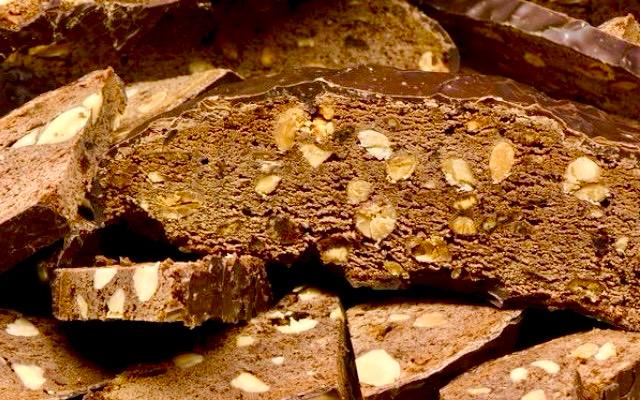
The panpepato is one of the oldest Christmas sweets in the peninsula, a compact mixture of dried fruit, candied fruit, honey, cocoa and spices. Two Protected Geographical Indications (PGI) protect today the most well-known versions: the Pampepato di Terni PGI, registered in 2020, and the Pampapato di Ferrara PGI, registered in 2015. The first contains chocolate in the dough, the second spreads it into a thick extra dark coating.
Alongside the PGIs, the national list of Traditional Agri-food Products (PATs) records the Umbrian pampepato, the panpepato, the panpapato and the pangiallo from Lazio. Unlike panettone and pandoro, where industrial production is clearly dominant, panpepato is born mainly in artisanal bakeries and confectionery shops, as well as in small confectionery and bakery enterprises in the area. Following are the market, documented history, regulations, PATs, composition and consumption occasions.
The panpepato market: bakeries, confectionery shops and small local enterprises
The great leavened products for the holidays follow an industrial logic. The confectionery industry represented by Unione Italiana Food produced in approximately 2024 90 K tonnes By panettone e pandoro, for a value of 596.3 million euros, with 13,468 tonnes exported (Manuelli, 2025). Also the nougat It counts on industrial nougat factories capable of supplying modern distribution in Italy and abroad.
Gingerbread follows another path. There are no large confectionery groups that make it a mass product, nor public statistics on the certified volumes of the two PGIs. The production is headed by a network of laboratories of an artisanal or small-industrial dimension, rooted in their cities of origin. In Terni the PGI promoting group was born from the membership of 20 producers, local pastry shops and bakeries, in a phase in which local production had grown by over 50% in two years (UmbriaOn, s.d.). In Ferrara, the PGI was desired by the city's producing companies, to whom the specification leaves room for customizing the recipe (Travel Emilia-Romagna, 2025).
This supply chain, however, rests on a broad base. As of 31 March 2025, registered artisanal gelato makers and pastry chefs in Italy were 12.962 (Unioncamere-InfoCamere, 2025). The Umbrian TAP sheet indicates as processing facilities the bread-making or pastry-making laboratory with a point of sale (Umbria Region, N/A).
Also the consumption season is extending. As with panettone, pandoro, nougat and ricciarelli, sweets increasingly less tied to the Christmas calendar alone, 54% of Italians report consuming festive leavened products also before and after the holidays (Manuelli, 2025). In Terni, panpepato is thus found in the months following Christmas in some bakeries and pastry shops (Lorenzoni, 2018).
Peppery bread, Pope's bread: documented history
The roots of the sweet are medieval. In Siena the spiced bread was prepared for Christmas as early as 14th century, as a progenitor of panforte (Accademia della Crusca, 2017).
A Ferrara the tradition dates back to 16th century, in the convent of the cloistered nuns of Corpus Domini, where spiced bread was prepared to offer to prelates at Christmas. The sweet later entered the Este court; the domed shape recalls the cardinal's hat. The Chocolate arrived in 1902, when a pastry chef opened a laboratory in the historic center and coated the bread with dark chocolate, decreeing its fortune (Ferrara PGI regulations). The name itself, Pope's bread, is traced back to the city's transition to the Papal States.
In Umbria the disciplinary rules place the origins of Terni pampepato in 16th century, at least for the composition of the ingredients, and defines it as 'the Christmas dessert par excellence'. The first large-scale professional production dates back to 1913, in a Terni pastry shop. The name panpepato was later replaced by pampepato, also due to the effect of the Gentile school reform of 1923 (PGI Terni disciplinary rules). The oldest written recipe known today dates back to 1851 (Umbria Region, N/A).
An original Umbrian track then leads to Narni, where the historian Francesco Bussetti documents the presence of the dessert already in Eighteenth century. The Marquis Giovanni Eroli, in a memorial of 1840, transcribes the recipe of the nuns of San Bernardo: flour, walnuts, ten pounds of Honey, half a pound of pepper, sultanas, cloves, candied fruit, with a sugar and chocolate glaze (Terni Municipal Library, n.d.). Bussetti also wonders about a possible link with the Ferrara dessert.
The PGIs of panpepato and their regulations
The two PGIs belong to the class of bakery, pastry and confectionery products (Implementing Regulation (EU) 2015/2267; Implementing Regulation (EU) 2020/1538).
Pampepato di Terni PGI
The Pampepato di Terni PGI, or Panpepato di Terni PGI, is a round domed cake, with a flat base, a diameter of 1 to 20 cm and a weight of 25 grams to 1 kg. The exterior is dark brown, almost black, with dried fruit visible; on the palate it opens on chocolate, then on dried fruit and candied fruit, with a strong finish of chocolate and spices (regulation, article 2).
The production area includes the entire province of Terni as well as six municipalities in the province of Perugia: Massa Martana, Marsciano, Todi, Fratta Todina, Montecastello di Vibio and Deruta (regulation, article 3).
The recipe is set for 10 kg of raw dough. The roasted dried fruit, among almonds, walnuts e hazelnuts, weighs 4 to 6 kg. Followed by raisins and orange and citron candied fruit (1.5-3 kg), wildflower honey (0.5-1.5 kg), chocolate with at least 50% cocoa (0.5-1.5 kg), bitter cocoa, Coffee, pepper, cinnamon, nutmeg and very little flour, wheat or corn, rice or almonds. Cooked must, liqueur, pine nuts and orange zest are optional; sugar cannot exceed 50 grams. Water must never be added, nor are colorants or preservatives allowed (regulation, article 4).
The method involves cooking at 160-200 °C for 5-25 minutes, depending on the size, and cooling for at least 12 hours. The first sealed wrapper must be applied at the production site, as the air disperses the aromas, brings out the cocoa butter and softens the dried fruit. The dessert is sold whole or in slices (regulation, article 4). The controls are carried out by 3A – Umbria Agri-Food Technology Park (disciplinary).
Pampapato di Ferrara PGI
The Pampapato di Ferrara PGI, or Pampepato di Ferrara PGI, has a cap shape, flat base and convex surface, covered in dark chocolate extra shiny. The sizes range from 10 grams to 3 kg, with a diameter from 3 to 35 cm. The scent opens on chocolate, then on nutmeg, cinnamon, candied fruit and toasted almonds (disciplinary). The production area is the entire province of Ferrara.
The specification defines the recipe for 100 kg of raw dough with approximately 35 kg of type '0' soft wheat flour, 25 kg of candied orange, lemon and citron fruit, 15 kg of sweet almonds toasted in their skin, 15 kg of sugar, 10 kg of bitter cocoa, in addition to spices, including nutmeg and cinnamon. Wildflower honey can partially replace sugar, up to 5 kg, while toasted hazelnuts can accompany almonds. There coverage requires approximately 12 kg of extra dark chocolate with at least 54% cocoa (regulation). It is one of the few desserts no added fat: no milk, butter, oil or lard (Emilia-Romagna Region, n.d.).
THE'dough it is worked for 35-45 minutes, portioned, shaped and cooked at 180-220 °C for 15-90 minutes. One follows maturation 1-4 days in an environment with relative humidity of 75-90%, or an immersion in an alcoholic orange bath, then covering. The first sealed wrapping is applied at the production site (disciplinary). The checks are entrusted to Agroqualità (Emilia-Romagna Region, 2024).
Traditional Agri-food Products and municipal designations
The national list of Traditional Agri-food Products, which reached its twenty-sixth revision in 2026, includes various variations of the dessert (MASAF, 2026).
In Umbria The pampepato it is PAT in the Terna area as well as in the municipalities of Massa Martana, Todi, Marsciano, Deruta and Stroncone. The card describes a round loaf with walnuts, raisins, almonds, hazelnuts, pine nuts, candied fruit, cocoa, honey, cooked must, coffee, lemon, pepper, cinnamon, mistrà or Marsala PDO dry, little sugar and very little flour (Umbria Region, n.d.). The same Umbrian list includes strufoli and castagnole, the fried desserts of the holidays, for which the choice of frying oils affects the result.
The Lazio includes pampepato, panpapato and pangiallo (ARSIAL, 2026). In Tuscany the family includes panforte di Massa Marittima as well as chocolate-glazed panforte from Pistoia (MIPAAF, 2022), alongside Panforte di Siena PGI.
Calendar and consumption occasions
In Terni the season opens on 8 December, when many kitchens in the city prepare pampepato (Terni Municipal Library, n.d.). Since 2009, a local city restaurant has been awarding the 'Pampepato of the Year' award: the winner receives a wooden pastry spoon, destined to be passed on to the next winner every year. In 2002 the Terni pastry chefs created a 112 kg pampepato (IGP Terni specification). The festival every November Sweet Pampepato brings together certified producers in the city center.
In Ferrara the dessert is exchanged at Christmas between relatives, friends and colleagues as an 'act of gratitude, an expression of cordiality, a symbolic gesture of affection' (IGP Ferrara regulations). The minimum sizes, 10 grams, are also suitable for corporate gifts.
Conclusions
Gingerbread combines a common matrix, dried fruit, honey or sugar, cocoa and spices, with two interpretations protected by the European Union. The Pampepato di Terni PGI focuses on dried fruit and chocolate in the dough, the Pampapato di Ferrara PGI on the extra dark coating and the absence of added fats. The PAT from Umbria and Lazio, together with the Tuscan panforti, complete a family of spicy desserts from central Italy.
Unlike large leavened products, this dessert remains entrusted to pastry shops, bakeries and small local companies, which keep the recipes and sizes. For international buyers, the two PGIs offer a product with certified origin, with preservation guaranteed by the sealed packaging and the absence of added water.
Dario Dongo
Frequently asked questions
How many PGIs exist for pampepato? Two: Pampepato di Terni PGI, registered in 2020, and Pampapato di Ferrara PGI, registered in 2015.
How do the panpepato of Terni and that of Ferrara differ? The Terni dessert contains chocolate in the dough, with 40-60% dried fruit, and has no mandatory covering; the Ferrara one is covered in extra dark chocolate with at least 54% cocoa and contains no added fat.
Where is Pampepato di Terni PGI produced? In the entire province of Terni and in six municipalities of the province of Perugia: Massa Martana, Marsciano, Todi, Fratta Todina, Montecastello di Vibio and Deruta.
Is panpepato an industrial product? Largely no: unlike panettone and pandoro, it is produced mainly by pastry shops, bakeries and small local confectionery companies.
Which regions recognize panpepato as a Traditional Agri-food Product? Umbria, with pampepato, and Lazio, with panpepato, panpapato and pangiallo; Tuscany registers the panforti of Massa Marittima and Pistoia.
References
Regulations and European rules
Commission Implementing Regulation (EU) 2015/2267 of 24 November 2015 entering a name in the register of protected designations of origin and protected geographical indications [Pampapato di Ferrara/Pampepato di Ferrara (PGI)]. OJ L 322, 8.12.2015, p. 13. http://data.europa.eu/eli/reg_impl/2015/2267/oj
Commission Implementing Regulation (EU) 2020/1538 of 16 October 2020 entering a name in the register of protected designations of origin and protected geographical indications ['Pampepato di Terni'/'Panpepato di Terni' (PGI)]. OJ L 353, 23.10.2020, p. 1. http://data.europa.eu/eli/reg_impl/2020/1538/oj
Ministry of Agricultural, Food and Forestry Policies. (2015). Publication of the production regulation for the Protected Geographical Indication «Pampapato di Ferrara / Pampepato di Ferrara». Official Journal of the Italian Republic, General Series no. 302 of 30.12.2015. https://www.gazzettaufficiale.it/eli/gu/2015/12/30/302/sg/pdf
Ministry of Agricultural, Food, Forestry and Tourism Policies. (2019). Proposal for recognition of the protected geographical indication «Pampepato di Terni/Panpepato di Terni» (19A04816). Official Gazette of the Italian Republic, General Series No. 173 of 25.7.2019. https://unionalimentari.com/wp-content/uploads/2024/09/MIPAAFT-Proposta-riconoscimento-Pampepato-di-TerniCOMPL.pdf
Regulation (EU) 2024/1143 of the European Parliament and of the Council of 11 April 2024 on geographical indications for wine, spirit drinks and agricultural products, as well as traditional specialities guaranteed and optional quality terms for agricultural products, amending Regulations (EU) No 1308/2013, (EU) 2019/787 and (EU) 2019/1753 and repealing Regulation (EU) No 1151/2012. Consolidated text: 18/03/2026. http://data.europa.eu/eli/reg/2024/1143/2026-03-18
PAT lists and institutional sources
ARSIAL. (2026). National List of Traditional Agri-food Products. Lazio Region (Annex I). https://www.arsial.it/wp-content/uploads/2026/06/PAT-Lazio_2026.xlsx.pdf
MASAF. (2026). Twenty-sixth revision of the list of traditional agri-food products. https://www.masaf.gov.it/flex/cm/pages/ServeBLOB.php/L/IT/IDPagina/24151
Emilia-Romagna Region. (n.d.). Pampapato or Pampepato di Ferrara PGI. https://agricoltura.regione.emilia-romagna.it/dop-igp/prodotti-dop-e-igp-emilia-romagna/tutte-dop-igp-emilia-romagna/pampapato-o-pampepato-di-ferrara-igp
Emilia-Romagna Region. (2024). List of PDO and PGI Certification Bodies. https://agricoltura.regione.emilia-romagna.it/dop-igp/temi/prodotti-dop-e-igp-emilia-romagna/elenco-organismi-di-controllo-dop-e-igp-agosto-2023/@@download/file/Elenco%20OdC%20DOP-IGP_RER_febbraio_2024.pdf
Emilia-Romagna Region. (2025). Regional list of traditional agri-food products from Emilia-Romagna. Twenty-sixth revision (determination 23282/2025). https://agricoltura.regione.emilia-romagna.it/dop-igp/altri-regimi-di-qualita/prodotti-tradizionali/elenco-regionale-dei-prodotti-agroalimentari-tradizionali-ventiquattresima-revisione/@@download/file
Umbria Region. (n.d.). List of traditional agri-food products of the Umbria Region. https://regione.umbria.it/documents/18/4766773/Elenco+dei+prodotti+agroalimentari+tradizionali+della+Regione+Umbria/d939510f-7d96-44dc-a710-a62322ff7e18
Umbria region. (s.d.). Identification sheet of traditional Umbrian agri-food products: Pampepato. https://regione.umbria.it/documents/18/9035346/pampepato.pdf/b47e7a33-b22b-4965-a28a-e05be4118efb
Historical and linguistic sources
Accademia della Crusca. (2017, 22 December). Pani di Natale (edited by V. Gheno, Linguistic Consultation). https://accademiadellacrusca.it/it/consulenza/pani-di-natale/1387
Terni Municipal Library. (n.d.). Pampepato (bibliographic sheet on F. Bussetti, Del Panpepato narnese, della sua «esportazione» a Ferrara e altre storie, Il Formichiere, 2020). https://bct.comune.terni.it/sites/default/files/pampepato.pdf
Market and production data
Lorenzoni, A. (2018, 13 February). Panpepato star at Cioccolentino. Terninrete. https://terninrete.it/?p=11133
Manuelli, M. T. (2025, 25 November). Panettone and Pandoro, sales held up for Christmas. But the season is getting longer. Il Sole 24 Ore. https://en.ilsole24ore.com/art/panettone-and-pandoro-sales-held-at-christmas-but-season-lengthens-AHxVuGrD
Unioncamere, InfoCamere. (2025, July 19). More beauticians (+10.4%), fewer carpenters (-10.9%): Italy's artisans are changing their skin (press release, Movimprese data). https://infocamere.it/dam/jcr:c4caf927-a575-441d-8118-8df7b440232b/mestieri_artigiani_luglio2025.2025-07-21-09-31-21.pdf

Dario Dongo, lawyer and journalist, PhD in international food law, founder of WIISE (FARE - GIFT – Food Times) and Égalité.


