

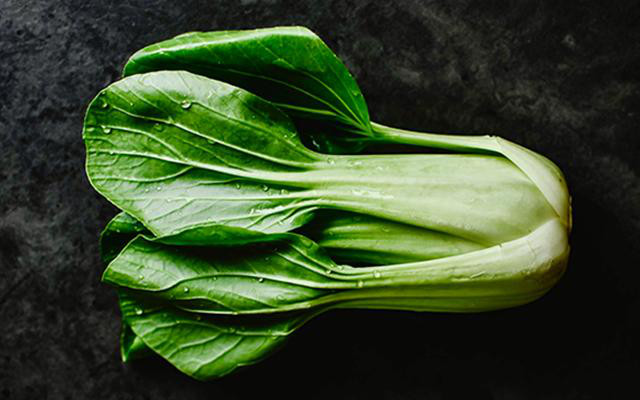
The pak choi, or bok choy, is a leafy vegetable of Asian origin with tender leaves and fleshy ribs, white or light green. The Cantonese name means 'white vegetable', referring specifically to the ribs. In Italy it has been cultivated for over ten years, especially in the Agro Pontino (Lazio) area from where it reaches wholesale markets, catering, and export to Northern Europe (FreshPlaza, 2014; Nieddu, 2025).
Botany: closer to turnip tops than to cabbage
Pak choi is Brassica rapa subsp. chinensis, the same species as turnip and turnip tops, and not Brassica oleracea like cabbage, savoy, and broccoli (Li et al., 2025). And it is different from the elongated-headed Chinese cabbage called napa, which belongs to the subspecies pekinensis (Schuh & MacKenzie, 2022).
It is a cool-season crop. It prefers fertile, well-drained soils but capable of retaining moisture, with a pH between 6.0 and 7.5, and a rotation of at least four years without other brassicas. The main pests include flea beetles and leaf-feeding larvae (Schuh & MacKenzie, 2022).
The Pontine supply chain
The first documented Italian record dates back to 2013. Denis Carnello, a farmer in San Felice Circeo (Latina, Lazio), started a trial on 4,000-5,000 square meters and expanded it to one hectare in 2014. He cultivated by direct sowing, with cycles of 40-70 days, the types with green and white ribs in equal parts. The product went to the Agro-food Center of Rome and approximately 70% abroad, especially to England, through intermediaries (FreshPlaza, 2014).
Ten years later the crop has become a small supply chain. Gianpaolo Forcina, wholesaler at the Fondi fruit and vegetable market and national president of the Young Fedagro, describes a gradual process started six-seven years earlier by cooperatives that bring together 40-50 producers. The cultivation starts in October and the harvest has been extended until June and early July, with the peak demand between March and May (Nieddu, 2025).
Originally intended for the Asian community, Pak choi from Agro Pontino today reaches restaurants, hotels, cruise ships and wholesale markets in Northern Italy. Abroad, it is demanded by Germany, Switzerland and Eastern countries (Nieddu, 2025). However, there are no public statistics on the areas, production or foreign trade of pak choi alone: Istat records it together with other vegetables.
Cultivation and organic
Light influences the plant's composition. In a Korean experiment, exposure to light for 20 hours a day increased growth and, at the sixth week, glucosinolate production. Water stress reduced growth without effects on glucosinolates, except on glucoraphanin (Park et al., 2021).
For purchases, the preferable is certified organic pak choi. A meta-analysis finds overall benefits of organic farming on pollinator diversity in all types of landscapes, varying according to crop and context (Walker et al., 2025). Organic values and controls are explained in a GIFT in-depth study.
Nutritional values
The CREA food composition tables do not contain a sheet for pak choi. The closest reference is the FoodData Central database of the United States Department of Agriculture (USDA), which reports the following nutritional values per 100 g of raw product (USDA, n.d.).
| Per 100 g | Raw Pak choi |
| Energy (kcal) | 20 |
| Fats (g) | 0,2 |
| of which saturated fatty acids (g) | n.d. |
| Carbohydrates (g) | 3.5* |
| of which sugars (g) | n.d. |
| Fiber (g) | 1,3 |
| Proteins (g) | 1,0 |
| Salt (g) | 0,04 |
| Vitamin C (mg) | over 30 (over 37%) |
Source: USDA FoodData Central, FDC 2685572 ‘Cabbage, bok choy, raw’. (*) Carbohydrates ‘by difference’, fiber included, according to the USDA method; do not correspond to available carbohydrates of European regulation. Salt calculated from sodium (× 2.5). In parentheses the percentage of reference nutrient values referred to in Annex XIII of Regulation (EU) No 1169/2011; vitamins and minerals reported only if at least 15%. ‘n.d.’: data not reported.
Pak choi is composed of about 95% of Water. With 20 kcal per 100 g it is within the limits of 'low calorie'. The fibers, over 6 g per 100 kcal, exceed twice of the threshold required to report the nutrition claim By 'high in fibre'. Vitamin C in turn exceeds double the significant quantity (EC regulation 1924/2006, Annex).
The scientific evidence
Research on pak choi mainly concerns the chemical composition of the plant. In seven cultivars, the following have been identified 513 metabolites, including 92 flavonoidsmore abundant in green leaf varieties than in purple ones (Khan et al., 2022). A study by Shenyang Agricultural University on five cultivars grown in fall 2022 found 670 metabolites in 13 categories, with the greatest differences in phenolic acids (Dong et al., 2024).
A Korean study compared lines of Brassica rapa selected for high content of glucosinolates with the parental pak choi. On mouse cells stimulated in the lab, the selected lines showed antioxidant and anti-inflammatory activity superior (Choi et al., 2023). This is in any case a preclinical result on experimental material, pending clinical studies on pak choi consumption.
Cooking
The pan frying retains glucosinolates better than boiling, where they instead disperse in the cooking water. A group from Wageningen University sautéed 150 g portions of leaves cut into strips for 1, 2, 4, and 8 minutes, with the hotplate set at 160, 200, 225, or 250 °C. (Nugrahedi et al., 2017). Up to four minutes, the glucosinolate content remained equal to or higher than that of the raw leaves, at every temperature. At eight minutes, however, it decreased: at the highest settings, 225 and 250 °C, it dropped by about 30% compared toraw. The authors conclude that a short cooking, in a few minutes, it is suitable to preserve these compounds regardless of the pan temperature (Nugrahedi et al., 2017).
In the Cucchiaio d’Argento recipe pak choi, cut into wedges, is sautéed with garlic e chili pepper, it is flavored with soy sauce or oyster sauce and finished with toasted seeds. The stalks cook first, the leaves enter only in the last 2-3 minutes so the side dish remains crunchy (Il Cucchiaio d’Argento, n.d.).
The same rules apply for soups and broth dishes: stalks first, then leaves (Li et al., 2025). With extra virgin oil, garlic and a few drops of lemon at the end of cooking, pak choi approaches a chard side dish, and can replace it.
Buying advice
At the counter, firm and heavy heads should be chosen, with white stalks without spots and lively leaves; smaller heads are also the most tender (Il Cucchiaio d’Argento, n.d.). Products with yellowed, wilted or spotted leaves should be discarded (Li et al., 2025). On organic packaging, next to the European logo, the control body code and the place of cultivation must appear (EU, non-EU, EU and non-EU or, on a voluntary basis, the name of the country and possibly the region) of the agricultural raw materials (EU reg. 2018/848, art. 32).
For the professional supply chain, the University of California at Davis recommends rapid cooling after harvest and storage at 2 °C with relative humidity above 95%. At 0 °C pak choi can be stored for up to 40 days, but risks freezing; at 15 °C the duration drops below seven days. It is sensitive to ethylene, which at 5 ppm accelerates leaf yellowing: it should therefore be kept away from fruit that emits it (Li et al., 2025).
Conclusions
In ten years pak choi has gone from a test on a few square meters in San Felice Circeo to an Italian supply chain that supplies catering and European markets. Research describes a rich and variable composition among cultivars, without clinical evidence of specific effects. For those who buy and cook it, the important choices are organic product and known origin, a good cold chain and short cooking.
Dario Dongo
References
Scientific studies
Choi, H., Kim, H., Han, S., Park, H. W., Ha, I. J., Kim, J. S., & Lee, S.-G. (2023). Antioxidant and anti-inflammatory activities of high-glucosinolate-synthesis lines of Brassica rapa. Antioxidants, 12(9), 1693. https://doi.org/10.3390/antiox12091693
Dong, S., Fang, S., Li, J., Zheng, W., Wang, Z., Hu, J., Zhao, X., Liu, Z., Feng, H., & Zhang, Y. (2024). Comparative metabolic profiling of different pakchoi cultivars reveals nutritional diversity via widely targeted metabolomics. Food Chemistry: X, 22, 101379. https://doi.org/10.1016/j.fochx.2024.101379
Khan, W. A., Hu, H., Cuin, T. A., Hao, Y., Ji, X., Wang, J., & Hu, C. (2022). Untargeted metabolomics and comparative flavonoid analysis reveal the nutritional aspects of pak choi. Food Chemistry, 383, 132375. https://doi.org/10.1016/j.foodchem.2022.132375
Nugrahedi, P. Y., Oliviero, T., Heising, J. K., Dekker, M., & Verkerk, R. (2017). Stir-frying of Chinese cabbage and pakchoi retains health-promoting glucosinolates. Plant Foods for Human Nutrition, 72(4), 439-444. https://doi.org/10.1007/s11130-017-0646-x
Park, J.-E., Kim, J., Purevdorj, E., Son, Y.-J., Nho, C. W., & Yoo, G. (2021). Effects of long light exposure and drought stress on plant growth and glucosinolate production in pak choi (Brassica rapa subsp. chinensis). Food Chemistry, 340, 128167. https://doi.org/10.1016/j.foodchem.2020.128167
Walker, E., Wooliver, R., Russo, L., & Jagadamma, S. (2025). The context-dependent benefits of organic farming on pollinator biodiversity: A meta-analysis. Journal of Applied Ecology, 62(1), 41-52. https://doi.org/10.1111/1365-2664.14826
European Union regulatory sources
Regulation (EC) No 1924/2006 of the European Parliament and of the Council of 20 December 2006 on nutrition and health claims made on foods. Consolidated text: 13/12/2014. http://data.europa.eu/eli/reg/2006/1924/2014-12-13
Regulation (EU) No 1169/2011 of the European Parliament and of the Council of 25 October 2011 on the provision of food information to consumers. Consolidated text: 01/04/2025. http://data.europa.eu/eli/reg/2011/1169/2025-04-01
Regulation (EU) 2018/848 of the European Parliament and of the Council of 30 May 2018 on organic production and labelling of organic products and repealing Council Regulation (EC) No 834/2007. Consolidated text: 25/03/2025. http://data.europa.eu/eli/reg/2018/848/2025-03-25
Institutional publications and databases
Li, P., Zhang, Y., Hu, H., Liu, X., Kulchin, N. X., & Donis-González, I. R. (2025, August). Bok choy (pak choi, pok choi). University of California, Davis, Postharvest Research and Extension Center. https://postharvest.ucdavis.edu/produce-facts-sheets/bok-choy
Schuh, M., & MacKenzie, J. (2022). Growing Chinese cabbage and bok choy in home gardens. University of Minnesota Extension. https://extension.umn.edu/garden-and-home/yard-and-garden/gardening-in-minnesota/growing-chinese-cabbage-and-bok-choy
U.S. Department of Agriculture, Agricultural Research Service. (n.d.). Cabbage, bok choy, raw (FDC ID 2685572). FoodData Central. https://fdc.nal.usda.gov/food-details/2685572/nutrients
Journalistic and gastronomic sources
FreshPlaza. (2014, March 31). The Carnello company launches into the experimentation of Chinese cabbage Pak Choi. https://www.freshplaza.it/article/4063059/l-azienda-carnello-si-lancia-nella-sperimentazione-del-cavolo-cinese-pak-choi/
Il Cucchiaio d’Argento. (n.d.). Pak choi in the pan. https://www.cucchiaio.it/ricetta/pak-choi-padella/
Nieddu, G. B. (2025, June 6). Pak Choi, good success thanks to the Fondi market. Myfruit. https://www.myfruit.it/news/pak-choi-buon-successo-grazie-al-mercato-di-fondi

Dario Dongo, lawyer and journalist, PhD in international food law, founder of WIISE (FARE - GIFT – Food Times) and Égalité.


