

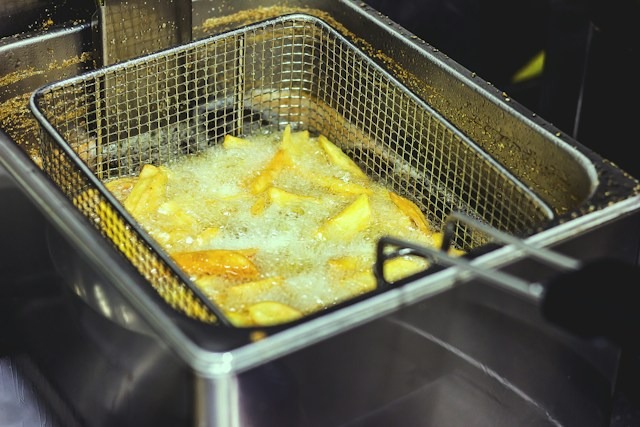
The frying asks theoil Severe performances. Temperatures of 170-180 °C, maintained for hours in the presence of water and oxygen, trigger oxidation, hydrolysis, and polymerization of triglycerides, with outcomes that depend on the fatty acid composition and natural or added antioxidants. Four oils compete for pans and fryers: extra virgin olive oil, high oleic sunflower oil, peanut oil, and grapeseed oil. Scientific studies published in recent years, together with the evolution of the supply of oils formulated for frying,today allow a more solid comparison than that based solely on the smoke point.
Smoke point and total polar compounds
The smoke point indicates the temperature at which an oil begins to visibly decompose, releasing smoke. It is the most frequently cited data on packaging, and oils formulated for frying usually state 230 °C, but it only describes the onset of the phenomenon and varies with free acidity and degree of refining. The actual frying resistance is instead measured by total polar compounds, the fraction of substances formed by oxidation, hydrolysis, and polymerization of triglycerides. The slower their formation, the longer the oil remains suitable for use.
In smokes volatile compounds derived from lipid oxidation concentrate, primarily aldehydes such as acrolein, formaldehyde, 2,4-decadienal and 4-hydroxy-2-nonenal. They are electrophilic molecules, capable of binding to proteins and DNA. Their health effects range from irritation of the mucous membranes and respiratory tract in those exposed to cooking fumes, to carcinogenicity (Scianò et al., 2025). Acrolein, the most reactive, is mainly formed from the oxidation of polyunsaturated fatty acids and increases with the temperature and duration ofheating (Scianò et al., 2025). The International Agency for Research on Cancer has classified it as probably carcinogenic to humans (group 2A), indicating among exposure sources also some cooking oils heated at high temperatures (IARC, 2021). Oils rich in oleic acid, such as extra virgin olive oil and high-oleic sunflower oil, mainly generate nonanal, a saturated aldehyde (Abrante-Pascual et al., 2024).
In Italy the oil used for frying does not must exceed 25% polar compounds (Ministry of Health, circular January 11, 1991 No. 1). The same circular also recommends drying food before immersing it, salting it after cooking, frequently changing the oil, and protecting it from light. Tester portable testers today allow measuring polar compounds directly in the fryer and scheduling oil changes based on objective data.
Extra virgin olive oil, more stable than expected
The most direct comparison between oils rich in monounsaturated fatty acids comes from the University of Porto (Portugal). Fresh potatoes were fried at 175 °C, eight hours a day, in extra virgin olive oil, peanut oil, and rapeseed oil. Peanut and rapeseed oil reached 25% polar compounds after 18-20 hours, while the extra virgin remained below the threshold after more than 28 hours (Santos et al., 2019). The authors note that extra virgin olive oil loses a good part of the bioactive compounds in the early hours but remains the most resistant to thermal oxidation and the least prone to generating undesirable volatile compounds. Potatoes fried in extra virgin oil are also enriched in phenolic compounds, those fried in rapeseed oil contain more aldehydes derived from polyunsaturated oxidation, while acrylamide does not depend on the type of oil (Santos et al., 2018).
Two studies from the University of La Rioja (Spain) subjected various cultivars of extra virgin olive oil to prolonged frying at 170 and 210 °C. Acidity remained within the category limit (0.8%) after 24 hours at 170 °C and peroxides within limits up to 18 hours at 210 °C, while positive sensory characteristics (fruity, bitter, pungent) were lost after more than 6 hours at 210 °C (Mehany et al., 2025a). The share of oleic acid remained above 76% even after frying in cultivars such as Arbequina and Royuela (Mehany et al., 2025b). The addition of olive extracts rich in hydroxytyrosol slowed degradation, but these are laboratory experiments and not commercial products.
Extra virgin olive oil is therefore suitable for domestic and professional frying, with the advantage of transferring phenols and vitamin E to the food. The price limits its use in large volumes and the aromatic profile, valuable when raw, diminishes as the cycles extend.
High oleic sunflower, the best quality/price ratio
The high oleic sunflower derives from varieties selected to accumulate over 80% oleic acid, compared to 34.86% of conventional sunflower (CREA, 2019). Researchers from the University of Naples Federico II and CREA simulated the conditions of a fast food, eight hours a day for six days, frying purple potatoes of the Purple Majesty variety. In the oil, with 84.13% oleic acid, polar compounds rose from 1.76% to 29.13% over the 48 hours of testing, and the prevalent volatile compounds were aldehydes derived from oleic and linoleic acids (Romano et al., 2021).
A study by the University of León (Spain) on the frying of churros It has been shown that high oleic exceeds 25% polar compounds after 48 hours, conventional sunflower already after 24 hours. After one day of use the Totox index, which synthesizes primary and secondary oxidation, was 87.79 versus 222.36 (Álvarez Graña et al., 2025). In continuous frying of fish cakes at 180 °C, after 18 hours high oleic recorded 27.50% polar compounds versus 25.67% palm oil, but an overall lower oxidation level after 24 hours and an oleic content always above 80% (Luo et al.,2024).
A group from the University of Novi Sad (Serbia) finally measured with the Rancimat method at 100 °C an induction time of 26.2 hours for high oleic and 27 hours for palm olein, indicating the former as the most promising, stable, and nutritionally advantageous alternative to olein (Lužaić et al., 2025).
Compared to extra virgin, high oleic sunflower presents additional advantages. The content of tocopherols, vitamin E that protects the oil from oxidation, ranges between 450 and 1,120 mg/kg, compared to 55-320 mg/kg in olive oil, and the amount of acids saturated fats is lower, between 6.2% and 13.9% compared to 8-26.2% (Abrante-Pascual et al., 2024). The neutral flavor does not interfere with that of foods, whereas the positive sensory characteristics of extra virgin oil fade with prolonged frying (Mehany et al., 2025a). However, high oleic sunflower lacks the polyphenols of extra virgin (Abrante-Pascual et al., 2024).
The price advantage must finally be monitored: in September 2026, the price index at origin for extra virgin oil, prepared by the Institute of Services for the Agricultural Food Market (Ismea), showed a 49.6% year-on-year decrease (Ismea Markets, 2026).
Peanut oil, an intermediate monounsaturated
Thepeanut oil contains 51.35% oleic acid and 27.90% linoleic acid of the total fatty acids (CREA, 2019). In the University of Porto test, peanut oil reached the threshold of 25% polar compounds between 18 and 20 hours, similar to rapeseed oil and before extra virgin (Santos et al., 2019), while the panel did not perceive progressive sensory degradation of potatoes fried in peanut oil, unlike the other two oils (Santos et al., 2018). However, recent literature dedicated to peanut frying, in first and second quartile journals, remains scarce.
An often overlooked aspect concerns the allergens. Peanuts and derived products are among the substances that cause allergies or intolerances with no exemption for refined oil, unlike what is provided for soybean oil (EU Reg. 1169/2011, Annex II, point 5). Restaurants and fryers using it must therefore inform their customers.
Grape seed oil, the fragility of polyunsaturated fats
Thegrapeseed oil is composed of 72.02% polyunsaturated fatty acids, almost all linoleic acid (71.71%), with just 16.95% oleic acid (CREA, 2019). This composition makes it sensitive to oxidation at high temperatures. Researchers from the Universities of Tabriz and Mohaghegh Ardabili (Iran) found its relatively low oxidative stability and concluded that even when mixed with sesame oil, richer in antioxidants, the product is not suitable for prolonged heating and frying (Khakbaz Heshmati et al., 2022). Refining raises its smoke point but does not alter the fatty acid composition: grapeseed oil is best used raw and in short cooking times.
Comparison table
| Parameter | Extra virgin olive oil | Peanut | Grapeseed | high oleic sunflower |
| Oleic acid (% fatty acids) | 76,13 | 51,35 | 16,95 | over 80 (84.13 in Romano et al., 2021) |
| Linoleic acid (% fatty acids) | 7,19 | 27,90 | 71,71 | not present in CREA tables |
| Vitamin E (mg/100 g) | 22,40 | 19,10 | 18,90 | not present in CREA tables |
| Time to reach 25% polar compounds in cited studies | over 28 hours (potatoes, 175 °C) | 18-20 hours (potatoes, 175 °C) | recent data not available | 48 hours (churros); less than 18 hours (fish cakes, continuous frying at 180 °C) |
| Sensory impact | characteristic, diminishes with frying | neutral | neutral | neutral |
| Recommended use | domestic and professional frying, even repeated | traditional frying, with allergen information | short and occasional frying | prolonged domestic and professional frying |
Sources: CREA (2019); Santos et al. (2019); Álvarez Graña et al. (2025); Luo et al. (2024); Romano et al. (2021). Experimental conditions differ from study to study, so times are not absolutely comparable.
Nutritional values according to CREA
The food composition tables indicated by CREA — Food and Nutrition Research Center (2019) report the nutritional values for extra virgin olive oil, peanut oil, grapeseed oil, and sunflower oil as follows, per 100 g.
| Per 100 g | Extra virgin olive oil (009210) | Peanut (009610) | Grape seed (009710) | Conventional sunflower (009650) |
| Energy | 3762 kJ, 899 kcal | 3762 kJ, 899 kcal | 3762 kJ, 899 kcal | 3762 kJ, 899 kcal |
| Fat | 99.9 g | 99.9 g | 99.9 g | 99.9 g |
| of which saturated fatty acids (% fatty acids) | 15,32 | 19,41 | 9,78 | 11,91 |
| of which monounsaturated (% fatty acids) | 77,27 | 52,57 | 17,36 | 35,35 |
| of which polyunsaturated (% fatty acids) | 7,97 | 27,90 | 72,02 | 53,20 |
| Carbohydrates | 0 g | 0 g | 0 g | 0 g |
| of which sugars | 0 g | 0 g | 0 g | 0 g |
| Fiber | 0 g | 0 g | 0 g | 0 g |
| Protein | 0 g | 0 g | 0 g | 0 g |
| Salt | traces | traces | traces | traces |
| Vitamin E | 22.40 mg (187% NRV) | 19.10 mg (159% NRV) | 18.90 mg (158% NRV) | 68.00 mg (567% NRV) |
CREA tables unfortunately do not yet include high-oleic sunflower, replaced for comparison by conventional sunflower, and express fatty acids as a percentage of their total.
Among micronutrients the only Vitamin E exceeds 15% of the nutritional reference values in Annex XIII of Regulation (EU) No 1169/2011 per 100 g. For the CREA portion of 10 g the intake corresponds to 18,7% for theextra virgin, at 15.9% for peanut, 15.8% for grapeseed and 56,7% for the sunflower conventional. Part of the tocopherols is also consumed during heating, in their role as antioxidants.
Permitted nutritional and health claims
All four oils considered can bear the claim ‘rich in unsaturated fats‘, reserved for products where at least 70% of fatty acids derive from unsaturated fats and these provide over 20% of energy (EC Reg. 1924/2006, Annex).
For vitamin E, which greatly exceeds twice the threshold required for a ‘source’, the wording is permitted ‘high in vitamin E (EC Reg. 1924/2006, Annex).
The same oils are subject to thehealth claim ‘The replacement of saturated fats with unsaturated fats in the diet contributes to the maintenance of normal blood cholesterol levels. Oleic acid is an unsaturated fat.’ (EU Reg. 432/2012, Annex).
The claims refer to the oil as is. Frying changes its composition, and they cannot be automatically extended to the fried food.
Our team of FARE (Food and Agriculture Requirements) supports operators in enhancing food products also in terms of nutritional and health profiles, in compliance with legislation in the various destination markets.
Oils formulated for frying, the evolution of the offer
The Italian market has seen growth in oils specifically for frying, almost all based on high oleic sunflower with antioxidants authorized as additives, such as tocopherol-rich extracts, rosemary extract and citric acid:
- Zucchi Oil Mill presented in May 2024 Fritto Libero!, high oleic sunflower oil with antioxidants for the channel retail, studied in collaboration with the Department of Soil, Plant and Food Sciences of the University of Bari Aldo Moro. The product declares 50% less odor compared to standard sunflower oils (Oleificio Zucchi, 2024; Oleificio Zucchi, 2025). For catering, Zucchi offers Fritturista, also presented at Sigep 2026: high oleic sunflower with extract rich in tocopherols (E306) and citric acid (E330). According to company tests on frozen fries, after 40 hours of frying it produces 30% less polar compoundscompared to a basic high oleic (Oleificio Zucchi, n.d.);
- Olitalia has been proposing for years Frienn, developed with the University of Bologna and chef Pasquale Torrente: high oleic sunflower with 80% oleic acid, extract rich in tocopherol and rosemary extract, seeds grown and processed in Italy, formulation protected by Italian patent. Also available for catering in bag in box of 20 liters (Olitalia, n.d.-a; Olitalia, n.d.-b);
- The organic is mainly present in high oleic sunflower, with references cold pressed, such as that of Girolomoni, or refined only by physical processes in steam flow, such as Sapore di Sole, in packages up to 5 liters (Macrolibrarsi, n.d.-a; Macrolibrarsi, n.d.-b). For extra virgin, the organic offering is wide. For frying, it is advisable to choose oils with low acidity, stored away from light and heat.
A choice to calibrate based on use
For prolonged and repeated frying, typical of catering, the high oleic sunflower offers optimal stability, with a more favorable fatty acid profile, and formulations with antioxidants extend its duration according to company data. Theextra virgin proves to be, among monounsaturated oils, the most resistant to degradation and the only one that enriches the food with phenols, at a higher cost. ThePeanut represents a neutral compromise in taste, with the obligation to indicate the allergen. The Grapeseed, rich in polyunsaturated fats, should be reserved for short and occasional frying. In any case, the quality of the fried food depends as much on the oil management as on its choice: temperature under control, filtering residues, replacement before the 25% threshold of polar compounds.
Dario Dongo
References
Scientific studies
Abrante-Pascual, S., Nieva-Echevarría, B., & Goicoechea-Oses, E. (2024). Vegetable oils and their use for frying: A review of their compositional differences and degradation. Foods, 13(24), 4186. https://doi.org/10.3390/foods13244186
Álvarez Graña, S., Abarquero, D., Claro, J., Combarros-Fuertes, P., Fresno, J. M., & Tornadijo, M. E. (2025). Behaviour of sunflower (Helianthus annuus L.) oil and high oleic sunflower oil during the frying of churros. Food Chemistry Advances, 6, 100899. https://doi.org/10.1016/j.focha.2025.100899
Khakbaz Heshmati, M., Jafarzadeh-Moghaddam, M., Pezeshki, A., & Shaddel, R. (2022). The oxidative and thermal stability of optimal synergistic mixture of sesame and grapeseed oils as affected by frying process. Food Science & Nutrition, 10(4), 1103-1112. https://doi.org/10.1002/fsn3.2774
Luo, X., Hu, B., Jia, C., Liu, R., Rong, J., Zhao, S., Niu, M., Xu, Y., Yin, T., & You, J. (2024). Study by means of 1H nuclear magnetic resonance of the oxidation process in high oleic sunflower oil and palm oil during deep-frying of fish cakes. Food Research International, 179, 113942. https://doi.org/10.1016/j.foodres.2024.113942
Lužaić, T., Škrbić, J., Nakov, G., Petrović, J., & Romanić, R. (2025). Deep-frying performance of palm olein and sunflower oil variants: Antioxidant-enriched and high-oleic oil as potential substitutes. Processes, 13(10), 3285. https://doi.org/10.3390/pr13103285
Mehany, T., González-Sáiz, J. M., & Pizarro, C. (2025a). Improving the biostability of extra virgin olive oil with olive fruit extract during prolonged deep frying. Foods, 14(2), 260. https://doi.org/10.3390/foods14020260
Mehany, T., González-Sáiz, J. M., & Pizarro, C. (2025b). Enhanced thermal resilience of olive oils: Fatty acid dynamics with polyphenols supplementation. Foods, 14(12), 2085. https://doi.org/10.3390/foods14122085
Romano, R., Filosa, G., Pizzolongo, F., Durazzo, A., Lucarini, M., Severino, P., Souto, E. B., & Santini, A. (2021). Oxidative stability of high oleic sunflower oil during deep-frying process of purple potato Purple Majesty. Heliyon, 7(3), e06294. https://doi.org/10.1016/j.heliyon.2021.e06294
Santos, C. S. P., García, L. M., Cruz, R., Cunha, S. C., Fernandes, J. O., & Casal, S. (2019). Impact of potatoes deep-frying on common monounsaturated-rich vegetable oils: A comparative study. Journal of Food Science and Technology, 56(1), 290-301. https://doi.org/10.1007/s13197-018-3489-z
Santos, C. S. P., Molina-Garcia, L., Cunha, S. C., & Casal, S. (2018). Fried potatoes: Impact of prolonged frying in monounsaturated oils. Food Chemistry, 243, 192-201. https://doi.org/10.1016/j.foodchem.2017.09.117
Scianò, F., Bernardoni, B. L., D’Agostino, I., Ferrara, G., Tafi, A., Garavaglia, S., & La Motta, C. (2025). Toxic aldehydes in cooking vegetable oils: Generation, toxicity and disposal methods. Food Chemistry: X, 29, 102744. https://doi.org/10.1016/j.fochx.2025.102744
EU regulatory sources
Regulation (EC) No 1924/2006 of the European Parliament and of the Council of 20 December 2006 on nutrition and health claims made on foods. Consolidated text: 13/12/2014. http://data.europa.eu/eli/reg/2006/1924/2014-12-13
Regulation (EU) No 1169/2011 of the European Parliament and of the Council of 25 October 2011 on the provision of food information to consumers, amending Regulations (EC) No 1924/2006 and (EC) No 1925/2006 of the European Parliament and of the Council, and repealing Commission Directive 87/250/EEC, Council Directive 90/496/EEC, Commission Directive 1999/10/EC, Directive 2000/13/EC of the European Parliament and of the Council, Commission Directives 2002/67/EC and 2008/5/EC and Commission Regulation (EC) No 608/2004. Consolidated text:01/04/2025. http://data.europa.eu/eli/reg/2011/1169/2025-04-01
Commission Regulation (EU) No 432/2012 of 16 May 2012 establishing a list of permitted health claims made on foods, other than those referring to the reduction of disease risk and to children’s development and health. Consolidated text: 20/08/2025. http://data.europa.eu/eli/reg/2012/432/2025-08-20
Italian regulatory sources
Ministry of Health. Circular 11 January 1991, no. 1, regarding oils and fats used for frying foods.
Institutional sources and databases
CREA Research Centre for Food and Nutrition. (2019). Food composition tables. Extra virgin olive oil, code 009210: https://www.alimentinutrizione.it/tabelle-nutrizionali/009210; peanut oil, code 009610: https://www.alimentinutrizione.it/tabelle-nutrizionali/009610; sunflower oil, code 009650: https://www.alimentinutrizione.it/tabelle-nutrizionali/009650; grapeseed oil, code 009710: https://www.alimentinutrizione.it/tabelle-nutrizionali/009710
IARC, International Agency for Research on Cancer. (2021). Acrolein, crotonaldehyde, and arecoline (IARC Monographs on the Identification of Carcinogenic Hazards to Humans, vol. 128). https://publications.iarc.who.int/602
Ismea Markets. (2026). Olive oil, indicators, price index (September 2026). https://www.ismeamercati.it/flex/cm/pages/ServeBLOB.php/L/IT/IDPagina/2070
Company documentation
Macrolibrarsi. (n.d.-a). Organic high oleic sunflower seed oil, Girolomoni. https://www.macrolibrarsi.it/prodotti/__olio-di-semi-di-girasole-alto-oleico-bio.php
Macrolibrarsi. (n.d.-b). Organic high oleic sunflower seed oil, Sapore di Sole. https://www.macrolibrarsi.it/prodotti/__olio-di-semi-di-girasole-alto-oleico-bio-sapore-di-sole-effegi-srl.php
Oleificio Zucchi. (May 2024). Oleificio Zucchi protagonista at Linkontro 2024 [press release]. https://www.senzalinea.it/giornale/oleificio-zucchi-protagonista-a-linkontro-2024
Oleificio Zucchi. (2025). Zucchi Free Fry! Product sheet, Anuga 2025. https://www.anuga.com/product/469539
Oleificio Zucchi. (n.d.). Fritturista. Technical sheet, Sigep 2026. https://www.sigep.it/restricted-assets/digital-profiles/01_ATTACHMENTS/SIG26/FLYER-FRITTURISTA-mod-68f8cb31ab492.pdf.pdf
Olitalia. (n.d.-a). Frienn, much more than a frying oil. http://frienn.olitalia.com/it/frienn-molto-pi%C3%B9-di-un-olio-friggere
Olitalia. (n.d.-b). Olitalia srl. Company profile, ICE Agency. https://velp.digital.ice.it/azienda/olitalia-srl

Dario Dongo, lawyer and journalist, PhD in international food law, founder of WIISE (FARE - GIFT – Food Times) and Égalité.


