

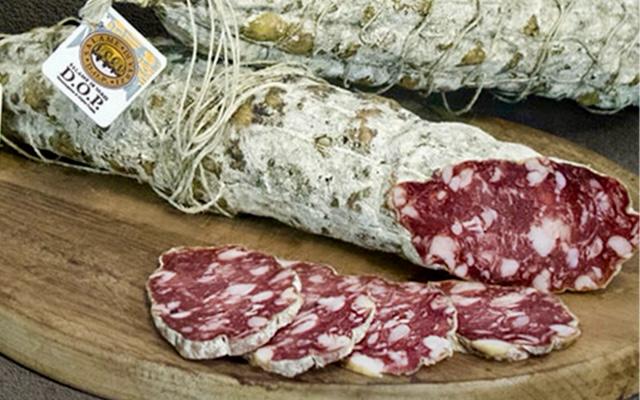
The salami Italian has fourteen names registered in the European Union – six PDO and eight PGI – with different specifications for the pig breeding area, aromas and minimum maturing times, from the Oltrepò Pavese to the Nebrodi. The salami is worth approx a quarter of exports of Italian cured meats, which in 2025 exceeded 2.5 billion euros for the first time.
Following, the volumes of certified production and exports, the specifications compared, the rules on nitrites and origin of the meat, the salamis registered among the Traditional Agri-Food Products and the De.Co., the nutritional profile compared with the admitted claims and the differences with the 'Italian sounding' salamis produced in other countries.
History, fermentation technology and legal definition of salami are covered in the previous article 'Italian salami: history, rules, PDO and PGI'.
Consumption and export of Italian salami, the data
The Meat and Cured Meat Industrial Association (ASSICA) presented the sector data at the annual meeting in June 2026. In 2025 the Italian production of cured meats has reached 1.173 million tonnes (+0.6%), worth 9.643 billion euros (+1.9%). Availability for consumption on the domestic market stood at 989,200 tonnes (+0.5%), equal to 16.6 kg per capita. Salami represents 8.3% of this availability, after cooked ham (28.1%), cured ham (21%) and mortadella and sausages (19.6%): approximately 82 K tonnes per year, according to a processing by GIFT on ASSICA data (ASSICA, 2026).
THE'export exceeded for the first time the threshold of 2.5 billion euros, with 231,645 tonnes shipped (+5.3% in volume and value). European Union countries absorbed 163,810 tonnes for 1.695 billion (+6.4% and +6.6%), third countries 67,835 tonnes for 811 million (+2.9% and +2.6%). France and Germany remain the top markets, with around 867 million euros overall, while the United States recorded a slight decline: 19,394 tonnes (-3.8%) for 249.2 million (-5.8%), in the year of the new duties (ASSICA, 2026).
For salami the latest available disaggregated data concerns 2024: 53,347 tonnes exported (+14.0%) for 631.7 million euros (+11.2%), with the most significant growth in the United States (+88.8% in volume, +63.3% in value), based on ASSICA processing of provisional Istat data (ASSICA, 2025). Salami is therefore worth slightly less than one quarter of volumes and approximately one quarter of the value of Italian cured meat exports. ASSICA reported positive performance for salami also in 2025, without disclosing details.
the certified productions they constitute a high-value niche segment. In Lombardy, in 2024, Salame di Varzi PDO counted 662,048 pieces, with an average annual growth of 2.2%; Salame Cremona PGI 139 tonnes produced in the region (+1.7% average per year); Salame Brianza PDO 159 tonnes (-4.9% average per year in 2019-2024). Mortara PGI goose salami returned to the market with 1,436 pieces, after four years without certified production (Lombardy Region, 2025). In Sicily, Salame S. Angelo PGI reached 108 tons and 1.368 million euros in turnover in 2023 (Qualigeo, s.d.): compared to 2019, the compound annual growth rate (CAGR) is equal to 5.8% in value and 1.5% in volume, a sign of valorization that proceeds more rapidly than quantities (GIFT processing).
Table 1: Italian cured meats and salami, main market data
| Indicator | Value | Change | Source |
| Cured meat production, 2025 | 1,173 M kt; 9.643 billion euros | +0.6% in volume; +1.9% in value | ASSICA, 2026 |
| Availability for consumption, 2025 | 989.2 kt; 16.6 kg per capita | +0,5% | ASSICA, 2026 |
| Share of salami on availability for consumption | 8.3% (approximately 82 K kt, GIFT estimate) | N/A | ASSICA, 2026 |
| Export of cured meats, 2025 | 231.645 kt; over 2.5 billion euros | +5.3% in volume and in value | ASSICA, 2026 |
| of which EU countries / third countries | 163.810 kt, 1.695 billion euros / 67.835 kt, 811 million euros | +6.4%, +6.6% / +2.9%, +2.6% | ASSICA, 2026 |
| Export of salamis, 2024 | 53.347 kt; 631.7 million euros | +14.0% in volume; +11.2% in value | ASSICA, 2025 (provisional Istat data) |
| Salame S. Angelo PGI, 2019-2023 | 101.932 kg and 1.093 million euros in 2019; 108.079 kg and 1.368 million euros in 2023 | Compound annual rate +1.5% in volume, +5.8% in value | Qualigeo; GIFT calculation |
Historical traces of the denominations
One of the first documented names of an Italian sausage carries with it a place of origin. Varro, in De lingua Latina (47-45 BC), explains that the casing filled with minced meat is called lucanica 'quod milites a Lucanis didicerint', since the Roman soldiers had learned the recipe from the Lucanians (Varro, De lingua Latina, V).
Some designations preserve precise documentary traces:
- the Salama da sugo Ferrarese, consumed after long cooking, inspired in 1722 a short poem titled Salameide (Ferrara Terra e Acqua, n.d.);
- for Salame S. Angelo PGI, a municipal resolution in the mid-nineteenth century introduced a tax on products of economic importance, including salami, together with the so-called 'Rivelo', a declaration of the place of conservation and the quantities produced which anticipated self-certification (Qualigeo, n.d.);
- The name of Italian Salamini alla Cacciatora PDO refers to the habit of hunters of carrying a small-sized salami in their saddlebags (ARSIAL, 2025).
Regional variety also emerges in homonymy. In Abruzzo the lists of Traditional Agri-food Products (PATs) distinguish the Vastese ventricina, stuffed into a pig's bladder or stomach, from Teramana ventricina, soft and spreadable (Abruzzo Region, 2023): two different products under the same name.
Nitrites, meat origin and protection of names
The legal definition of salami, established by the interministerial decree of 2025 with pH not lower than 4.9 on the market, prevalent lactic flora and prohibition of colorants and mechanically separated meat, is analysed in detail on GIFT.
Salamis fall among meat-based products defined by specific hygiene rules for foods of animal origin (Regulation (EC) 853/2004, Annex I, section 7.1) and – as ready-to-eat foods – are subject to European microbiological criteria, in particular for Listeria monocytogenes (Regulation (EC) 2073/2005, Annex I, chapter 1), which can also be inactivated through specific natural bacterial cultures.
The use of nitrites and nitrates is regulated by the Regulation on food additives (Regulation (EC) 1333/2008, Annex II, part E, category 08.3), as amended by Regulation (EU) 2023/2108: from 9 October 2025 the maximum dose of added nitrites drops to 80 mg/kg for meat-based products in general, with specific rules for traditional dry-cured products of category 08.3.4. FARE has explored this topic in Meat preparations, meat-based products and additives.
As regards the indication in label of the origin of meat:
- the European regulation on consumer information relating to food products requires the indication of the origin of the primary ingredient when the declared origin of the product - outside of registered trademarks and PGIs, within a few limits – is different from that of the meat (Regulation (EU) 1169/2011, art. 26.3; Implementing Regulation (EU) 2018/775);
- in Italy there is still a transitional national regime of mandatory indication of the place of birth, breeding and slaughter of pigs for processed meat, which has been extended until 31 December 2026 (DM 26 December 2025). Registered names are protected against usurpation, imitation and evocation (EU regulation 2024/1143, art. 26), while nutritional indications are permitted under the conditions of the specific regulation (EC regulation 1924/2006, Annex).
Six PDO and eight PGI, production rules compared
The European register includes six PDO salami:
- The Salame Brianza PDO and the Salame di Varzi PDO, in Lombardy, were registered in 1996 (EC reg. 1107/96). Varzi is produced in the mountain community of Oltrepò Pavese with black peppercorns and garlic infusion in filtered red wine; the minimum maturation varies with the size, from 45 days for the 0.5-0.7 kg fillet to 180 days for the double casing sewn (disciplinary, articles 3-5). Brianza, whose regulations were updated in 2024, sets minimum maturing times that increase with the diameter (regulations, article 5);
- The Salame Piacentino PDO (Regulation (EC) 1263/96), in Emilia-Romagna (from pigs also from Lombardy), ages for at least 45 days from salting, at temperatures between 12 and 19 °C;
- i Salamini italiani alla cacciatora PDO (Regulation (EC) 1778/2001) come from pigs raised and slaughtered in eleven regions of Central-Northern Italy, have a diameter not exceeding 6 cm and age for at least ten days, without accelerated fermentation techniques (regulation, articles 2-4);
- the Soppressata di Calabria PDO (Regulation (EC) 134/98) is made from pigs raised in Calabria, has the shape of a slightly flattened cylinder and ages for at least 45 days;
- the Soprèssa Vicentina PDO (Regulation (EC) 492/2003) uses pigs born and raised in the province of Vicenza and ages for at least 60 days for sizes of 1-1.5 kg and 80 days for those of 1.5-2.5 kg (Regulation (EU) 588/2010, Annex II).
the PGI are instead eight:
- The Salame Felino PGI (Implementing Regulation (EU) 186/2013) is restricted to the province of Parma, in Emilia-Romagna, with a fat/protein ratio not exceeding 1.5 (regulation, articles 2-3);
- The Salame Cremona PGI (Regulation (EC) 1362/2007) is produced in Lombardy, Emilia-Romagna, Piedmont and Veneto, with crushed garlic and natural casing;
- the Finocchiona PGI (EU exec. reg. 2015/629) is produced throughout Tuscany, excluding the islands, with fennel seeds and/or flowers, sizes from 0.5 to 25 kg per bag, proteins not lower than 20% and fats no higher than 35% (regulation, article 2);
- The Ciauscolo PGI (Regulation EC 729/2009) is the soft and spreadable salami of the Marche;
- The Mortara PGI goose salami (EC reg. 1165/2004), in the province of Pavia (Lombardy), combines goose meat and pork;
- The Salame S. Angelo PGI (EC reg. 944/2008) was born only in the municipality of Sant'Angelo di Brolo, on the Nebrodi in Sicily, with sea salt and black pepper, fat within 20% of the mixture and minimum maturation of 30 to 60 days depending on the format (Qualigeo, s.d.);
- The Salame Piemonte PGI (Exec. Reg. EU 2015/1161) is produced and aged in Piedmont with Piedmont red wine;
- the Salama da sugo PGI (Exec. Reg. EU 1173/2014), processed in the province of Ferrara in Emilia-Romagna excluding the municipalities of Goro, Codigoro, Lagosanto and Comacchio, is consumed after long cooking (regulations, article 3).
Among Calabrian cured meats, Calabria Sausage is also PDO, which however does not belong to the category of salami.
PATs and De.Co., the map of local salami
The national list of Traditional Agri-food Products (PATs), which reached its 26th revision with 5,813 entries (DM MASAF no. 59360 of 6 February 2026), collects products with processing methods consolidated for at least twenty-five years, registered by Regions (law 238/2016, art. 12.1). Salami appear there in great number:
- The Piedmont includes, among others, donkey salami, goat salami (susiccia 'd crava), horse salami, wild boar salami and cooked salami (Piedmont Region, 2024);
- The Lazio the Olevano ventricina and the cooked salami of Tuscia (Lazio Region, 2022);
- THE'Abruzzo the two ventricinas already mentioned (Abruzzo Region, 2023). Such registrations, however, as we have seen, do not entail binding regulations nor exclusive rights to the name.
the municipal designations (De.Co.) are instead established with a resolution and regulation of the Municipality and attest the link of a product with municipal territory, without the legal protection of European geographical indications. An example is the Salame Nobile Cremasco De.Co. of the Municipality of Crema, produced and aged for at least 90 days in the 48 municipalities of Cremasco (Municipality of Crema, s.d.).
Table 2: Italian salami registered as PDO and PGI
| Designation | Type | Registration | Production area | Main requirements of the specification |
| Salame Brianza | PDO | Reg. EC 1107/96 | Lombardy | Minimum aging according to diameter |
| Salame di Varzi | PDO | Reg. EC 1107/96 | Mountain community of Oltrepò Pavese (Pavia) | Black peppercorns, garlic infusion in filtered red wine; minimum aging of 45-180 days according to size |
| Salame Piacentino | PDO | Reg. EC 1263/96 | Province of Piacenza | At least 45 days from salting, at 12-19 °C |
| Salamini italiani alla cacciatora | PDO | Reg. EC 1778/2001 | 11 regions of Central-Northern Italy | Diameter up to 6 cm; at least 10 days; no accelerated fermentation |
| Soppressata di Calabria | PDO | Reg. EC 134/98 | Calabria | Pigs raised in Calabria; slightly flattened shape; at least 45 days |
| Soprèssa Vicentina | PDO | Reg. EC 492/2003 | Province of Vicenza | Pigs born and raised in the province of Vicenza; at least 60-80 days according to size |
| Salame Cremona | PGI | Reg. EC 1362/2007 | Lombardy, Emilia-Romagna, Piedmont, Veneto | Crushed garlic, natural casing |
| Salame Felino | PGI | Reg. exec. EU 186/2013 | Province of Parma | Fat/protein ratio up to 1.5 |
| Finocchiona | PGI | Reg. exec. EU 2015/629 | Tuscany (islands excluded) | Fennel seeds and/or flowers; proteins at least 20%, fats up to 35% |
| Ciauscolo | PGI | Reg. EC 729/2009 | Marche | Soft and spreadable consistency |
| Mortara goose salami | PGI | Reg. EC 1165/2004 | Province of Pavia | Goose meat and pork |
| Salame S. Angelo | PGI | Regulation (EC) 944/2008 | Sant'Angelo di Brolo (Messina) | Sea salt, black pepper; fat up to 20%; 30-60 days according to the format |
| Piedmont Salami | PGI | Implementing Regulation (EU) 2015/1161 | Piedmont | Piedmontese red wine |
| Salama da sugo | PGI | Implementing Regulation (EU) 1173/2014 | Province of Ferrara (excluding four municipalities) | It is consumed after long cooking |
Nutritional profile compared of four salami
The food composition tables indicated by CREA - Food and Nutrition Research Center (2019) refer to four salami items with the following nutritional values, per 100 g and in the order of the nutritional declaration (EU regulation 1169/2011, Annex XV). CREA expresses saturated fatty acids as a percentage of total fatty acids and not in grams; salt is calculated from sodium (sodium x 2.5).
Table 3: nutritional values per 100 g (CREA, 2019)
| Nutrient | Milan Salami (110640) | Salamini alla cacciatora PDO (110610) | Felino Salami (110630) | Soppressata di Calabria (110740) |
| Energy | 1.610 kJ / 385 kcal | 1.718 kJ / 411 kcal | 1.569 kJ / 375 kcal | 1.577 kJ / 377 kcal |
| Fats | 31.0 g | 32.7 g | 27.9 g | 26.3 g |
| of which saturated fatty acids | 33.8% of fatty acids* | 31.9% of fatty acids* | 37.05% of fatty acids* | not reported |
| Carbohydrates | 1.1 g | 0.7 g | 0.5 g | 0.9 g |
| of which sugars | not reported | not reported | 0.5 g | 0.9 g |
| Fibre | 0 g | 0 g | 0 g | 0 g |
| Proteins | 25.4 g | 28.4 g | 30.5 g | 34.2 g |
| Salt (sodium x 2.5) | 3.9 g | 4.2 g | 4.2 g | not reported |
| Micronutrients equal to or above 15% NRV | Thiamine 48.2%, potassium 32.9%, niacin 31.1%, zinc 30%, phosphorus 29.1%, selenium 29.1%, vitamin B12 22.4% | Vitamin B6 62.1%, niacin 48.3%, thiamine 45.5%, potassium 34.7%, phosphorus 29.1%, selenium 25.5%, zinc 25%, vitamin B12 20.8% | Zinc 43%, thiamine 30.9%, potassium 24.3%, copper 21%, riboflavin 18.6% | not reported |
(*) CREA expresses saturated fatty acids as a percentage of total fatty acids and not in grams. NRV: nutritional reference values as in Annex XIII to Regulation (EU) No. 1169/2011.
Compared to reference nutritional values of which in Annex XIII to Regulation (EU) No. 1169/2011, exceed 15% per 100 g:
- in Salame Milano thiamine (48.2%), potassium (32.9%), niacin (31.1%), zinc (30%), phosphorus and selenium (29.1%), vitamin B12 (22.4%);
- in Salamini alla cacciatora vitamin B6 (62.1%), niacin (48.3%), thiamine (45.5%), potassium (34.7%), phosphorus (29.1%), selenium (25.5%), zinc (25%) and vitamin B12 (20.8%);
- in Salame Felino zinc (43%), thiamine (30.9%), potassium (24.3%), copper (21%) and riboflavin (18.6%).
Permitted nutritional claims and market valorization
Proteins provide 26% to 36% of the energy in the four CREA entries, above the 20% threshold required for the indication 'high in protein' (Regulation (EC) 1924/2006, Annex).
For vitamins and minerals, the indication 'source of' requires at least 15% of the nutritional reference values per 100 g and 'high in' at least double (EC regulation 1924/2006, Annex). Based on CREA data, Salame Milano could therefore boast a high content of thiamine, potassium, niacin and zinc and be a source of phosphorus, selenium and vitamin B12.
Our team of FARE (Food and Agriculture Requirements) supports operators, consortia and their representatives in the valorisation of supply chains and products under these and other aspects: nutrition claims and health claims, origin and geographical indications, environmental and sustainability assertions, in compliance with applicable regulations in the various EU and non-EU destination markets, including the development of corporate governance systems and operational procedures.
Salami Made in Italy and 'Italian sounding', what are the differences?
The first element that distinguishes Made in Italy salami from their imitations produced in various countries is legal:
- in Italy the name 'salami' presupposes a natural fermentation verifiable, according to the parameters of the 2025 decree;
- in the United States, on the contrary, 'Genoa salami' or 'sopressata' indicate preparation styles, not origins, and the federal authority above all sets a maximum moisture/protein ratio: 2.3:1 for Genoa salami, 1.9:1 for dry and hard salami (Swine Extension, n.d.).
The second distinctive element is supply chain:
- the PDO link the raw material to the territory: pigs raised in Calabria for Soppressata, born and raised in the province of Vicenza for Soprèssa, Italian heavy pig from eleven regions for Salamini alla cacciatora;
- for all other Made in Italy salamis the indication 'Origin: Italy' certifies the birth, breeding and slaughter of pigs in the country (DM 26 December 2025).
The third element is Process, which includes the maturing times and conditions set by the specifications, the ban on accelerated fermentation in the Salamini alla Cacciatora, the identifying aromas (the infusion of garlic and wine from the Varzi, the fennel from the Finocchiona, the chilli pepper from the Soppressata).
Conclusions
Fourteen different regulations by area, aromas and ageing processes, a double-digit growth in salami exports in 2024 and certified productions with increasing value, such as Salame S. Angelo PGI, outline a niche segment with high added value. Traditional Agri-food Products (PATs) and De.Co. complete the map of local salami, while the profile rich in proteins, B vitamins, potassium and zinc allows targeted nutritional claims, to be communicated in compliance with the rules of the different destination markets.
Dario Dongo
Credit cover Varzi Salami PDO Protection Consortium
References
European Union regulatory sources
Commission Implementing Regulation (EU) 2018/775 of 28 May 2018 laying down rules for the application of Article 26(3) of Regulation (EU) No 1169/2011 of the European Parliament and of the Council on the provision of food information to consumers, as regards the rules for indicating the country of origin or place of provenance of the primary ingredient of a food. OJ L 131, 29.5.2018, p. 8. http://data.europa.eu/eli/reg_impl/2018/775/oj
Commission Regulation (EC) No 2073/2005 of 15 November 2005 on microbiological criteria for foodstuffs. Consolidated text: 01/07/2026. http://data.europa.eu/eli/reg/2005/2073/2026-07-01
Commission Regulation (EU) No 1047/2012 of 8 November 2012 amending Regulation (EC) No 1924/2006 with regard to the list of nutrition claims. OJ L 310, 9.11.2012, p. 36. http://data.europa.eu/eli/reg/2012/1047/oj
Commission Regulation (EU) 2023/2108 of 6 October 2023 amending Annex II to Regulation (EC) No 1333/2008 of the European Parliament and of the Council and the Annex to Commission Regulation (EU) No 231/2012 as regards food additives nitrites (E 249-250) and nitrates (E 251-252). OJ L, 2023/2108, 9.10.2023. http://data.europa.eu/eli/reg/2023/2108/oj
Regulation (EC) No 853/2004 of the European Parliament and of the Council of 29 April 2004 laying down specific hygiene rules for food of animal origin. Consolidated text: 07/05/2026. http://data.europa.eu/eli/reg/2004/853/2026-05-07
Regulation (EC) No 1333/2008 of the European Parliament and of the Council of 16 December 2008 on food additives. Consolidated text: 18/08/2026. http://data.europa.eu/eli/reg/2008/1333/2026-08-18
Regulation (EC) No 1924/2006 of the European Parliament and of the Council of 20 December 2006 on nutrition and health claims made on foods. Consolidated text: 13/12/2014. http://data.europa.eu/eli/reg/2006/1924/2014-12-13
Regulation (EU) No 1169/2011 of the European Parliament and of the Council of 25 October 2011 on the provision of food information to consumers. Consolidated text: 01/04/2025. http://data.europa.eu/eli/reg/2011/1169/2025-04-01
Regulation (EU) 2024/1143 of the European Parliament and of the Council of 11 April 2024 on geographical indications for wine, spirit drinks and agricultural products, as well as traditional specialities guaranteed and optional quality terms for agricultural products. Consolidated text: 18/03/2026. http://data.europa.eu/eli/reg/2024/1143/2026-03-18
Registrations and production rules of denominations
ARSIAL (2025). Salamini italiani alla cacciatora PDO, fact sheet in Lazio agri-food heritage. https://www.arsial.it/wp-content/uploads/2025/06/SalaminiItaliani_CacciatoraIGP.pdf
Chamber of Commerce of Ferrara (2014). Production specification Salama da sugo, abstract. https://fe.camcom.it/urp/stampa/comunicatistampa/2014-comunicati-stampa/allegati-comunicati-stampa-2014/allegato-disciplinare-salama-da-sugo-c.s.-n.-80
Chamber of Commerce of Reggio Calabria (n.d.). Products with PDO and PGI designation. https://rc.camcom.gov.it/PDF/I-prodotti-a-marchio-DOP-e-IGP_498.htm
Commission Implementing Regulation (EU) No 186/2013 of 5 March 2013 entering a name in the register of protected designations of origin and protected geographical indications (Salame Felino (PGI)). OJ L 62, 6.3.2013. http://data.europa.eu/eli/reg_impl/2013/186/oj
Commission Implementing Regulation (EU) 2015/1161 of 2 July 2015 entering a name in the register of protected designations of origin and protected geographical indications [Salame Piemonte (PGI)]. OJ L 188, 16.7.2015. http://data.europa.eu/eli/reg_impl/2015/1161/oj
Commission Regulation (EC) No 944/2008 of 25 September 2008 entering certain names in the Register of protected designations of origin and protected geographical indications (Salame S. Angelo (PGI), Chouriço Azedo de Vinhais or Azedo de Vinhais or Chouriço de Pão de Vinhais (PGI), Presunto do Alentejo or Paleta do Alentejo (PDO)). OJ L 258, 26.9.2008. http://data.europa.eu/eli/reg/2008/944/oj
Commission Regulation (EU) No 588/2010 of 5 July 2010 approving minor amendments to the specification for a name entered in the register of protected designations of origin and protected geographical indications (Soprèssa Vicentina (PDO)). OJ L 170, 6.7.2010. http://data.europa.eu/eli/reg/2010/588/oj
Consortium for the protection of Salame Brianza PDO (2024). Production regulations for the protected designation of origin 'Salame Brianza', consolidated version approved by MASAF decree 27 September 2024 (GU no. 237 of 9.10.2024). https://ifcq.it/wp-content/uploads/salame-brianza/disciplinare_settembre_2024-2.pdf
European Commission (s.d.). eAmbrosia, the EU geographical indications register. https://ec.europa.eu/agriculture/eambrosia/geographical-indications-register/
Ministry of Agricultural, Food and Forestry Policies (2017). Amendment of the production specification for the protected geographical indication 'Finocchiona' (GU no. 135 of 13.6.2017). https://www.unionalimentari.com/wp-content/uploads/2024/09/MIPAAF-modifica-disciplinare-FINOCCHIONA.pdf
Qualigeo (s.d.). Salame S. Angelo PGI. https://www.qualigeo.eu/prodotto-qualigeo/salame-s-angelo-igp/
Emilia-Romagna Region (2012). Request for modification of the specification for the denomination 'Salame Piacentino', BURERT, April 2012. https://bur.regione.emilia-romagna.it/area-bollettini/bollettini-pubblicati/2012/aprile-periodico-parte-seconda-1a-quindicina/richiesta-di-modifica-del-disciplinare-della-denominazione-201csalame-piacentino201d/allegato-salame-piacentino
Emilia-Romagna Region (2023). Amendment of the PGI production specification 'Salame Felino', synoptic, BURERT, February 2023. Amendment to the production disciplinary for Salame Felino PGI
Emilia-Romagna Region (N/A). Registered PDO and PGI. https://agricoltura.regione.emilia-romagna.it/dop-igp/prodotti-dop-e-igp-emilia-romagna/dop-e-igp-registrate.pdf/@@download/file
Friuli Venezia Giulia Region (N/A). Salamini italiani alla cacciatora PDO. https://www.regione.fvg.it/rafvg/cms/RAFVG/economia-imprese/agricoltura-foreste/FOGLIA28/
WIPO Lex (N/A). Production disciplinary of Salame di Varzi. https://www.wipo.int/wipolex/en/legislation/details/2553
Italian regulatory sources
Decree of 6 August 2020, 'Provisions for the mandatory indication of the place of origin on the label of processed pork' (GU no. 230 of 16.9.2020). https://unionalimentari.com/wp-content/uploads/2024/09/MIPAAF-decreto-6.8.2020-luogo-provenienza-carni-suine-trasformate.pdf
Decree of 26 December 2025, 'Extension of the experimental regimes of the indication of origin to be shown on food labels' (GU no. 34 of 11.2.2026). https://www.gazzettaufficiale.it/eli/gu/2026/02/11/34/sg/pdf
Interministerial decree of 8 August 2025, 'Discipline of the production and sale of certain delicatessen products' (GU no. 195 of 23.8.2025). https://www.mimit.gov.it/it/normativa/decreti-interministeriali/decreto-interministeriale-8-agosto-2025-disciplina-dei-salumi-abrogazione-e-sostituzione-del-decreto-interministeriale-21-settembre-2005-e-il-decreto-interministeriale-26-maggio-2016
MASAF decree n. 59360 of 6 February 2026, 'Update of the national list of traditional agri-food products pursuant to article 12, paragraph 1, of law 12 December 2016, n. 238', 26th revision (GU no. 40 of 18.2.2026).
Law 12 December 2016, n. 238, 'Organic discipline of vine cultivation and wine production and trade'. Regulatory. Latest consolidated version: 05/14/2026. Law no. 238 of 12 December 2016
Statistical and market sources
ASSICA (2025). Data on the export of Italian cured meats in 2024 (based on provisional Istat data), presented at the Annual Assembly, Brussels, 26 June 2025. https://www.assica.it
ASSICA (2026). 2025 data from the cured meats sector, presented at the conference 'The future of pork and cured meats in the era of global uncertainty', Annual Assembly, Rome, 18 June 2026. https://www.assica.it
Lombardy Region (2025). Certified quality systems in Lombardy. 2025 Report. https://www.regione.lombardia.it/content/dam/rl/canali-tematici-servizi/10-agricoltura/01-agricoltura-biologica/red-agricoltura-biologica-in-lombardia/allegati/Sistemi%20di%20qualità%20certificata%20in%20Lombardia-RAPPORTO%202025.pdf
Nutritional sources
CREA, Food and Nutrition Research Center (2019). Food composition tables, item 'Salame Milano', code. 110640. https://www.alimentinutrizione.it/tabelle-nutrizionali/110640
CREA, Food and Nutrition Research Center (2019). Food composition tables, item 'Italian salami alla Cacciatora DOP', code. 110610. https://www.alimentinutrizione.it/tabelle-nutrizionali/110610
CREA, Food and Nutrition Research Center (2019). Food composition tables, item 'Salame Felino', code. 110630. https://www.alimentinutrizione.it/tabelle-nutrizionali/110630
CREA, Food and Nutrition Research Center (2019). Food composition tables, item 'Soppressata di Calabria', code. 110740. https://www.alimentinutrizione.it/tabelle-nutrizionali/110740
Historical and cultural sources
Ferrara Terra e Acqua (N/A). Salama da sugo PGI. https://www.ferraraterraeacqua.it/en/flavours/typical-products/salama-da-sugo-o-salamina-igp
Varrone, M. T. De lingua Latina, book V. The Latin Library. https://www.thelatinlibrary.com/varro.ll5.html
PATs, De.Co. and other sources
Municipality of Crema, Municipal Commission for De.Co. (s.d.). De.Co. identification card 'Salame Nobile Cremasco'. Identification sheet for Salame Nobile
Abruzzo Region (2023). Updated list of Traditional Agri-food Products (PATs) Abruzzo 2023. Updated list of Traditional Agri-food Products (PATs) Abruzzo 2023
Lazio Region (2022). Annex B, list of Traditional Agri-food Products. Annex B - List of products
Piedmont Region (2024). Resolution of the Regional Council of 2 December 2024, 'Approval of the 9th update of the list of traditional agri-food products (PAT) of Piedmont'. Regional Government Resolution No. 468-1050 of 2 December 2024
Swine Extension (n.d.). Dry and semi-dry fermented and direct acidified sausage validation. Dry and semi-dry fermented and direct acidified sausage validation

Dario Dongo, lawyer and journalist, PhD in international food law, founder of WIISE (FARE - GIFT – Food Times) and Égalité.


