


The association of Italian beer producers AssoBirra has published its Annual Report 2022 which describes the production scenario, between industries and microbreweries, the trend of the national market and of import-export. (1)
The growth opportunities of the brewing supply chain Made in Italy are however hindered by a paradoxical excise system. Also, in the humble opinion of the author, by the lack of vision on the phenomenon zero-alcohol e low-alcohol.
Italian beer, an industrial and microbrewery history
The production of Italian beer began in the mid-19th century, organizing in Milan in 1907 the first 'Union of Beer Manufacturers', 'Association of Brewers and Maltsters', now AssoBirra. Industrial production grew rapidly from the post-war period until the end of the 1990s. Thanks to technological improvements, mergers and acquisitions by large breweries (Peroni, Pedavena-Dreher, Wuhrer), and investments accompanying the development of the national market. (2)
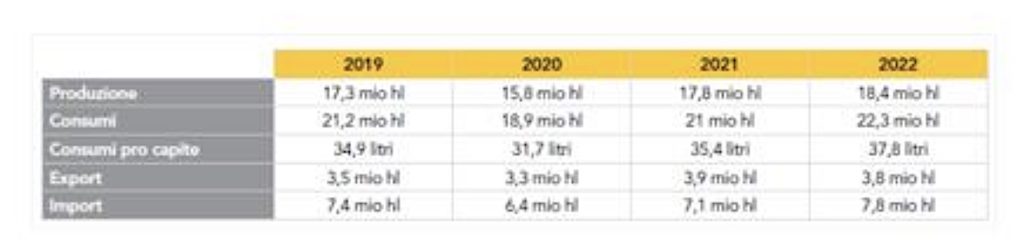
Craft breweries in Italy started in the late '80s, thanks to growing consumer interest in short and local supply chains and technological innovations that enabled the creation of micro-plants. Around 2015, riding the wave of success of craft beers in the USA and continental Europe, craft beers have also flourished in Italy microbreweries, brewpubs e contract brewing. To the point of attracting the attention of the major breweries, which have also begun to occupy this segment with various acquisitions.
Italian brewing supply chain
CERB – the Research Center for Beer Excellence, in Perugia – is the first research center dedicated to research and innovation in the brewing sector in Italy. Prof. Paolo Fantozzi, its founder, described the evolution of the brewing supply chain and Italian beer from various aspects. (3)
Barley cultivation in Italy
Barley cultivations in Italy have been diversified in recent years, integrating barley crops for feed use (with a high protein content) with those for brewing use (with a lower protein level).
A revolution for farmers who, in the supply of barley aimed at malt production for 100% Italian beer, have improved the profitability of the cultivation of this cereal.
Acquisitions
The major brands of Italian beer, over the decades, have been acquired by the giants dominating the global market (Anheuser-Busch InBev, Heineken, Diageo, Asahi the first four).
Remain Italian-owned the leader Castello – Pedavena beer, the Forst – Menabrea group and Birra Messina (with the brands Birra dello Stretto and Birra Doc 15), as well as numerous microbreweries.
Research and training
Research on the brewing supply chain and beer has seen great development in Italian universities, now third in Europe for the number of publications on the subject. The historic Pedavena brewing school has been revived and followed by specialist and university training courses, with specific degree courses and master’s degrees dedicated, from Udine to Perugia.
the terroir – in Italian beer as in enology – is also the subject of studies (Carbone et al., 2021) which allowed us to identify the cultivar Cascade as an ideal hop to be grown in Italy, to offer distinctive sensory characteristics (for bitterness and aroma) to the beer Made in Italy. (4)
Excise duties on beer, the paradox of Italian taxation
Excise duties on alcoholic beverages are provided for in Directives 92/83/EC, 92/84/EC and Directive (EU) 2020/262, transposed into Italy with Legislative Decree 504/1995 (Consolidated Text of Excise Duties) and subsequent amendments. Production taxes and related exemptions apply to beer, wine, other fermented beverages, intermediate products, ethyl alcohol, together.
The paradox of beer, in Italian taxation, is the determination of the excise duty based on the saccharometric level (Plato degree) rather than the alcohol content, for each hectoliter of beverage at a temperature of 20 degrees Celsius (5,6,7,8).
Alcohol and alcoholic beverages are exempt from excise duty, among other things, when used in the manufacture of:
– final products that do not contain alcohol,
– aromas intended for the preparation of foods and non-alcoholic beverages with an actual alcoholic strength
The Milleproroghe Decree 2022 applied an almost invisible reduction to the excise duty (0.67%, from €2.99 to 2.97 per degree Plato per hectoliter. In addition to confirming tax reductions for small Italian beer producers (-50% up to 10,000 hectoliters/year, – 30% up to 30,000, -20% up to 60,000 hectoliters per year) (10,11).
Italian beer zero-alcohol e low-alcohol, the untapped potential
‘It is estimated (Future Market Insights data) that the global non-alcoholic beer market is expected to double its value over ten years, from about 18.6 billion euros to over 38.6 billion by 2032, growing at an annual rate of 7.8%. Abroad the phenomenon has literally exploded’.
Non-alcoholic beers (< 1.2% alc. vol) – in addition to meeting the needs of responsible driving and alcohol-free work – gather the growing interest of consumers more attentive to weight control, abdominal bloating, and health. And they can proudly bear, upon meeting the relevant conditions, Nutrition and health claims.
Nutrition and health claims
the Nutrition and Health Claims Regulation (EC) No 1924/06 prohibits the use of health claims in commercial information (and/or in any communication traceable to economic operators, including on social network) relating to alcoholic beverages (> 1.2% alc. vol). Restricting the permitted nutritional indications on such beverages to only the terms ‘low alcohol content’, ‘reduced alcohol content’ or ‘reduced caloric content’.
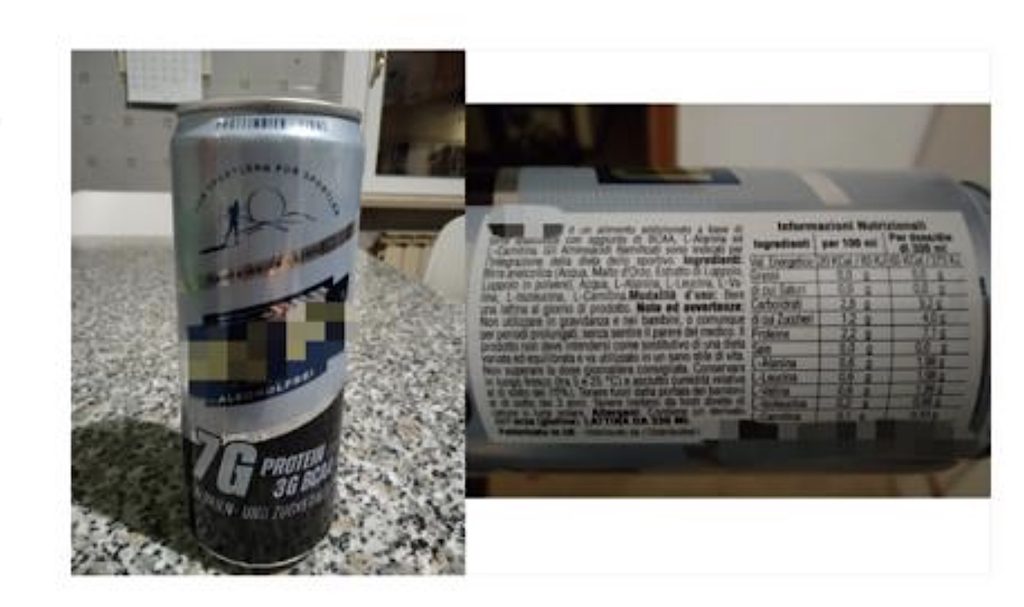
Alcohol content equal to or less than 1.2% alc. vol. conversely allows the use in the EU of any nutrition claim e health claim, subject to the conditions established for each in the NHC regulation and its implementing regulation (EU reg. 432/12. See e.g. Figure 2). Not to mention the opportunity for research and innovation to produce functional non-alcoholic beers (e.g., by integration with arabinoxylans and other prebiotic fibers extracted through upcycling of the spent grains).
Preliminary conclusions
The secular tradition of Italian beer – combined with international recognition of Made in Italy agri-food, its terroir and the attention to taste – could translate into added value by focusing attention on identity values linked to territories, such as the use of spring waters (e.g. Pedavena) and local ingredients (malt, hops), as well as on the global boom of beers zero-alcohol e low-alcohol (12).
Dario Dongo e Andrea Adelmo Della Penna
Notes
(1) AssoBirra. Annual Report 2022 https://www.assobirra.it/wp-content/uploads/2023/05/AnnualReport_2022.pdf
(2) Christian Garavaglia (2021). Industry evolution: Evidence from the Italian brewing industry. Competition & Change 0(0):1-21, https://doi.org/10.1177/10245294211007408
(3) Paolo Fantozzi (2017) The Italian Academic Research on Beer: Past, Present and Future. Ital. J. Food Sci. 29(4):565-581, https://doi.org/10.14674/IJFS-1054
(4) Carbone et al. (2021).Tasting the Italian Terroir through Craft Beer: Quality and Sensory Assessment of Cascade Hops Grown in Central Italy and Derived Monovarietal Beers. Foods 10:2085, https://doi.org/10.3390/foods10092085
(5) Directive 92/83/EEC, rrelating to the harmonization of structures of excise duties on alcohol and alcoholic beverages. http://data.europa.eu/eli/dir/1992/83/2022-01-01 Consolidated text as of 1.1.22
(6) Directive 92/84/EEC, relating to the approximation of excise duty rates on alcohol and alcoholic beverages http://data.europa.eu/eli/dir/1992/84/oj
(7) Directive (EU) 2020/262, which establishes the general excise duty system. http://data.europa.eu/eli/dir/2020/262/2022-04-26 Consolidated text as of 26.4.26
(8) Legislative Decree 504/1995. Consolidated text of legislative provisions concerning taxes on production and consumption and related criminal and administrative sanctions https://www.normattiva.it/eli/stato/DECRETO_LEGISLATIVO/1995/10/26/504/CONSOLIDATED
(9) See Legislative Decree no. 504/1994, articles 17 and 27.3, letters 'e', 'f'
(10) ADM. Circular no. 8/2023. Legislative Decree no. 504/95. Alcoholic products, beer tax sector. Redetermination of excise rates, normal and reduced. https://www.adm.gov.it/portale/documents/20182/92292784/Circolare+8.2023.pdf/7e137240-ccd0-0ffb-1309-a6b967b16f41?version=1.1&t=1678186462553 Prot. 127929/RU. 7.3.23.
(11) Lollobrigida, reducing excise duties is useful for competitiveness. ANSA. 18.5.23 https://www.ansa.it/canale_terraegusto/notizie/in_breve/2023/05/18/lollobrigida-ridurre-le-accise-e-utile-per-la-competitivita_80eae881-4b12-459c-a31f-e9c010eba92e.html
(12) Marta Strinati, Dario Dongo. Non-alcoholic beer, 15 products compared. GIFT (Great Italian Food Trade). 27.9.22

Dario Dongo, lawyer and journalist, PhD in international food law, founder of WIISE (FARE - GIFT – Food Times) and Égalité.

Graduate in Food Technologies and Biotechnologies, qualified food technologist, follows the research and development area. With particular regard to European research projects (in Horizon 2020, PRIMA) in which the FARE division of WIISE S.r.l. benefit company participates.


