

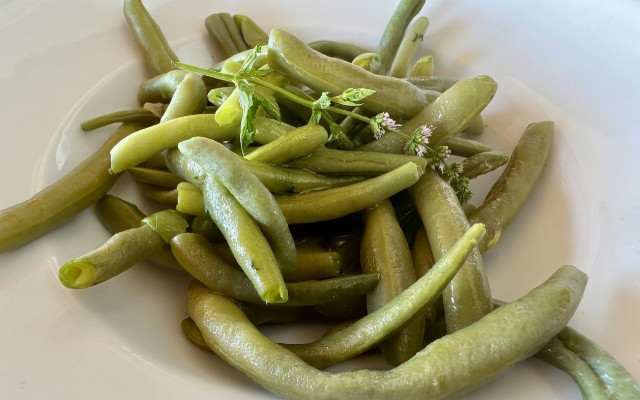
Seventeen thousand hectares cultivated, 152,000 tons harvested and quotations where the very fine caliber with manual selection exceed 6 euros per kilo. The Italian green bean represents a significant agricultural sector, supported by mass consumption that finds frozen foods as the leading market segment. From a nutritional point of view, the vegetable has a clear primacy: 100 grams of raw product provide 43.5% of the Reference Nutritional Value of folates. A detailed analysis between botany, agronomic history, supply chain dynamics andstability of bioactives during cooking highlights its real value for consumers and operators.
Botanical Framework and Pod Selection
The green bean is the immature pod By Phaseolus vulgaris L., harvested before the seeds enlarge and before the pericarp walls lignify. The distinction is not academic: in agricultural statistics and nutritional tables, the green bean is classified among the vegetable crops, not among grain legumes, because its profile is that of a vegetable – over 90% water, 24 kcal per 100 grams – and not that of a dry legume.
From a horticultural perspective, cultivars are distinguished by use – ‘snap’ or fresh shelling – and by growth habit: dwarf, short cycle and suitable for mechanical harvesting, and climbing, which require supports, lengthen the cycle and offer longer pods. The trait that has made mass consumption possible is the absence of the string, the fibrous tissues along the pod sutures: it is that mutation, combined with the low fiber content in the walls, that defines the commercial category today.
From the Seeds of Clement VII to the Stringless Pod
Before Christopher Columbus, another legume was cultivated in Europe and the Mediterranean: the cowpea (Cowpea), the pháselos of the Greeks, the phaseolus of the Latins. The Phaseolus vulgaris American comes later, and in Italy the first news of experimental cultivation dates back to 1528-29The spread is sponsored by Pope Clement VII, Giulio de’ Medici, who promotes its cultivation first in the Vatican gardens and then in the Papal States.
The Italian node of the story has a precise name: Pierio Valeriano (Giovan Pietro Dalle Fosse, Belluno 1477 – 1558), humanist at the papal court, who receives as a gift part of those seeds and starts a personal experimental cultivation. From 1532 he distributes them to his network of correspondents spread across southern Italy, the Alps, France and Germany: it is the first documented experiment of agronomic diffusion of an American species in Europe, and explains why the Belluno area remains one of the historical areas of the bean in Italy today.
The leap towards the modern green bean comes much later, with the selection of stringless lines and with the industrialization of the pod: first preserved, then – from the sixties – frozen, which made the product available twelve months a year and shifted the center of demand.
Surface Area Volume and Fresh Produce Geography in Italy
Istat does not publish an independent item for green beans alone: the survey on surfaces and productions aggregates ‘fresh bean and green bean’ within horticultural crops. The most recent disaggregated data available at the historical series level is that of the Italian Statistical Yearbook 2024 (table 13.2), which records for 2023 17 thousand hectares in production and 152,400 tons harvested, compared to 15 thousand hectares and 131,600 tons in 2022 (Istat, 2024).
The review of the 2019-2023 series is instructive: the area fluctuates between 15 and 18 thousand hectares, production between 131,600 and 169,900 tons. It is a structurally stable sector, with years conditioned more by climate than by the market. Istat had moreover reported for 2023 a production increase of 15,8% for the green bean, among the most significant variations in the entire horticultural sector (Istat, 2024). For 2024, the 2025 Yearbook instead records an overall decrease in horticultural crops (-2.0% in production, -9.4% in area), without detail for the green bean (Istat, 2025).
At European level theItaly is, by volume, the second producer after France. The national center of gravity is twofold: Campania for open field and greenhouse production – where ‘bean and green bean’ cover about 3,839 hectares, 12.8% of the regional vegetable growing area – Veneto e Emilia-Romagna for protected cultivation and for the industrial supply chain.
Wholesale Price Dynamics and Size Differentials
In wholesale markets, the 2026 campaign followed a clear curve, readable in BMTI-Italmercati surveys at the markets of Milan, Bologna, Padua and Rome:
- a May the entry of Italian product hand-picked product pushes prices down and causes the progressive exit of Moroccan green bean from sales; however, the gap remains very wide and the very fine easily exceeds 6.00 euro/kg;
- in June production gets underway and prices drop, with the ‘Piatto Verde’ variety at more regular prices;
- a July the heat wave in the Centre-South slows yields and reverses the trend: on July 20th the green bean is the only vegetable with a sharp rise, with hand harvest again above 6 euros and residual availability of machine-harvested product. At the end of the month, the arrival of Campanian volumes brings prices slightly down.
Two indications for buyers:
- in green beans the price differential does not depend on origin but on the size e from , and the gap between machine harvest and very fine hand harvested can exceed the 2:1 ratio;, and the gap between the machine harvest and the very fine hand harvest can exceed the 2:1 ratio;
- the substitution window between North African product and Italian product opens at May and it ends in autumn, and it is the only interval in which the freshness of Italian origin is really available in mass distribution volumes.
The Motivated Success of Frozen Green Beans
According to the NielsenIQ data processed for the Italian Institute of Frozen Foods (IIAS), in 2025 domestic consumption of frozen foods in Italy exceeded 642 thousand tons (+1.1% compared to 2024); the vegetables remain by far the leading category, with almost 207 thousand tons (-0.1%), ahead of fish (104 thousand) and potatoes (over 92 thousand) (IIAS, 2026).
The picture is consistent with Ismea data on domestic purchases: in the first half of 2025 fresh vegetables grew by 4,9% in volume and ready-to-eat products recover (+2.3%), while frozen vegetables remain stable (Ismea, 2025). Frozen food is therefore a consolidated consumption base.
On the nutritional level the fresh/frozen comparison must be carefully observed:
- the blanching that precedes freezing, even if optimized at the industrial level, leads to losses of water-soluble vitamins; however, the correct comparison is not the freshly picked pod but the one that the consumer finds in the refrigerator after a few days from harvest;
- Acomparative analysis on eight horticultural species – including green beans – compared the freshly picked fresh product, fresh stored for five days in the refrigerator, and frozen, measuring ascorbic acid, total folates and trans-β-carotene. Frozen often equaled or exceeded fresh stored more often than the opposite occurred (Li et al., 2017).
Wonder of Venice and the Germplasm Europe is Registering
Among Italian local varieties the best documented case is the green bean Meraviglia di Venezia, edible-pod flat and light yellow, stringless, cultivated in Cavallino-Treporti and the islands of the northern lagoon – Sant’Erasmo, Le Vignole. It is listed among the traditional agri-food products of Veneto and in the Slow Food Ark of Taste.
The documentation dates back to the Austrian cadastre of 1826 preserved at the State Archive of Venice, and the variety is already described in the manual ‘Practical Horticulture’ by Antonio Turchi (1959) among the climbing yellow-podded snap beans. The pod measures 16-18 cm in the climbing type and 10-12 cm in the dwarf type; the seeds are black or brown at full maturity. Production is niche, available from May to October from the few producers of the lagoon fringe.
Within the European project BRESOV (Horizon 2020) a Snap Bean Panel of 311 lines collected in Europe among local populations and elite cultivars, from which a core collection that maximizes the phenotypic diversity of the pod (García-Fernández et al., 2022). It is from this material that the most solid data on the nutritional quality of the snap bean come today.
Agronomic Techniques and Timeliness of Harvest
The snap bean has a short cycle and rapid uptake, which makes it demanding in readily available fertility even on poor soils. The symbiosis with bacteria of the genus Rhizobium reduces the need for nitrogen fertilization, while fertilization must be set on phosphorus and, where lacking, potassium. The drip fertigation is today the standard in specialized areas, because the crop is sensitive both to water stress during flowering and to excesses, which favor fungal diseases.
The harvest window is the real critical factor. The pod must be picked when the walls are still tender and the seeds just beginning to show: a few days' delay turns a first-class product into raw material for industry. After harvest, the respiration rate remains high even at low temperature, and in the cut pod it is higher than in the whole one: hence the wilting, enzymatic browning, and increase in fiber that reduce commercial and nutritional value within a few days.
The natural seasonality in Italy covers the period from May to October, with the peak between July and September. Out of season, the fresh market is supplied from North Africa – especially Morocco, the leading exporter in the EU – and Spain, while the Netherlands operates as a re-export hub.
Food Composition and High Protein Quality
The following values are those from the CREA food composition tables for 'Fresh green beans, raw (food code 004310, edible portion 95%, reference portion 200 g).
| Nutrient | Per 100 g of edible portion |
| Energy | 24 kcal (101 kJ) |
| Water | 90.5 g |
| Proteins | 2.1 g |
| Lipids | 0.1 g |
| Carbohydrates | 2.4 g |
| of which sugars | 2.4 g |
| Dietary fiber | 2.9 g (0.71 soluble; 2.14 insoluble) |
A often overlooked fact: according to calculations performed by CREA, thechemical index of the protein fraction of green beans is 98 (a very high value, with methionine and cysteine as limiting amino acids). The amino acid profile is therefore favorable, although the protein content is much lower than that of dry legumes, since green beans are rich in water. Thecombination with cereals can enhance the complementarity of amino acid profiles, improving the overall supply of essential amino acids.
Vitamins and Minerals Above 15% of the NRV: The Primacy of Folates
Applying to CREA values the nutrient reference values of Annex XIII to Regulation (EU) No. 1169/2011, only one micronutrient exceeds the 15% threshold per 100 grams which Regulation (EC) No. 1924/2006 defines as a 'significant amount':
– high folate content (vitamin B9), 87 µg per 100 g, equal to 43.5% of the NRV (NRV: 200 µg).
No other micronutrient reaches 15% per 100 grams; potassium is just below, at 14.0%. Considering instead the 200 gram portion indicated by CREA itself, micronutrients exceeding 15% of the NRV increase to four, in descending order:
- folates, 174 µg equal to87,0% of the NRV;
- potassium, 560 mg equal to 28.0%;
- riboflavin, 0.30 mg equal to 21.4%;
- vitamin C, 12 mg equal to 15.0%.
A methodological warning: the values refer to the raw product. Since folates and vitamin C are thermolabile and water-soluble, cooking in water significantly reduces their content. The cooking method, in green beans, therefore affects the nutritional profile more than the variety.
Phenolic Profile and Flavonol Extractability in Thermal Processes
The most comprehensive work on European green beans was conducted by CREA of Foggia with the Polytechnic University of Marche and the Spanish SERIDA on 54 green bean lines cultivated under organic, with phenolic insight on 14 lines with contrasting hardness (Menga et al., 2023). There are three results useful for producers and buyers:
- the phenolic profile of the pod is dominated by flavonoids, which account for about 90% of total phenols in raw and 99% in cooked. The predominant compound is quercetin-3-O-rutinoside (rutin), followed by kaempferol-3-O-rutinoside and quercetin-3-O-glucoside;
- The boiling in water for ten minutes produces opposite effects on different metabolites. Vanillic acid (-85%), quercetin (-42%) and apigenin-8-C-glucoside (-71%) decrease due to leaching; however, five compounds increase from 1.31 to 3.92 times, with rutin leading. In individual lines, rutin increase ranges from 1.8 to 28 times. The proposed explanation is greater extractability after cell wall breakdown;
- despite the increase of some glycosylated flavonols, the antioxidant capacity overall (TEAC) decreases on average by 39% with boiling, from 18.43 to 11.24 µmol of Trolox equivalents per gram. The loss is not uniform: the purple-podded line SBP053 shows a non-significant drop (-3.1%), while a yellow line reaches -73.9%. Pod color, therefore, is a predictor of thermal stability.
Regarding production methods, a dedicated study found that the organic green bean raw shows content of higher flavonoids and antioxidant activity than conventional, whereas the latter shows higher levels of chlorophyll and total phenols (Lima et al., 2017). It is a real but subtle difference, adding to the main reason to prefer organic: maximum ecosystem and biodiversity preservation.
Steaming vs Boiling
the comparison direct between boiling and steaming It was conducted by the Laboratory of Commodity Sciences of Sapienza University of Rome on three varieties of green beans – green, yellow and purple – and the verdict is clear on two converging fronts (Preti et al., 2017):
- antioxidants: boiling reduces the initial antioxidant capacity by up to 30% in the yellow variety and total polyphenols by up to 43% in the green variety, while steam preserves the initial content much better;
- biogenic amines, nitrogenous molecules that accumulate during food degradation and which, like histamine and tyramine, can cause adverse reactions in sensitive individuals. Boiling causes a significant increase in the green and yellow varieties, while steaming does not produce increases. The purple variety, richest in health-promoting compounds, also proves to be the most stable to cooking on both parameters.
The ideal cooking of green beans is therefore steamed, 6-8 minutes for a medium-sized pod. Followed by quick cooling in ice water to stop chlorophyll degradation, and raw seasoning with extra virgin olive oil. If you still choose to boil, use little water and short times; and the cooking water, which carries folate, vitamin C, and free phenols, should be recovered in a soup rather than discarded.
The Green Bean in Italian Cuisine
Italian cuisine celebrated by UNESCO includes the use of green beans in different national and regional contexts:
- thesalad of green beans — boiled or steamed, cooled and dressed raw, alone or with potatoes, eggs, tuna, red onion — represents the most common use;
- in Liguria, trofie or trenette with potatoes and green beans and pesto alla genovese. The pod is added to the pot in the last minutes of cooking, together with the pasta;
- in the Center-South, green beans are often prepared stewed stewed. ‘all’uccelletto’ green beans, in Tuscany, stewed with tomato, garlic, basil or sage. Together with potatoes and cherry tomatoes in Campania;
- in Piedmontese and national tradition green beans are one of the four or five canonical vegetables of theRussian salad.
Sensory Freshness Indices and Professional Purchase Parameters
For the final consumer, the freshness and quality markers of fresh green beans are three:
- consistency. The pod must snap sharply with a dry sound: if it bends without breaking it is dehydrated or overripe;
- the color must be uniform and bright, without dull areas or brown spots, a sign of enzymatic browning;
- appearance. The seeds should not be visibly raised through the wall, as their outline indicates that harvesting occurred late and that the fiber is already forming.
For theprofessional buyer three more criteria apply. The , cold chain, because the green bean has high post-harvest respiration and the time between field and cell is the first determinant of shelf life. There , sizing, which on wholesale markets is worth more than the origin in terms of price. For frozen products, the origin, the absence of added salt and condiments and the system certification.
In both cases, the organic remains the preferred choice: it excludes synthetic pesticide residues, protects soil biodiversity, and—as the above data show—is often associated with a flavonoid profile superior to conventional.
Enhancement Prospects for the Green Bean Supply Chain
The Italian green bean supply chain expresses solid production volumes and a structured presence in industrial processing. However, the enhancement of the sector requires an informational update: the communication of nutritional primacies, such as the significant contribution of vitamin B9, should be accompanied by indications on optimal preparation techniques. The choice of steaming over boiling and support for organic farming constitute the operational levers to preserve the polyphenolic fraction and ensurethe overall quality of the product throughout the entire distribution chain.
Dario Dongo
References
Scientific Literature
García-Fernández, C., Jurado, M., Campa, A., Brezeanu, C., Geffroy, V., Bitocchi, E., Papa, R., & Ferreira, J. J. (2022). A Core Set of Snap Bean Genotypes Established by Phenotyping a Large Panel Collected in Europe. Plants (Basel, Switzerland), 11(5), 577. https://doi.org/10.3390/plants11050577
Li, L., Pegg, R. B., Eitenmiller, R. R., Chun, J.-Y., & Kerrihard, A. L. (2017). Selected nutrient analyses of fresh, fresh-stored, and frozen fruits and vegetables. Journal of Food Composition and Analysis, 59, 8–17. https://doi.org/10.1016/j.jfca.2017.02.002
Lima, G. P. P., Costa, S. M., Monaco, K. A., Uliana, M. R., Fernandez, R. M., Correa, C. R., Vianello, F., Cisneros-Zevallos, L., & Minatel, I. O. (2017). Cooking processes increase bioactive compounds in organic and conventional green beans. International journal of food sciences and nutrition, 68(8), 919–930. https://doi.org/10.1080/09637486.2017.1324563
Menga, V., Fares, C., Campa, A., Ferreira, J. J., Bitocchi, E., Papa, R., & Beleggia, R. (2023). Variability of nutritional, antioxidant, and textural traits of a collection of snap beans of different colors. Horticulturae, 9(3), 311. https://doi.org/10.3390/horticulturae9030311
Preti, R., Rapa, M., & Vinci, G. (2017). Effect of steaming and boiling on the antioxidant properties and biogenic amines content in green bean (Phaseolus vulgaris) varieties of different colours. Journal of Food Quality, 2017, 5329070. https://doi.org/10.1155/2017/5329070
Institutional Sources and Databases
CREA – Research Center for Food and Nutrition. (2019). Fresh green beans (food code 004310). Food composition tables. https://www.alimentinutrizione.it/tabelle-nutrizionali/004310
Istat. (2024). Italian Statistical Yearbook 2024, chapter 13 – Agriculture, table 13.2. https://www.istat.it/storage/ASI/2024/capitoli/C13.pdf
Istat. (2025). Italian Statistical Yearbook 2025, chapter 13 – Agriculture. https://www.istat.it/storage/ASI/2025/capitoli/C13.pdf
Ismea. (2025, November 14). Food consumption of families. The dynamics in the first half of 2025, no. 2/2025. https://www.ismeamercati.it/flex/cm/pages/ServeBLOB.php/L/IT/IDPagina/13672
Ismea. (2026, January 22). AgriMarkets, III quarter 2025. https://www.ismea.it/flex/cm/pages/ServeBLOB.php/L/IT/IDPagina/13544
Italian Institute of Frozen Foods. (2026, February 25). Frozen foods: in 2025 the growth of consumption in Italian homes continues. https://www.istitutosurgelati.it/surgelati-nel-2025-continua-la-crescita-dei-consumi-nelle-case-degli-italiani-11-rispetto-al-2024-per-un-totale-di-oltre-642-mila-tonnellate-consumate/
Market and Sector Sources
Bmti – Italmercati. (2026). Survey of fruit and vegetable prices at wholesale markets, weekly summaries of May 11 and 25, June 22 and 29, July 6, 20, and 27, 2026, published by Fresh Point Magazine. https://www.freshpointmagazine.it/retail-marketing/gdo/andamento-prezzi-ortofrutta-in-italia-al-20-luglio-2026/
CBI – Centre for the Promotion of Imports from developing countries. (2025). The European market potential for green beans. https://www.cbi.eu/market-information/fresh-fruit-vegetables/green-beans/market-potential
Slow Food Foundation for Biodiversity. (n.d.). green bean Meraviglia di Venezia. Ark of Taste. https://www.fondazioneslowfood.com/it/arca-del-gusto-slow-food/fagiolino-meraviglia-di-venezia/
Veneto Region, Agricultural Biodiversity. (n.d.). Phaseolus. Presentation. https://biodiversita.provincia.vicenza.it/present/pr_phaseolus.htm
European Regulations
Regulation (EU) No 1169/2011 of the European Parliament and of the Council of 25 October 2011 on the provision of food information to consumers. Consolidated text: 01/04/2025. http://data.europa.eu/eli/reg/2011/1169/2025-04-01
Regulation (EC) No 1924/2006 of the European Parliament and of the Council of 20 December 2006 on nutrition and health claims made on foods. Consolidated text: 13/12/2014. http://data.europa.eu/eli/reg/2006/1924/2014-12-13

Dario Dongo, lawyer and journalist, PhD in international food law, founder of WIISE (FARE - GIFT – Food Times) and Égalité.


