


The twentieth anniversary of Consorzio Italia del Gusto, celebrated in Rome on June 19, 2026, outlines the balance of a private aggregation model that today moves a turnover of 22 billion euros. Beyond institutional celebrations, the data from the Nomisma Observatory presented on the occasion reveal a geography of Italian agri-food exports deep and asymmetric. Alongside consolidation in mature markets and geopolitical slowdowns, triple-digit growth emerges in unexpected territories and niche leadership in major Asian markets.
The first private consortium of Made in Italy food products
Founded in 2006 by Giovanni Rana, Italia del Gusto is the first private consortium of companies operating in the food and wine sector Italian, whose members are selected for product quality and brand value. Its mission is to help member companies improve their competitive position in international markets, strengthening their image as producers of excellence through marketing, promotion and global communication activities, participation in international fairs and development of commercial and logistical partnerships.
Today the Consortium represents 30 companies, 38 product categories, over 53,000 employees and an aggregated turnover of about 22 billion euros. Among the members are some of the most iconic realities of Made in Italy agri-food: Amadori, Auricchio, Barilla, Bauli, Caffè Borbone, Cirio, Colussi, Elah-Dufour, Filippo Berio, Noberasco, Orogel, Parmalat, Parmareggio, Rana, Rio Mare, Riso Gallo, Rovagnati, Sammontana, San Benedetto, Santa Rosa, Valfrutta, Valsoia and Vecchia Romagna, among others.
From the stage, Giovanni Rana recalled the path taken, indicating a growth of aggregate turnover of the Consortium ‘from 5 to 22 billion euros‘ in twenty years, and identifying the sharing of ideas and collaboration among members as the key to that expansion. Despite international uncertainties, he said he was optimistic: ‘We are doing well because we export food, and Italian food is adored worldwide‘.
System strategies to compete in foreign markets
Giacomo Ponti, CEO of Ponti SpA, is the current chairman of the Consortium — confirmed for the current three-year term — succeeding Mario Preve of Riso Gallo. In reviewing the twenty-year balance sheet, the Knight of Labor Giacomo Ponti recalled the consortium philosophy: ‘in these twenty years, Italia del Gusto has demonstrated that creating a system is a strategic lever to compete and grow in international markets. The ability to unite different experiences, skills, and visions has allowed consortium companies to increase their business abroad and consolidate the positioning of Made in Italy in the world‘. The strength of Made in Italy, he added, today lies in ‘the ability to present itself cohesively in foreign markets, enhancing identity, quality, and innovation‘. Among the key events of consortium activity remain the main international sector events, from Anuga to TuttoFood.
The map of global consumption between Europe and Asia
The celebrations took place in a macroeconomic context that offers insights both on opportunities and system vulnerabilities. According to theNomisma Observatory for Italia del Gusto, the global GDP is expected to reach +3.3% in 2025, in a phase characterized by an increasingly uneven dynamic: theIndia remains the most dynamic market among the target countries (+7,3%) and China China maintains a sustained pace (+5,0%), while the euro area shows a weaker profile (+1,4%), afflicted by stagnation in Germany (+0.2%) and France (+0.8%) and supported mainly by Spain (+2.9%) and Poland (+3.3%).
On the front of food & beverage consumption the geographical gap is marked: between 2019 and 2024 India and China have recorded a growth in per capita consumption of +26%, followed by Poland and the United States (+14%), compared to more moderate trends in mature economies.
In this scenario, theItalian agri-food sector reached a value of 59.3 billion euros of exports, confirming the sixth position worldwide — behind Germany, the Netherlands, and the United States — and a share equal to 4.6% of global trade of the sector. Growth is recorded at +5,1%, second only to that of Germany and Indonesia.
TheEuropean Union is confirmed as the main outlet market for Made in Italy (+7,3%), with France and Germany which remain the countries most dependent on the Italian offer: respectively the 9,9% and the 9,3% of their import food & beverage comes from Italy. Among the most dynamic markets stand out Poland (+21.6%) and Spain (+13.0%).
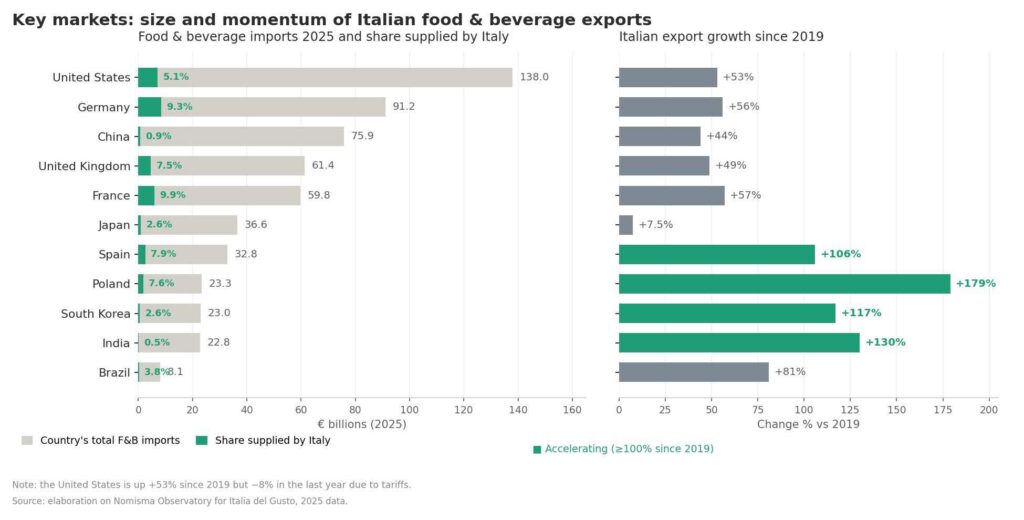
The main markets of interest
The import of Made in Italy food and beverages in the 11 monitored countries by Nomisma reaches about in 2025 573 billion euros. The first 5 importers – United States, Germany, China, United Kingdom and France – alone represent almost 74%. The following table provides the scale of each market — population, per capita wealth, and value of food imports — alongside Italy's competitive positioning.
| Market | Population (mln) | GDP per capita (US$) | F&B Import (billion €) | IT Share | IT Export Value | Pos. | Var. '25/'24 | Var. vs 2019
|
| United States | 338 | 89.599 | 138,0 | 5,1% | 7.1 billion € | 3rd | -8% | +53% |
| Germany | 85 | 73.553 | 91,2 | 9,3% | 8.5 billion € | 3rd | +9% | +56% |
| China | 1.416 | 29.191 | 75,9 | 0,9% | 702 million € | 23rd | -5% | +44% |
| United Kingdom | 70 | 63.759 | 61,4 | 7,5% | 4.6 billion € | 6th | +4% | +49% |
| France | 69 | 66.061 | 59,8 | 9,9% | 5.9 billion € | 5th | +5% | +57% |
| Japan | 123 | 54.815 | 36,6 | 2,6% | 942 million € | 11th | -7,9% | +7,5% |
| Spain | 48 | 56.888 | 32,8 | 7,9% | 2.6 billion € | 4th | +10,4% | +106% |
| Poland | 38 | 55.340 | 23,3 | 7,6% | 1.8 billion € | 3rd | +16% | +179% |
| South Korea | 52 | 65.080 | 23,0 | 2,6% | 592 million € | 12th | +6,5% | +117% |
| India | 1.464 | 12.101 | 22,8 | 0,5% | 119 million € | 22nd | +39% | +130% |
| Brazil | 219 | 23.310 | 8,1 | 3,8% | 307 million € | 9th | +4% | +81% |
Source: elaboration from Nomisma Observatory for Italia del Gusto; population and GDP per capita (international dollars at purchasing power parity) based on IMF and OECD data, 2025.
It is in Europe that Italian food finds the main growth space, while other destinations appear more exposed to trade tensions. In Germany (F&B import of 91.2 billion) Italy is the third supplier with a share of 9.3% (8.5 billion euros), growing by +9% in the last year and +56% since 2019. Made in Italy dominates key sectors: wine (43.9% of German imports), tomato derivatives (60.9%), olive oil (57.5%), dry pasta (83.8%) and vinegar (71.9%).
in France (import of nearly 60 billion) Italy is the fifth supplier with 9.9% (5.9 billion), +5% in the last year and +57% since 2019, and remains the leading supplier of cheeses (34.0%), wine (33.6%), dry pasta (60.3%), tomato derivatives (63.4%), and fresh pasta (42.5%).
The most impressive growth performances come from emerging markets for Made in Italy:
- in Poland food exports from Italy (third supplier, 7.6%, 1.8 billion) marks +16% in the last year — best performance among the top ten exporters — and a +179% since 2019, first country in growth;
- in Spain Italy is the fourth supplier (7.9%, 2.6 billion), with growth of +10.4% in the last year and + +106% since 2019;
- the United Kingdom (sixth supplier, 7.5%, 4.6 billion) confirms an +4% annual growth and +49% since 2019, with Italy as the leading supplier of dried pasta (73%), tomato derivatives (58%) and wheat flour (33%).
The Asian frontier: high potential non-EU markets
The most promising outlook is for large non-EU markets, where Italian presence remains marginal compared to potential size:
- in China the Italian share is just 0.9% (702 million, twenty-third place, -5% in the last year), but with +44% since 2019 and a clear leadership in chocolate (17.2%), dried pasta (44.1%), tomato derivatives (98.3%) and vinegar (36.9%);
- in India Italy weighs 0.5% (119 million), but grows by +39% in the last year and by +130% since 2019, establishing itself as the leading supplier of chocolate (21.8%), tomato derivatives (41.3%) and dry pasta (84.7%);
- the South Korea marks a +6,5% annual and +117% since 2019, second only to Vietnam in historical dynamics;
- weaker is the Japan where Italy is the eleventh supplier (2.6% of f&b imports, 942 million, -7.9% in the last year), and is still a leader in tomato derivatives (38%), vinegar (46%) and dry pasta (30%);
- closing the picture is the Brazil where Italy is the ninth supplier of food and beverages (3.8%, 307 million, +4%), and leads the import of vinegar (84.4%), truffles (76.4%) and tomato derivatives (57.2%).
The dynamic is opposite with the United States: Italy – while remaining the third supplier of the market (5.1%, 7.1 billion) and the first among European countries – suffers a contraction of about -8% in the last twelve months, penalized by the trade barriers of the Trump administration. Cheeses among the most affected categories. A structural vulnerability that the system will have to face with geographic diversification strategies.
Strength segments and product identity
Among the categories analyzed in the monitored markets, the most relevant by import value in 2025 are Coffee (over 34 billion euros, almost 6% of the total f&b import), baked goods (25.9 billion; 4.5%), chocolate (21.8 billion; 3.8%) and cheeses (19.4 billion; 3.4%). Chocolate and coffee show the most expansive dynamic, driven by the increase of commodities in question; the trend for cheeses is also positive, with high Italian shares in France (34.0%) and the United States (23.3%).
On the opposite front, wine, tomato derivatives and olive oil register widespread declines in the main markets. Particularly severe is the drop in olive oil — in the last year -29,0% in the United States, -34,6% in France, -52,0% in Spain — largely attributable to the price correction after the 2024 boom (on aggregate levels, -19% in value but +17% in volume)
Transversely, tomato derivatives, dry pasta e vinegar there remain the categories in which Italy leads almost every market analyzed: the true backbone of the tricolor leadership, as summarized by the following table.
| Market | Categories in which Italy is the first supplier (share of the country's imports)
|
| United States | Cheeses (23.3%), dry pasta (59.4%), ice cream (19.0%), vinegar (69.5%), tomato derivatives (50.1%), truffles (12.5%) |
| Germany | Wine (43.9%), dry pasta (83.8%), vinegar (71.9%), tomato derivatives (60.9%), olive oil (57.5%), rice (29.7%), flour (29.7%), truffles (12.6%) |
| China | Tomato derivatives (98.3%), dry pasta (44.1%), vinegar (36.9%), chocolate (17.2%) |
| United Kingdom | Dry pasta (73%), tomato derivatives (58%), flour (33%), fresh pasta (25%), truffles (23%), vegetable derivatives (20%), vinegar (39%) |
| France | Tomato derivatives (63.4%), dry pasta (60.3%), vinegar (49.8%), fresh pasta (42.5%), cheeses (34.0%), wine (33.6%), rice (29.1%), jams (29.1%) |
| Japan | Vinegar (46%), tomato derivatives (38%), dry pasta (30%) |
| Spain | Dry pasta (78.9%), vinegar (53.6%), fresh pasta (46.1%), flour (31.6%), jams (26.6%) |
| Poland | Dry pasta, wine, tomato derivatives, olive oil (~⅓ each) |
| South Korea | Vinegar (74.5%), tomato derivatives (31.4%) |
| India | Dry pasta (84.7%), tomato derivatives (41.3%), chocolate (21.8%) |
| Brazil | Vinegar (84.4%), truffles (76.4%), tomato derivatives (57.2%), fresh pasta (50.3%), mineral water (34.7%), baked goods (21.5%) |
Future strategies of Made in Italy agri-food
Twenty years after the founding, Italy of Taste demonstrates that the system logic can coexist with the distinctiveness of individual brands, which maintain a strong capacity for global penetration. At the same time, it highlights the need for a flexible strategic vision. If Central Europe confirms itself as the safest landing place and markets like Poland register extraordinary performances, vulnerability on the US front requires reflection on the diversification of geopolitical risk. The challenge for the agri-food system in the next twenty years lies in the ability totransform the current sector leaderships of extra-EU markets into structured and constant trade flows.
Editorial office of GIFT (Great Italian Food Trade)


