
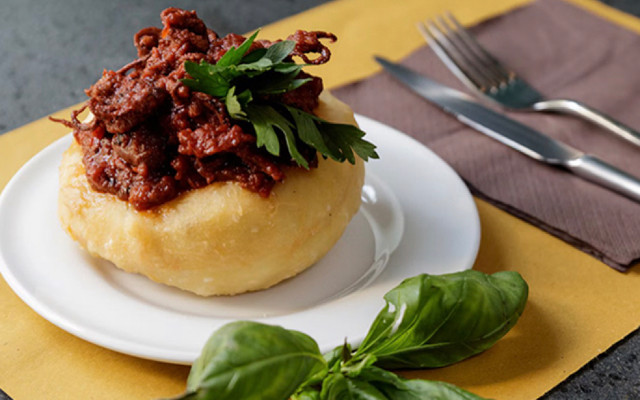
The polenta is a dish made from cereal flour cooked in salted water and stirred for a long time in a copper pot. In Italy, for over four centuries, flour from corn and the dish is a staple especially in Lombardy, Veneto and Friuli, where it serves as a first course, side dish or bread substitute (Treccani, N.d.). Following is the history of corn, the recovered local varieties, nutritional values, regional dishes, recipes by Pellegrino Artusi and a guide to flours and ready-made products.
History of corn and polenta in Italy
The name is older than the ingredient. In Latin polenta indicated the flour barley and the term is related to puls, cereal porridge (Treccani, N.d.). When corn (Zea mays L.) arrived from the Americas, it found a name, a copper pot and a gesture already prepared, though changing the cereal.
Christopher Columbus he described it in the 1492 logbook, mistaking it for panìco - an ancient cereal belonging to the Poaceae (Graminacee) family, then cultivated in the Po Valley - and already in 1493-1494 Pietro Martire d'Anghiera sent the seeds to Cardinal Ascanio Sforza. For some decades it remained a botanical garden curiosity. It became agricultural crop in the second half of the sixteenth century and the first documented sale dates back to 1601, in the feud of Valmareno, in the Treviso area (Brandolini & Brandolini, 2009).
In the seventeenth and eighteenth centuries, maize became established as a response to famines and replaced millet, sorghum and buckwheat. Farmers preferred types with vitreous kernel, which are preserved well from one harvest to another and provide the most suitable flour for polenta (Brandolini & Brandolini, 2009; Stagnati et al., 2022).
Pairings and completeness of the dish
Polenta is almost always paired with cheeses, butter, meats, fish or legumes. Popular wisdom combines taste and nutrition, since maize proteins have a chemical score of 66 and lysine as a limiting amino acid (CREA, 2019), while Legumes and dairy products are rich in them: their combination thus brings to the dish complementary proteins.
Where polenta was for months the only food available to the labourers, pellagra instead spread, a disease linked to the lack of niacin and tryptophan which Francesco Frapolli described as early as 1771. In Italy the cases were reduced by two thirds between 1881 and 1910, also due to the effect of the 1902 law on the prevention and treatment of the disease; the food cause was demonstrated in 1914-1915 and the role of niacin was clarified in 1937 (Pingani et al., 2022).
Local corn varieties for polenta
In 1954 the experimental maize cultivation station in Bergamo collected 562 accessions of traditional maize throughout Italy, shortly before US-origin dented hybrids took their place. Those collections are still preserved in Bergamo and form the basis of the ongoing recovery (Brandolini & Brandolini, 2009).
In Lombardy 13 local varieties are still grown. Those from the mountains often have a pointed seed, a characteristic that favors faster drying of the grain (Sangiorgio et al., 2021). Four cultivars are registered in the national register of conservation varieties: Spinato di Gandino, Rostrato Rosso di Rovetta, Scagliolo di Carenno and Nero Spinoso (Giupponi & Giorgi, 2018). Nero Spinoso from Valle Camonica owes its color to phlobaphenes, pigments from the dei family flavonoids (Cassani et al., 2017). Rostrati corn originated in northern Italy: a survey recorded 28 local varieties still cultivated, 18 of which had never been described before (Ardenghi et al., 2018). The Gandino Horntail is also protected by one municipal designation (Municipality of Gandino, 2015).
In Veneto yellow polenta is usually prepared with Marano, while Biancoperla produces white polenta and is a Slow Food Presidium. Sponcio is cultivated in the Belluno area, 'pointed' in dialect due to the shape of the seeds, registered in the Ark of Taste (Slow Food Foundation, s.d.-a, s.d.-b). Marano and Biancoperla flours are recognized among the Traditional Agri-food Products of Veneto (Veneto Region, 2007).
On shelves you can also find the flour of Corvino Maize, with black, elongated and pointed grains like a raven's beak, also offered in instant crushed version.
Nutritional values of maize flour and polenta
The food composition tables indicated by CREA (Food and Nutrition Research Centre, 2019) report the following nutritional values for maize flour, raw polenta and cooked polenta, per 100 g of product.
| Per 100 g | Maize flour | Polenta, raw | Polenta, cooked |
| Energy | 1426 kJ / 341 kcal | 1353 kJ / 323 kcal | 303 kJ / 73 kcal |
| Fats | 2.7 g | 0.7 g | 0.04 g |
| of which saturated fatty acids | 0.34 g* | not reported | not reported |
| Carbohydrates | 73.5 g | 72.7 g | 17.8 g |
| of which sugars | 1.5 g | 0.6 g | 0.2 g |
| Fibre | 3.1 g | 6.2 g | 0.9 g |
| Proteins | 8.7 g | 8.0 g | 0.9 g |
| Salt | < 0.01 g* | 0.01 g | 0.23 g |
| Thiamine | 0.35 mg (31.8% NRV) | 0.24 mg (21.8% NRV) | 0.05 mg |
(*) calculated values: CREA expresses saturated fatty acids as 12.76% of total lipids. Salt = sodium x 2.5.
The Thiamine (vitamin B1) is the only micronutrient which exceeds 15% of the reference nutritional values referred to in Annex XIII to Regulation (EU) No 1169/2011, in the flour as well as in raw polenta.
Cooked polenta is composed of four-fifths water (80.4 g) and provides 73 kcal per 100 g: the 340 g portion indicated by CREA provides 248. The energy comes almost entirely from starch (16 g). It is worth remembering that corn is naturally gluten-free.
Polenta taragna and regional polenta dishes
The polenta taragna is typical of Valtellina and the Bergamo and Brescia valleys. It combines corn flour and buckwheat, with butter and cheese added at the end of cooking: Bitto DOP, Valtellina Casera DOP, Formai de Mut, Taleggio PDO. The name comes from the tarel, the long wooden stick with which you 'tare', that is, turn, the polenta in the copper cauldron l. Buckwheat contains 12.4 g of protein, 10 g of fiber, 450 mg of potassium and 330 mg of phosphorus per 100 g (CREA, 2019). The dictionary also records the black polenta of buckwheat alone, in Trentino and Valtellina, and sweet polenta made from chestnuts (Treccani, s.d.).
Elsewhere the pairings change:
- in the Aosta Valley polenta concia is seasoned with Fontina DOP e butter;
- in Lombardy and Piedmont it pairs with Gorgonzola DOP;
- in Veneto it accompanies salt cod and, in Venice, it serves as the base for cicchetti;
- on the eastern Alps it arrives on the table with Asiago DOP, Montasio DOP e Piave DOP, perhaps with a glass of Friuli DOC;
- in the Bergamo and Brescia areas it is polenta e osei, with small birds;
- in Lunigiana, chained polenta cooks together with beans e black cabbage;
- wherever it is found with porcini mushrooms, with sausage and stews pork.
Pellegrino Artusi's recipes
Artusi does not offer a simple polenta recipe nor does he describe cooking in the cauldron. In Science in the kitchen and the art of eating well, polenta enters among the 'transmitted', the middle dishes, with two baked preparations. They already appear in the 1895 edition at numbers 177 and 178 and bear the numbers 232 and 233 in the definitive edition (Artusi, 1895; Artusi.net, s.d.).
The polenta made with corn flour and sausages it is a rather tender polenta, spread on a pastry board to the thickness of a finger and cut into almonds, i.e. into lozenges. The sausages are cooked with a drop of water, peeled, crumbled and combined with tomato sauce or preserves. It is made up in layers on a baking tray with Parmesan, sausages and a few pieces of butter, it is heated with the heat above and below and is served as the first course of a 'fork breakfast'. The same polenta, the author notes, can also be made hard, cut into slices.
The baked polenta instead starts from a firm polenta made with corn flour cooked in a Milk, salted at the end of cooking, poured onto a pastry board two fingers high and, once cold, cut into half a centimeter slices. The layers alternate grated parmesan, a meat sauce like that of macaroni Bolognese (n. 87) and a little balsamella (n. 137). Artusi adds that, during game time, 'a skilled cook can shape it by filling it with stewed cooked birds'.
The yellow flour returns in other pages of the definitive edition: the yellow flour gnocchi (n. 90), to be seasoned to taste like polenta with sausages, the Lodigiana polenta fritters (n. 172), the yellow flour millet (n. 241) and the yellow flour deflation (n. 682).
Desired flours, wholemeal, organic, instant and ready-made polenta
Flours are distinguished first of all by particle size:
- The bramata, medium or coarse, is the most used for polenta;
- the fioretto has medium grain;
- the flour fine of maize gives creamy and delicate polenta;
- the flour whole grain preserves the germ and external parts of the kernel;
- the flours instant and precooked, finally, are ready in 5-10 minutes (Altroconsumo, 2023);
Flours and polenta from agriculture organic follow European rules on organic production (Regulation (EU) 2018/848). The organic in Italy today offers a broad base of national raw material, whose origin can be highlighted with the Italian organic mark. Whole grain, organic and Italian: it is the combination which unites taste, nutrition and care of the territory.
The ready polenta – in brick or tray – belong to the family of cooked products to be reheated like vegetables of fresh-cut fruit and are suitable for the grill, oven and pan. On the label, the list of ingredients and the nutritional declaration indicate the amount of corn, salt and any condiments (EU regulation 1169/2011, art. 18 and 30).
Corn in Italy: 2025 data
In 2025 Italy grew corn 540,945 hectares, with a harvest of approximately 5.5 kt and a yield of 101.9 quintals per hectare, grown 17.4% compared to 2006 (Istat, 2026). Official statistics do not isolate polenta flours or ready polenta. The value of the food chain is thus recognised in distinctive signs: local vitreous varieties, stone milling, PATs, municipal names, Presidia and, for the accompanying cheeses, PDO and PGI.
In summary
Italian polenta is a Latin name applied to an American cereal, adopted in the Po Valley in the sixteenth century and became a dish composed with cheeses, meats, fish and legumes. The local varieties recovered in Lombardy and Veneto expand its colours and flavours, instant flours and ready polenta shorten cooking times, and the nutritional table confirms its lightness: 73 kcal per 100 g, before seasoning.
Operators wishing to enhance their supply chains, processes and products in compliance with applicable rules can contact our team of DO (Food and Agriculture Requirements) for the strategic planning of commercial information, also in the environmental and sustainability fields.
Dario Dongo
References
European Union regulatory sources
Regulation (EC) No 1924/2006 of the European Parliament and of the Council of 20 December 2006 on nutrition and health claims made on foods. Consolidated text: 12/13/2014. http://data.europa.eu/eli/reg/2006/1924/2014-12-13
Regulation (EU) No 1169/2011 of the European Parliament and of the Council of 25 October 2011 on the provision of food information to consumers. Consolidated text: 04/01/2025. http://data.europa.eu/eli/reg/2011/1169/2025-04-01
Regulation (EU) 2018/848 of the European Parliament and of the Council of 30 May 2018 on organic production and labeling of organic products. Consolidated text: 03/25/2025. http://data.europa.eu/eli/reg/2018/848/2025-03-25
Nutritional and statistical sources
CREA – Food and Nutrition Research Center. (2019). Food composition tables. Corn flour (000260), https://www.alimentinutrizione.it/tabelle-nutrizionali/000260; Polenta, raw (000075), https://www.alimentinutrizione.it/tabelle-nutrizionali/000075; Polenta, cooked (000076), https://www.alimentinutrizione.it/tabelle-nutrizionali/000076; Buckwheat (000050), https://www.alimentinutrizione.it/tabelle-nutrizionali/000050
Istat. (2026, September 4). Agricultural and livestock production. Year 2025. https://www.istat.it/wp-content/uploads/2026/09/Focus_Produzioni-agricole-e-zootecniche_Anno-2025-rev-7-settembre.pdf
Scientific studies
Ardenghi, N. M. G., Rossi, G., & Guzzon, F. (2018). Back to beaked: Zea mays subsp. mays Rostrata Group in northern Italy, refugia and revival of open-pollinated maize landraces in an intensive cropping system. PeerJ, 6, e5123. https://doi.org/10.7717/peerj.5123
Brandolini, A., & Brandolini, A. (2009). Maize introduction, evolution and diffusion in Italy. Maydica, 54, 233–242.
Cassani, E., Puglisi, D., Cantaluppi, E., Landoni, M., Giupponi, L., Giorgi, A., & Pilu, R. (2017). Genetic studies regarding the control of seed pigmentation of an ancient European pointed maize (Zea mays L.) rich in phlobaphenes: the “Nero Spinoso” from the Camonica valley. Genetic Resources and Crop Evolution, 64(4), 761–773. https://doi.org/10.1007/s10722-016-0399-7
Pingani, L., Garagnani, A., Marchi, M., Bombardieri, C., & Galeazzi, G. M. (2022). Historical micronutrient psychiatry: descriptive analysis of patients with pellagra admitted to the “San Lazzaro” asylum in Reggio Emilia (Italy) in the decade 1901-1910. Medicina Historica, 6(2), e2022022. https://iris.unimore.it/bitstream/11380/1287104/1/2022_PINGANI_MED%20HIS.pdf
Sangiorgio, S., Colombo, F., Ghidoli, M., Giupponi, L., Ferro, G., Ferro, C. G., Cassani, E., Landoni, M., & Pilu, R. (2021). The ancient varieties of mountain maize: the inheritance of the pointed character and its effect on the natural drying process. Agronomy, 11(11), 2295. https://doi.org/10.3390/agronomy11112295
Stagnati, L., Soffritti, G., Desiderio, F., Lanubile, A., Zambianchi, S., Marocco, A., Rossi, G., & Busconi, M. (2022). The rediscovery of traditional maize agrobiodiversity: a study case from Northern Italy. Sustainability, 14(19), 12110. https://doi.org/10.3390/su141912110
Sources on local varieties and biodiversity
Comune di Gandino. (2015). Mais Spinato di Gandino [leaflet]. https://www.gandino.it/sites/default/files/content/article/8162-pieghevole_mais_spinato_2015.pdf
Slow Food Foundation. (n.d.-a). Mais biancoperla. Slow Food Presidium. https://www.fondazioneslowfood.com/it/presidi-slow-food/mais-biancoperla/
Slow Food Foundation. (n.d.-b). Mais sponcio. Ark of Taste. https://www.fondazioneslowfood.com/it/arca-del-gusto-slow-food/mais-sponcio/
Giupponi, L., & Giorgi, A. (Eds.). (2018). Traditional cultivars of the Lombard mountains listed in the National Register of conservation varieties. UNIMONT, University of Milan. https://www.unimontagna.it/web/uploads/2017/11/opuscolo-cultivar-montane-RELIVE.pdf
Veneto Region. (2007). [Sheets of plant species, annex 5 to the Rural Development Programme]. https://elezioni.regione.veneto.it/static/www/agricoltura-e-foreste/psr_alleg_05_schede_specie_vegetali_rev20082007.pdf
Historical and gastronomic sources
Altroconsumo. (2023, March 23). Maize: polenta is on the table. https://www.altroconsumo.it/alimentazione/pasta/speciali/mais
Artusi, P. (1895). Science in the kitchen and the art of eating well (2nd ed.). Tramessi, nos. 177-178. Wikipedia. https://it.wikisource.org/wiki/La_scienza_in_cucina_e_l'arte_di_mangiar_bene_(1895)/Ricette/Tramessi
Artusi.net. (N/A). Tramessi. Recipes from no. 227 to no. 252. https://www.artusi.net/ricette/le-ricette-di-pellegrino-artusi/tramessi.html
Treccani. (N/A). Polenta. In Online Vocabulary. https://www.treccani.it/vocabolario/polenta/

Dario Dongo, lawyer and journalist, PhD in international food law, founder of WIISE (FARE - GIFT – Food Times) and Égalité.


