

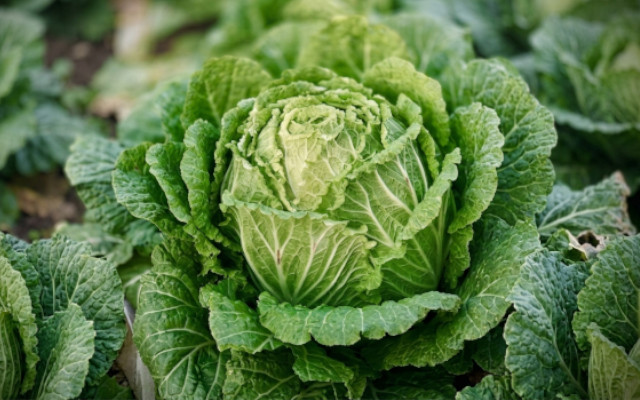
Cabbage, savoy, black cabbage, broccoli and Brussels sprouts belong to the same species, Brassica oleracea, selected over the centuries to enhance the different organs of the plant: leaves, buds, inflorescences, stem. In cooking and on the table, they differ in texture, use and nutritional composition (CREA, 2019a-e).
I Italian cabbages offer contained energy, fiber and vitamin C. Choosing products organic, seasonal and of known origin also links the quality of the dish to the protection of agricultural biodiversity (Walker et al., 2025).
Areas and production in Italy
ISTAT statistics detect the leaf cabbages (cabbage, savoy, Brussels and others) separately from cauliflower – item that in ISTAT detailed tables also includes the broccoli – and from broccoletto di rapa, i.e. turnip tops. In 2023 leaf cabbages occupied about 11 thousand hectares for a production of 236 thousand tons, down 22% compared to 2019 (14 thousand hectares and 301 thousand tons). In the same 2023, cauliflower instead covered 15 thousand hectares with a production of 355 thousand tons, broccoletto di rapa 10 thousand hectares with 161 thousand tons (Istat, 2024).
From Catone to Belli
Catone, in De agri cultura (ca. 160 BC), considers cabbage superior to every other vegetable. He recommends eating it raw, dipped invinegar, and suggests eating plenty of it before a banquet in order to be able to drink at will. He distinguishes three types, the smooth one with broad leaves, the curly one and a tenderer one with a thin stem, and attributes to the plant healing virtues for wounds, colic and headaches (chapters 156-157).
In Rome the Romanesco broccoli has been cultivated in the countryside since ancient times. The regional card recalls that Giuseppe Gioachino Belli, in the sonnet ‘Er testamento der Pasqualino’ from 1834, gives the gardener a nickname linked to the broccoli head he cultivated and sold (Regione Lazio, n.d.).
The curly black cabbage of Tuscany is a local ecotype linked to peasant cuisine of ribollita and bread soup, produced in the area for at least 150 years (Regione Toscana, n.d.).
Botany and seasonality
The head (Brassica oleracea var. capitata) and the savoy cabbage (var. sabauda) form a head of leaves, smooth in the first and blistered in the second. The black cabbage has long, dark and wrinkled leaves, not gathered in a ball. The Brussels sprouts (var. gemmifera) are axillary buds, the kohlrabi is a swollen stem, broccoli e cauliflowers are immature inflorescences (CREA, 2019a-e; Regione Lombardia, 2017).
The turnip tops instead derive from turnip and must be distinguished from broccoli, even in nutritional comparison (Regione Lombardia, 2017). Autumn and winter are the reference seasons, with different calendars depending on type and territories: Tuscan black cabbage is harvested from October to March, Romanesco broccoli is on the market from mid-October to the end of March (Regione Toscana, n.d.; Regione Lazio, n.d.).
Integrated and organic cultivation
The regulations of integrated production, such as those updated in 2026 by the Campania Region, require each company to have a fertilization plan calculated using the balance method based on soil analysis, and irrigation volumes commensurate with the crop's water balance (Campania Region, 2026).
The certified organic goes further, with stringent limits on synthetic fertilizers and pesticides. A 2025 meta-analysis finds benefits of organic farming on pollinator diversity in all types of landscapes, more marked in simplified ones, with variable responses according to crop and insect group (Walker et al., 2025).
Nutritional values
The food composition tables indicated by CREA — Food and Nutrition Research Center (2019) report the following nutritional values per 100 g of edible portion of raw cabbages.
| Per 100 g | Green cabbage | Red cabbage | savoy cabbage | Green sprouting broccoli | Brussels sprouts |
| Energy (kJ) | 100 | 90 | 121 | 125 | 197 |
| Energy (kcal) | 24 | 22 | 29 | 30 | 47 |
| Fats (g) | 0,1 | 0,2 | 0,1 | 0,3 | 0,5 |
| of which saturated fatty acids (g) | n.d. | n.d. | n.d. | n.d. | n.d. |
| Carbohydrates (g) | 2,5 | 2,7 | 3,8 | 2,0 | 4,2 |
| of which sugars (g) | 2,5 | 2,7 | 3,8 | 2,0 | 3,3 |
| Fiber (g) | 2,6 | 1,0 | 2,9 | 3,0 | 5,0 |
| Proteins (g) | 2,1 | 1,9 | 2,0 | 3,4 | 4,2 |
| Salt (g) | 0,06 | 0,02 | n.d. | 0,02 | 0,02 |
| Vitamin C (mg) | 47 (59%) | 52 (65%) | n.d. | 77 (96%) | 81 (101%) |
| Vitamin A (µg RE) | – | – | n.d. | 123 (15%) | 220 (28%) |
| Folate (µg) | – | – | n.d. | – | 100 (50%) |
| Riboflavin (mg) | – | – | n.d. | 0.21 (15%) | – |
| Potassium (mg) | – | – | n.d. | 370 (19%) | 450 (23%) |
| Zinc (mg) | – | – | n.d. | 2.35 (24%) | – |
Source: CREA, sheets 005200, 005190, 005210, 005180, 005170. Salt calculated from sodium (× 2.5). Percentages in parentheses refer to reference nutritional values in Annex XIII of Regulation (EU) No. 1169/2011; vitamins and minerals shown only if at least 15%. 'n.d.': data not reported by CREA; '–': below 15%.
All five types have a fiber content higher than 3 g per 100 kcal, a threshold that allows the nutritional claim ‘high fiber content‘. Cabbages, broccoli and Brussels sprouts exceed double the significant amount of vitamin C and can boast 'high vitamin C content'. Brussels sprouts are also 'high content of folate‘ (reg. EC 1924/2006, Annex).
Possible health benefits
One umbrella review An umbrella review of 41 meta-analyses, which gather 303 observational studies and over 13 million participants, suggests a possible association between cruciferous vegetable consumption and a reduced risk of stomach, lung, and endometrial cancers, as well as all-cause mortality (Li et al., 2022).
In the kitchen
In the Tuscan ribollita black cabbage is the star with beans cannellini and the Bread stale; the version of Il Cucchiaio d’Argento adds Savoy cabbage, carrots, and potatoes and requires several hours of rest before reheating (Il Cucchiaio d’Argento, n.d.).
The Lombard cassoeula combines Savoy cabbage with the less prized cuts of pork and is linked to the feast of Saint Anthony Abbot on January 17. It varies from province to province: in Bergamo they add cabbage, in Varese small sausage patties called verzini (Gambero Rosso, 2020).
In Rome the pasta and Romanesco broccoli in razza broth is prepared with a broth also made from fish scraps, filtered and completed with broccoli tops, tomato, anchovy, and broken spaghetti (Lazio Region, n.d.). Catone’s advice, raw cabbage seasoned with vinegar, remains valid for thinly sliced cabbage in salad.
Buying advice
Fresh cabbages should be chosen heavy and compact, with shiny and crunchy leaves, cleanly cut core, tight florets, and closed flowers; the broccoli stalks, peeled and sliced, are cooked like the florets (Lombardy Region, 2017). On organic packages, next to the European logo, there must be the control body code and the indication of the origin of agricultural raw materials, such as ‘Agricoltura Italia’ (EU reg. 2018/848, art. 32).
Conclusions
Italian cabbages combine a variety of shapes and uses that few other vegetable species can boast, as well as balanced nutritional profiles. The decrease in cultivated areas over the last five years makes it more important to support local ecotypes and organic supply chains by choosing seasonal products of declared origin.
Dario Dongo
References
Scientific studies
Li, Y.-Z., Yang, Z.-Y., Gong, T.-T., Liu, Y.-S., Liu, F.-H., Wen, Z.-Y., Li, X.-Y., Gao, C., Luan, M., Zhao, Y.-H., & Wu, Q.-J. (2022). Cruciferous vegetable consumption and multiple health outcomes: An umbrella review of 41 systematic reviews and meta-analyses of 303 observational studies. Food & Function, 13(8), 4247-4259. https://doi.org/10.1039/D1FO03094A
Walker, E., Wooliver, R., Russo, L., & Jagadamma, S. (2025). The context-dependent benefits of organic farming on pollinator biodiversity: A meta-analysis. Journal of Applied Ecology, 62(1), 41-52. https://doi.org/10.1111/1365-2664.14826
EU legislative sources
Regulation (EC) No 1924/2006 of the European Parliament and of the Council of 20 December 2006 on nutrition and health claims made on foods. Consolidated text: 13/12/2014. http://data.europa.eu/eli/reg/2006/1924/2014-12-13
Regulation (EU) No 1169/2011 of the European Parliament and of the Council of 25 October 2011 on the provision of food information to consumers. Consolidated text: 01/04/2025. http://data.europa.eu/eli/reg/2011/1169/2025-04-01
Regulation (EU) 2018/848 of the European Parliament and of the Council of 30 May 2018 on organic production and labelling of organic products and repealing Council Regulation (EC) No 834/2007. Consolidated text: 25/03/2025. http://data.europa.eu/eli/reg/2018/848/2025-03-25
Institutional data and publications
CREA – Research Centre for Food and Nutrition. (2019a). Brussels sprouts, raw (code 005170). Food composition tables. https://www.alimentinutrizione.it/tabelle-nutrizionali/005170
CREA – Research Centre for Food and Nutrition. (2019b). Sprouting broccoli, raw (code 005180). Food composition tables. https://www.alimentinutrizione.it/tabelle-nutrizionali/005180
CREA – Research Centre for Food and Nutrition. (2019c). Red cabbage, raw (code 005190). Food composition tables. https://www.alimentinutrizione.it/tabelle-nutrizionali/005190
CREA – Research Centre for Food and Nutrition. (2019d). Green cabbage, raw (code 005200). Food composition tables. https://www.alimentinutrizione.it/tabelle-nutrizionali/005200
CREA – Research Centre for Food and Nutrition. (2019e). Savoy cabbage, raw (code 005210). Food composition tables. https://www.alimentinutrizione.it/tabelle-nutrizionali/005210
Istat. (2024). Italian statistical yearbook 2024, chap. 13 ‘Agriculture’, table 13.2. https://www.istat.it/storage/ASI/2024/capitoli/C13.pdf
Region Campania, Department of Agriculture. (2026). Integrated production regulations. Update 2026. https://agricoltura.regione.campania.it/difesa/files/disciplinari-2026-produzione.pdf
Region Lazio. (n.d.). Romanesco broccoli. Lazio Parks, Nature in the Field. https://www.parchilazio.it/schede-13263-broccolo_romanesco
Region Lombardy. (2017, December 22). What cabbage do you want? GoodLombardy. https://www.buonalombardia.regione.lombardia.it/wps/portal/site/buonalombardia/DettaglioRedazionale/educazione-alimentare/fare-la-spesa/che-cavolo-vuoi
Region Tuscany. (n.d.). curly black cabbage of TuscanyThe traditional Tuscan products, sheet 51. https://prodtrad.regione.toscana.it/LIB_ProdTrad/Prodotto.php?ID=51
Historical and gastronomic sources
Catone, M. P. (1934). On agriculture, chs. 156-157. Loeb Classical Library. LacusCurtius, University of Chicago. https://penelope.uchicago.edu/Thayer/E/Roman/Texts/Cato/De_Agricultura/K*.html
Gambero Rosso. (2020, October 13). Cassoeula: origin, history, and recipe. https://www.gamberorosso.it/?p=119694
Il Cucchiaio d’Argento. (n.d.). Simple Ribollita. https://www.cucchiaio.it/ricetta/ricetta-ribollita-semplice/
Region Lazio. (n.d.). pasta and Romanesco broccoli in razza broth. Lazio Parks. https://www.parchilazio.it/schede-14092-pasta_e_broccolo_romanesco_in_brodo_di_razza
GIFT Insights
Dongo, D. (2025, November 27). The Italian cauliflower: biodiversity and health benefits. GIFT – Great Italian Food Trade. https://www.greatitalianfoodtrade.it/verdure/il-cavolfiore-italiano-biodiversita-e-benefici-per-la-salute/
Strinati, M. (2025, October 22). The broccoli, a functional vegetable (if cooked well). GIFT – Great Italian Food Trade. https://www.greatitalianfoodtrade.it/verdure/broccolo-ortaggio-funzionale-cottura/

Dario Dongo, lawyer and journalist, PhD in international food law, founder of WIISE (FARE - GIFT – Food Times) and Égalité.


