

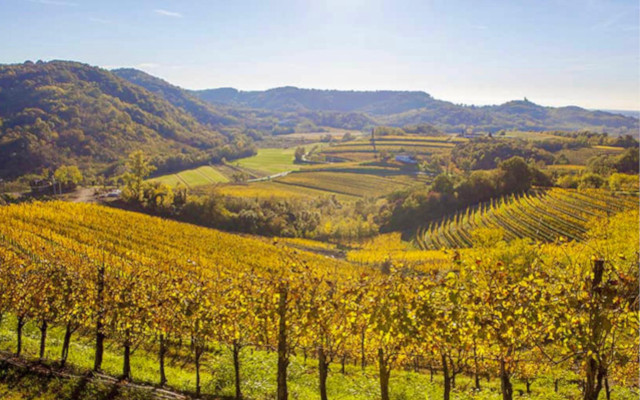
The controlled designation of origin ‘Friuli’ or ‘Friuli Venezia Giulia’ protects twenty-one — soon twenty-three — types of wine over four provinces, with 3,500 hectares claimed and about 23 million bottles. Born in 2016, it covers the entire wine-growing area from the Grave of Pordenone to the Trieste Karst, passing through Isontino and the Udine plain.
It is the tool with which the Friuli vineyard has chosen to present itself in a unified way on the markets, leaving the historical denominations — Collio, Colli Orientali, Carso, Isonzo, Aquileia, Annia, Latisana, Grave — to tell the story of the individual territories.
In this article we analyze the production regulations, market data, the Tocai case, and the production history of the region, with two summary tables on the characteristics of all white and red wines of the denomination.
The denomination in numbers: 3,500 hectares, 173 thousand hectoliters, 92 companies
The most recent data were disclosed by the annual assembly of the Consortium for protection, held in San Vito al Tagliamento on July 29, 2026. On 3,500 hectares claimed by DOC Friuli in the 2025 harvest, 317,000 quintals of grapes were collected, a figure substantially aligned with the previous year despite climatic difficulties. Production reached 173,081 hectoliters, equal to about 23 million bottles: over 40 percent of all wine bottled in Friuli-Venezia Giulia (De Toma, 2026).
The data that deserves attention is the actual yield. 31,700 tons of grapes on 3,500 hectares mean just over 90 quintals per hectare, against a regulatory limit that for most types reaches 140 quintals. The denomination, in other words, consistently operates around two-thirds of the theoretical production potential: a safety margin that explains why the system holds even in difficult years without resorting to extraordinary yield reductions.
The Consortium, operational since 2019 — three years after the birth of the DOC — now associates 92 companies, with new entries expected, and has moved its headquarters inside the San Vito al Tagliamento wine hub, where three certification bodies (Triveneta Certificazioni, Ceviq and Valoritalia) and the Consortia of Friuli Grave, delle Venezie and Prosecco also operate.
The regional framework and the export issue
At the system level, the utilized agricultural area for vineyard in Friuli-Venezia Giulia is around 22,000 hectares, almost entirely included in DOC and IGT zones, distributed over about 9,000 companies with an average area of 2.5 hectares. The sector accounts for almost 15% of the regional gross agricultural production sold (Autonomous Region Friuli Venezia Giulia, 2026a). The region produces less than 2.5% of Italian wine by volume, but it consistently ranks among the top for denomination production share (MASAF, 2020).
On the front of markets, 2025 was a year of contraction for Italian wine: 20.95 million hectoliters exported (−2.0%) for 7.78 billion euros (−3.7%), against a national production of 44.38 million hectoliters (Ismea, 2026). Contrary to the trend, the exports of Friuli-Venezia Giulia exported for 238 million euros, +8% (The Numbers of Wine, 2026, on Istat data).
However, the data must be read with caution, as the regional export statistics are built on theorigin of the exporting company, not on the origin of the wine: it therefore also includes the Prosecco DOC and the Pinot Grigio delle Venezie bottled by companies based in the region. It is therefore not an indicator of the commercial performance of the DOC Friuli as such, for which there are currently no disaggregated export data from public sources.
More directly related to certified quality is the data of DOP economy: in 2024 the production value of the regional DOP-IGP wine sector reached 862 million euros (+8.0%), fourth national place, with only the province of Pordenone in eighth place in Italy with 320 million (+9.8%). Added to the 402 million of the food sector, the system of regional geographical indications exceeds 1.2 billion euros (Ismea & Fondazione Qualivita, 2025).
Regional policies for the protection and balance of the vineyard potential
The management of the productive potential has been, in recent years, the true field of intervention of the Region. For the DOC Friuli, the Regional Council resolution no. 1040 of 24 July 2025 extended until 31 July 2026 the temporary suspension of the registration of vineyards to the vineyard registry for the purposes of claiming Pinot Grigio: measure introduced in 2022 for areas planted or grafted after 31 July 2021 and replicated in parallel for the DOC Friuli Grave (DGR no. 1041/2025).
As of 30 July 2026 — date of the last update of the institutional page — no extension has been published for the DOC Friuli, while the DOC 'delle Venezie' obtained an extension until 31 July 2028 and the DOC Prosecco saw the suspension of vineyard registrations of Glera, Pinot Nero, Chardonnay, Pinot Bianco, and Pinot Grigio for three consecutive seasons (Autonomous Region Friuli Venezia Giulia, 2026b).
For the 2025 harvest the Region also intervened with three decrees of 14 August 2025: no. 42291 allowed the reduction of the minimum natural volumetric alcoholic strength of the grapes at harvest for the DOC ‘delle Venezie’, ‘Friuli’, and ‘Friuli Grave’; nos. 42300 and 42301 authorized theenrichment of the 2025 harvest products. They are now recurring climate adaptation tools, which say a lot about the pressure on the technological and phenolic ripening of grapes in the Friulian plain.
Two thousand years of viticulture, from Pucino to Friulano
The part of the Friuli DOC regulations dedicated to human factors (regulation, article 9) is unusually rich and itself constitutes a historical source worthy of attention.
From the colony of Aquileia to the Middle Ages
The Latin colony of Aquileia is deduced in 181 BC, as Livy tells in book 40 of the Annals; it is most likely from there that organized viticulture in Friuli begins, although Strabo alludes to a pre-Roman Aquileia that already supplied nearby peoples with wine and oil. The Wine Pucino, produced near the Timavo springs, was appreciated at the imperial court: Empress Livia attributed her eighty-six years to that wine alone.
About the barrel the regulation reports an ongoing historiographical controversy. Hugh Johnson dates the replacement of the amphora with the barrel, a Celtic invention, to the 3rd century AD; but Herodian testifies that in 238 AD Maximinus Thrax crossed the flooded Isonzo on a bridge made by tying together barrels abandoned in the countryside, and Strabo recalls in Aquileia barrels 'as big as houses'. The eighteenth-century agronomist Antonio Zanon claimed that they were invented by Friulians; Tito Maniacco denies it. The regulation, honestly, limits itself to recording that 'there are reasonable conjectures.'
A document from 762 AD — the list of assets of the Lombard brothers Erfo, Anto, and Marco, founders of the Salt monastery of Povoletto — obliges the farmers of Medea and Cisis to deliver one hundred amphorae of wine annually: a quantity largely exceeding the needs of the monastic community, proving that the wine trade did not stop even in the Early Middle Ages.
Bertoli’s eighteen hundreds and the first specialized vineyard
The most surprising chapter is that of Count Lodovico Bertoli, who in the 1747 published in Venice, at fifty-nine years old, Le vigne ed il vino di Borgogna in FriuliBertoli openly contests the promiscuous cultivation and the 'Friulian planting' — the vine married to the trees — and establishes in Biauzzo, in Marinutto locality, a vineyard specialized in low vines on dry stakes, oriented north-south. Eight and a half hectares of Refosco at a density of 9,338 plants per hectare: a plantation which the regulation itself defines futuristic, and which contemporaries judged mad.
Also in the cellar Bertoli anticipates: he reduces skin maceration to one and a half days to obtain the delicate ruby of Burgundy wines, transfers to chestnut or mountain cherry barrels, and conducts fermentation with a funnel-filler inserted in the barrel hole — a technique very similar to barrel fermentation dei bianchi contemporanei, qui applicata a un rosso. Alcune sue bottiglie, presentate sul mercato veneziano, furono vendute come francesi.
On the other side works Giovanni Bottari, in San Michele di Latisana, who does not abandon the planting but corrects it: reduces vines per stake and the shoots to increase the mulberry leaves without sacrificing the grapes. And Abbot Gottardo Canciani, in the Memoir of 1773, recommends harvesting ripe grapes, immediately pressing them, separating the black from the white, and transferring before spring to full barrels: elementary and still valid advice.
The vine-growing tradition and the revival of the vineyard in the second half of the twentieth century
Pietro di Maniago, in the Catalog of the vine varieties of the Veneto Kingdom del 1823, censisce 127 grape varieties cultivated in Friuli; the Bulletin of the Friulian Agricultural Association records 357 , in 1863Then come powdery mildew, phylloxera and downy mildew. Production data are impressive: 167,565 hectoliters in 1841, just 14,259 in 1862.
The post-phylloxera reconstruction transforms the Aquileian plain into the largest vine nursery center in the world. In 1881 the Gorizian Agricultural Society requests 2,000 florins from the Austrian government for a nursery of American vines; in 1902 a state nursery is established in Monfalcone producing 780,000 cuttings of Rupestris Monticola.
Giovanni Battista Toppani, nurseryman in Ruda, is the first to import the Kober 5BB rootstock into Italy. In 1953 the Aquileia nursery consortium was founded, which in 1965 became the Tullio Consortium: it exported between 25 and 30 million cuttings per year to Germany, from over 250 hectares of mother plants cataloged clump by clump and protected by hail nets. Beyond the Tagliamento, on September 4, 1936, the following were established Vivai Cooperativi Rauscedo.
The structural leap arrives in post-war: between 1950 and 1979 the specialized vineyard goes from 27% to 93% of the surface, 22,235 hectares compared to 1,550 of promiscuous vines. In 1939 Guido Poggi had published theAmpelographic Atlas, sixty-five plates that save the most valuable native varieties; of the historic grape varieties, at the end of the 1950s, the varietal selection recovers a few: Ribolla in Gorizia, Refosco from Carso, Verduzzo and Picolit in Udine.
The identity of Tocai and the European legal dispute
No story better illustrates the relationship between local identity and supranational law. The vine variety today called Friulano genetically coincides with Sauvignonasse (or Sauvignon vert), once widespread in the Bordeaux region and then abandoned in favor of Sauvignon blanc; in the National Register of grape varieties it is still registered as ‘Tocai friulano B’, with the official synonyms Friulano, Tai, and Tuchì. It was the ampelographer Giovanni Dalmasso, in the 1930s, who proposed the denomination ‘Tocai friulano’ precisely to avoid confusion with Tokaji.
The confusion, however, was not accepted by Hungary. With the decision 93/724/EC On 23 November 1993 the Council approved the agreement between the European Community and the Republic of Hungary on the mutual protection and control of wine denominations, which prohibited the use of the name 'Tocai' after 31 March 2007. Regulation (EC) No 753/2002, Annex II, as amended by Regulation (EC) No 1512/2005, incorporated the transitional period.
The Friuli-Venezia Giulia Region and ERSA challenged the national implementing legislation before the Lazio Regional Administrative Court (TAR), which raised a preliminary ruling.
With the judgment 12 May 2005, case C-347/03, the Court of Justice rejected the complaints, recognizing in Article 133 of the EC Treaty a suitable legal basis for the agreement. One point must be clarified, as it is often referred to incorrectly: the Court established that ‘Tocai friulano’ and ‘Tocai italico’ were not geographical indications, but names of grape varieties recognized in Italy, whereas ‘Tokaj’ constituted Hungarian geographical indication. Therefore, it was not a conflict between two geographical indications, but between one geographical indication and a homonymous grape variety name.
From 1 April 2007 the name disappears from Italian labels. The Regions moved in a scattered and uncoordinated manner: the Ministry authorized ‘Friulano’ for Friuli-Venezia Giulia and ‘Tai’ for Veneto, while Lombardy — where the grape variety was almost extinct — only later obtained ‘Tuchì’ for the DOC San Martino della Battaglia. The Region then attempted the legislative route with its own regional law, and the matter reached the Constitutional Court (ruling no. 368/2008). Outside the European Union, moreover, the use of ‘Tocai Friulano’ on labels remainsallowed.
The production regulations
The production specification of Friuli DOP currently in force, approved with the implementing regulation (EU) 2020/1680 of the Commission of 6 November 2020, is structured in ten articles. Below is a summary of its essential points.
Denomination and allowed types
The name Friuli DOP is still reserved for twenty-one types of wines:
- fourteen whites (White, Sparkling, Classic method sparkling, Ribolla gialla sparkling, Ribolla gialla classic method sparkling, Chardonnay, Friulano, Malvasia, Pinot blanc, Pinot gris, Riesling, Sauvignon, Aromatic Traminer, Verduzzo friulano) and
- seven reds (Red, Cabernet, Cabernet Franc, Cabernet Sauvignon, Merlot, Pinot noir, Refosco dal peduncolo rosso).
No mention of 'reserve' is provided for any. The name can also be expressed in Slovenian (specification, article 1).
Ampelographic bases and exclusions
The White can be obtained, alone or jointly, from Chardonnay, Friulano, Istrian Malvasia, Pinot blanc, Pinot gris, Riesling, Sauvignon, Aromatic Traminer, Verduzzo friulano and Ribolla gialla; the Red from Cabernet franc, Cabernet Sauvignon, Carmenere, Merlot, Pinot noir and Refosco dal peduncolo rosso. The generic sparkling wines allow Chardonnay, Pinot blanc, Pinot gris and Pinot noir vinified as white.
For types with varietal indication the threshold of85% single-varietal applies at the company level, with a maximum of 15% of grapes, musts and wines from other grape varieties with similarly colored berries suitable for the four provinces, expressly excluding Moscati, Müller Thurgau and Traminer.
Three clarifications deserve operational attention: in Cabernet, Cabernet franc, Cabernet sauvignon and Carmenere may contribute, separately or jointly; in Riesling, Italian Riesling and Rhine Riesling; in Malvasia, Istrian Malvasia must contribute (specification, article 2).
An area covering four provinces
The delimitation includes the entire municipal territory of a very large number of municipalities: thirty-nine in the province of Pordenone, twenty-five in that of Gorizia, six in the Trieste area (Duino-Aurisina, Monrupino, Muggia, San Dorligo della Valle, Sgonico, Trieste) and over eighty in the province of Udine. It is in fact the entire regional vineyard area, and it is this breadth that makes DOC Friuli a ‘umbrella’ designation more than a strictly territorial indication (regulation, article 3).
Rules for viticulture
All vineyards on suitable land are eligible for registration, excluding those with high water availability due to rising groundwater and peat soils. For new plantings and replantings, vertical wall forms and GDC are allowed, excluding canopy and pergola, with a density not less than 3,500 vines per hectare. Any forcing practice is prohibited; emergency irrigation is permitted.
The maximum production varies by type: 14 tons per hectare for most wines, 13 for Cabernet, Cabernet Franc, Riesling, and aromatic Traminer, 12 for Malvasia. The minimum natural alcohol content by volume is 10.00% for still wines and 9.50% for sparkling wines. In favorable years, the total production may not exceed the limits by 20%.
The Region, upon proposal by the Consortium and after consulting category organizations, may set lower limits before harvest for market balance or in the event of disasters, and may allow producers to comply with the reduction also using stock from the previous three years (regulation, article 4).
Vinification, transformation yields and sparkling wine production
Vinification and aging must take place in the production area, with traditional exceptions for seven municipalities in the province of Treviso (Cordignano, Orsago, Gaiarine, Portobuffolè, Mansuè, Meduna di Livenza, Motta di Livenza) and three in the province of Venice (Portogruaro, Pramaggiore, Annone Veneto). The operations of prise de mousse, stabilization and sweetening of sparkling wines are also allowed in the provinces of Treviso and Venice and in the Slovenian municipality of Dobrovo: a rare cross-border derogation in the Italian context.
The grape/wine yield cannot exceed 70% for Cabernet, Cabernet Franc, Cabernet Sauvignon, Merlot, Pinot Noir, Refosco dal Peduncolo Rosso, and Red, and 75% for other types; exceeding 80% results in loss of denomination rights for the entire batch. For sparkling wines, the limit is 65%, with non-denominable surplus up to 70%.
Sparkling wine and Ribolla gialla sparkling wine are obtained exclusively by natural fermentation in autoclave: minimum processing of 90 days, lees aging not less than 90 days in vessels without agitators or 30 days with agitator devices. The vintage requires a total of 18 months, with 12 months on lees (9 with agitators) and release for consumption after 24 months from November 1 of the harvest year.
For the classic method, tirage allowed from February 1 following the harvest, processing not less than 9 months, bottle aging of at least another 9 months and release for consumption not before 25 months. The vintage classic method instead requires thirty months of bottle aging and release for consumption after thirty-seven months from November 1, with at least 85% of the cuvée referring to the vintage.
The regulations finally allow the reclassification to DOC Friuli of wines from other regional denominations, provided the area falls entirely within the delimitation and the yield of the designation of origin is equal or lower (regulations, article 5).
Label, closures and controls
The grape variety name must appear in characters not larger than those of the denomination; mentions can be in Italian and/or Slovene. Additional qualifications not provided are prohibited, including the terms 'extra', 'fine', 'chosen', 'selected', 'superior', 'old' (regulations, article 7).
As for packaging, all legal containers and all closure systems are allowed except exclusion of crown caps e, for sparkling wines, of the stopper made of plastic (regulations, article 8).
The authorized control body is CEVIQ S.r.l., based in Pradamano (UD), which operates according to a control plan approved by the Ministry (regulations, article 10).
Analytical and sensory profiles of white and red wines
The two tables below cross-reference the production limits (regulations, article 4) with the analytical and sensory parameters at release for consumption (regulations, article 6). Note the systematic difference between minimum natural alcohol content at harvest and minimum total alcohol content at consumption: half a point for still wines, one and a half points for sparkling wines. It is the range within which the regulations allow enrichment, and the reason why regional decrees on increasing the alcohol content have become a fixed late summer appointment.
Table 1 — White wines and sparkling wines
| Type | Max grape yield (t/ha) | Minimum natural alcohol content | Minimum total alcohol content at consumption | Minimum total acidity (g/l) | Minimum non-reducing extract (g/l) | Sensory profile (summary)
|
| White | 14,0 | 10,00% | 10,50% | 4,0 | 14,0 | Straw yellow, sometimes with greenish reflections; pleasant and fine aroma; dry, harmonious |
| Chardonnay | 14,0 | 10,00% | 10,50% | 4,0 | 14,0 | Delicate, characteristic, fruity aroma; dry, harmonious |
| Friulano | 14,0 | 10,00% | 10,50% | 4,0 | 14,0 | From straw yellow to golden; characteristic aroma; dry, harmonious |
| Malvasia (Istrian) | 12,0 | 10,00% | 10,50% | 4,0 | 14,0 | Fruity, characteristic aroma; dry, rounded, harmonious |
| Pinot blanc | 14,0 | 10,00% | 10,50% | 4,0 | 14,0 | Characteristic, fruity aroma; dry, harmonious, delicate and velvety |
| Pinot grigio | 14,0 | 10,00% | 10,50% | 4,0 | 14,0 | Straw yellow or coppery; fruity; from dry to off-dry |
| Riesling (Italian and/or Rhine) | 13,0 | 10,00% | 10,50% | 4,0 | 14,0 | Semi-aromatic smell, characteristic, fine; from dry to semi-dry |
| Sauvignon | 14,0 | 10,00% | 10,50% | 4,0 | 14,0 | Characteristic, fruity smell; dry, harmonious |
| Aromatic Traminer | 13,0 | 10,00% | 10,50% | 4,0 | 14,0 | Aromatic, intense smell; intense and aromatic, from dry to semi-dry |
| Friulano Verduzzo | 14,0 | 10,00% | 10,50% | 4,0 | 18,0 | From deep straw to amber; intense, harmonious smell; from dry to sweet |
| Sparkling wine (V.S., autoclave) | 14,0 | 9,50% | 11,00% | 5,0 | 14,0 | Fine and persistent foam; savory, harmonious; from extra brut to extra dry |
| Classic method sparkling wine | 14.0* | 9.50%* | 11,00% | 5,0 | 15,0 | From straw to golden, sometimes hints of yeast; from pas dosé to extra dry |
| Ribolla Gialla sparkling wine (V.S.) | 14,0 | 9,50% | 11,00% | 5,0 | 14,0 | Fine and persistent foam; fine, characteristic smell; lively, harmonious |
| Ribolla Gialla classic method sparkling wine | 14.0* | 9.50%* | 11,00% | 5,0 | 15,0 | Fine and intense foam; fine, broad smell; savory, from pas dosé to extra dry |
* The yield table (regulation, article 4) explicitly indicates the entries ‘Spumante’ and ‘Ribolla Gialla spumante’; the classic method versions are not listed separately and are intended to refer to the same bases.
Table 2 — Red wines
| Type | Max grape yield (t/ha) | Max grape/wine yield | Minimum natural alcohol content | Minimum total alcohol content at consumption | Minimum total acidity (g/l) | Minimum non-reducing extract (g/l) | Sensory profile (summary)
|
| Red | 14,0 | 70% | 10,00% | 10,50% | 4,0 | 18,0 | Ruby tending towards garnet if aged; intense, fine smell; dry, full-bodied, harmonious |
| Cabernet (franc, sauvignon, Carmenere) | 13,0 | 70% | 10,00% | 10,50% | 4,0 | 18,0 | Ruby; intense, characteristic smell; full-bodied, sometimes slightly herbaceous |
| Cabernet franc | 13,0 | 70% | 10,00% | 10,50% | 4,0 | 18,0 | Ruby toward garnet; herbaceous, intense smell; full, tannic |
| Cabernet sauvignon | 14,0 | 70% | 10,00% | 10,50% | 4,0 | 18,0 | Ruby toward garnet; characteristic, pleasant, intense smell; dry, harmonious |
| Merlot | 14,0 | 70% | 10,00% | 10,50% | 4,0 | 18,0 | Ruby; intense, characteristic smell; structured, savory, improves with aging |
| Pinot noir | 14,0 | 70% | 10,00% | 10,50% | 4,0 | 18,0 | Ruby toward garnet; fine, characteristic smell; harmonious, dry or semi-dry |
| Refosco dal peduncle rosso | 14,0 | 70% | 10,00% | 10,50% | 4,0 | 18,0 | Intense violet ruby; intense, fruity smell; dry, sometimes slightly bitter |
The regulation does not set specific values for maximum total alcoholic strength, minimum effective strength, maximum volatile acidity and total sulfur dioxide, implicitly referring to the limits established at the EU level. However, it specifies that theminimum total acidity, fixed at 4.0 g/l for all still varieties, is higher than the community minimum of 3.5 g/l: a choice that says a lot about acid profile sought by the denomination. When the wines are vinified or aged in wood, they may present the characteristic aroma.
The three pedoclimatic contexts between alluvial plain, ferretto and ponca
Three pedological environments govern the style of the wines. The western plain, on franco-sandy and franco-sandy-silty alluvial deposits with abundant calcareous-dolomitic material, enjoys the warmest climate and good pre-harvest temperature variations. The eastern plain is characterized by soil types ferretto, with a prevalence of covered gravel or mixed with an altered earthy layer of 30-70 centimeters: these soils, according to the regulations, are responsible for the moderate alcohol content of the denomination's wines and their aromatic finesse.
The eastern hill is dominated by Eocene marls mixed with sandstone of the Cormòns Flysch, called 'ponca' in Friulian, while the western and northern hills present moraine soil with gravelly debris and clay-silty matrix. On the ponca, the prevalent training system is the double inverted and viticulture is set to high-density Guyot on dense terraces: this results in wines of greater structure and body.
The shelter of the Julian Prealps from northern winds, the short distance from the Adriatic Sea (about forty kilometers) and the action of the bora wind complete the picture, with average summer temperatures of 21.5-22.5 °C, winter around 4 °C, and rainfall from 1,000-1,200 mm on the coast to 2,500-3,000 mm in the pre-Alpine belt.
Management, vineyard and cellar choices
The regulation text lists five consolidated strategies in the last thirty years:
- production containment also through thinning, with harvesting at the best aromatic and phenolic balance;
- thermal conditioning of rooms and wine containers;
- selection of vertical trellis training systems;
- the safeguarding of ancient biotypes through massal selection instead of clonal;
- the renewal of wine vessels with widespread use of stainless steel in the early stages and barrels and barriques for aging.
For the whites the regulations describe a careful selection, soft pressing and fermentation at controlled temperature without skins, to enhance varietal aromas; batches destined for long aging in wood or bottle instead involve more or less brief contact with the skins, with wines richer in coloring substances. For the reds contact with the skins is essential for the extraction of the polyphenolic fraction, while aging in wood remains optional and the diversification of batches serves the final balance.
At the table: pairings that work
Friulian cuisine crosses Central European and Adriatic influences, and the denomination offers a sufficiently broad spectrum to cover both. With the Prosciutto di San Daniele PDO and Prosciutto di Sauris IGP the sparkling Ribolla Gialla works well: minimum acidity of 5 g/l and fine perlage compensate the sweetness of the cured meat. With shellfish and Triestine-style spider crab, a well-structured Friulano or a Pinot Bianco work better.
Among the first courses, the jota Triestine — beans, potatoes and sauerkraut — requires a tannic red; the Carnic cjarsons, with their characteristic sweet and sour register, find a partner in Sauvignon; the sclopit risotto (Silene vulgaris) in Friulano or Pinot Bianco. The frico supports a dry Friulano Verduzzo or a structured white; musetto with brovada calls for Merlot or Cabernet; game and polenta demand Refosco dal peduncolo rosso, whose slightly bitter vein is codified by the regulations themselves.
On the Sweets — gubana, presnitz, strucolo — the sweet version of Friulano Verduzzo remains the reference: it is the only white of the denomination with a minimum non-reducing extract of 18 g/l, aligned with the reds, and the only one whose flavor is allowed 'from dry to sweet'.
Tips for purchasing
For those who buy a bottle
The Friulano remains the most logical entry point, with the caveat that the DOC Friuli, due to the area’s size, does not identify a subzone: those seeking the hilly expression of the grape must look to the Collio, Colli Orientali, or Isonzo denominations. The Pinot Grigio of the denomination, often dismissed as a volume product, has a label detail worth reading: the regulations allow the reflex coppery, cioè la vinificazione con breve contatto sulle bucce, ed è lì che il vitigno mostra il proprio carattere.
For reds, the Refosco dal peduncle rosso is the most interesting discovery opportunity: intense violet ruby, fruity, with a bitter finish as an identifying feature and not a flaw. For sparkling wines, the Ribolla Gialla traditional method requires at least eighteen months total between processing and aging—thirty if vintage-dated—and an extract one gram higher than autoclave sparkling wines: these are the parameters for comparison with other Italian bubbles.
For buyers, catering and distribution
Two elements matter in planning. First: the denomination is structurally under capacity, con rese effettive attorno ai due terzi del massimo, il che riduce il rischio di svalutazione da eccesso di offerta ma limita anche l’elasticità nel breve periodo. Secondo: il disciplinare è in fase di sostituzione integrale, e l’ingresso di Rosé and still Ribolla Gialla will change the available assortment.
For the Ho.Re.Ca. channel, structured whites—Chardonnay, Sauvignon, Friulano—and Ribolla Gialla traditional method sparkling wines offer the most solid differentiation margins. For modern distribution, Pinot Grigio DOC Friuli maintains a competitive quality-price ratio, with the caveat that it is a segment where internal competition from the DOC ‘delle Venezie’—27,500 hectares—is an order of magnitude higher.
Organic: the real data, not the desired one
It should be said here something promotional narratives tend to overlook. The Italian organic vineyard stands at about 19% of the vineyard area national (Ismea, 2026), but Friuli-Venezia Giulia is historically among the regions with the lowest incidence of organic viticulture: in the SINAB surveys it is consistently placed at the bottom group along with Sardinia, Aosta Valley and Liguria, with shares around 9% compared to 40-50% of Marche, Calabria, Tuscany and Sicily (Sinab, 2024; I Numeri del Vino, 2024). The relative growth has been significant in recent years, but it starts from a very low base and concerns the entire regional vineyard, not the DOC Friuli, for which no disaggregated organic data are publicly available.
It is all the more important to prioritize certified organic — pursuant to regulation (EU) 2018/848, with specific winemaking rules that limit sulfites and enological practices — to encourage conversion to organic in a region where it is still a minority, as an opportunity to enhance products towards integral quality.
The introduction of Rosato and still Ribolla gialla
On July 30 2026, speaking at the 'Pre-harvest' of Assoenologi Friuli Venezia Giulia, the regional councilor for Agri-food Resources Stefano Zannier announced the positive conclusion of the revision process. The public hearings ended with a favorable outcome and ministerial communications have arrived allowing publication in the Official Gazette, with the opening of the observation period. Zannier emphasized that this is not an update, but a substantially new regulation (Il Friuli, 2026).
The main content is already known: the introduction of Rosato e still Ribolla gialla will increase the types from twenty-one to twenty-three. The logic is explicitly twofold:
- Rosato captures an expanding international demand, capable of guaranteeing volumes and presence in modern distribution;
- still Ribolla gialla capitalizes on growing interest in a strongly identity-bearing grape variety, so far present in the denomination only in sparkling versions.
The text is under review by the Ministry and must obtain approval from the National Wine Committee: according to the president of the Consortium Stefano Trinco, it will hardly be published in time for the 2026 harvest, and more realistically it will be discussed for the 2027 (De Toma, 2026).
For a sector that in 2025 saw national exports contract and consumer pressure increase, the DOC Friuli's bet is clear: to use the breadth of the area and the flexibility of the basket to absorb volumes that the hillside denominations cannot or do not want to absorb, without lowering prices.
Provisional conclusions
The Friuli DOC demonstrates how the vocation of an extraordinary territory can translate into a modern system strategy. From the famous elegance of the whites to the unique straightforwardness of the native reds, the designation consolidates a structure capable of creating critical mass in foreign markets, offering efficient services and protection to consortium companies. The integration of new types and the constant monitoring of yields testify to the maturity of a production model ready to face future challenges, guiding the Friulian vineyardtowards a further qualification of its global offer.
Dario Dongo
Credit cover Consorzio DOC Friuli
References
Regulations and acts of the European Union
European Commission. (2020). Commission Implementing Regulation (EU) 2020/1680 of 6 November 2020 approving a non-minor amendment to the specification of a name registered in the register of protected designations of origin and protected geographical indicationsOJ L 379, 13.11.2020.
European Commission. (2002). Regulation (EC) No 753/2002, Annex II, as amended by Regulation (EC) No 1512/2005.
Council of the European Union. (1993). Decision 93/724/EEC of 23 November 1993 concerning the conclusion of an agreement between the European Community and the Republic of Hungary on the mutual protection and control of wine designations.
European Parliament and Council. (2018). Regulation (EU) 2018/848 on organic production and labelling of organic products.
European Parliament and Council. (2024). Regulation (EU) 2024/1143 on geographical indications of wines, spirits and agricultural products.
Jurisprudence
Constitutional Court. (2008). Judgment No. 368 of 2008. https://giurcost.org/decisioni/2008/0368s-08.html
Court of Justice of the European Communities. (2005). Judgment 12 May 2005, Case C-347/03, Autonomous Region Friuli-Venezia Giulia and ERSA v Ministry of Agricultural and Forestry Policies.
Regional acts and news
De Toma, R. (2026, 29 July). Doc Friuli expands: still Ribolla Gialla and Rosé arriving. il Nord Est. https://www.ilnordest.it/economia/imprese/doc-friuli-ribolla-gialla-ferma-rosato-y8ljvsdl
Il Friuli. (2026, 30 July). Viticulture: Zannier, Doc Friuli ready for the new regulations. https://www.ilfriuli.it/economia/vitivinicoltura-zannier-doc-friuli-pronta-al-nuovo-disciplinare/
Autonomous Region Friuli Venezia Giulia. (2026a). Overview of the wine sector. https://www.regione.fvg.it/rafvg/cms/RAFVG/economia-imprese/agricoltura-foreste/FOGLIA10/FOGLIA1/
Autonomous Region Friuli Venezia Giulia. (2026b). Wine sector – specific measures for wine companies [update July 30, 2026; includes decrees no. 42291, 42300 and 42301 of August 14, 2025, and council resolutions no. 1040 and 1041 of July 24, 2025, no. 970-972 of July 3, 2026, and no. 1104-1106 of July 24, 2026]. https://www.regione.fvg.it/rafvg/cms/RAFVG/economia-imprese/agricoltura-foreste/FOGLIA10/
Sector data and reports
I Numeri del Vino. (2026). Italian wine exports by region and type – 2025 update [elaborations on Istat data]. https://www.inumeridelvino.it/2026/05/esportazioni-italiane-di-vino-per-regione-e-tipologia-aggiornamento-2025.html
Ismea. (2026). Wine – sector sheet, April 2026. https://www.ismeamercati.it/vino
Ismea & Qualivita Foundation. (2025). 23rd Ismea-Qualivita Report on Italian agri-food and wine productions with PDO, PGI and STG. https://www.qualivita.it/news/presentato-il-xxiii-rapporto-ismea-qualivita/
Sinab. (2024). Organic wine – sector sheet [Sinab, Masaf, Ismea, CIHEAM Bari]. https://sinab.it/wp-content/uploads/2024/10/Scheda-di-settore-del-vino-biologico_DEF.pdf
Sinab. (2025). Bio in numbers 2025 [Sinab, Masaf, Ismea, CIHEAM Bari]. https://sinab.it/wp-content/uploads/2025/12/Rapporto-BIC-ISMEA-2025-web_17_12.pdf

Dario Dongo, lawyer and journalist, PhD in international food law, founder of WIISE (FARE - GIFT – Food Times) and Égalité.


