

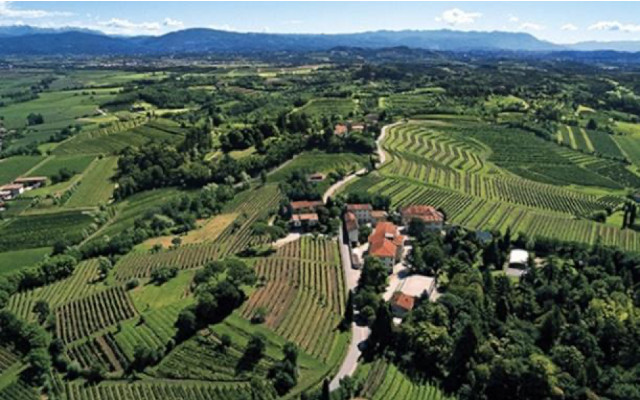
Friuli Colli Orientali renews its DOC in 2025 and consolidates a winemaking model capable of pushing regional exports to +8% in a shrinking national market. From the hills of Udine to the Slovenian border, the combination of ponca soils and an extraordinary wealth of native vines defines a unique identity, integrated by three historic micro-DOCGs dedicated to niche productions.
The Friuli Colli Orientali PDO is the denomination of the eastern hills of the province of Udine, between Tarcento, Cividale del Friuli and Corno di Rosazzo, on the border with Slovenia. Recognized in 1970 under the name Colli Orientali del Friuli, it admits 21 varieties, a Sweet type and six sub-zones. In the same territory were born three PDOs: Ramandolo, Colli Orientali del Friuli Picolit and Rosazzo (Friuli Colli Orientali regulation, articles 1 and 2).
The Consorzio Tutela Vini Friuli Colli Orientali e Ramandolo brings together around 200 members, three-quarters of whom are bottlers, on around 2,000 registered hectares, with over 80,000 hectoliters of DOC wine and at least 30% sold abroad (Consorzio Tutela Vini Friuli Colli Orientali e Ramandolo, n.d.). Following the rules of the DOC and the three DOCGs, the territory, the native vines, the market and the pairings.
A historic PDO renewed in 2025
The denomination was recognized in 1970 as Colli Orientali del Friuli and took its current name of Friuli Colli Orientali in 2011. The last ordinary amendment to the specifications, approved in 2025, applies in Italy from the 2025/2026 harvest (DM 7.7.2025, premises and art. 2). In European Union law, DOC and DOCG correspond to DOP, protected designations of origin, protected according to the rules on geographical indications wines (Regulation (EU) 1308/2013, art. 93; Regulation (EU) 2024/1143).
The Protection Consortium was established in 1970 and protects the DOC and the three DOCG of the territory (Cronache di Gusto, 2023). The denomination is flanked by Friuli DOC, the regional DOC established to offer a single Geographical Indication to the region's wines.
Production zone and ponca
The zone comprises 19 municipalities of the province of Udine: Attimis, Buttrio, Cividale del Friuli, Corno di Rosazzo, Faedis, Magnano in Riviera, Manzano, Moimacco, Nimis, Povoletto, Premariacco, Prepotto, Reana del Rojale, Remanzacco, San Giovanni al Natisone, San Pietro al Natisone, Tarcento, Tricesimo and Torreano (Friuli Colli Orientali production rules, article 8).
The vineyards are located between 100 and 400 metres of altitude, on Eocene flysch soils which in Friulian are called ponca: an alternation of marl and sandstone that crumbles easily in the air. The specification defines Cividale as 'the heart of the Colli Orientali' and recalls the Lombard duchy, of which the Longobard Temple remains, dating back to around 760 (disciplinary Friuli Colli Orientali, article 8).
Varieties and types allowed by the regulation
The production rules permit 11 white-berried vine varieties and 10 red-berried varieties:
- i whites are Chardonnay, Malvasia, Pinot bianco, Pinot grigio, Ribolla gialla, Riesling, Sauvignon, Friulano, Traminer aromatico and Verduzzo friulano, with Pinot grigio also in the ramato version. The reds are Cabernet, Cabernet franc, Cabernet sauvignon, Merlot, Pignolo, Pinot nero, Refosco dal peduncolo rosso, Refosco, Schioppettino and Tazzelenghe (Friuli Colli Orientali production rules, article 2).
The wine with the name of the grape variety must come for at least 85% from the indicated grapes. White can include Picolit, excluding Traminer, and the type Sweet is obtained from white grapes, Picolit included. The Pinot grigio ramato, at least 85% Pinot grigio, follows the rules of rosé wines and is linked to the success of Italian rosé wine (Friuli Colli Orientali regulations, articles 1, 2 and 6). The regulations do not provide for sparkling wine type. Pure Picolit belongs to the homonymous PDO.
Rules for viticulture and winemaking
New plantings must have at least 3,500 vines per hectare. The maximum yield is 11 tons of grapes per hectare, with a minimum natural alcoholic strength of 10% vol, and the yield of the grapes in wine cannot exceed 70% (Friuli Colli Orientali regulations, article 4). Winemaking takes place in the production area, with exceptions for the rest of the province of Udine and for some municipalities in Collio; The use of wood is permitted (Friuli Colli Orientali regulations, article 5).
The mention reserve requires at least two years of aging from November 1st of the harvest year, four for Pignolo, which cannot be sold before November of the third year after harvest. THE'vintage on the label is mandatory and the name of the grape variety must be written below that of the denomination, in characters no larger (Friuli Colli Orientali regulations, article 7).
The six sub-zones
The regulations provide for six sub-zones: Cialla, Ribolla Gialla di Rosazzo, Pignolo di Rosazzo, Schioppettino di Prepotto, Savorgnano and Refosco di Faedis (disciplinary Friuli Colli Orientali, article 1). Each sub-area links a small territory to one or a few vines.
Cialla, in part of the municipality of Prepotto, allows Ribolla Gialla, Verduzzo Friulano, Refosco dal Peduncolo Rosso, Schioppettino, White and Red. The yields they drop to 8 tons per hectare for whites and 6 for reds, and the reserve requires four years from 1 January following the harvest (Friuli Colli Orientali regulations, Cialla Annex).
The sub-zones Ribolla Gialla di Rosazzo e Pignolo di Rosazzo occupy a small area between Corno di Rosazzo, Manzano and San Giovanni al Natisone; the Schioppettino di Prepotto is reserved for the black berry grape variety of Prepotto.
Savorgnano, in the northern part of Povoletto, combines Friulano (80-90%) and Picolit (10-20%). The Refosco di Faedis is obtained from Refosco Nostrano cultivated in Faedis and in the nearby municipalities of Torreano, Attimis, Nimis, Povoletto and Tarcento (Friuli Colli Orientali regulation, annexes).
| Parameter | Friuli Colli Orientali PDO | Ramandolo DOCG | Colli Orientali del Friuli Picolit PDO | Rosazzo DOCG |
| Grape varieties | At least 85% of the indicated grape variety | Friuli Verduzzo | Picolit at least 85% (Cialla 100%) | Friulano at least 50%, Sauvignon and Pinot Blanc or Chardonnay 20-30% each, Ribolla up to 10% |
| Minimum density of new plantings | 3,500 vines/ha | 3,000 vines/ha | 3,500 vines/ha | 4,000 vines/ha |
| Maximum grape yield | 11 t/ha (Cialla 6-8) | 8 t/ha | 4 t/ha | 8 t/ha |
| Grape/wine yield | 70% | 65% | 55% | 56 hl/ha |
| Minimum total alcohol content | approx. 11% vol (Sweet 12%) | 14% vol | 15% vol (Cialla 16%) | 12% vol |
| Release for consumption | Pignolo from the third year | From November of the year after the harvest | From 1 September of the year after the harvest | From April 1st of the second year |
Sources: Friuli Colli Orientali DOC, Ramandolo DOCG, Colli Orientali del Friuli Picolit DOCG and Rosazzo DOCG regulations.
Ramandolo PDO, the sweet Verduzzo of Nimis and Tarcento
The Ramandolo became DOCG in 2001, after being a sub-zone of Colli Orientali del Friuli. It is obtained only from Friuli Verduzzo, locally called Verduzzo Giallo, grown in a delimited area of the Nimis and Tarcento hills. The vineyards in the area can also produce Friuli Colli Orientali Verduzzo, respecting the yields of Ramandolo (Ramandolo regulations, articles 1, 2 and 3). The last modification of the specification is in 2024.
The yield maximum is 8 tons of grapes per hectare and the grapes must reach at least 11% natural vol. THE'withering takes place on the plant or in suitable premises, and the wine yield cannot exceed 65%. The wine is available for consumption from November of the year following the harvest; the reserve from 1 December of the third year, with at least 14% total vol (Ramandolo regulations, articles 4, 5 and 6).
The regulation links Ramandolo to Monte Bernadia, which protects the vineyards from cold northern winds, to Eocene limestone and steep terraced slopes, often worked by hand. In favourable vintages the late harvest combines withering and noble rot. The wine is described as golden, slightly tannic, sweet, with notes of acacia, honey and ripe fruit (Ramandolo regulation, article 9).
Colli Orientali del Friuli Picolit PDO
The Picolit it was already indicated in the DOC since 1970 and has been DOCG since 2006. It requires at least 85% Picolit, 100% in the Cialla sub-area, and the production area coincides with the 19 municipalities of the DOC (Picolit disciplinary, articles 1, 2 and 3). The yield is among the lowest in Italy: 4 tonnes of grapes per hectare and no more than 55% in wine, i.e. 22 hectolitres per hectare (Picolit regulation, articles 4 and 5).
The grapes must reach at least 13% natural vol, 14% for Cialla, and enrichment is prohibited. Drying and aging in wood are permitted. The golden yellow wine must reach at least 15% total vol, 16% for Cialla, and cannot be sold before September 1st of the year following the harvest. Only Cialla can use the reserve mention, after four years (Picolit disciplinary, articles 5, 6 and 7).
Rosazzo PDO, a blended white wine
The Rosazzo it is the youngest DOCG in the area, recognized in 2011 as an evolution of the sub-area of the same name. It is a still white wine with at least 50% Friulano, with Sauvignon between 20 and 30%, Pinot bianco and/or Chardonnay between 20 and 30% and Ribolla bianca up to 10%. The grapes come from the hills of Manzano, San Giovanni al Natisone and a small part of Corno di Rosazzo (Rosazzo regulations, articles 2 and 3).
Vineyards must have at least 4,000 plants per hectare, with no more than 2 kg of grapes per plant and 8 tons per hectare. The wine is available for consumption from 1 April of the second year after the harvest, with a mandatory vintage (Rosazzo regulations, articles 4, 5 and 7).
The native vine varieties of Colli Orientali
The Friulano, already known as Tocai Friulano, has a straw yellow color and a dry flavor with a 'slightly bitter' note. There Ribolla gialla is dry, lively and fresh; the Friuli Verduzzo is golden yellow, dry or off-dry, slightly tannic (Friuli Colli Orientali disciplinary rules, article 6).
Among the reds, the Schioppettino has a ruby color tending to garnet and a full, herbaceous and dry flavor; the Pignolo is dry and elegant; the Refosco dal peduncolo rosso has an intense ruby color with violet reflections and a full, slightly bitter flavor (Friuli Colli Orientali disciplinary rules, article 6). These native vine varieties give their name to three of the six sub-zones and represent the most recognizable part of the territory's red wines.
The market for Colli Orientali wines
The DOC comprises approximately 2,000 hectares registered and over 80,000 hectoliters of wine, of which at least 30% exported, mainly in Europe but also in the United States and Japan (Consorzio Tutela Vini Friuli Colli Orientali e Ramandolo, n.d.). The most bottled grape variety is Ribolla gialla, with approximately 1.3 million bottles; Pinot grigio, Friulano and Sauvignon each exceed one million, Refosco dal peduncolo rosso reaches 600,000 (Cronache di Gusto, 2023).
The DOCGs are instead niche productions. The latest data published for individual denominations, relating to the 2019 harvest, indicated 37 hectares and 128,000 bottles for Ramandolo, 42 hectares and 55,000 bottles for Picolit, 19 hectares and 40,000 bottles for Rosazzo, against 1,911 hectares claimed and approximately 8 million bottles for the DOC (Fondazione Qualivita, 2020).
In 2025, wine companies in Friuli Venezia Giulia registered 238 million euros of export, +8% compared to 2024, bucking the trend against the national decline of 4% (Baccaglio, 2026b). Regional data does not distinguish individual designations. The surface area of organic vineyard of the region was 1,989 hectares in 2024, declining by 18% following very rainy vintages (Baccaglio, 2026a).
Gastronomic pairings
Friulano and Ribolla Gialla accompany San Daniele PDO prosciutto, Adriatic fish and vegetables; Rosazzo goes well with more structured dishes, such as white meats and frico By Montasio PDO. Refosco, Schioppettino and Pignolo go with cured meats, game, braised meats and aged cheeses. Ramandolo and Picolit close the meal with gubana (a traditional leavened dessert from Friuli-Venezia Giulia), dry pastries and blue cheeses.
Dario Dongo
Credit cover: Consorzio Friuli Colli Orientali e Ramandolo DOCG
References
European Union regulatory sources
Regulation (EU) No 1308/2013 of the European Parliament and of the Council of 17 December 2013 establishing a common organisation of the markets in agricultural products and repealing Council Regulations (EEC) No 922/72, (EEC) No 234/79, (EC) No 1037/2001 and (EC) No 1234/2007. Consolidated text: 18/08/2026. http://data.europa.eu/eli/reg/2013/1308/2026-08-18
Regulation (EU) 2024/1143 of the European Parliament and of the Council of 11 April 2024 on geographical indications for wine, spirit drinks and agricultural products, as well as traditional specialities guaranteed and optional quality terms for agricultural products. Consolidated text: 18/03/2026. http://data.europa.eu/eli/reg/2024/1143/2026-03-18
Production regulations and Italian acts
MASAF Decree 7 July 2025. Approval of an ordinary amendment to the production specification for the controlled designation of origin of 'Friuli Colli Orientali' wines. Official Journal, General Series n. 173 of 28.7.2025. https://www.colliorientali.com/wp-content/uploads/2026/02/Friuli_Colli_Orientali_DOC__DM_7.07.25_Mod.Ordinaria_GU28.07.2025.pdf
Production regulations for the DOCG 'Colli Orientali del Friuli Picolit', approved with Ministerial Decree 30.3.2006, last modification Ministerial Decree 7.3.2014. https://aisitalia.it/Disciplinari/Friuli%20Venezia%20Giulia/DOCG/Colli%20Orientali%20del%20Friuli%20Picolit.pdf
Production regulations for the DOCG 'Ramandolo', approved with Ministerial Decree 9.10.2001, last modification 2024. https://aisitalia.it/Disciplinari/Friuli%20Venezia%20Giulia/DOCG/Ramandolo.pdf
Production regulations for the DOCG 'Rosazzo', approved with Ministerial Decree 14.10.2011 (GU no. 249 of 25.10.2011), last modification Ministerial Decree 7.3.2014. https://aisitalia.it/Disciplinari/Friuli%20Venezia%20Giulia/DOCG/Rosazzo.pdf
Data and statistics
Baccaglio, M. (2026a, 30 August). The numbers of organic viticulture in Italy – update 2024. The numbers of wine. https://www.inumeridelvino.it/2026/08/i-numeri-della-viticoltura-biologica-in-italia-aggiornamento-2024.html
Baccaglio, M. (2026b, 5 May). Italian wine exports by region and type – update 2025. The numbers of wine. https://www.inumeridelvino.it/2026/05/esportazioni-italiane-di-vino-per-regione-e-tipologia-aggiornamento-2025.html
Consorzio Tutela Vini Friuli Colli Orientali e Ramandolo. (N/A). The Consortium. https://www.colliorientali.com/
Fondazione Qualivita. (2020, 24 January). Consorzio Friuli Colli Orientali: all vintage data collected in 2 K hectares PDO. https://www.qualivita.it/news/consorzio-friuli-colli-orientali-dop-raccolti-tutti-i-dati-della-vendemmia-in-2-mila-ettari-dop/
Industry press
Chronicles of Taste. (2023, August 22). Consorzio Tutela Vini Friuli Colli Orientali and Ramandolo, celebrated (finally) the 50th anniversary of the organization. https://www.cronachedigusto.it/vino-e-dintorni/consorzio-tutela-vini-friuli-colli-orientali-e-ramandolo-festeggiati-finalmente-i-50-anni-dellorganizzazione/

Dario Dongo, lawyer and journalist, PhD in international food law, founder of WIISE (FARE - GIFT – Food Times) and Égalité.


 e alle DOCG Ramandolo, Picolit e Rosazzo: sottozone, terreni di ponca, autoctoni e dati export.)