
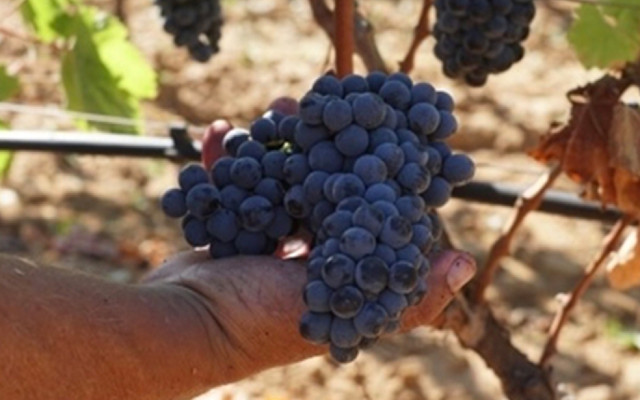
One Sardinian vineyard in four, only one regional denomination with three sub-areas and the mention 'classic' reserved for Nuoro and Ogliastra. The Cannonau from the notarial deeds of the sixteenth century to the genetic comparison with the Garnacha, with the 2024 numbers and the data on the long-lived communities of central Sardinia.
The Cannonau is the most cultivated variety in Sardinia. In 2022 it occupied 7,438 hectares out of 27,579 of the regional vineyard, 27% of the surface area, and almost two-thirds of that surface area, 4,783 hectares, is concentrated in the province of Nuoro (elaboration of Laore Sardegna data, 2026). The Cannonau di Sardegna PDO, recognized in 1972, is the reference designation. In 2024 it certified 67,214 hectolitres and bottled 58,530, equal to approximately 7.8 million bottles, 22.6% of the wine with designation of origin produced on the island (elaboration based on Laore Sardegna data, 2026).
The same vine, under other names, is cultivated in Spain as Garnacha and in France as Grenache, and is among the top ten varieties in the world by surface area (OIV, 2017). In Sardinia it has built its own identity, linked to the granite soils of Barbagia, to the little tree and to a name that the law reserves for the denomination of origin. Following are the numbers of the vineyard and the market, the historical attestations, the genetics, the rules of the specification, the profile of the wine and the pairings.
Cannonau area, production and market
There Sardinia matters 27,488 hectares of vineyard, 27.5% less than in 2000; 35.5% of the surface is intended for PDO wines and 19.1% for PGI wines (elaboration based on Ismea data, 2026). Wine production was 403,000 hectoliters in 2024 and 437,000 in 2025, according to provisional data, up by 8.6% (Ismea, 2026).
Cannonau lost ground in the long run but gained value. In 1990 it covered 11,405 hectares, in 2009 7,691; in the same period of time the wine certified with denomination rose from 5,797 hectoliters to over 67,000 (Laore Sardegna, 2026). There share of grapes intended for DOC however, it remains contained: in the 2023/24 campaign, 2,025 hectares were claimed, just over a quarter of the surface area in Cannonau (elaboration based on Laore Sardegna data, 2026). The Protection Consortium, which since 2025 shares the Oristano headquarters with that of Vermentino di Sardegna, brings together 88 companies (Atzeni, 2025).
THE'export of Sardinian wine has achieved 28 million euros in 2024, growing by 6.8% on the previous year. The United States is the first market, with almost 9 million euros of imported Sardinian drinks, followed by Germany, Switzerland, Japan and the United Kingdom (based on Laore Sardegna data, 2026, based on Istat). However, the figure remains modest compared to the value of Sardinian wine on the national markets and the international appeal of the island.
Table 1. Cannonau in figures
| Indicator | value | Source |
| Sardinian vineyard | 27,488 ha | Ismea on Agea data |
| Surface in Cannonau | 7,438 ha, 27% (2022) | Laore Sardegna |
| Cannonau in the province of Nuoro | 4,783 ha (2022) | Laore Sardegna |
| Area claimed for Cannonau di Sardegna PDO | 2,025 ha (2023/24) | Laore Sardegna |
| Wine certified Cannonau di Sardegna PDO | 67,214 hl (2024) | Laore Sardegna |
| Bottled wine Cannonau di Sardegna PDO | 58,530 hl, approximately 7.8 million bottles (2024) | Laore Sardegna |
| Wine production in Sardinia | 437,000 hl (2025, provisional) | Italian agrifood promotion agency |
| Sardinian wine exports | 28 million euros (2024) | Laore Sardegna based on Istat data |
Historical records of Cannonau
The first mention of the Cannonau vine on the island is found in a notarial deed drawn up in Cagliari in 1549 by the notary Bernardino Coni (Crespan et al., 2015). The disciplinary recalls that in the seventeenth century two observers, the royal visitor Martín Carrillo in 1612 and the Franciscan Giorgio Aleo in 1677, described 'Cañonates wines of particular value produced throughout the island. In the eighteenth century Andrea Manca dell'Arca wrote about it in his 'Agricoltura di Sardegna', in the nineteenth century the botanist Giuseppe Giacinto Moris classified it as Vitis praestans and Vittorio Angius indicated it as the most widespread vine in his censuses (Cannonau di Sardegna disciplinary, article 9).
The genealogy of name follows the western Mediterranean routes. Studies on Sardinian viticulture associate Cannonau with Canonazo of Seville and to the Aragonese Granaxa, and Sardinia was part of the Crown of Aragon from the fourteenth century (Madau, 1976). However, the national database of vine varieties indicates a detail that complicates the story: in Spain Garnacha appears for a long time as a white wine, and the first mention as a 'tinto' wine dates back to 1734, almost two centuries after the Cagliari act (Crespan et al., 2015).
The grapevine, moreover, has much more ancient roots in Sardegna. In nuragic site of Sa Osa, near Cabras, were found dated grape pips from the late Bronze Age, between 1286 and 1115 B.C., with characteristics of already cultivated vines. According to the authors, the island 'could have been a secondary domestication center of the grapevine' (Ucchesu et al., 2015). The study does not concern Cannonau and does not prove its origin, but rather documents Sardinian viticulture of over three thousand years.
The twentieth century gave Cannonau his literary name. In the preface to Hans Barth's guide to Italian taverns, Gabriele D'Annunzio celebrated the 'nepente d'Oliena' (Madau, 1976), and the regulations recall that homage (Cannonau di Sardegna regulations, article 9). The name is today one of the three subareas of the denomination.
Cannonau genetics and its relationship with Garnacha
DNA analysis with microsatellite markers confirmed the synonymy between Cannonau and several Spanish accessions of Garnacha Tinta, but only for a part of those analyzed; the same study excluded a direct origin from the Sardinian wild vines sampled (De Mattia et al., 2009). The international catalog of vine varieties indicates Spain as the country of origin of Garnacha and records among its synonyms Cannonau, Tai rosso, Alicante, Granaccia and Gamay perugino (VIVC, s.d.). The national database instead describes Cannonau as 'similar but not identical to the Iberian Garnacha', and leaves it the hypothesis of a Sardinian origin is open (Crespan et al., 2015). The debate is not over, and no genetic study published in recent years has definitively established the direction of the route between Sardinia and the Iberian Peninsula.
The Sardinian population of the vine still retains a own variability. An investigation by the University of Sassari on 83 Cannonau biotypes revealed 'a considerable level of intra-varietal diversity', a resource for clonal selection and climate adaptation (Domanda et al., 2026). In the National Register the Cannonau is registered with the code 051, next to the entries Alicante and Tocai red, linked as synonyms (Autonomous Region of Sardinia, 2023).
Production rules in the specification
Zone, varieties and types
The production area of Cannonau di Sardegna PDO coincides with the entire regional territory. The wine must come from at least 85% from Cannonau grapes, complemented by other non-aromatic black grape varieties; with the mention 'classic', reserved for the municipalities of the provinces of Nuoro and Ogliastra, the share rises to 90% (Cannonau di Sardegna regulations, articles 2 and 3). The specification provides for the typologies red, Rosé, reserve, passito and liquoroso, dry or sweet (Cannonau di Sardegna specification, article 1), and records the local names of the vine: 'Cannonadu, Nannonatu, Canonao, Ratagliadu nieddu' (Cannonau di Sardegna specification, article 2).
The sub-zones
Three sub-zones identify the historic areas:
- Oliena, or Nepente di Oliena, comprises the municipality of Oliena and part of Orgosolo, in the heart of Barbagia;
- Jerzu concerns the municipalities of Jerzu and Cardedu in Ogliastra;
- Capo Ferrato brings together Castiadas, Muravera, San Vito, Villaputzu and Villasimius on the south-eastern coast (Cannonau di Sardegna regulations, article 3). In the sub-areas, winemaking, aging and bottling must take place within the area (Cannonau di Sardegna regulations, article 5).
Rules for viticulture and winemaking
New plantings must have at least 3,500 vines per hectare and the pergola system is prohibited. The maximum yield is 11 tons of grapes per hectare, 9 for the 'classic', with alcohol content natural minimum of 12.5% for red and rosé and 13% for reserve and 'classic' (Cannonau di Sardegna regulations, article 4). There yield of grapes in wine it cannot exceed 70%, 55% for passito. The reserve ages at least two years starting from November 1st of the year of harvest, of which at least six months in wood; the 'classic' two years, of which at least twelve months in wooden barrels; the liqueur for at least six months in wooden barrels and cannot be released for consumption before 1 November of the year following the harvest (Cannonau di Sardegna regulations, article 5).
The indication on the label vintage è mandatory and terms such as 'end', 'chosen', 'selected' are prohibited; for reserve, 'classic' and sub-zones, screw caps are not permitted (Cannonau di Sardegna regulations, articles 7 and 8). The current specification has not undergone changes in recent years; the revision is indicated by the Consortium as a future objective, and there is no request for a DOCG (Atzeni, 2025). The only Sardinian DOCG remains the Vermentino di Gallura, as we have seen.
Table 2. The types of Cannonau di Sardegna PDO
| Type | Minimum Cannonau | Max grape yield | Minimum alcohol at consumption | Minimum ageing |
| Red | 85% | 11 t/ha | 12.5% vol | Entry from 1 April of the following year |
| Rosé | 85% | 11 t/ha | 12.5% vol | Entry from January 1st of the following year |
| Reserve | 85% | 11 t/ha | 13% vol | 2 years, of which 6 months in wood |
| Classico | 90% | 9 t/ha | 13.5% vol | 2 years, of which 12 months in wood |
| Passito | 85% | 11 t/ha | 15% vol, of which 13% actual | Entry from November 1st of the following year |
| Dry fortified wine | 85% | 11 t/ha | 18% vol actual | 6 months in wood |
| Sweet liqueur wine | 85% | 11 t/ha | 16% vol actual | 6 months in wood |
Fonte: disciplinare Cannonau di Sardegna, articoli 2, 4, 5 e 6
The name Cannonau in other designations
Outside the regional PDO Cannonau enters the Mandrolisai PDO, in the center of the island, where it competes for 20 to 35% with Bovale Sardo and Monica (Mandrolisai regulations, article 2). The typical Sardinian geographical indications instead allow it only in blends: their specifications exclude the name of the vine from the label, effectively reserving it for the denomination of origin (Isola dei Nuraghi specifications, article 2). Outside Sardinia the same variety occurs in Italy with other names, such as the red Tai of the Berici Hills or the Alicante of the Tuscan Maremma, for which the specification allows the synonym Grenache (Maremma Toscana specification, article 7.5).
The wine profile
The regulation describes a red wine with colour more or less intense ruby, which in the 'classic' and in the reserves tends towards garnet with age, from bouquet 'pleasant, characteristic' and with a 'savory, characteristic' flavour; the passito has an 'intense, ethereal' aroma and flavour 'sweet, full' (Cannonau di Sardegna regulations, article 6). In the glass, young Cannonau expresses ripe red fruits, cherries and Mediterranean scrub; with wood and time, tones of plum, sweet spices, tobacco and undergrowth emerge, supported by a velvety tannin and a warm and savory finish.
Research from the University of Sassari confirms the range of expressions. Cannonau grapes have the same aromatic signature, but with 'great variability' between samples, and some higher alcohols such as 2-phenylethanol, with a rose note, contribute to the complexity of the wine (Petretto et al., 2021). The phenolic profile, dominated by flavan-3-ols, procyanidins and flavonols, varies more with maturation, vineyard management and microclimate than with the area of origin (Montoro et al., 2026). Even the microbial flora of the grapes, different between Mamoiada and Santadi vineyards, persists in musts fermented without selected yeasts and leaves a trace of the origin of the wine (Mezzasalma et al., 2017).
In the vineyard Cannonau responds well to controlled water stress and treatments with abscisic acid, which in the study conducted on three Mediterranean varieties improved the composition of the berries more in Cannonau than in other vines (Cocco et al., 2020). It's an advantage on an island where the sapling and the low yields of the hillside vineyards have always had to deal with long, dry summers.
Cannonau and Sardinian longevity
Central-eastern Sardinia is one of the areas in the world with the highest concentration of centenarians. The study that identified it found in the mountain areas of the island a ratio between centenarians and centenarians of 1.35, compared to 2.43 in the rest of Sardinia, a sign of exceptional male longevity (Poulain et al., 2004). Subsequent research included it among the Blue Zones, together with Okinawa, Nicoya and Icaria, and attributed a role to the consumption of locally produced foods (Poulain et al., 2013).
Wine is part of that diet. In a comparison between the elderly of Ogliastra and those of the Nicoya peninsula, in Costa Rica, pistokku bread was consumed every day and Cannonau more than once or twice a week by almost 80% of those interviewed; however, the authors specify that the study 'does not allow to determine cause-effect relationships, but only associations' (Nieddu et al., 2020). Cannonau therefore belongs to a long-lived lifestyle, made up of physical work, family ties and simple cuisine, without research being able to attribute its own effect to it.
In any case, in the European Union 'drinks containing more than 1.2% alcohol by volume cannot bear health claims' (EC regulation 1924/2006, art. 4.3). The story of Sardinian longevity remains a cultural heritage of the island and cannot become a health topic on labels or in advertising. On the relationship between brands, generic indications and health claims, see the FARE question Brands, generic indications, 'nutrition and health claims'.
Pairings and service
The young red Cannonau, served at 16°C, accompanies culurgiones, malloreddus with sausage sauce and island cured meats. The 'classic' and the reserve, at 18°C, stand up to roast suckling pig, lamb, sheep in coat and mature cheeses such as Pecorino Sardo PDO and Fiore Sardo PDO. The rosé, served chilled, pairs with bottarga and seafood cuisine; pane carasau and pane guttiau accompany all versions. The passito and sweet liquorous wine close the meal with almond sweets and seadas; the journey of Sardinian wines continues with Vernaccia di Oristano and, at the end of the meal, with Mirto.
Dario Dongo
Credit cover: Consorzio Tutela Vini di Alghero presso Cantina Santa Maria La Palma Snc
Frequently asked questions about Cannonau
Is Cannonau the same vine as Grenache? The DNA of many accessions coincides with that of Spanish Garnacha, called Grenache in France (De Mattia et al., 2009). The direction of the path between Sardinia and Spain remains debated (Crespan et al., 2015).
Does a DOCG Cannonau exist? No. Cannonau di Sardegna is a regional DOC, with the mention 'classic' and three sub-areas (Cannonau di Sardegna disciplinary, article 1); the only Sardinian DOCG is Vermentino di Gallura.
What does 'classic' mean on the label? Indicates a Cannonau from the provinces of Nuoro and Ogliastra, with at least 90% of the grape variety, reduced yield and two years of aging, of which twelve months in wood (Cannonau di Sardegna regulations, articles 2, 4 and 5).
What is Nepenthes of Oliena? It is the alternative name of the Oliena sub-area, in the Nuoro area, linked to the literary homage by Gabriele D'Annunzio (Cannonau di Sardegna regulations, articles 3 and 9).
Does Cannonau extend life? Wine is part of the traditional diet of the long-lived communities of Ogliastra, but studies reveal only an association, not a cause and effect relationship (Nieddu et al., 2020).
References
European Union regulatory sources
Regulation (EC) No 1924/2006 of the European Parliament and of the Council of 20 December 2006 on nutrition and health claims made on foods. Consolidated text: 13/12/2014. http://data.europa.eu/eli/reg/2006/1924/2014-12-13
Regulation (EU) 2024/1143 of the European Parliament and of the Council of 11 April 2024 on geographical indications for wine, spirit drinks and agricultural products, as well as traditional specialities guaranteed and optional quality terms for agricultural products, amending Regulations (EU) No 1308/2013, (EU) 2019/787 and (EU) 2019/1753 and repealing Regulation (EU) No 1151/2012. Consolidated text: 18/03/2026. http://data.europa.eu/eli/reg/2024/1143/2026-03-18
Production regulations and Italian acts
Production regulations for the DOC 'Cannonau di Sardegna', approved with Presidential Decree 21.7.1972 (GU no. 248 of 21.9.1972), last modification DM 7.3.2014. https://aisitalia.it/Disciplinari/Sardegna/DOC/Cannonau%20di%20Sardegna.pdf
Production regulations for the DOC 'Mandrolisai', approved with Presidential Decree 6.6.1981, last modification DM 7.3.2014. https://aisitalia.it/Disciplinari/Sardegna/DOC/Mandrolisai.pdf
Production regulations for the DOC 'Maremma Toscana', last modified by Ministerial Decree 8.5.2023 (GU no. 113 of 16.5.2023). https://aisitalia.it/Disciplinari/Toscana/DOC/Maremma%20toscana.pdf
MASAF. Decree of 31 July 2019, modification of the production regulations for wines with the typical geographical indication 'Isola dei Nuraghi'. Official Journal no. 186 of 9.8.2019.
MASAF. Alphabetical list of Italian PDO wines. https://www.masaf.gov.it/flex/cm/pages/ServeAttachment.php/L/IT/D/1%252Fd%252F5%252FD.fd1629819dea12c20cf4/P/BLOB%3AID%3D4625/E/pdf?mode=download
Autonomous Region of Sardegna. (2023). Determination no. 256 of 5.4.2023, Annex 1, vine varieties suitable for cultivation in Sardegna. https://www.sardegnaambiente.it/documenti/1_38_20230407091439.pdf
Data and statistics
Ismea. (2026, April). Wine sector sheet. https://www.ismeamercati.it/flex/files/1/0/4/D.0305cc7a715a31e70eee/Scheda_VIno_aprile_2026.pdf
Laore Sardegna, Consorte, A., Delogu, G., Peretto, R., Saiu, L., & Scano, A. (2026). Analysis report 2026. The wine supply chain. Regional agency for agricultural development. https://www.lestradedelvino.com/wp-content/uploads/2026/02/65_43_20260224131011.pdf
OIV, Organization Internationale de la Vigne et du Vin. (2017). Focus OIV 2017. Distribution of the world's grapevine varieties. https://www.oiv.int/public/medias/5888/en-distribution-of-the-worlds-grapevine-varieties.pdf
Scientific literature
Cocco, M., Mercenaro, L., Lo Cascio, M., & Nieddu, G. (2020). Effects of vine water status and exogenous abscisic acid on berry composition of three red wine grapes grown under Mediterranean climate. Horticulturae, 6(1), 12. https://doi.org/10.3390/horticulturae6010012
Domanda, C., Mercenaro, L., Deiana, P., Bressan, M., Santona, M., Porceddu, A., Rau, D., & Nieddu, G. (2026). Assessment of intra-varietal diversity among biotypes of the cv. Cannonau. BIO Web of Conferences, 235, 01002. https://doi.org/10.1051/bioconf/202623501002
Mezzasalma, V., Sandionigi, A., Bruni, I., Bruno, A., Lovicu, G., Casiraghi, M., & Labra, M. (2017). Grape microbiome as a reliable and persistent signature of field origin and environmental conditions in Cannonau wine production. PLOS ONE, 12(9), e0184615. https://doi.org/10.1371/journal.pone.0184615
Montoro, P., Petretto, G. L., Crescenzi, M. A., Urgeghe, P. P., & Del Caro, A. (2026). Qualitative evaluation by ESI-LTQ-Orbitrap-MS of the phenol fraction from 'Cannonau di Sardegna' red wines. European Food Research and Technology, 252(6). https://doi.org/10.1007/s00217-026-05171-z
Nieddu, A., Vindas, L., Errigo, A., Vindas, J., Pes, G. M., & Dore, M. P. (2020). Dietary habits, anthropometric features and daily performance in two independent long-lived populations from Nicoya peninsula (Costa Rica) and Ogliastra (Sardinia). Nutrients, 12(6), 1621. https://doi.org/10.3390/nu12061621
Petretto, G. L., Mercenaro, L., Urgeghe, P. P., Fadda, C., Valentoni, A., & Del Caro, A. (2021). Grape and wine composition in Vitis vinifera L. cv. Cannonau explored by GC-MS and sensory analysis. Foods, 10(1), 101. https://doi.org/10.3390/foods10010101
Ucchesu, M., Orrù, M., Grillo, O., Venora, G., Usai, A., Serreli, P. F., & Bacchetta, G. (2015). Earliest evidence of a primitive cultivar of Vitis vinifera L. during the Bronze Age in Sardinia (Italy). Vegetation History and Archaeobotany, 24(5), 587–600. https://doi.org/10.1007/s00334-014-0512-9
Historical, ampelographic, genetic and demographic sources
Crespan, M., Giust, M., Migliaro, D., Scalabrelli, G., & D’Onofrio, C. (2015). Cannonau. In Italian Vitis Database (ISSN 2282-006X). https://vitisdb.it/varieties/show/1460
De Mattia, F., Lovicu, G., Tardaguila, J., Grassi, F., Imazio, S., Scienza, A., & Labra, M. (2009). Genetic relationships between Sardinian and Spanish viticulture: the case of 'Cannonau' and 'Garnacha'. Journal of Horticultural Science and Biotechnology, 84(1), 65–71. https://doi.org/10.1080/14620316.2009.11512481
Madau, G. (1976). Some considerations on the wines of Ogliastra. Annals of the Faculty of Agriculture of the University of Sassari. https://iris.uniss.it/retrieve/e1dc1a2d-05c0-1507-e053-3a05fe0ac7a3/Madau_G_Articolo_1976_Qualche.pdf
Poulain, M., Herm, A., & Pes, G. (2013). The Blue Zones: areas of exceptional longevity around the world. Vienna Yearbook of Population Research, 11, 87–108. https://doi.org/10.1553/populationyearbook2013s87
Poulain, M., Pes, G. M., Grasland, C., Carru, C., Ferrucci, L., Baggio, G., Franceschi, C., & Deiana, L. (2004). Identification of a geographic area characterized by extreme longevity in the Sardinia island: the AKEA study. Experimental Gerontology, 39(9), 1423–1429. https://doi.org/10.1016/j.exger.2004.06.016
VIVC, Vitis International Variety Catalogue. (N/A). Garnacha Tinta. https://www.vivc.de/index.php?r=passport%2Fview&id=4461
Sector sources
Atzeni, G. (2025, 18 June). [Vermentino and Cannonau Consortia of Sardinia, single headquarters in Oristano]. Gambero Rosso. https://www.gamberorosso.it/news/wine/vermentino-cannonau-consortiums-sardinia-single-headquarters/

Dario Dongo, lawyer and journalist, PhD in international food law, founder of WIISE (FARE - GIFT – Food Times) and Égalité.


