

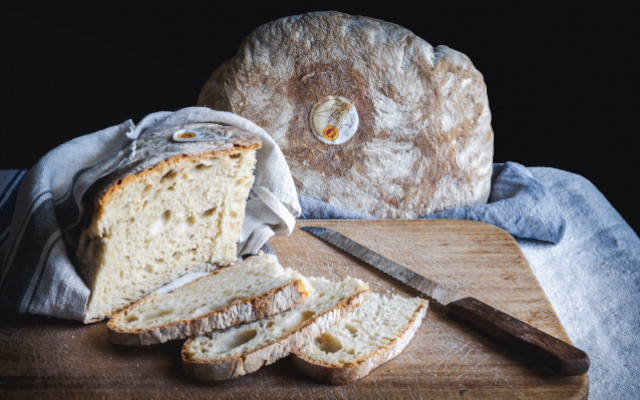
The Tuscan PDO Bread is the expression of a subtraction that creates value. The absence of salt, a distinctive feature of regional baking, combines with the use of local soft wheat varieties that retain the wheat germ. This balance between medieval heritage and contemporary technical rigor – ensured by sourdough fermentation monitored by university research – positions the ‘sciocco’ bread as a benchmark model for quality baking and public health in Europe.
The Ismea-Qualivita report on the PDO Economy (2025) places Tuscan PDO Bread fourth among Italian Geographical Indication baked products – after Piadina Romagnola PGI, the Tuscan Cantuccini PGI and the Culurgionis of Olgiastra PGI – with a production value that in 2024 reached 2.2 million euros (-3.3% compared to 2023), with 900 tons produced by 52 operators.
The identity of the ‘sciocco’ bread between history and territory
The origins of Tuscan bread without salt date back to Middle Ages and are documented by historical sources that intertwine political rivalries and the salt economy.
The salt war: Pisa against Florence
The most accepted theory places the origin of ‘sciocco’ bread in 12th century, during the harsh rivalry between the Maritime Republics of Pisa and Florence. Pisa controlled trade towards the inland, including the salt that traveled up the Arno river. Around 1100, due to supply difficulties caused by Saracen pirates, Pisa began heavily taxing the salt destined for Florence. The Florentines decided to give up salt in bread-making.
Florentine taxes
The sustenance of the medieval Florentine state depended on taxes (indirect taxes), particularly from salt tax. The high cost of salt – whose essential purpose was preserving pork meat – pushed the people and bakers to adopt salt-free bread-making, a practice common among Tuscan sharecroppers in the 19th century.
Historical testimonies
Documentary sources attest:
- Dante Alighieri (13th-14th century), in the 17th canto of the Paradise of the Divine Comedy: (‘You will indeed taste how salty is others' bread) confirms that as early as the 13th-14th century in Florence, bread was without salt;
- Pierandrea Mattioli (16th century): first written testimony on the production of ‘sciocco’ bread;
- Saverio Manetti (1765): documents the Tuscan custom of not using salt and describes the natural yeast (‘formento‘) as sourdough preserved in the dough trough;
- Giuseppe Negri (20th century): cites ‘the insipid Tuscan ‘loaf’.
Altopascio bread
The bread of Altopascio, famous since the Middle Ages, was distributed by the Spedale del Tau to pilgrims along the Via Francigena. Produced without yeast and without salt, represents an ancient variant of the ‘sciocco’ bread tradition.
Regulatory requirements: Tuscan flour and wheat germ
Protected designation of origin (PDO) ‘Tuscan Bread‘ is exclusively reserved for bread that meets the requirements established in the specific production specification, registered under Regulation (EU) No. 1174/2011.
The latest amendment to the specification, approved in 2026 and currently being published, introduces the possibility of also using type ‘1’ and ‘2’ flours, milled by roller or stone mill respecting specific requirements.
The area of production and packaging of Tuscan PDO Bread includes the entire administrative territory of Tuscany Region (article 3 – Production zone).
Ingredients and product characteristics
The denomination Tuscan PDO Bread designates bread obtained by the ancient processing system used in Tuscany, which exclusively uses:
- sourdough starter (or sourdough starter);
- Water;
- soft wheat flour type ‘0’ – or types ‘1’ and ‘2’ – containing the wheat germ and produced from varieties cultivated in the production area.
At the time of marketing, Tuscan PDO Bread must present the following morphological characteristics:
- small loaf: weight 450–550 g, diamond shape;
- loaf: 900–1100 g or 1800–2200 g, rectangular shape with rounded corners;
- bread thickness: 5–12 cm.
The physical and organoleptic characteristics are:
- crust: crumbly and crunchy, matte dark hazelnut color;
- crumb: white or ivory-white color for bread made with type ‘0’ flour, amber in cases of use of ‘1’ or ‘2’ flours with irregular alveolation;
- aroma: toasted hazelnut;
- taste: ‘sciocco’ (saltless) and slightly acidic;
- moisture: not exceeding 30% by weight (specification, article 2 – Product characteristics).
Raw material
The raw material is represented by soft wheat flour type ‘0’ or type ‘1’ or type ‘2’ containing the wheat germ, produced from wheat cultivated, stored and milled exclusively in Tuscany.
Allowed wheat varieties:
The varieties used, alone or together, include:
- red kernel cultivar (maximum 80% in the blend): Centauro, Bilancia, Serio, Verna, Pandas and their derivatives;
- white kernel cultivar (maximum 50% in the blend): Mieti, Mec, Marzotto, Bolero and their derivatives;
- other varieties registered in the Regional Germplasm Register of Tuscany or in the National Seed Register as conservation varieties (article 5.1 – Raw material).
The varieties Mieti, Mec, Marzotto and Pandas largely derive from those that, starting from early 1900s, were subject to study and genetic improvement in Valdichiana, one of the areas most suitable for cereal cultivation in Tuscany (article 6 – Elements that prove the link with the environment).
Milling
The milling process is divided into successive phases that ensure the quality of the flour and the preservation of the wheat germ:
- before storage, soft wheat undergoes pre-cleaning treatments (aspiration or ventilation, sifting), cleaning and moistening with water. The cleaned kernels are moistened and left to rest for at least 8 hours, in order to facilitate the removal of the seed coats while avoiding damage to the wheat germ;
- Milling at a maximum temperature of 40°C, through roller mills equipped with machines fitted with pairs of metal rollers of different diameters, plansichters and whatever is necessary to obtain type ‘0’ flour containing the wheat germ. The new regulation (2026) also allows for type ‘1 or type 2’ flours milling stone milling, where ‘the kernels enter the mills and are ground into flour in a single pass, to obtain a 100% wholemeal flour’, then sieved and made type 1 and 2; at the exit of the processing the flour has a maximum temperature of 35°C. ‘The flour thus obtained fully contains the germ’;
- mandatory aging: immediately after milling, the flour must be stored at the mill for at least 10 days from the end of milling, to ensure the carrying out of maturation processes (article 5.2 – Milling).
Technological characteristics of flour:
The flours intended for the production of Pane Toscano PDO must meet the following parameters:
| Parameter | Flour type '0' | Flour type ‘1’ or type ‘2’ |
|---|---|---|
| W (Chopin) | Between 160 and 230 | Between 140 and 230 |
| P/L (index) | Between 0.35 and 0.65 | Between 0.30 and 0.90 |
| Water Absorption | Greater than 54% | Greater than 54% |
| C:D (Brabender stability) | Greater than 6′ | Greater than 5′ |
| Falling Number | Greater than 260 | Greater than 280 |
Note: Only for the preparation of sourdough, the flours may have a W value higher than that indicated in the table.
Legend of parameters:
- W (Chopin): flour strength, measures the dough's resistance to deformation
- P/L: ratio between dough tenacity (P) and extensibility (L)
- Water Absorption: water absorption capacity of the flour
- C:D (Brabender): dough stability during mixing
- Falling Number: Hagberg-Perten index, measures enzymatic activity (alpha-amylase).
Baking process
The baking process of Pane Toscano DOP is divided into successive phases respecting prolonged fermentation times, essential for the development of the product's organoleptic characteristics.
The sourdough:
The natural yeast used consists of a portion of dough from a previous preparation which, stored in a suitable environment, undergoes a gradual process of fermentation and acidification. This portion of sour dough, the so-called ‘sourdough starter‘ or ‘mother’, properly refreshed and incorporated into a new dough, is able to cause its leavening. At the end of the refreshment, a portion of dough is ‘detached’ to ensure the sourdough starter for the next day.
To ensure theuniformity of the production process and the maintenance of unique characteristics, bakers reconstruct the sourdough starter using a specific sourdough starter, either fresh or lyophilized, which is added to type ‘0’ flour and water. The typical microbiological component of the sourdough starter is held at the laboratories of Agricultural Microbiology and Food Technology Faculty of Agriculture, University of Pisa in the strain collection or as sourdough starter maintained at public or private facilities connected to them.
Phase 1 – Preparation of the ‘biga’ (first dough):
The production method involves the preparation of the so-called ‘biga‘, first dough used for the multiplication of the refreshed natural yeast.
Ingredients for 1 kg of flour:
- soft wheat flour type ‘0’ or ‘1’ or ‘2’ containing the germ: 1 kg;
- water: at least 500 ml;
- sourdough starter: at least 200 g.
Resting of the biga: after preparation, the biga is left to rest for a period not less than 8 hours.
Phase 2 – Preparation of the final dough:
Subsequently, the biga is used as a leavening agent for the preparation of the final dough.
Ingredients for 1 kg of flour:
- soft wheat flour type ‘0’ or ‘1’ or ‘2’ containing the germ: 1 kg;
- water: at least 550 ml;
- biga: at least 200 g.
The dough can be worked by hand or machine.
Phase 3 – Dough resting:
The dough thus prepared is left to rest for at least 20 minutes.
Phase 4 – Dividing:
During this phase, the dough is divided into portions whose size varies according to the weight and shape (portion size) of the finished product.
Phase 5 – Rest after dividing:
The portions are left to rest for at least 15 minutes, so as to ensure proper oxygenation.
Phase 6 – Shaping:
After resting, proceed to prepare the ’small loaves’, that is, the shaping-modeling of the dough portions according to the expected portion sizes:
- small loaf (450–550 g, diamond shape);
- small loaf (900–1100 g, rectangular shape);
- large loaf (1800–2200 g, rectangular shape).
Phase 7 – Final fermentation:
The small loaves are left to rest for a period not less than 2 hours and 30 minutes, until optimal fermentation is reached.
Phase 8 – Baking:
After the fermentation time, the dough shapes are placed in the oven for baking.
Summary of minimum process times:
| Phase | Minimum time |
|---|---|
| Biga resting | 8 hours |
| Final dough resting | 20 minutes |
| Rest after dividing | 15 minutes |
| Final fermentation | 2 hours and 30 minutes |
| Total fermentation | ≥11 hours |
These prolonged times are essential to allow the lactic acid fermentation mediated by the sourdough starter, which gives the Tuscan bread its characteristic slightly sour taste and the aroma of roasted hazelnut (article 5.2 – Baking process).
Historical, geographical and cultural roots
The regulations dedicate ample space to the demonstration of historical, geographical and cultural connection between the product and the Tuscan territory.
Territorial characteristics:
The production area of Pane Toscano DOP has a declining altitude trend from the interior towards the coast and from North to South. The area is bounded by Apennine ridges which act as a barrier to disturbances coming from the East and North-East, while it is fully exposed to winds and precipitation coming from the West.
Wheat cultivation:
The cultivation of soft wheat is carried out mainly in the large plains (Arno and Tiber Valleys) but especially in the vast hilly areas and plateaus of the Apennines. These environments have allowed the differentiation of local wheat ecotypes, progenitors from which many of the varieties currently cultivated to produce the flour suitable for Pane Toscano DOP have originated.
Historical-cultural connection:
The history of Tuscany led to the birth of a bread different from those produced in other Italian regions. Pane Toscano is without salt, a characteristic confirmed by numerous historical sources that attest to the persistence of this tradition through the centuries, constituting a unique historical and cultural heritage of the Tuscan territory (article 6 – Elements that prove the link with the environment).
Traceability and controls
The traceability of the product is guaranteed through:
- registration in lists managed by the control structure of all operators in the supply chain: raw material producers, millers, bakers, and packers;
- registration of inputs and outputs of each stage of the supply chain, from farm to fork;
- systematic control by the control structure, according to the disciplinary and the related control plan (article 4 – Proof of origin).
The designated structure is the Italian sector leader CSQA Certifications Srl, headquartered in Thiene (article 7 – Controls).
Marketing and labeling
Pane Toscano DOP can be placed on the market:
- in whole form o pre-sliced;
- in food packaging, also in modified atmosphere;
- in multilayer paper windowed packaging or other suitable packaging for sliced bread.
The packages must display in label:
- The logo of the ‘Pane Toscano’ designation;
- The European PDO symbol, in the same visual field as the designation;
- name or company name and address of the baker individual and/or associated.
The addition of any other qualification different from those provided, including adjectives like ‘type’, ‘taste’, ‘use’, chosen and similar, is prohibited. However, the following are allowed:
- indications referring to companies, names, company names, private brands, consortia, provided they do not have laudatory meaning, are not misleading to the consumer, and are printed in characters no taller than those of the ‘Pane Toscano’ designation;
- any information regarding the use and organoleptic characteristics of the product, as well as historical and cultural references.
Loose sale:
As an alternative to packaging, the placing on the market of Pane Toscano PDO without any packaging. In this case:
- the product must be identified by means of mark made of food-grade material affixed directly on the bread before baking, bearing the designation logo and other mandatory information;
- in sales premises, the product must be placed in special compartments or containers bearing a card with:
- logo of the designation ‘Pane Toscano’ and/or text ‘Pane Toscano’ followed by the acronym PDO or the wording ‘Protected Designation of Origin’ and the wording ‘naturally leavened’;
- European PDO graphic symbol in the same visual field as the designation.
The logo of the Pane Toscano PDO consists of an image with a perimeter not less than 3 cm depicting the perimeter of the Tuscany region and the wording ‘Pane Toscano PDO naturally leavened’ (article 8 – Labeling).
Digestibility and health: the nutritional benefits of sourdough
Pane Toscano has a nutritional profile consistent with wheat-based baked goods without fatty matrices, with some peculiarities related toabsence of salt, in the presence of wheat germ and to the natural leavening.
Benefits of sourdough fermentation
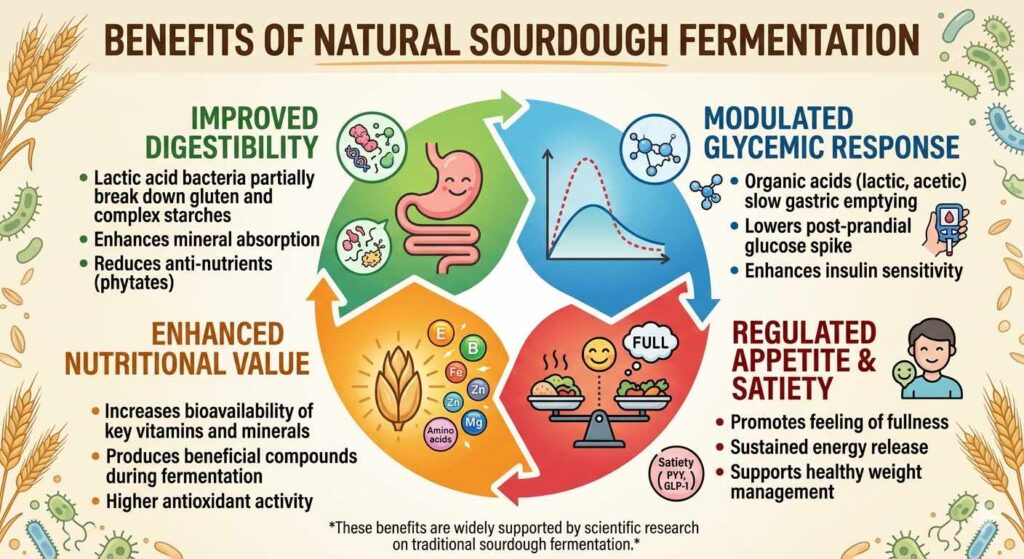
Scientific literature attributes to the consumption of bread fermented with sourdough starter some health benefits that – although in the absence of authorized ‘health claims’ in the European Union, under regulation (EC) no. 1924/06 – deserve consideration:
- greater digestibility: a study in vivo controlled demonstrated that breads fermented with natural yeast are more digestible than those produced with industrial yeast, with significantly different gastrointestinal responses (Rizzello et al., 2019). In fact, sourdough fermentation modifies the structure of proteins and carbohydrates, making them more accessible to digestive enzymes;
- mineral bioavailability: lactic acid fermentation increases the availability of iron, zinc, and magnesium thanks to the reduction of phytates, antinutritional compounds present in cereals that chelate minerals making them non-absorbable (Gobbetti et al., 2014);
- glycemic index modulation: sourdough yeast can favorably influence the glycemic response compared to conventional breads. The organic acids produced during fermentation – lactic acid and acetic acid, in particular – actually slow gastric emptying and reduce postprandial glycemic peak, partially inhibiting the alpha-amylase enzyme (Gobbetti et al., 2014);
- appetite regulation: randomized controlled studies have highlighted the effects of bread rich in lactic acid (typical of sourdough) on appetite regulation, with potential implications for body weight management (Chatonidi et al., 2024).
Nutritional value of wheat germ
The processing of soft wheat for Pane Toscano DOP is also characterized by the ability to preserve the wheat germ, rich in vitamin E, a powerful antioxidant that contributes to the high nutritional value and participates in leavening processes thanks to its enzymatic content.
The use of semi-wholemeal flours – type ‘1’ and type ‘2’ also entails nutritional benefits linked to the higher presence of fiber and bioactive compounds, widely described in the scientific literature.
Absence of salt and public health
Theabsence of salt represents a distinctive and strategic nutritional characteristic for public health. With virtually absent sodium content (traces less than 10 mg per 100 g), Pane Toscano DOP contrasts with traditional bread which typically contains 500-600 mg of sodium per 100 g.
This peculiarity makes the product particularly suitable for low-sodium diets and in the prevention of arterial hypertension, in line with the recommendations of theWorld Health Organization which in 2023 reiterated the urgency of reducing sodium intake in the global population, recommending consumption below 2 grams of sodium per day (equivalent to 5 grams of salt) (WHO, 2023).
Preservation and shelf life
Sourdough fermentation – in addition to contributing to the development of a complex aromatic profile with characteristic toasted hazelnut notes – improves the natural preservability of the bread and its microbiological safety, thanks to the production of natural antimicrobial compounds (organic acids, bacteriocins, hydrogen peroxide) that inhibit the development of molds and pathogenic bacteria (Islam & Islam, 2024; Oleinikova et al., 2025).
A recent study aimed at investigating technological strategies to extend the shelf life of Pane Toscano DOP demonstrated the effectiveness of compostable packaging systems 'bag-in-bag' that preserve the organoleptic and microbiological characteristics of the product, while reducing the environmental impact of the packaging (Offei et al., 2025).
The Consortium for the protection of Pane Toscano DOP has also commissioned a series of scientific studies aimed at extending the natural preservation of the product, in modified atmosphere, up to 60 days. However, this prospect requires substantial investments in the installation of ‘‘clean rooms’, in order to minimize the presence of bacteria and molds that could compromise its quality and shelf life.
From ribollita to gourmet cuisine: versatility on the table
Pane Toscano stands out for its extraordinary culinary versatility. According to the director of the Protection Consortium, Daniele Pardini, ‘there are numerous historical sources confirming the decisive role that Pane Toscano has had in the characterization and success of Tuscan cuisine’, suggesting that unsalted bread even preceded the development of Tuscan cuisine itself.
Pairing with cold cuts and cheeses: the absence of salt enhances savory products such as raw ham, Tuscan pecorino PDO and typical salamis (such as finocchiona and the Prato mortadella PGI), creating a gustatory balance where the ‘scioccò’ bread acts as a neutral counterpoint that enhances the strong flavors of the cold cuts.
Soups and traditional dishes: Tuscan bread is an essential ingredient in iconic preparations of Tuscan cuisine:
- ribollita: soup with black cabbage, beans and stale bread;
- tomato bread soup: bread, tomato, basil and oil;
- panzanella: summer salad with stale bread, tomatoes, cucumbers and onion;
- acquacotta: poor soup from Maremma.
Recovery of stale bread: the compact structure and long shelf life (traditionally bread was made only once a week and stored in the bread bin) make Tuscan bread ideal for:
- bruschetta: bread toasted with garlic and extra virgin olive oil;
- fettunta: a more rustic variant of bruschetta
- crostini: base for hot (e.g. crostini with chicken liver) and cold appetizers.
Contemporary cuisine: Tuscan PDO bread is used in gourmet preparations as a base for refined tartines and pairings with Tuscan PGI extra virgin olive oils that is Tuscan PDO (Chianti Classico, Terre di Siena, Lucca).
Tips for buyers
Consumers and operators are first recommended to verify the presence of the official Tuscan PDO Bread logo (outline of the Tuscany region with the wording ‘Pane Toscano PDO naturally leavened’) and of the European PDO symbol, on the label or mark placed directly on the bread sold in bulk. It is also advisable to favor i products organic, where available, to promote supply chains that are more respectful of ecosystems and biodiversity, as well as to encourage the conversion of crops to such standards.
Where to find it:
To find certified points of sale, consult the Consortium website.
Storage instructions:
- store at room temperature in a dry place, wrapped in a cotton cloth or paper;
- avoid refrigeration that accelerates hardening due to starch retrogradation;
- recover stale bread for traditional soups or bruschetta.
Beyond borders: the shelf life challenge for export
A critical aspect of the regulations concerns theabsence of provisions for freezing as a method of storage and marketing. Considering that the shelf life of Pane Toscano DOP under standard conditions is only 6 days (Offei et al., 2025), the inability to market the frozen product constitutes a objective constraint to expansion in foreign markets.
This limitation appears particularly penalizing considering the strong identity bond that Tuscan DOP Bread has with the tourist experience in Tuscany. The millions of tourists who visit the region every year and try the unsalted bread paired with Tuscan cold cuts, ribollita or pappa al pomodoro, represent a potential pool of consumers in their home markets, where the sensory memory of that gastronomic experience could translate into effective demand.
The Italian diaspora (over 60 million descendants worldwide) and the premium channels of Italian catering abroad would be natural markets for the product, willing to pay a premium price for certified authenticity. However, the current disciplinary configuration precludes access to these segments, limiting production to a geographic radius compatible with distribution times of fresh or modified atmosphere products (maximum 20 days).
A revision of the disciplinary that includes certified freezing protocols – safeguarding the organoleptic and nutritional integrity of the product through rapid freezing technologies (blast freezing at -40°C) – can unlock an exponential growth potential, offering global consumers authentic products as an alternative to their imitations ('Italian sounding').
Conclusions
The future success of Tuscan DOP Bread lies in the ability to combine the strictness of the regulations with the new needs of the global market.into a certified nutritional excellence.
Dario Dongo
Credit cover Consortium for the Protection of Tuscan Bread PDO
Bibliography
- Chatonidi, G., Pradal, I., De Vuyst, L., Courtin, C. M., & Verbeke, K. (2024). Effect of lactic acid-rich sourdough bread on appetite regulation: A randomized, double-blind controlled trial. Current Research in Food Science, 10, 100956. https://doi.org/10.1016/j.crfs.2024.100956
- Consortium for the Protection of Tuscan Bread PDO. Production Specifications of the Protected Designation of Origin «TUSCAN BREAD». https://www.panetoscanodop.it/media/Disciplinare_Pane_Toscano_DOP.pdf
- Gobbetti, M., Rizzello, C.G., Di Cagno, R., De Angelis, M. (2014). How the sourdough may affect the functional features of leavened baked goods. Food Microbiology, 37: 30-40. https://doi.org/10.1016/j.fm.2013.04.012
- Islam, M. A., & Islam, S. (2024). Sourdough Bread Quality: Facts and Factors. Foods, 13(13), 2132. https://doi.org/10.3390/foods13132132
- Ismea & Qualivita Foundation. (2025). ISMEA-Qualivita 2025 Report on Italian agri-food and wine productions PDO, PGI and TSG (23rd ed.). Qualivita Editions. https://www.ismea.it/flex/cm/pages/ServeAttachment.php/L/IT/D/1%252Fe%252F8%252FD.fefdd2e7c08546544955/P/BLOB%3AID%3D13512/E/pdf?mode=download
- Offei, C. A., Marianelli, A., Macaluso, M., Mercanti, N., Pereira De Sousa, B. A. C., Rondanini, M. A., Borsani, S., & Zinnai, A. (2025). Technological Strategies to Enhance the Shelf Life of PDO Tuscan Bread in a Compostable Bag-in-Bag System. Foods, 15(1), 65. https://doi.org/10.3390/foods15010065
- Oleinikova, Y., Amangeldi, A., Zhaksylyk, A., Saubenova, M., & Sadanov, A. (2025). Sourdough Microbiota for Improving Bread Preservation and Safety: Main Directions and New Strategies. Foods, 14(14), 2443. https://doi.org/10.3390/foods14142443
- Rizzello, C.G., Portincasa, P., Montemurro, M., Di Palo, D.M., Lorusso, M.P., De Angelis, M., Bonfrate, L., Genot, B., Gobbetti, M. (2019). Sourdough fermented breads are more digestible than those started with baker’s yeast alone: An in vivo challenge dissecting distinct gastrointestinal responses. Nutrients, 11(12): 2954. https://doi.org/10.3390/nu11122954
- European Union. (2011). Regulation (EU) No 1174/2011 of the Commission of 14 November 2011 concerning the registration of a designation in the register of protected designations of origin and protected geographical indications [Pane Toscano (PDO)]. Official Journal of the European Union, L 301/24. http://data.europa.eu/eli/reg/2011/1174/oj
- World Health Organization. (2023). WHO global report on sodium intake reduction. Geneva: World Health Organization. https://www.who.int/publications/i/item/9789240069985

Dario Dongo, lawyer and journalist, PhD in international food law, founder of WIISE (FARE - GIFT – Food Times) and Égalité.


