

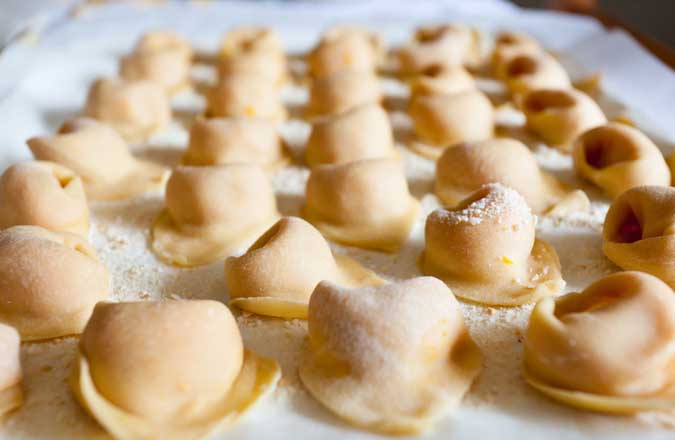
The filled pasta, in English filled pasta or stuffed pasta, is a thin pastry - made with egg or just flour and water - which contains a filling of meat, cheese, vegetables or fish. Tortellini, ravioli, agnolotti, cappelletti, anolini, casoncelli, pansoti and culurgionis are its best-known regional forms. The word abroad ravioli it has become the common name of the entire family, while in Italy each territory has its own name, its own style and its own seasoning.
The sector combines the manual skills of pasta makers and the technology of pasta factories, capable of bringing a fresh, pasteurized or frozen product to the world's tables. In 2025 Italy exported almost 191 kt of filled pasta for 827 million euros (Eurostat, 2026). Only two specialties are registered in the European Union as geographical indications, the Cappellacci di pumpkin Ferraresi PGI and the Culurgionis d'Ogliastra PGI. Following are the regional formats, production and labeling rules, nutritional values and choice criteria for consumers and buyers.
Export 2025, 827 million euros
The CN tariff code 1902 20 includes filled pasta products, even cooked or otherwise prepared, and therefore fresh, frozen and dried stuffed pasta. In 2025, Italy exported 190,958 tonnes per year under this heading 827.3 million euros, against 194,300 tonnes and 819.2 million in 2024. Volumes are slightly down (-1.7%), value is up (+1.0%) and average price rises from 4.22 to 4.33 euros per kilo (Eurostat, 2026). Over ten years, value has more than doubled from 377 million euros in 2015.
The France it is the first market, with 180.4 million euros (21.8% of the total), followed by Germany (114.4 million), the United Kingdom (113.2 million) and the United States (77.9 million). Countries outside the European Union are worth 252.2 million, just under a third of exports (Eurostat, 2026). The data concerns filled pasta only and should not be added or compared with the statistics of dry pasta, which follow other customs items.
Ravioli, tortelli and tortellini: names and shapes
The vocabulary of stuffed pasta changes from one region and province to another, and the same name can indicate different formats. There Encyclopedia of Pasta by Oretta Zanini De Vita, a reference work on traditional Italian pasta formats, describes for example tortelli as flour and egg pasta with fillings that vary according to location and occasions, and cappelletti as squares of pasta dough folded in the shape of a small hat and cooked in meat broth (Zanini De Vita, 2009).
Pellegrino Artusi, in the manual that gave a common language to the bourgeois cuisine of united Italy, already dedicated distinct recipes to cappelletti Romagnoli, tortellini alla Bolognese and several versions of ravioli. And when presenting the Genoese ravioli, the author observed how the authentic ones did not have to contain meat, confirming the rigor in the various regional specialties (Artusi, 1891/2010).
In today's commercial use i ravioli the square, rectangular or round formats closed between two sheets of pasta are generally tortellini and cappelletti are small formats folded around the finger tortelloni and tortelli are the larger ones. Ravioli recipes from home cooking remain the basis of a vast repertoire, which the industry draws on for its own formats.
Regional specialities
Tortellini from Bologna
The tortellino it is the gastronomic symbol of Bologna, disputed for centuries with Modena and linked to the Emilian legend which claims it was modeled on the navel of Venus. In 1974 the Bolognese delegation of the Italian Academy of Cuisine, in agreement with the Dotta Confraternita del Tortellino, deposited the recipe for the filling at the Chamber of Commerce of Bologna: pork loin, raw ham and mortadella in equal parts, Parmigiano Reggiano, eggs and nutmeg, in a sheet of flour and eggs. The tortellino De.Co. Bologna, the municipal designation of the capital city, admits only the ingredients of the filed recipe and prescribes the sheet rolled with a rolling pin (Municipality of Bologna, 2021).
The recipe has nineteenth-century roots. Artusi, in tortellini alla bolognese, had already eliminated the chicken present in previous recipe books, entrusting the flavor to raw ham and mortadella from Bologna, with beef marrow, Parmigiano Reggiano, eggs and nutmeg (Artusi, 1891/2010; Gambero Rosso, N/A). The canonical serving is in meat broth.
Cappellacci, tortelli and tortelloni
Ferrara guards the Cappellacci with Ferrarese PGI pumpkin, registered in 2016 (e.g. EU regulation 2016/164). The pastry is made of soft wheat flour, with the possible addition of durum wheat flour, and whole eggs, rolled to a thickness between 0.4 and 0.7 millimetres. The filling is based on pumpkin violina (Cucurbita moschata) cooked in the oven, approximately 400 grams per kilo of finished product, with grated cheese, breadcrumbs and nutmeg; Colorants and preservatives are prohibited. The rounded and folded shape recalls the straw hat of farmers, with a diameter between 4 and 7 centimetres. The production area coincides with the province of Ferrara, in Emilia-Romagna, and the product can be marketed fresh, in a protective atmosphere or frozen or quick-frozen (regulation, articles 2-4).
Cappellacci are different from Mantuan pumpkin tortelli, which include the filling macaroons and mustard, and in Ferrara they are served al ragù or with butter and sage (Gambero Rosso, s.d.-a). Throughout Emilia-Romagna i tortelli e i tortelloni of thin, with ricotta e spinach o chard, represent the most widespread vegetarian version, in artisanal pastries as well as in refrigerated counters.
Cappelletti and anolini
I cappelletti they are widespread in Romagna and Marche. Squares of type 0 flour pastry and eggs are closed in the shape of a hat around a filling of mixed meats and spices, according to local customs, and cooked in broth (Zanini De Vita, 2009). In Artusi's Romagna version the filling combines ricotta or raviggiolo and capon breast (Artusi, 1891/2010).
The anolini they belong to the provinces of Parma and Piacenza, in Emilia. The pastry is made of flour and eggs, the filling of stew beef and parmesan; in Val d'Arda the filling avoids meat and is limited to parmesan and breadcrumbs. Once upon a time the anolino was closed in a crescent shape, today the traditional shape is a small disc, delicately cooked in broth (Zanini De Vita, 2009).
Agnolotti del Piemonte
In Piedmont, egg pasta gave rise to tajarìn and, in the stuffed version, garlic agnolotti and the ravioli del plin. The regional documentation on fresh artisanal pasta links agnolotti to the abundance of roast meats and spices on the festive table, so much so that it is made the Christmas dish of Piedmont (Piedmont Region, n.d.).
Ravioli genovesi and pansoti
In Liguria ravioli alla genovese contain a filling of veal, offal, vegetables and spices and are cut into rectangles with the wheel (Zanini De Vita, 2009). pansoti – more recent and at the same time more famous – are born as a variant of lean ravioli. The filling combines the wild herbs of preboggion and prescinsêua, Genoese curd cheese, while the classic dressing is walnut sauce. walnuts.
Casoncelli di Bergamo and Brescia
I casoncelli, casonsèi in dialect, are the most famous first course of Bergamo cuisine and are also widespread in the Brescia area, in Lombardy. The pastry is made of flour, eggs and salt, sometimes with a drizzle of oil. The filling is meat-based and the canonical seasoning is butter melted butter with sage and crispy pancetta (inLombardia, n.d.; Zanini De Vita, 2009).
Culurgionis d'Ogliastra PGI
In Sardinia Culurgionis d'Ogliastra PGI, registered in 2016 (Regulation (EU) 2016/1729), are small parcels closed by hand with the characteristic herringbone stitching, obtained with at least ten folds of the pasta sheet. The pasta sheet combines durum wheat semolina and soft wheat flour, with lard or butter or extra virgin olive oil. The filling is composed of 60-80% potatoes, with a mixture of cheeses (casu axedu, pecorino, goat's cheese or cow's milk), extra virgin olive oil and optional aromas such as mint, garlic, basil and onion. Each piece weighs between 20 and 33 grams, with a ratio between pastry and filling between 0.5 and 2. Production takes place in the municipalities of Ogliastra and, by historical custom, in Esterzili, Sadali and Escalaplano. The product is sold fresh, in a modified atmosphere or frozen, while loose sale is permitted only for fresh products (regulations, articles 2-5).
From hand-made pasta sheets to industrial production
Filled pasta is born in home kitchens and in the workshops of sfogline, and artisanal production remains alive in every region. pasteurization and packaging in protective atmosphere have enabled pasta manufacturers to increase shelf-life and reach retail and foreign markets. Many industries, however, still work with thin sheets and closures that reproduce the manual gesture, thanks to Italian creativity in designing special machinery.
National rules are set by DPR 187/2001:
- fresh pasta sold in bulk must be stored at no more than 4 °C and consumed within five days from production (DPR 187/2001, art. 9.4);
- fresh pasta pre-packaged it must have a humidity of no less than 24%, a water activity, i.e. the amount of free water available for microorganisms, between 0.92 and 0.97, a heat treatment at least equivalent to pasteurization and storage at no more than 4 °C, with a tolerance of 2 °C (Presidential Decree 187/2001, art. 9.5);
- the pastas stabilized, with humidity of at least 20% and water activity not exceeding 0.92, can instead be transported and stored at room temperature (DPR 187/2001, art. 9.6).
The freezing completes the range, especially for catering and long-distance exports.
The sheet presented as egg pasta must contain at least four whole hen eggs, equal to 200 grams, per kilogram of semolina (DPR 187/2001, art. 8). In fresh pastas, the use of soft wheat flour (DPR 187/2001, art. 9.2).
Label: name, QUID and origin
The denomination of the food describes pastry and filling, for example 'fresh egg pasta with ricotta and spinach filling'. Regulation (EU) no. 1169/2011 requires the indication of QUID (Quantitative Ingredient Declaration), when an ingredient or a category of ingredients 'figures in the name of the food or is generally associated with this name by the consumer' (EU regulation 1169/2011, art. 22.1, letter 'a'), or is highlighted on the label with words or images. In stuffed pasta the QUID therefore concerns the filling, when it is mentioned in the name, and the characterizing ingredients such as meat, ham, ricotta, spinach or porcini mushrooms.
The percentage is calculated in the recipe, at the time of use of the ingredients, and must be referred to the finished product (EU regulation 1169/2011, Annex VIII, point 3; European Commission, 2017). A single figure on the total, for each characterizing ingredient, allows the consumer to compare different products without making calculations. In this regard, reference is made to the FARE's in-depth analysis on QUID of compound ingredients (Dongo, 2026).
When the label contains a geographical reference – e.g. Made in Italy, or tricolour flag, outside the registered trademark and any PGI – and the primary ingredient of the filling comes from another country, its origin must be indicated or declared as different from that of the food (e.g. EU regulation 2018/775, art. 2).
Nutritional profiles
The food composition tables indicated by CREA — Food and Nutrition Research Centre (2019) report the nutritional values shown below for fresh tortellini and ravioli with ricotta and spinach, raw and cooked, per 100 grams.
| Values per 100 g | Fresh tortellini, raw | Fresh tortellini, cooked | Ravioli ricotta and spinach, raw | Ravioli ricotta and spinach, cooked
|
| Energy (kJ / kcal) | 1265 / 302 | 659 / 158 | 1109 / 265 | 739 / 177 |
| Fats (g) | 7,1 | 3,7 | 7,3 | 4,6 |
| of which saturated fatty acids (g) | N/A | N/A | N/A | N/A |
| Carbohydrates (g) | 49,9 | 26,0 | 40,7 | 27,5 |
| of which sugars (g) | 1,3 | 0,7 | 1,8 | 1,4 |
| Fibre (g) | 1,2 | 0,6 | 2,2 | 1,6 |
| Proteins (g) | 12,2 | 6,4 | 10,6 | 7,2 |
| Salt (g) | N/A | N/A | N/A | N/A |
Source: CREA (2019), items 000880, 000885, 000875 and 000876. N/A: data not reported by CREA.
For these items CREA does not report saturated fatty acids and sodium, nor vitamins and minerals; the values of salt and saturated fats of the individual product should be read in the nutritional declaration on the label. The cooking in water halves the energy density, since the pasta sheet and filling absorb an equal amount of water. A 150-gram portion of cooked tortellini thus provides on average 237 kcal and 9.6 grams of proteins, a 175-gram portion of cooked ravioli 310 kcal and 12.6 grams of proteins (CREA, 2019).
In the ready-to-eat product, i.e. cooked, proteins provide approximately 16% of the energy in both tortellini and ravioli. Both therefore satisfy the conditions of the claim 'source of proteins', which requires that at least 12% of the energy value of the food comes from proteins (EC regulation 1924/2006, Annex). However, since recipes vary between producers and products, it is always useful to check the relevant nutritional declarations on the label.
How to choose at the refrigerated counter and in the restaurant
For the consumer, the first indication is the name, with the type of pastry and filling, followed by the percentages of the characterizing ingredients. A filling with an abundance of quality ingredients - such as cheeses and cured meats with a designation of origin or seasonal vegetables - is indicative of a carefully prepared recipe.
For restaurateurs, delicatessens and importers the technical sheet must report recipe, ratio between pasta sheet and filling, weight of the piece, yield and cooking time, heat treatments and shelf life.
The frozen format offers consistency and long shelf life in catering and shipments outside the EU, the fresh one in protective atmosphere lends itself to refrigerated distribution. The organic certification expresses the greatest value of the guarantee of high standards for the protection of ecosystems and biodiversity, increasingly appreciated both in Italy and in foreign markets.
The added value of filled pasta
Filled pasta transforms supply chain ingredients, from PDO cheeses to cured meats, from vegetables to pumpkin, into a high value-added product appreciated throughout Europe and other continents. Regional specialties offer producers a story of territory, and conservation technologies allow it to be transported far away without sacrificing quality.
Companies that produce or market filled pasta can rely on the consulting activities of FARE (Food and Agriculture Requirements) for the strategic planning of commercial information compliance - from labeling to environmental and sustainability assertions on supply chains, processes and products, including nutrition & health claims - and in the development of governance corporate and operational procedures.
Dario Dongo
Quick answers on tortellini and ravioli
Tortellini and ravioli, what is the difference? Tortellini are small pieces of puff pastry folded and wrapped around the finger, typical of Bologna and Modena and served in broth. Ravioli are generally closed between two sheets, in a square, rectangular or round shape, and throughout the world their name indicates the entire family of filled pasta (Zanini De Vita, 2009).
How much of the product is filling? The percentage appears on the label when the filling appears in the denomination. In the Culurgionis d'Ogliastra PGI the ratio between pastry and filling varies between 0.5 and 2, while in the Cappellacci di pumpkin Ferraresi PGI the pumpkin alone is worth around 40% of the product (disciplinary).
How long does fresh filled pasta last? Fresh loose pasta must be consumed within five days of production. Pre-packaged pasta, pasteurised and stored in the refrigerator, shows the expiry date on the label, while stabilised pastas can be stored at room temperature (DPR 187/2001, art. 9).
Which Italian filled pastas are PGI? The Cappellacci di pumpkin Ferraresi PGI, produced in the province of Ferrara, and the Culurgionis d'Ogliastra PGI, produced in Sardinia, both registered in 2016. The tortellino di Bologna is instead protected by a registered recipe and a municipal denomination.
Is filled pasta a protein food? Cotti, tortellini and ravioli provide between 6 and 7 grams of protein per 100 grams, equal to approximately 16% of the energy, and can therefore carry the claim 'source of protein' (CREA, 2019).
References
European Union regulatory sources
Commission Implementing Regulation (EU) 2016/164 of 28 January 2016 entering a name in the register of protected designations of origin and protected geographical indications (Cappellacci di zucca ferraresi (PGI)). OJ L 32, 9.2.2016. http://data.europa.eu/eli/reg_impl/2016/164/oj
Commission Implementing Regulation (EU) 2016/1729 of 22 September 2016 entering a name in the register of protected designations of origin and protected geographical indications (Culurgionis d'Ogliastra (PGI)). OJ L 262, 29.9.2016, p. 1. http://data.europa.eu/eli/reg_impl/2016/1729/oj
Commission Implementing Regulation (EU) 2018/775 of 28 May 2018 laying down rules for the application of Article 26(3) of Regulation (EU) No 1169/2011 of the European Parliament and of the Council on the provision of food information to consumers, as regards the rules for indicating the country of origin or place of provenance of the primary ingredient of a food. Consolidated text: 09/06/2019. http://data.europa.eu/eli/reg_impl/2018/775/2019-06-09
Commission Notice on the application of the principle of quantitative ingredients declaration (QUID) (2017/C 393/05). OJ C 393, 21.11.2017. https://eur-lex.europa.eu/legal-content/EN/TXT/?uri=OJ:C:2017:393:TOC
Regulation (EC) No 1924/2006 of the European Parliament and of the Council of 20 December 2006 on nutrition and health claims made on foods. Consolidated text: 13/12/2014. http://data.europa.eu/eli/reg/2006/1924/2014-12-13
Regulation (EU) No 1169/2011 of the European Parliament and of the Council of 25 October 2011 on the provision of food information to consumers. Consolidated text: 01/04/2025. http://data.europa.eu/eli/reg/2011/1169/2025-04-01
Regulation (EU) 2024/1143 of the European Parliament and of the Council of 11 April 2024 on geographical indications for wine, spirit drinks and agricultural products, as well as traditional specialities guaranteed and optional quality terms for agricultural products. Consolidated text: 18/03/2026. http://data.europa.eu/eli/reg/2024/1143/2026-03-18
Italian regulatory sources
Decree of the President of the Republic 9 February 2001, n. 187. Regulation for the revision of the legislation on the production and marketing of flours and pasta, pursuant to article 50 of law 22 February 1994, n. 146. Regulations. Latest consolidated version: 12/14/2018. https://www.normattiva.it/uri-res/N2Ls?urn:nir:presidente.repubblica:decreto:2001-02-09;187!vig=
Ministry of Business and Made in Italy. (2024). Circular 18 September 2024, n. 31577. Guidelines on food labeling. https://www.mimit.gov.it/it/normativa/circolari-note-direttive-e-atti-di-indirizzo/circolare-18-settembre-2024-linee-guida-sulletichettatura-alimentare
Ministry of Agricultural, Food and Forestry Policies. (2016). Registration of the denomination 'Cappellacci di pumpkin Ferraresi' in the register of protected designations of origin and protected geographical indications, with production specifications. Official Journal, n. 49 of 29.2.2016.
Ministry of Agricultural, Food, Forestry and Tourism Policies. (2019). Minor modification to the production specification of the denomination 'Culurgionis d'Ogliastra' registered as a protected geographical indication. Official Journal, n. 20 of 24.1.2019.
Statistical sources
Eurostat. (2026). EU trade since 1988 by HS2-4-6 and CN8 (DS-045409). CN 1902 20, Italy, exports 2015, 2024 and 2025 [data extracted 13.11.2026]. https://ec.europa.eu/eurostat/api/comext/dissemination/statistics/1.0/data/DS-045409
Nutritional sources
CREA – Food and Nutrition Research Centre. (2019). Food composition tables. 2019 update. Items 000875 (Ravioli, raw, fresh), 000876 (Ravioli, cooked), 000880 (Tortellini, fresh), 000885 (Tortellini, fresh, cooked). https://www.alimentinutrizione.it/tabelle-nutrizionali/000880
Sources on labeling
Dongo, D. (2026, 21 October). Food labels, QUID on compound ingredient. FARE. https://fareagrifood.com/2026/10/21/quid-ingrediente-composto-etichettatura-alimenti/
Historical and gastronomic sources
Artusi, P. (2010). Science in the kitchen and the art of eating well (A. Capatti, ed.). BUR Rizzoli. (Original work published in 1891)
Municipality of Bologna. (2021). Tortellino bolognese [De.Co. form]. https://assets.culturabologna.it/ab561e4b-e4a3-4787-acf7-b342c5431bba-2021-tortellino-bolognese.pdf
Gambero Rosso. (n.d.-a). Where to eat typical cappellacci di zucca in Ferrara. The best 8 restaurants selected by Gambero Rosso. https://www.gamberorosso.it/?p=117977
Red Shrimp. (s.d.-b). Welcome tortellino (with chicken). The true story of the original recipe. https://www.gamberorosso.it/notizie/storie/tortellino-di-pollo-la-storia-ricetta-originaria/
inLombardia. (n.d.). Casoncelli alla bergamasca. VisitBergamo. https://www.visitbergamo.net/en/?p=86041
Piedmont region. (s.d.). Regulations for the excellence of the artisan food business. Fresh pasta. https://www.regione.piemonte.it/web/media/8155/download
Zanini De Vita, O. (2009). Encyclopedia of pasta (M. B. Fant, Trad.). University of California Press. https://doi.org/10.1525/9780520944718

Dario Dongo, lawyer and journalist, PhD in international food law, founder of WIISE (FARE - GIFT – Food Times) and Égalité.


