

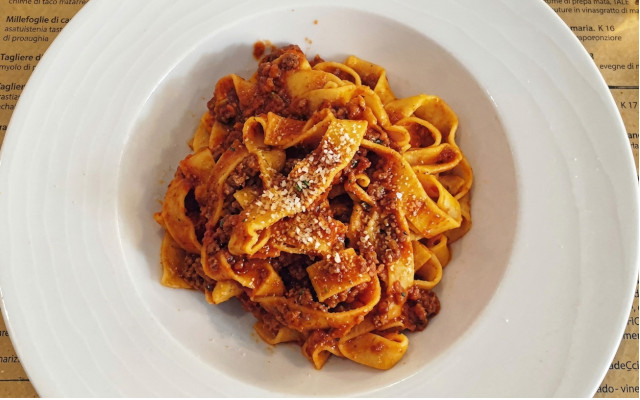
The Bolognese sauce è la ricetta italiana ‘più richiesta nel mondo’, come ha osservato il segretario generale dell’Accademia Italiana della Cucina (AGI, 2023), ed è con ogni probabilità anche la più reinterpretata. Questa guida ne ripercorre la registered recipe in Bologna, the ragù from other regions, the ready-made sauce market and the new generation of vegetable ragù a base di legumi. Un paragrafo è dedicato ai lettori non italiani i quali desiderino distinguere l’originale Made in Italy dal ‘Bolognese’ Italian sounding.
The recipe registered in Bologna
In April 2023 the Italian Academy of Cuisine deposited the updated recipe for ragù with the Chamber of Commerce of Bologna, over forty years after the first deposit in October 1982. The chamber of commerce collection includes 34 recipes from the Bolognese gastronomic culture, starting from the size of the tagliatella, deposited in 1972 (Chamber of Commerce of Bologna, 2023).
The doses for six people include 400 g of beef pulp coarsely ground, 150 g of fresh pork belly, half an onion, a carrot and a stick of celery, a glass of red or white wine, 200 g of tomato puree, a spoonful of double concentrate, broth, three spoons of extra virgin olive oil, salt and pepper. Whole milk is optional. Cooking takes approx two hours, up to three depending on the meat (Italian Academy of Cuisine, 2023).
Instead of the folder (beef diaphragm), which is difficult to find today, the following are recommended anterior cuts rich in collagen: muscle, shoulder, shoulder, belly, brisket. Mixed meats are permitted (approximately 60% beef and pork), knife cutting, stretched or rolled bacon and a hint of nutmeg. However, veal pulp, smoked bacon, pork alone,garlic, rosemary, parsley and other flavourings, brandy and flour to thicken. Livers, sausage, peas e porcini mushrooms dried can enrich the sauce (Italian Academy of Cuisine, 2023).
The recipe was developed following historical research and consultations with restaurateurs, families and experts, and does not aim to be presented as the only possible version (Bologna Chamber of Commerce, 2023). The 'Classic Bolognese ragù' also figures among the Traditional Agri-Food Products dell’Emilia-Romagna (Regione Emilia-Romagna, 2025). L’antenato più celebre si trova nei ‘Maccheroni alla bolognese‘ di Pellegrino Artusi (1891): un sugo di vitello tirato a brodo, all’epoca ancora senza pomodoro (Cesari, 2020).
The ragù of the Italian regions
Ragù is, in hindsight, a family of sauces in the regional traditions of Italian cuisine:
- The Neapolitan ragù it cooks whole pieces of beef, pork ribs and rolls for about six hours, and the meat is served as a second course;
- there Genoese, also Neapolitan, stews meat and onions until they fall apart, without tomatoes, and seasons the hand-broken ziti;
- in Veneto the duck ragù, without tomato, accompanies the bigoli;
- in Tuscany and on the Apennines wild boar goes well with pappardelle;
- in Puglia the chops a Orecchiette and cavatelli;
- in Abruzzo the mutton with spaghetti alla guitar LINK;
- in Sardinia lamb with malloreddus;
- in Marche mixed meats and livers with Campofilone macaroni.
The white 'courtyard' ragù and fish ragù complete the picture (Baldwin, 2023).
Fake 'Bolognese', how to recognize it
Outside Italy the word 'Bolognese' often designates preparations which only share the name with Bologna, sometimes even distorted. Four clues help you recognize them:
- there Pasta. In Bologna the ragù seasoning the egg tagliatelle e le lasagne. Nel 2019 l’allora sindaco Virginio Merola raccolse sui social network fotografie di ‘spaghetti Bolognese’ da tutto il mondo, li archiviò alla voce fake news e ricordò che la città ha dato al mondo tagliatelle, tortellini e lasagne (CBC News, 2019). L’abbinamento con gli spaghetti compare per la prima volta in un ricettario stampato negli Stati Uniti nel 1917 e poi nei menu di New York del 1920 (Cesari, 2020). Lo spag bol ha quindi più familiarità con Manhattan che con le Due Torri;
- The ingredients. The registered recipe excludes garlic, rosemary, parsley and any other aroma. A 'Bolognese' scented with garlic and oregano tells a respectable story, but it's another story;
- The color. With 550 g of meat and 200 g of tomato puree, the ragù is authentic brown, dense and shiny. A red, runny sauce with a few crumbs of meat is a tomato sauce, however ambitious;
- The time. Two hours of cooking is the minimum wage, as collagen does not know the 'ready in ten minutes' instructions.
A study attached to the UNESCO candidacy of Bolognese gastronomic culture has cataloged the phenomenon, named 'Bolognese sounding'. Vi compaiono ‘Kangaroo Bolognaise’, ‘Chicken Bologna’, tofu ‘Bolognese’, spaghetti di konjac, lasagne con la maionese al posto della besciamella, spaghetti al ragù serviti in un bicchiere o in un cono di cialda, patatine al gusto di spaghetti alla bolognese (Segrè et al., s.d.). Il canguro, per quanto risulta, non ha mai pascolato sull’Appennino. Quanto al cono, a Bologna si usa per il gelato.
Il valore del ragù originale Made in Italy risiede nella scelta e la combinazione dei tagli di carne, nel soffritto, nelle ore di fuoco lento e in una cultura della tavola che il 10 dicembre 2025 l’UNESCO has inscribed, together with the entire Italian cuisine, in the intangible cultural heritage of humanity. It is therefore advisable to look for only authentic Italian products on the shelf, being wary of 'Italian sounding' imitations.
Ready-made sauces, the Italian market
In the year ending in August 2025, the sauces, sauces and condiments sector in Italy reached 167 thousand tons (+2.6%) and 1.1 billion euros (+2.5%). Ready-made sauces and bases, with 81 thousand tonnes (+2.7%), represent 48.4% by volume, according to NIQ data (Modern Distribution, 2025).
THE'offer of ragù includes stable preserves in glass, fresh refrigerated and frozen products, made by large brands, small industries, butchers and delicatessens.
Demand is oriented towards products with clean label: the essential ingredients are meat, tomato, sautéed vegetables, extra virgin olive oil, wine. The wording 'artisanal workmanship' it also deserves attention and does not in itself imply better quality.
Vegetable ragù, the MartinoRossi innovation
The Italian food market prodotti plant-based it reached 639 million euros in 2024 and, according to AstraRicerche research, 45% of Italians want to increase the consumption of plant products (Manuelli, 2025). The development of vegetable ragout had to solve two great challenges, the consistency of the ground coffee and the depth of flavour, without extending the label.
MartinoRossi SpA, founded in the early fifties in Malagnino (Cremona), is at the forefront on this path thanks to the use of natural protein concentrates of legumes, which it creates with only physical processes: the concentration does not require water or solvents, unlike isolates, and naturally attenuates the green note of the legume (MartinoRossi, s.d.).
The Beamy brand dry ragout mix counts four ingredients: protein of pea, flour red lentil, corn flour, psyllium fiber. It contains no additives, flavourings, gluten, soy or other ingredients. It is poured into a sauté of vegetables with tomato pulp and cooked in 15-20 minutes (Martino's Market, s.d.-a). The ready-made vegetable ragù contains 78% Italian tomato pulp and 8.2% textured pea proteins (Martino's Market, s.d.-b).
The union of legume flours and protein concentrates preserves the merits of the raw material – i.e. fibres, minerals and bioactive compounds – and fits into the vein already described for the cereal and legume pasta.
Nutritional profiles
The food composition tables indicated by CREA - Food and Nutrition Research Center (2019) refer to the following nutritional values for Bolognese sauce.
| Bolognese sauce (CREA, code PC0007) | Average values per 100 g |
| Energy | 818 kJ / 196 kcal |
| Fats | 15.4g |
| of which saturated fatty acids | data not reported |
| Carbohydrates | 1.9g |
| of which sugars | 1.9g |
| Fibers | 0.9g |
| Proteins | 12.0g |
| Salt | 0.98g |
| Vitamin A | 262 µg (33% NRV) |
| Zinc | 2.62 mg (26% NRV) |
| Potassium | 511 mg (26% NRV) |
| Phosphorus | 151 mg (22% NRV) |
| Niacin | 2.90 mg (18% NRV) |
| Folates | 35 µg (18% NRV) |
I dati derivano da due preparazioni sperimentali del CREA, la cui ricetta (vitellone, salsiccia, burro, aglio, 30 minuti di cottura) differisce da quella depositata a Bologna. Il sale è calcolato dal sodio (390 mg). Le percentuali si riferiscono ai valori nutrizionali di riferimento di cui in Allegato XIII al regolamento (UE) n. 1169/2011. Le proteine apportano circa il 24% dell’energia, oltre la soglia del 20% richiesta per l’indicazione ‘ad alto contenuto di proteine’ (reg. CE 1924/2006, Allegato).
The manufacturer's nutritional declarations apply to the two Beamy vegetable ragùs (Martino's Market, s.d.-a, s.d.-b).
| Average values per 100 g | Dry preparation for ragù | Ready-made vegetable ragout |
| Energy | 1531 kJ / 363 kcal | 477 kJ / 114 kcal |
| Fats | 6.0g | 7.0g |
| of which saturated fatty acids | 1.1g | 0.8g |
| Carbohydrates | 14 g | 5.1g |
| of which sugars | 1.0g | 3.5g |
| Fibers | 8.6g | 1.9g |
| Proteins | 59 g | 6.6g |
| Salt | 1.6g | 0.78g |
| Iron | 11 mg (79% NRV) | 2.2 mg (16% NRV) |
The values of the dry preparation concern the product as it is, before the addition of tomato and sauté. The ready-made vegetable ragù, already in the form intended for consumption, obtains approximately 23% of the energy from proteins and provides 16% of the reference iron, with only 0.8 g of saturated fat per 100 g.
Criteria for choosing and reading the label
The recipes vary a lot, so the nutritional declaration of the single product remains the reference. The meat that appears in the name must be indicated as a percentage in the list of ingredients (EU regulation 1169/2011, art. 22), even when it is part of a compound ingredient. Negli acquisti online le informazioni obbligatorie, a eccezione del termine minimo di conservazione o della data di scadenza, devono venire rese disponibili prima della conclusione dell’acquisto (reg. UE 1169/2011, art. 14.1, lett. ‘a’).
Those looking for guarantees on the application of the highest standards of protection of ecosystems and animal welfare for products of animal origin can direct their choices towards the product certified organic (reg. UE 2018/848). Ristoratori, gastronomie e buyer possono dedicare altresì attenzione alla scheda tecnica (percentuale di carne o di proteine vegetali, resa, conservazione), la documentazione di filiera e una prova sensoriale su campione, con riguardo a consistenza, colore e persistenza.
Conclusions
Bolognese ragù has a registered recipe, a large family of regional relatives and, throughout the world, many namesakes. Recognizing the original is simple: egg tagliatelle or durum wheat semolina pasta, plenty of meat, a little tomato, no rush if you prepare it at home. The vegetable ragout of Italian legumes, with few natural ingredients and a significant protein profile, once again confirms the Italian avant-garde in food innovation.
Dario Dongo
References
European Union regulatory sources
Regulation (EC) No 1924/2006 of the European Parliament and of the Council of 20 December 2006 on nutrition and health claims made on foods. Consolidated text: 12/13/2014. http://data.europa.eu/eli/reg/2006/1924/2014-12-13
Regulation (EU) No 1169/2011 of the European Parliament and of the Council of 25 October 2011 on the provision of food information to consumers. Consolidated text: 04/01/2025. http://data.europa.eu/eli/reg/2011/1169/2025-04-01
Regulation (EU) 2018/848 of the European Parliament and of the Council of 30 May 2018 on organic production and labeling of organic products and repealing Council Regulation (EC) No 834/2007. Consolidated text: 03/25/2025. http://data.europa.eu/eli/reg/2018/848/2025-03-25
Institutional sources
Accademia Italiana della Cucina. (2023). Ricetta aggiornata del tradizionale ragù alla bolognese, depositata il 20 aprile 2023 alla Camera di Commercio di Bologna. https://accademiaitalianadellacucina.it/sites/default/files/Rag%C3%B9%20alla%20bolognese%20-%20ricetta%20aggiornata%2020%20aprile%202023.pdf
Camera di commercio di Bologna. (2023, 20 aprile). L’Accademia Italiana della Cucina ha depositato alla Camera di commercio di Bologna la ricetta aggiornata del vero ragù alla bolognese [Comunicato stampa]. https://www.bo.camcom.it/sites/default/files/comunicazione/comunicati/2023/comunicato%20stampa%20deposito%20rinnovata%20ricetta%20vero%20Rag%C3%B9%20alla%20bolognese%2020%20aprile%202023.pdf
CREA – Centro di ricerca Alimenti e Nutrizione. (2019). Tabelle di composizione degli alimenti. Ragù alla bolognese (codice PC0007). https://alimentinutrizione.it/tabelle-nutrizionali/PC0007
Regione Emilia-Romagna. (2025). Elenco regionale dei Prodotti Agroalimentari Tradizionali dell’Emilia-Romagna. Ventiseiesima revisione (determina 23282/2025). https://agricoltura.regione.emilia-romagna.it/dop-igp/altri-regimi-di-qualita/prodotti-tradizionali/editore-regionale-dei-prodotti-agroalimentari-tradizionali-ventiquattresima-revisione/@@download/file
Segrè, A. (coord.), Binazzi, D., De Biasi, G., Naldi, G., & Neri, N. (s.d.). Studio Bolognese sounding. Allegato al documento di candidatura a sito UNESCO della Cultura Gastronomica Bolognese. Città metropolitana di Bologna. https://www.cittametropolitana.bo.it/portale/Engine/RAServeFile.php/f/allegati_generici/Allegato_Bolognese_Sounding.pdf
Gastronomic and historical sources
Artusi, P. (1891). La scienza in cucina e l’arte di mangiar bene. Firenze: Landi.
Baldwin, E. (2023, 27 novembre). Exploring Italy’s many ragù recipes: from the Neapolitan and Bolognese, to the fish-based one. Gambero Rosso International. https://www.gamberorossointernational.com/news/exploring-italys-many-ragu-recipes-from-the-neapolitan-and-bolognese-to-the-fish-based-one
Cesari, L. (2020, 27 aprile). Gli spaghetti alla bolognese, la ricetta che non c’è. Origini e storia. Gambero Rosso. https://www.gamberorosso.it/notizie/storie/gli-spaghetti-alla-bolognese-la-ricetta-che-non-ce-origini-e-storia/
Press and market data
AGI. (2023, 20 aprile). Il vero ragù alla bolognese, la ricetta aggiornata. https://www.agi.it/cronaca/news/2023-04-20/vero_ragu_bolognese_ricetta_aggiornata_ingredienti-21053153/
CBC News. (2019, 3 marzo). Mayor of Bologna, Italy, on crusade to expose fake spaghetti Bolognese. https://www.cbc.ca/lite/story/1.5041024
Distribuzione Moderna. (2025, 12 novembre). Sughi, salse e condimenti: un comparto tra genuinità e piacere. https://distribuzionemoderna.info/mercati/sughi-salse-e-condimenti-tra-genuinita-e-piacere
Manuelli, M. T. (2025, 28 luglio). MartinoRossi grows with protein flours and plant-based retail products. Il Sole 24 Ore. https://en.ilsole24ore.com/art/martinorossi-grows-protein-flours-and-plant-based-products-in-retail-AHvFLYiB
Company sources
Martino’s Market. (s.d.-a). Beamy – Preparato per ragù plant-based. https://martinosmarket.com/products/beamy-preparato-per-ragu-plant-based
Martino’s Market. (s.d.-b). Beamy ragù vegetale 200 g. https://martinosmarket.com/products/beamy-ragu-vegetale
MartinoRossi SpA. (s.d.). Industria alimentare. Proteine vegetali. https://www.martinorossispa.it/prodotti/industria-alimentare/

Dario Dongo, lawyer and journalist, PhD in international food law, founder of WIISE (FARE - GIFT – Food Times) and Égalité.


