


TheTuscan IGP extra virgin olive oil confirms itself as the undisputed leader among Italian extra virgin olive oils with Geographical Indication, driving theexport with a record value of 41 million euros. In an increasingly demanding global market, Tuscan excellence relies not only on the unbreakable bond with the territory and history, but evolves through a traceability advanced. From the integration of new EU regulations to the digitization of the guarantee through QR codethe Tuscan IGP model represents the perfect synthesis between olive biodiversity and consumer protection.
According to the latest report ISMEA-Qualivita on the PDO Economy (2025) Tuscan PGI Oil – with a production of 2,364 tonnes (+9.5%), a production value of 32 million euros (+8.9%) and a consumer value of 47 million euros (+9.5%) – reached first place in retail valueexport, For 41 million euros (+9,5%), among Italian extra virgin olive oils with Geographical Indication.
The main destinations remain the United States (main non-EU market), Germanythe Northern European countries and Japan. The average price per liter in international markets is between €18-25 for premium references, with higher peaks for single-varietal and certified organic productions.
The dynamics 2024/2025 are characterized by:
- climatic variability residual, which continues to guide production strategies towards quality rather than quantity;
- increasing demand for certified oils e organic, in line with the preferences of sophisticated consumers;
- consolidation of position in premium segment, with a strong presence in specialized channels, high-end GDO and starred catering.
From the Etruscans to EU protection: the regulatory evolution
The cultivation of theolive tree in Tuscany has its roots in the era Etruscan and Roman. ‘The first legislative document, which constitutes the ‘Statute of the Oil Sellers’, dates back to 1318, composed of eighty-six articles that organically address the exercise of the art. In this document, there is the intent to isolate and protect olive oil production, as well as to qualify the operators of the ‘district’ of Florence, which at the time included a large part of the regional territory. The Oil Sellers, in fact, had to be registered in a special register to operate.
In the last years of the 1500, thanks to the policy of the Medici, there was a further development of olive cultivation. In the 1600 there was the subdivision of large estates into sharecropping farms with a further development of the cultivation that played a predominant role in the business economy in the 1700s. Over the last centuries, olive cultivation has assumed, in Tuscany, great economic and environmental importance, also remarkably shaping the Tuscan landscape’ (Consorzio Toscano IGP regulation, 2024, article 10 – Link with the geographical area).
The recognition of theProtected Geographical Indication (PGI) took place in 1997 with Regulation (EC) No. 1065/97, subsequently updated and consolidated within Regulation (EU) 2024/1143. This step represented a strategic breakthrough to protect the regional identity of the product and counter imitations and unfair commercial practices on international markets (Mengoni, 2025).
Identity on the label: geographical mentions and cultivars
‘The protected geographical indication ‘Toscano’, possibly accompanied by one of the following additional geographical indications: ‘Seggiano’, ‘Lucchesi Hills’, ‘Lunigiana Hills’, ‘Arezzo Hills’, ‘Sienese Hills’, ‘Florence Hills’, ‘Montalbano’, ‘Pisani Mountains’ is reserved for extra virgin olive oil that meets the conditions and requirements established in the production specification, as recently updated (Toscano IGP Consortium specification, 2024, article 1 – Designation).
Cultivar and production area
The protected geographical indication ‘Toscano’, without any additional geographical mention, must be obtained from the following olive varieties ‘present, alone or together, in the olive groves: Americano, Arancino, Ciliegino, Frantoio, Grappolo, Gremignolo, Grossolana, Larcianese, Lazzero, Leccino, Leccio del Corno, Leccione, Madonna dell’Impruneta, Marzio, Maurino, Melaiolo, Mignolo, Moraiolo, Morchiaio, Olivastra Seggianese, Olivella, Pendolino, Pesciatino, Piangente, Punteruolo, Razzaio, Razzo, Rossellino, Rossello, San Francesco, Santa Caterina, Scarlinese, Tondello and other varieties registered in any case in the Regional Register of Native Tuscan Germplasm’. Each geographical mention is subject to the use of specific cultivars (specification, article 2 – Varieties).
The olive production area intended for the production of Toscano IGP extra virgin olive oil is delimited to the administrative territory of the Tuscany Region, with restrictions to individual municipalities of the provinces concerned by additional geographical mentions (specification, article 3 – Production area).
Cultivation and harvesting requirements
‘The environmental and cultivation conditions of the olive groves (…) must be those traditional and characteristic of the area and, in any case, able to confer to the olives and the derived oil the specific qualitative characteristics. The planting distances, training forms and pruning systems must be rational from an agronomic point of view, but such as not to modify the characteristics of the olive tree and the oil’. The maximum olive yield cannot exceed 9 tons per hectare for specialized plantations, or 50 kg per plant in mixed-crop olive groves (regulation, article 4 – Cultivation characteristics).
The olive harvest takes place directly from the plant with mechanical means or by hand-picking. The olives must be washed with water and/or air, with a ban on any other treatment. The final harvest date is set at December 15 (regulation, article 5 – Methods of oil extraction).
Oil characteristics
At the time of marketing, the extra virgin olive oil with protected geographical indication ‘Toscano’ must meet the following characteristics:
- color: from green to golden yellow with color changes over time;
- flavor: fruity from light to intense accompanied by one or more hints of: green or ripe olive, almond, other ripe fruit, artichoke, leafy greens;
- taste: presence of bitterness;
- tactile sensations: perception of pungency;
- panel test evaluation: levels allowed by current regulations;
- maximum total acidity expressed in oleic acid, by weight, not exceeding 0.45 grams per 100 g of oil (slightly more than half of limit set by Reg. EU 2022/2104, equal to 0.8 g);
- peroxide number: ≤ 14 meqO2/Kg.
Specific parameters are also defined for single oils with additional geographical indication (regulation, article 6 – Characteristics at consumption).
Innovation and transparency: the new digital passport
I controls are entrusted to Toscana Certification Agroalimentare (TCA) S.r.l. which verifies compliance through field inspections, laboratory analyses and documentary audits throughout the supply chain (regulation, article 7 – controls).
The operations of packaging must take place within the Tuscany region. Thelabel must mandatorily include:
- indication ‘Protected Geographical Indication’ or ‘IGP‘;
- logo IGP ‘Toscano Oil’ with registered official graphics;
- production vintage;
- producer/packer references (regulation, article 8 – Designation and presentation).
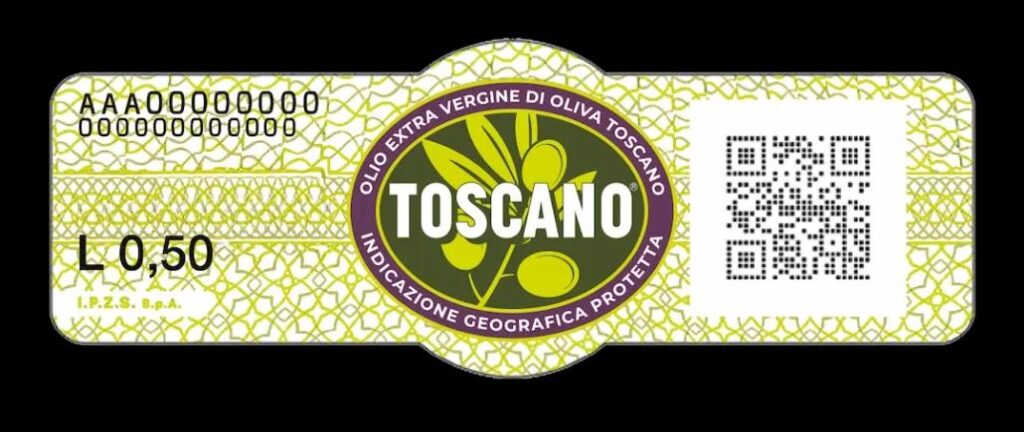
Each batch of Tuscan IGP Oil is subject to complete traceability through loading/unloading registers at olive growers, mills and packers (regulation, article 9 – Proof of origin). As of October 10, 2025, the new mark of the State Printing Office, designed to guarantee the highest standards of safety and authenticity. By scanning the QR code shown on the mark, the consumer can consult the digital passport of the bottle purchased (Tuscan Oil Consortium IGP, 2026).
Nutraceutical profile: polyphenols and health claims
Theextra virgin olive oil is recognized by the international scientific community for its cardiovascular health benefits, mainly attributable to the content of monounsaturated fatty acids (oleic acid >70%) and the content of bioactive substances. Tuscan IGP Oil, obtained from early harvest, is distinguished by particularly high concentrations of:
- polyphenols (>250 mg/kg, often >400 mg/kg in selected productions): powerful antioxidants with anti-inflammatory and protective effects on the cardiovascular system;
- tocopherols (vitamin E): contribute to oxidative stability and antiradical action;
- volatile compounds (esters, aldehydes, alcohols): responsible for the aromatic profile and indicators of freshness and quality of the production process (Angerosa et al., 2004).
Regulation (EU) 432/2012 allows the use of the health claim ‘i polyphenols of olive oil contribute to the protection of blood lipids from oxidative stress’ in the commercial information of only ‘olive oil that contains at least 5 mg of hydroxytyrosol and its derivatives (for example, oleuropein and tyrosol complex) per 20 g of olive oil. The indication must be accompanied by information to the consumer that the beneficial effect is obtained with thedaily intake By 20 g of olive oil’.
Gastronomic uses and pairings
Thanks to its aromatic intensity and balanced structure, Tuscan PGI Olive Oil is particularly suitable for:
- use raw on Tuscan bread (‘sciocco’, i.e. without salt), bruschetta, legumes (ribollita, beans all’uccelletto), grilled vegetables and grilled meats (Florentine steak);
- seasoning of soups and broths of Tuscan tradition (pappa al pomodoro, acquacotta);
- pinzimonio of raw seasonal vegetables;
- finishing of fish dishes delicate, where the oil balances saltiness and freshness;
- quality catering, where the oil becomes a distinctive ingredient.
Its structure and phenolic content also make it suitable for short cooking at moderate temperature, while expressing its maximum sensory and nutritional potential when cold. The Tuscan PGI Olive Oil Consortium offers some original recipes on its website, cited in the bibliography.
Guide to conscious purchasing and support for international buyers
‘Foodies’ and international buyers should first verify theauthenticity of Tuscan PGI olive oil and the presence on the label of the PGI guarantee mark, as well as the QR code for products packaged after October 10, 2025. Favoring certified products whenever possible organic (Reg. EU 2018/848). to support supply chains committed to the highest standards of environmental and biodiversity protection.
The team of GIFT (Great Italian Food Trade) has solid experience in supporting international buyers in the search for reliable suppliers of Italian agri-food excellences, helping to select productive partners able to meet quality, certification and logistics requirements.
Conclusions
TheTuscan IGP Oil It represents an economic and cultural system that protects 2,364 tons of certified quality and the pleasant olive groves that characterize the landscape of the hills depicted by Leonardo da Vinci. The introduction of the State Printing Office's mark and direct access to supply chain data via QR Code elevate the product to unprecedented transparency standards. For food trade operators and global consumers, choosing this PGI means rewarding olive growing that regenerates the landscape and guarantees health benefitsmeasurable, consolidating the prestige of Made in Italy in the world.
Dario Dongo
Bibliography
- Angerosa, F., Servili, M., Selvaggini, R., Taticchi, A., Esposto, S., & Montedoro, G. (2004). Volatile compounds in virgin olive oil: occurrence and their relationship with the quality. Journal of Chromatography A, 1054(1-2), 17-31. https://doi.org/10.1016/j.chroma.2004.07.093
- Borghini, F., Tamasi, G., Loiselle, S. A., Baglioni, M., Ferrari, S., Bisozzi, F., Costantini, S., Tozzi, C., Riccaboni, A., & Rossi, C. (2024). Phenolic profiles in olive leaves from different cultivars in Tuscany and their use as a marker of varietal and geographical origin on a small scale. Molecules, 29(15), 3617. https://doi.org/10.3390/molecules29153617
- Consorzio Olio Toscano IGP. (2024). Production regulations of Toscano IGP Olive Oil. Florence: Consorzio Olio Toscano IGP. https://www.oliotoscanoigp.it/wp-content/uploads/2024/10/DisciplinareToscano_IGP_2024.pdf
- Consorzio Olio Toscano IGP. (2026). Recipes with Toscano IGP Olive Oil. https://www.oliotoscanoigp.it/caratteristiche-olio-toscano-igp/ricette-olio-extravergine-toscano/
- Commission Delegated Regulation (EU) 2022/2104 of 29 July 2022 supplementing Regulation (EU) No 1308/2013 of the European Parliament and of the Council as regards marketing standards for olive oil, and repealing Commission Regulation (EEC) No 2568/91 and Commission Implementing Regulation (EU) No 29/2012. Consolidated text: 10/06/2024 http://data.europa.eu/eli/reg_del/2022/2104/2024-06-10
- Girelli, C. R., Coco, L. D., Zelasco, S., Salimonti, A., Conforti, F. L., Biagianti, A., Barbini, D., & Fanizzi, F. P. (2018). Traceability of “Tuscan PGI” Extra Virgin Olive Oils by ¹H NMR Metabolic Profiles Collection and Analysis. Metabolites, 8(4), 60. https://doi.org/10.3390/metabo8040060
- Mengoni, M., Belletti, G., & Marescotti, A. (2025). Short food supply chains. In Reference Module in Food Science. Elsevier. https://doi.org/10.1016/B978-0-443-15976-3.00128-8
- Pelacani, S., Tommasini, S., Ferrari, M., Ghiotto, M., Pecchioni, E., Riccio, R., & Moretti, S. (2025). Geochemical fingerprinting of extra virgin olive oils based on radiogenic strontium isotopes. Science of the Total Environment, 990, 179894. https://doi.org/10.1016/j.scitotenv.2025.179894
- Regulation (EU) 2018/848 of the European Parliament and of the Council of 30 May 2018 on organic production and labelling of organic products. Consolidated text: 25/03/2025 http://data.europa.eu/eli/reg/2018/848/2025-03-25
- Commission Regulation (EU) No 432/2012 of 16 May 2012 establishing a list of permitted health claims made on foods, other than those referring to the reduction of disease risk and to children’s development and health. Consolidated text: 20/08/2025 http://data.europa.eu/eli/reg/2012/432/2025-08-20

Dario Dongo, lawyer and journalist, PhD in international food law, founder of WIISE (FARE - GIFT – Food Times) and Égalité.


