

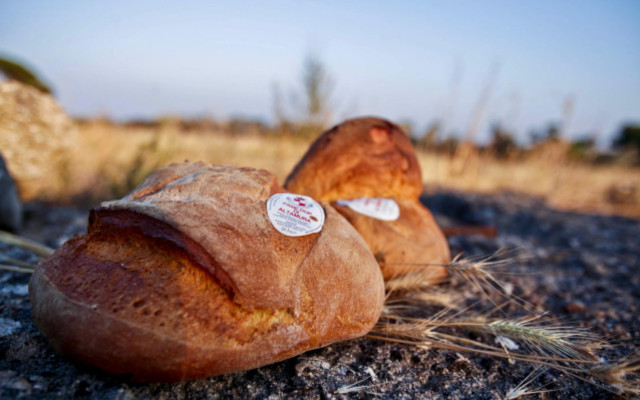
The Altamura DOP bread draws its identity from the strength of local durum wheat and the vitality of sourdough, ingredients that define its structure and aromas. The first bread in Europe to receive community protection, with regulation (EC) no. 1107/06, it represents the technical evolution of a rural tradition where re-milled semolina, rich in proteins and wheat germ oil, blends with a slow fermentation. The result is a highly durable food, a reflection of a unique geological ecosystem in the heart of Alta Murgia.
The origins of Altamura bread date back toantiquity. The Latin poet Horace, in the 1st century BC, defined it as ‘the best in the world’, highlighting its reputation even then (Satires, I, 5, v. 90).
Historically, the bread was prepared in peasant houses and baked in public ovens. The loaves were marked to distinguish ownership.
Its long shelf life – up to several days – made it ideal for shepherds and farmers working far from home, contributing to the birth of many traditions and popular stories linked to its function as ‘travel bread’.
DOP disciplinary regulations
The production specification (published in the Official Gazette of the Italian Republic no. 168 of 21 July 2003) reserves the protected designation of origin ‘Pane di Altamura’ to the ‘bread obtained by theancient processing system (with sourdough yeast or sourdough-salt sea-water) and from the use of re-milled semolina of durum wheat varieties grown in the territories of the municipalities of north-western Murgia’ (article 2), in compliance with the following requirements.
The terroir of Murgia: karst soils and ideal microclimate
‘the production area of the Pane di Altamura PDO includes the territories of the Municipalities of Altamura, Gravina di Puglia, Poggiorsini, Spinazzola, Minervino Murge’ (specification, article 3).
‘The bread produced is considered ‘unique’ qualitybecause it derives from excellent durum wheat, obtained in an environment with specific geographical-environmental factors, which characterize the territory of Murgia north-western and from the use of potable water normally used in the territory.
The territory concerned is the only part of the Apulian territory that preserves structural, physiographic and environmental characteristics close to the original ones. These characteristics are:
- territory never subject to marine ingress;
- epigean and hypogean karst forms and systems are rare;
- autochthonous hydrography;
- temperature of water entering the underground with an average value of 12°C;
- humid mesothermal Mediterranean climate;
- asepticity of the environment due to solid precipitation;
- soil permeability 10^-5 ÷10^-6 cm/sec,
- chemical composition of the soils’ (article 4).
The grain architecture: re-milled semolina and germ oil
The specification prescribes the exclusive use of re-milled semolina of durum wheat grown in the geographical area delimited (article 5), coming from at least 80% from varieties Apulian, Arcangelo, Duilio, Simeto.
The chemical-physical characteristics wheat and semolina must be certified and meet the following quality parameters:
- durum wheat: hectoliter weight: ≥ 78 kg/hl; proteins ≥ 11%; ashes
- durum wheat semolina: indice di glutine < 80; indice di giallo > 20.
‘I re-milled they must be obtained from milling processes entirely similar to those currently used in the territory of Altamura described below. The mills operating in the aforementioned area are equipped with machines with a pair of metal rollers of different diameters and equipped with various roughness arranged so as to be progressively closer together. The rotation speed is about 300 (three hundred) revolutions per minute, the temperature operating not exceeding 40 °C. Such a structure, through friction actions, causes the breakage of most of the cells of the aleurone layer of the grain, thus impregnating with the precious germ oil the
re-milled durum wheat’ (specification, article 4).
Natural fermentation: three renewals of sourdough starter
The ingredients mandatory and exclusive for Altamura DOP Bread are:
- semolina re-milled durum wheat;
- Water;
- sea salt;
- sourdough starter (natural sourdough. Specification, article 2).
The production process consists of the following stages:
- dough: the sourdough starter is obtained with a minimum three renewals to increase the fermented mass by adding water and durum wheat semolina, at 20% compared to the amount of durum wheat semolina to be kneaded. For 100 kg of durum wheat semolina, 20 kg (20%) of natural yeast, 2 kg (2%) of sea salt, about 60 liters (60%) of water at 18° C are required. The kneading operation must last 20 minutes, using a planetary mixer. The water used for kneading must be potable, distributed throughout the area andcertified in detail by the waterworks management authority;
- leavening and first resting phase: ‘upon completion of the kneading operation it is necessary to cover the mass with a cotton cloth of a certain thickness in order to obtain leavening at a uniform temperature. In this condition the dough must rest for at least ninety minutes’;
- shaping and second resting phase: ‘at the end of the previous processing phase, weighing and the first shaping are carried out manually to allow the mass to be gathered in its natural fibrous casing. In this condition the dough rests for thirty minutes’;
- reshaping and third resting phase: ‘a further manual shaping is performed, followed by a resting period of at least fifteen minutes’;
- baking and cooking: ‘before being baked the ‘loaf’ is turned upside down and with a light pressure of the hand, applied on one side, it is accompanied into the oven. The oven is fueled preferably with wood or gas, indirect heating, and must reach the temperature of 250°C. Direct heating ovens used for baking ‘Pane di Altamura’ must be fueled with wood of the type oak. The first part of the cooking takes place with the oven open. After fifteen minutes, the oven mouth is closed and it is left to cook for another fifteen minutes’;
- removal from the oven: ‘the oven mouth is left open for at least five minutes to allow the steam to escape and consequently to promote thedrying of the crust which becomes crunchy. The loaves of bread are then removed from the oven and placed on wooden boards’ (specifications, article 6).
Visual identity: traditional shapes and crunchy crust
At the time of placing on the market, Pane di Altamura DOP must present the following characteristics:
- minimum weight: 0.5 kg;
- shape traditional overlapped (‘a cornetto’, in dialect ‘u skuanète’), with side marks, or low (priest’s hat, in dialect ‘a cappidd d’prévte’) without marks;
- crust thick at least 3 mm, golden brown in color;
- crumb straw yellow with uniform alveolation;
- humidity ≤ 33% (regulation, article 7).
Traceability and controls
The regulation provides official registers for farmers, mills, and bakers, as well as controls throughout the entire supply chain to guarantee the origin and compliance of the product. The designated control body verifies compliance at every stage (regulation, article 8).
Traceability and guarantees of the DOP label
The finished product can be marketed:
- after packaging in micro-perforated shrink wrap with a label stating: list of ingredients, manufacturer, expiration date, logo; or
- ‘without any packaging with only the application on the finished product of a sticker in biodegradable material bearing the characteristics listed above and the wording ‘Pane di Altamura’ (article 9).
The logo to be used inseparably with the protected designation of origin consists of ‘Samnite Shield surmounted by the crown-armour quartered in twos red and white. In the center of the oval appears, horizontally, in three lines, the inscription PANE DOP DI ALTAMURA’. (article 11).
Temporary change
The decree of the Ministry of Agriculture of February 7, 2025 introduced a Temporary change to article 4 of the regulation, to allow the use of a re-milled durum wheat semolina obtained from the milling of durum wheats produced from different varieties, always grown in the delimited territory. The amendment was effective until July 31, 2025, subject to further extensions.
The advantages of sourdough
A systematic review with meta-analysis published in Critical Reviews in Food Science and Nutrition has shown that the consumption of naturally leavened bread significantly reduces the increase of postprandial blood glucose compared to industrially fermented bread (and control glucose solutions), with more pronounced effects when prepared with wholemeal flour (Rolim et al., 2024)
Uses
Altamura Bread is extremely versatile:
- for daily consumption;
- as a base for bruschettas and appetizers;
- accompanying soups and Legumes;
- as an ingredient in traditional Apulian recipes (e.g. cialledda, pancotto)
The thick crust and long shelf life also make it ideal for deferred use over time, maintaining fragrance and organoleptic characteristics.
Tips for buyers
Consumers are advised to:
- choose authentic Altamura Bread PDO, verifying the European logo and the absence of leavening agents (e.g. brewer's yeast) in the ingredients list;
- prefer products from organic farming where available, to contribute to the development of supply chains that are more respectful of the environment and biodiversity;
- store the product in a cool, dry place after purchase, preferably in paper bags or cotton sacks.
Conclusions
The centrality of local durum wheat and the exclusive use of sourdough elevate Altamura PDO Bread beyond common baking standards. The rigor in preserving native cultivars and low-temperature milling processes ensure a superior nutritional profile and optimal digestibility. Valuing this excellence means recognizing the role of cereal biodiversity and certified craftsmanship as drivers of a transparent, resilient, and authentically Italian food system.
Dario Dongo
Credit cover Altamura Bread PDO Consortium
Bibliography
- Commission Regulation (EC) No 1107/96 of 12 June 1996 on the registration of geographical indications and designations of origin under the procedure laid down in Article 17 of Council Regulation (EEC) No 2081/92. Consolidated text: 20/11/2008 http://data.europa.eu/eli/reg/1996/1107/2008-11-20
- Altamura Bread PDO Protection Consortium. Production specification. https://www.panealtamuradop.it/pane-dop/disciplinare/
- MASAF. (2025). Decree 7 February 2025. Temporary modification of the production specifications of the denomination 'Pane di Altamura' registered as a protected designation of origin. Official Gazette n. 40 of 18 February 2025. https://www.gazzettaufficiale.it/atto/serie_generale/caricaDettaglioAtto/originario?atto.dataPubblicazioneGazzetta=2025-02-18&atto.codiceRedazionale=25A00992
- Horace. (1st century BC). Satires, I, 5, v. 90.
- Pasqualone, A., Alba, V., Mangini, G., Blanco, A., & Montemurro, C. (2010). Durum wheat cultivar traceability in PDO Altamura bread by analysis of DNA microsatellites. European Food Research and Technology, 230(5), 723–729. https://doi.org/10.1007/s00217-009-1210-1
- Pasqualone, A., Summo, C., Bilancia, M. T., & Caponio, F. (2007). Variations of the sensory profile of durum wheat Altamura PDO (protected designation of origin) bread during staling. Journal of Food Science, 72(3), S191–S196. https://doi.org/10.1111/j.1750-3841.2007.00293.x
- Rolim, M. E., Fortes, M. I., Von Frankenberg, A., & Duarte, C. K. (2024). Consumption of sourdough bread and changes in the glycemic control and satiety: A systematic review. Critical Reviews in Food Science and Nutrition, 64(3), 801–816. https://doi.org/10.1080/10408398.2022.2108756

Dario Dongo, lawyer and journalist, PhD in international food law, founder of WIISE (FARE - GIFT – Food Times) and Égalité.


