

A glass of freshly squeezed or orange juice can meet the daily requirement of vitamin C, whereas an orange-flavored drink may instead provide excess sugars and problematic additives.
One must choose carefully, as some labels seem almost designed to confuse consumers. Our market survey on 34 products on shelves in Italy.
Freshly squeezed juice, orange juice, orange-flavored drink. 34 products compared
Our analysis ranges as always between the brands of the leaders in the Brand Industry (IDM) and the Distributor's Brand (MDD). Of the latter, we compare the private label of large-scale retail distribution (Coop, Esselunga, Carrefour, Conad), discount (Eurospin and Lidl) and their suppliers (Consilia).
The three types of products considered are freshly squeezed juice, fruit juice, and orange beverage. We have identified:
– origin of raw material, amount of sugars and vitamin C,
– for beverages also ingredients, fruit juice quantity, possible presence of problematic substances,
– transparency in labels, in some cases potentially misleading.
1) Freshly squeezed orange juice, the best
The juice of orange is the best product. 100% fruit subjected to a gentle treatment that better preserves the nutritional and organoleptic qualities of oranges. We examined 10, among blond and red. 4 are from Italian, Sicilian oranges, 6 from oranges from Spain and Morocco. Among the latter, two are produced abroad (Lidl in Germany, Tropicana by PepsiCo in France).
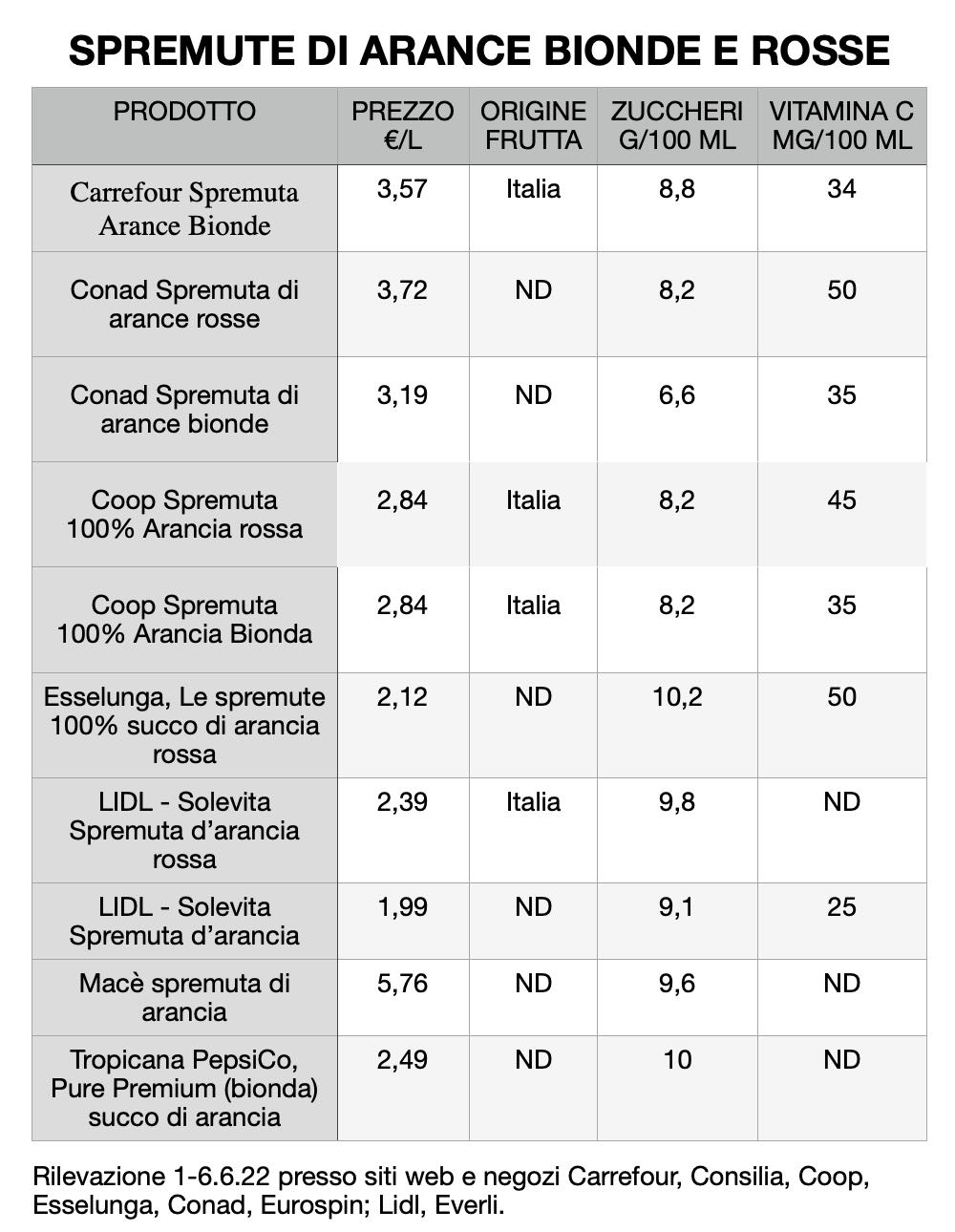
Vitamin C stands out in juices for the natural presence and quantity, which is higher in those of blood oranges (about 50 mg/100 ml) and still appreciable in those of blond oranges (about 35 mg/100 ml).
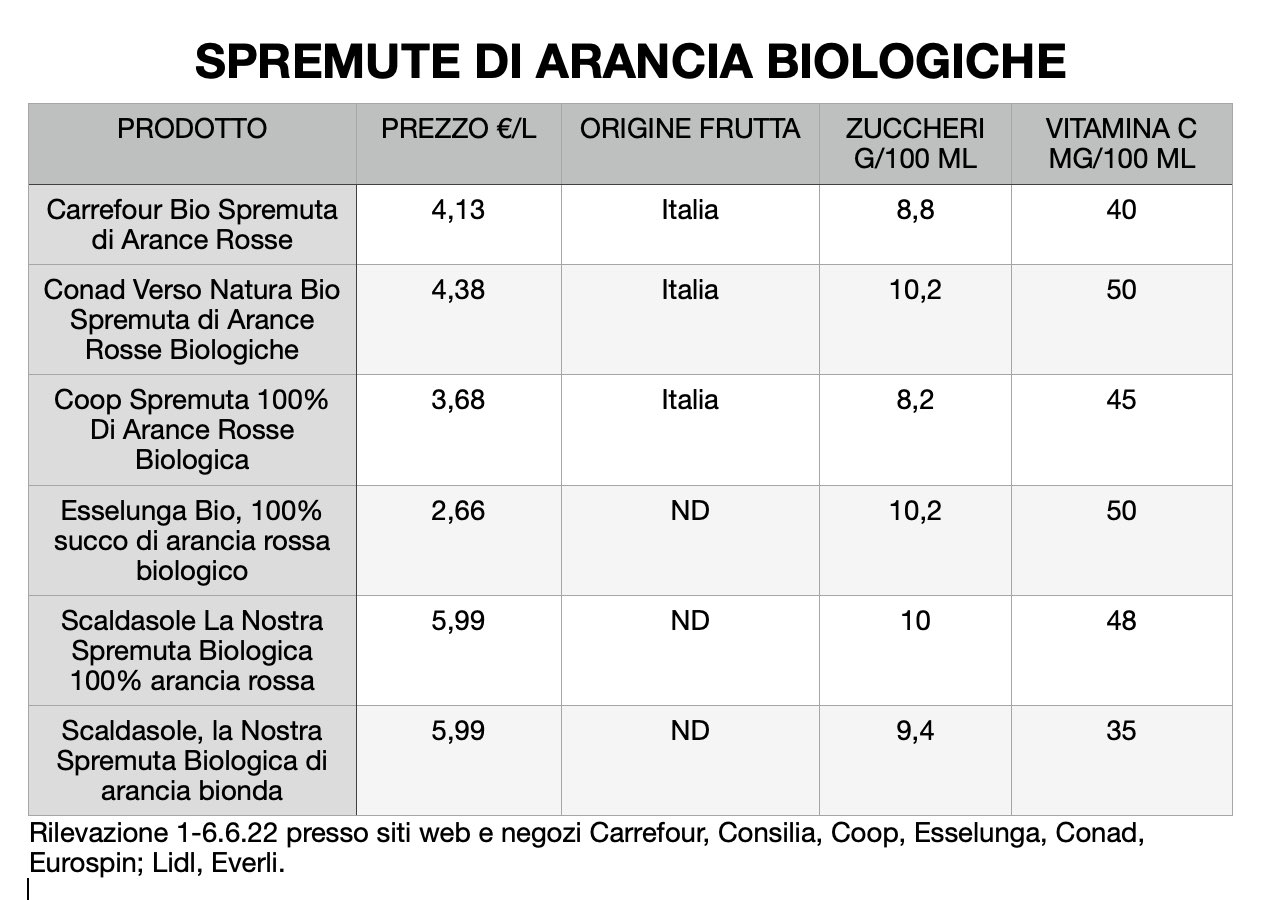
Organic is available and should be preferred. Both for health and the immune system, and for the neurobehavioral development of children, as has been seen. But also to promote a sustainable production system.
The characteristics of organic orange juice, as can be seen, are comparable to those of conventional juices, except for the price.
1.1) Orange juice, a fresh product
‘The juice is fruit as is. The fruit is squeezed – or aspirated – without any addition. It is frozen at -20 °C, a process that stabilizes the vitamins. Then it is crushed and lightly pasteurized (as with fresh milk). In fact, it lasts a maximum of 45 days. We have a 'jacketed' plant, which transfers heat without direct contact between the fruit and the steam', explains Giorgio Monaco, director of ‘Campo dei fiori’, the last company in Northern Italy to package juices and produce juices also under its own brand.
2) Concentrated orange juice
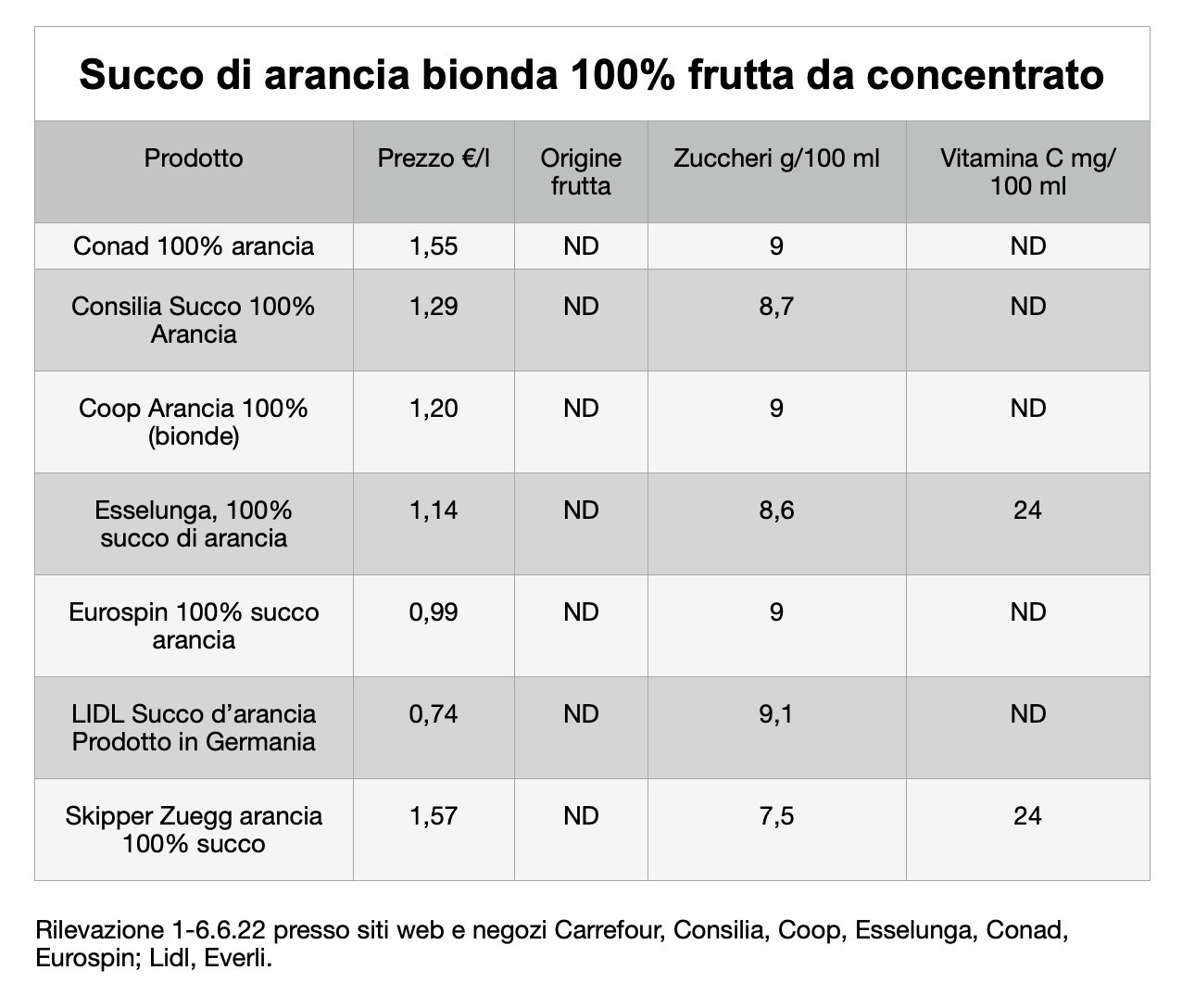
Orange juice from concentrate, 100% fruit according to European regulatory forecasts, ranks second in the ranking. The only ingredient is orange juice which is extracted, refined, pasteurized and concentrated by evaporation in the country of origin. It is then reconstituted with the addition of water in the destination country, where packaging takes place.
The origin of the fruit is never indicated, as it is not Italian. The concentrate from blond oranges mainly comes from Brazil and the USA, the main producers, and from Spain.
The price, in the 7 products examined, ranges from 0.74 to 1.57 euros per liter. Sugars vary between 7.5 and 9 grams per 100 ml (thus 15-18 grams in a 200 ml glass).
Vitamin C is shown in the nutritional table of only two products, brands Zuegg and Esselunga, both with 24 mg/100 ml. The shelf-life can reach six months.
3) Orange-flavored drinks
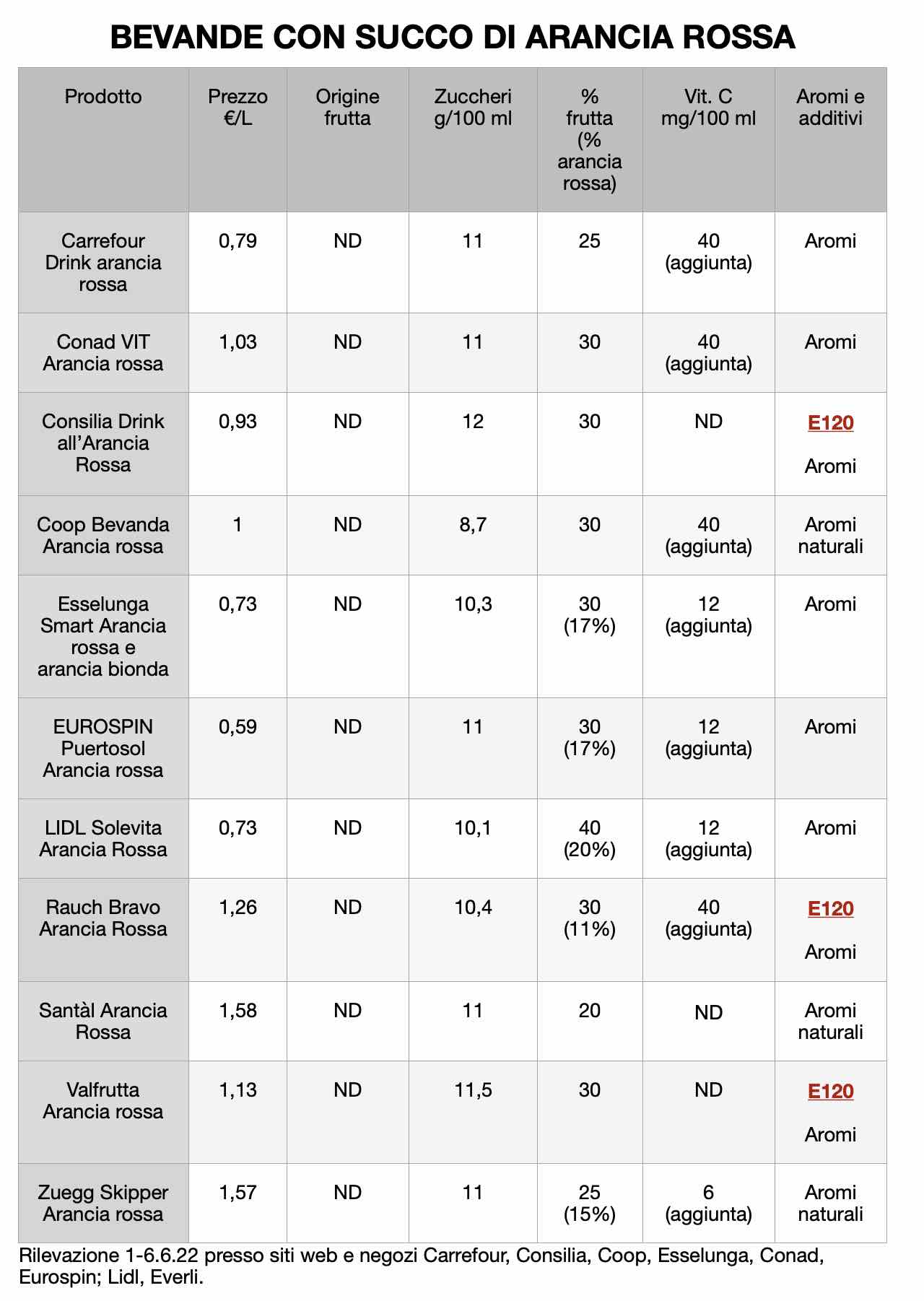
The drink with fruit is the cheapest and lowest value product. Among the 11 examined, the price ranges between 0.69 euro/liter, in discount Eurospin, and 1.58 €/l for Santàl and Zuegg. less prized, long shelf life (over a year).
The basic recipe includes water, orange juice from concentrate (in variable percentage), sugar, citric acid (or ascorbic acid), and flavors (natural or synthetic).
The nutritional properties and organoleptic ones are influenced by juice dilution with water and the 'correction' with sugar, flavors, colorings, sometimes also vitamin C.
3.1) Added sugars
Added sugars (sugar and/or glucose-fructose syrup) are not ideal for health (EFSA, 2022). And the overall sugar content in the orange-flavored drinks examined varies from 8.7 to 12 grams per 100 ml.
In other words, the range goes from 17.4 to 24 grams of sugar per glass, that is from 3 and a half teaspoons to almost 5 teaspoons of sugar – from 67 to 93 kcal – per 200 ml glass.
The colorings added to blood orange drinks are mostly natural, mostly carrot concentrates. However, some products colored with problematic additives are reported.
3.2) Cochineal, the coloring enemy of children
The coloring E120 (carminic acid or cochineal), allergenic and suspected of promoting hyperactivity in children, is present in 3 blood orange flavored drinks: Rauch Bravo (produced in Austria, Hungary, and Serbia), Valfrutta, and Consilia.
This additive is obtained by squeezing an insect, the cochineal, a cactus parasite. It is banned in organic products and subject to an acceptable daily intake of 2.5 mg/kg of body weight.
It is recommended to pay attention to its presence also in other products, such as the milk snacks Frùttolo Maxi Duo and Super Mario Yogoloso by Danone, as we have seen.
4) VAT per head
The price of fresh juices, as the table shows, it ranges from 2 to 3.70 euros/liter for red ones, from 2 to 5.76 for blondes. And taxes weigh on the price. In Italy, freshly squeezed juice is taxed with a 22% VAT, it is considered a luxury product. Concentrate juices and even fruit-flavored drinks, with sugar and even controversial additives, are instead taxed at 10%.
The fiscal policy opposes the health and agricultural policies. Resulting in taxing more heavily the healthiest product, often from oranges Made in Italy, and encouraging consumption of those subjected to intensive processing, starting from semifinished products arriving from afar.
‘The misplaced aspect in my opinion is applying the 22% VAT on the product in commerce, instead of on the cost. We see the effects now, with galloping inflation. If before 1 liter of freshly squeezed juice at one euro was taxed 22 cents, now it pays 33 for a price of 1.50 euros for the same liter of product', comments Giorgio Monaco.
5) Misleading labels
One last aspect worthy of attention is the carelessness, a euphemism, with which most of the labels on fruit juice drinks and other ingredients are made.
5.1) Nature of the product?
Type of drink. Images of succulent oranges and evocations of 'Orange', 'Blood Orange' in large characters appear on most of the labels of drinks that contain them only partially. Few bother to inform the consumer, on the front of the package, about the nature of 'beverage' or 'drink' with oranges, as prescribed by EU regulation 1169/11 (article 7.1.a). Except for Carrefour, Coop and Consilia (whose recipe is not the best, with synthetic aromas and coloring E120).
To avoid misunderstandings, the name of the food that precedes the list of ingredients must be checked.
5.2) Origin of the fruit, natural ingredients?
Origin of the fruit. The indication of origin is prescribed for fresh fruit, but not also for fruit juices and other drinks containing it. Unless the operator claims the origin of the product (understood as the country of last substantial transformation, e.g. 'Made in Italy’) and it does not match that of the primary ingredient. In this case, pursuant to EU Reg. 775/2018, it is mandatory to inform the consumer of the different origin or source of the raw material, in the same field of vision and with equal prominence.
It is doubted therefore the legitimacy of labels such as those of the Valfrutta orange drink, where the relationship with ‘the firsthand nature… from an Italian agricultural cooperative’, if the juice comes from imported raw materials. Also to be verified is the claim ’Made in Italy’ of LIDL.
Natural. The Valfrutta drink evokes the ‘firsthand nature’ with the coloring E120 and synthetic aromas. Skipper and Santàl refer to ‘100% natural ingredients’ on orange-flavored drinks that contain sugar, presumably refined and not compliant with 'naturalness' requirements. Good work to ICQRF and the Competition and Market Authority (Antitrust).
Marta Strinati and Dario Dongo

Professional journalist since January 1995, she has worked for newspapers (Il Messaggero, Paese Sera, La Stampa) and magazines (NumeroUno, Il Salvagente). Author of journalistic investigations on food, she published the book 'Reading labels to know what we eat'.

Dario Dongo, lawyer and journalist, PhD in international food law, founder of WIISE (FARE - GIFT – Food Times) and Égalité.


