

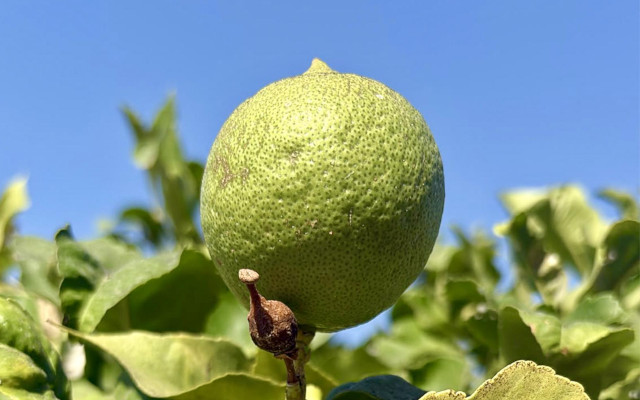
The Italian summer fruit and vegetable season offers a unique citrus: a lemon with peel green, more aromatic and less bitter than that of the yellow fruit. It is the verdello, fruit of the third bloom of Femminello and Monachello, obtained in Sicily through an ancient irrigation management technique. While the market welcomes large volumes of yellow citrus from the southern hemisphere, the Sicilian production offers a territorial alternative linked to the soils of Etna and Siracusan, protected by two specific Protected Geographical Indications.
Origin of the green color in the summer lemon
The lemon — Citrus limon (L.) Burm. — is a species everbearing: the same plant produces multiple blooms throughout the year. Hence the three commercial types of Femminello, which the Siracusa Lemon IGP specification distinguishes by harvest period and analytical parameters: primofiore from October 1st, bianchetto or maiolino from April 15th, verdello from July 1st (specification, article 2).
The green color does not indicate immaturity. It is the result of mild temperatures that accompany the last part of the fruit's development and do not trigger the degradation of chlorophyll in the flavedo. Verdello picked in July has already exceeded the thresholds of Acidity and of Brix degree required by the specification: a green and compliant fruit, therefore, not an unripe fruit.
Water stress management on lava soils
The technique is called forcing, or 'dry'. It consists in the voluntary suspension of irrigation for several weeks in the heart of summer: water stress induces the plant to a new emission of orange blossoms, and the resumption of irrigation at the end of July brings the fruits to maturation in the same season. The Etna Lemon PGI specification explicitly attributes this possibility to the permeability of lava soils of the Acese coastal area and defines it as practiced for over two centuries, indicating verdelli as the characteristic product of the Etnean lemon groves (specification, article 6).
It is not a technique replicable everywhere. It requires loose and draining soils, a sea-mitigated climate, and cultivars that enhance refowering. The link between agronomic practice and territory is so strong that it has left traces in the local toponymy: 'Riviera dei Limoni' and 'City of the Verdello Lemon' are expressions still in use in the Etnean district and are mentioned in the specification itself.
The two Sicilian IGPs of verdello
Italy counts seven geographical indications registered for lemon: Amalfi Coast e of Sorrento, Femminello del Gargano, Interdonato Messina, of Rocca Imperiale, of Siracusa and of Etna. Only the last two PGIs expressly provide for the verdello type.
Siracusa Lemon IGP and harvesting parameters
The denomination Siracusa Lemon PGI, registered with Regulation (EU) No 96/2011 and amended by Regulation (EU) 2015/1744, is reserved for the cultivar Femminello and its clones, cultivated in specialized plantations in ten municipalities of the province of Siracusa — Augusta, Melilli, Siracusa, Priolo Gargallo, Sortino, Solarino, Floridia, Avola, Noto, and Rosolini — within ten kilometers of the Ionian Sea and below 210 meters altitude (specification, articles 2 and 3).
The analytical parameters of the three types are the following (disciplinary, article 2):
| Type | Harvested from | Juice yield | Acidity | Brix degree |
| First flower | 1st October | ≥ 34% | > 6% | > 7 |
| Bianchetto or Maiolino | 15 April | ≥ 30% | > 5.5% | > 6.5 |
| verdello | 1st July | ≥ 25% | > 5.5% | > 6 |
The verdello is thus the type with the lowest juice yield and the lowest sugar content, while retaining the acidity of the bianchetto. Minimum weight 100 g, yellow citrus pulp, ellipsoidal-spheroidal shape, seeds mostly aborted.
On the agronomic level, the specifications:
- sets a maximum density of 400 plants per hectare, upgradable to 500 for existing plantations in declining productivity phase and to 850 in dynamic spacing;
- allows the rootstocks bitter orange, Poncirus trifoliata, Troyer citrange, Carrizo citrange and Citrus macrophylla;
- allows indiscriminately the conventional method, the integrated and the organic;
- imposes the manual harvesting with scissors and a maximum production of 29 t/ha for the fresh market (specifications, article 5).
The two rules that matter most to consumers are found in article 8:
- The absolute ban on waxes and synthetic fungicides in post-harvest, to guarantee the full edibility of the peel;
- the obligation to apply the PGI label on 100% of the fruits sold loose, to ensure their correct identification and traceability.
Controls were transferred in 2024 from the Sicilian Experimental Zooprophylactic Institute ‘A. Mirri’ to Bioagricert Ltd.
Etna Lemon and citral concentration
Registered with implementing regulation (EU) 2020/1533, the denomination Etna Lemon PGI covers 16 municipalities of the Ionian-Etna strip in the province of Catania — from Calatabiano and Castiglione di Sicilia in the north to San Gregorio di Catania and Aci Castello in the south — and allows two cultivars, Femminello and Monachello, for a total of six types: first flower, bianchetto and verdello for each (specifications, articles 2 and 3).
Compared to Syracuse, the structural parameters change:
- maximum density 700 plants per hectare (1,400 for the first six years in dynamic spacings);
- maximum production 60 t/ha for the entire campaign;
- allowed calibers 3, 4, 5 and 6, minimum weight of verdelli 80 g (specifications, articles 2 and 5).
Also in this case, the ban on synthetic waxes and fungicides in post-harvest and the integral stamping on loose lemons (regulation, article 8) apply.
The distinctive feature claimed by the Etna Lemon PDO regulation is chemical, not morphological: the content of citral — the mixture of geranial and neral aldehydes responsible for the lemon aroma. Studies conducted at the current CREA-OFA in Acireale measure an average citral content of 3.61% in Etna essential oils compared to 3.49% in Syracuse and 3.29% in Bagheria (regulation, article 6). The same article of the regulation attributes high concentrations of the basaltic soil matrix of manganese and strontium.
Analysis of production data and economic value
The Italian lemon production has been stable for five years. Istat estimates indicate 25 thousand hectares in production and 472,300 tons harvested in 2023, with a 2019-2023 series between 4.46 and 4.76 million quintals and an average yield of about 189 q/ha.
On the commercial front, the 2025 was an exceptional year for theexport By Italian lemons: Fruitimprese's elaborations on Istat data indicate +42.99% in quantity and +48.37% in value in the first half, and +37.65% in volume in the first nine months. Growth driven more by scarcity of supply in the Mediterranean basin — with Turkey retreating from the EU market due to post-harvest pesticide residue issues and Spain facing production difficulties — than by a structural increase in demand.
However, there is no official statistical disaggregation of verdello: supply chain estimates placing it around 30% of Sicilian lemons are attributable to operators, not statistical surveys.
Comparison between certified volumes and market shares
The data deserving attention is the large gap between production and certification. The Qualigeo series of the Syracuse Lemon PDO shows certified volumes with clear growth but at marginal levels: from 8,074 tons in 2019 to 13,724 t in 2023 (+28.7% over the previous year), against a turnover increasing from 7.67 to 10.55 million euros. The price implicit, calculated from the ratio between revenue and volumes, is however decreased from 0.95 to 0.77 euros per kilogram. And the 13,724 tons certified in 2023 weigh about 2,9% of the 472,300 tons of lemons harvested in Italy in the same year: the denomination moves growing volumes, not yet a price premium, and covers a negligible fraction of national production. The registered operators are 338, however the export is not valued in the database.
For the Etna Lemon PGI the picture is unfortunately of a completely different order of magnitude: 9,327 tons certified in 2022 and 21,357 t in 2023. In an area that the supply chain estimates to be in the order of tens of thousands of tons of potential total annual production, the denomination registered exactly around the verdello certifies a share measured in thousandths. It is the paradox worth considering: the product has a dedicated specification, a consortium recognized since 2023 and a control body designated since 2024, but in fact it travels almost entirely without denomination.
Organic in Italian and Sicilian citrus orchards
According to the ISMEA report Bio in numbers 2025 (2024 data), the areas with organic lemon and lime in Italy there are 7,524 hectares, of which 6,229 already converted and 1,295 in conversion, down 2.5% (-189 ha) compared to 2023. The organic citrus fruits overall occupy 31,302 hectares, down 5.2%.
Relating the 7,524 organic hectares to the about 25,000 lemon hectares recorded by ISTAT results in an incidence around 30%, consistent with the 27.9% that the report attributes to all citrus fruits—a value well above the 20.2% of the national organic UAA. Although the two statistical bases are not homogeneous (control body data on one side, estimates of production areas on the other), it is clear that:
- lemon is among the Italian crops most converted to organic farming, albeit decreasing;
- The Sicily alone accounts for 17,598 of the 31,302 national organic citrus hectares (56.22%).
Moreover, in 2024, the price differential between organic and conventional has widened precisely for lemons, according to the ISMEA shelf price survey. Investment in organic by citrus growers thus confirms the ability of these productions to generate greater value, not only environmentally but also economically.
Nutritional profiles of the fruit and juice
The CREA (2019) food composition tables include two sheets, respectively dedicated to fresh lemons (edible portion 64%, serving 150 g) and lemon juice.
Table. Macronutrients per 100 g of edible portion
| Nutrient | Fresh lemon | Lemon juice |
| Energy (kcal) | 16 | 10 |
| Energy (kJ) | 65 | 43 |
| Water (g) | 91,5 | 93,1 |
| Proteins (g) | 0,6 | 0,2 |
| Lipids (g) | 0 | 0 |
| Carbohydrates (g) | 2,5 | 2,5 |
| of which sugars (g) | 2,5 | 2,5 |
| Fibers (g) | 1,9 | traces |
Fresh lemon is a food with minimal energy density, free of lipids and starch: carbohydrates are entirely soluble sugars. The main difference between fruit and juice lies in fiber, which is zeroed in the juice because it remains in the peel and albedo.
Abundant vitamin C and fiber
Applying the nutritional reference values of Annex XIII to Regulation (EU) 1169/2011, lemon stands out for its exceptional content of vitamin C: 50 mg, equal to 62.5% of the NRV (80 mg) in the fresh fruit; 43 mg, equal to 53.8% of the NRV (80 mg). In both cases, amounts well above the 30% threshold set by regulation (EC) 1924/2006 for the wording ‘high vitamin C content‘. Up to 75 mg, equal to 93.8% of the NRV, in the 150 g portion of fresh lemon indicated by CREA.
Other micronutrients are instead present in the fresh fruit (100 g) in amounts below the 15% NRV threshold established to report the nutrition claim ‘source of’. In descending order: potassium 140 mg (7.0% of NRV), thiamine 0.04 mg (3.6%), niacin 0.30 mg (1.9%), calcium 14 mg (1.8%), phosphorus 11 mg (1.6%), iron 0.1 mg (0.7%), riboflavin 0.01 mg (0.7%).
Also worthy of attention are the fibers in the fresh fruit: 1.9 g per 16 kcal equivalent to 11.9 g per 100 kcal. That is to say, more than four times the threshold of 3 g/100 kcal set by regulation (EC) 1924/2006 for ‘high fiber content‘.
Evidence from clinical literature and bioactive compounds
The literature on bioactive compounds of citrus fruits is extensive and largely preclinical. Clinical evidence directly concerning lemon is still limited.
Clinical studies
Kidney stones. It is the field with the best data. A prospective randomized study conducted by the Mario Negri Institute of Bergamo on 203 patients with recurrent oxalate-calcium nephrolithiasis compared 60 mL of fresh lemon juice twice a day, in addition to the standard diet, against diet alone (Ruggenenti et al., 2021). At two years the difference did not reach statistical significance (HR 0.62; p = 0.089), also because adherence to treatment dropped from 68% to 48%. The exploratory analysis at one year instead shows an effectsignificant (HR 0.43; p = 0.028), confirmed after adjustment. The authors conclude a plausible but unproven effect, and report a higher frequency of gastrointestinal disturbances in the treated group. Lemon does not replace potassium citrate.
Lipid profile. A meta-analysis of nine clinical studies on 2,414 subjects reports for thehesperidin significant reductions in LDL cholesterol, total cholesterol, and triglycerides, but no effect on systolic, diastolic pressure, and HDL (Shylaja et al., 2024). Heterogeneity among studies is also high (I² up to 70%) and the doses used are nutraceutical, not dietary.
Carbohydrate metabolism. Theeriocitrin is the characteristic flavanone of lemon. A randomized double-blind crossover study on 30 hyperglycemic subjects, with 200 mg/day for twelve weeks, found a 6% reduction in blood glucose and a 22% increase in GLP-1 (Cesar et al., 2022). Small sample, patented product, industrial sponsor: an interesting signal, not proof.
Analysis of bioactive compounds
Bioactive compounds. The review by Saini et al. (2022) places lemon in a special position among citrus fruits: its dominant flavanone is theeriocitrin, which in the albedo covers more than half of the total flavonoids, while in the essential oil D-limonene represents 45-90% of the terpenoids. Flavedo and albedo contain more than the juice vesicles, which gives a chemical basis to the value of the peel.
The effects, however, are documented mainly in vitro and on animal models: in humans the only specific data on lemon is pharmacokinetic: at the same dose, eriocitrin is more bioavailable than orange hesperidin. A potential advantage, not yet a demonstrated benefit.
Research perspectives
In summary, lemon is a food with a favorable nutritional profile and high contents of vitamin C and fiber that in the European Union can legitimately be claimed on labels and advertising.
Other potential specific benefits remain instead to be verified: their claim presupposes human intervention studies, randomized and controlled, suitable to demonstrate a cause-effect relationship between a properly characterized constituent and a beneficial physiological effect, according to the scientific requirements indicated by EFSA for the purposes of applications for specific authorizations health claim, pursuant to Articles 13.5 and 14 of Regulation (EC) No 1924/2006.
DO (Food and Agriculture Requirements) is available to operators, consortia and research groups interested in contributing to the design of these studies and the preparation of the related dossiers.
Historical evolution of Sicilian lemon cultivation
The most solid historical reconstruction of Etna lemon cultivation is the one contained in the specifications of the Etna Lemon PGI (Article 6), based on verifiable sources.
Large-scale cultivation began at the end of the eighteenth century, driven by maritime trade from the ports of Riposto and Catania and by the use ofagrocotto — concentrated lemon juice — as an antiscorbutic remedy in Nordic countries. The fruit was already widely used in Sicily, as evidenced by the notes of the French traveler Viscount De Marcellus in 1841 on the granitas of Giarre prepared with freshly picked lemons and the snows of Etna.
The decisive push came in 1869, when Paolo Calì Fiorini, president of the Agricultural Committee of the Acireale district, launched to local entrepreneurs theappeal to plant lemons. This was followed by massive reclamation and stone removal works that brought the citrus groves up to 300-400 meters in altitude, replacing vines on terraced slopes supported by dry stone lava walls built in the 19th century.
Literature records the phenomenon: Federico De Roberto, in I Viceré (1894), describes the excavation of the ‘ancient lava flows of Mongibello’ to plant oranges and lemons. From a scientific perspective, the referent remains the study by Giulio Savastano, The cultivation biology of lemon on the eastern Etna slope, published in 1922 in the Annals of the Royal Experimental Station of Citrus and Fruit Growing of Acireale, where even then an ‘Etna lemon region’ was identified that coincides with the current PGI area.
A Syracuse the story is parallel but older: intensive cultivation began in the 17th century by the Jesuit fathers and feeds aprocessing industry — agro-cooked, calcium citrate, citric acid — that was exported to the United States and England.
Uses in cooking and industry
In the kitchen the verdello behaves differently from the yellow lemon. The peel è more aromatic and less bitter, because the albedo is thinner and the flavedo richer in oil glands; the juice is less abundant but equally acidic. In organic products and certified PGI lemons the rind is fully usable: grated zest or strips for desserts and first courses, candied, flavoring oils, vinegars and infusions.
In the industrial field verdello is sought for the limoncello, where the green peel provides a sharper aromatic profile. The industry of essential oils enhances its content in limonene, β-pinene, γ-terpinene and citral for fragrances, cosmetics and nutraceutical formulations; the beverage sector uses juices NFC (Not From Concentrate) and concentrates; the food industry recovers pulps, peel powders and pectin.
The regulations have been updated precisely to allow such uses: the 2015 amendment made the Siracusa Lemon PGI certifiable for processing, derogating from the production cap of 29 t/ha which only applies to the fresh market.
Practical guidance for purchase choices
The first criterion is theorigin, not the color. The delegated regulation (EU) 2023/2429 — in collecting marketing standards for fruit and vegetables in a single text — confirms the obligation to indicate the country of origin also on loose products. The citrus fruits are among the eleven products subject to specific rules which regulates categories, sizes and labeling and prohibits unregulated quality descriptors such as ‘premium’ or ‘supreme’.
The second criterion is rind. The fungicides Thiabendazole and Imazalil are authorized post-harvest on conventional citrus fruits, and their use requires the declaration of the treatment and the wording ‘inedible peel‘. The obligation is fully enforceable on packaged goods; on loose products omissions are frequent instead. Those who use the peel in cooking have only two real guarantees: the organic and the PGI which explicitly prohibit synthetic waxes and fungicides in post-harvest.
The third criterion is the season. From July to September the Italian lemon is green. A yellow lemon in August, except for prolonged refrigerated storage, is almost certainly imported from the southern hemisphere: checking it takes ten seconds and reading the label.
Conclusions
The verdello is a rare case of a product that owes its existence to a deliberate agronomic choice and a non-replicable pedoclimatic combination. It has two specifications that recognize it, its own analytical parameters, a ban on post-harvest treatments that make the peel edible, and a nutritional profile that withstands comparison with legal claims.
What is still missing is a market that recognizes its value. Twenty-one tons certified as Etna Lemon PGI in 2023, an implicit price under €0.80/kg for Siracusa Lemon PGI, organic areas down 2.5%: these are numbers that tell the story of a supply chain capable of producing quality but not yet transforming it into price.
The question that remains open — for the lemon as for the prickly pear and for theSicilian extra virgin olive oil — is whether the denomination tool, as it is currently managed, is sufficient. Or whether instead there is a need for the courage to aim straight at organic farming, to finally see the value of these superlative productions recognized, in Italy and around the world.
Dario Dongo
Credit cover Paolo Caruso
References
European Union regulatory sources
Commission Delegated Regulation (EU) 2023/2429 supplementing Regulation (EU) No 1308/2013 of the European Parliament and of the Council as regards marketing standards for the fruit and vegetables sector, certain processed fruit and vegetable products and the bananas sector. Consolidated text: 04/10/2025. http://data.europa.eu/eli/reg_del/2023/2429/2025-10-04
Commission Implementing Regulation (EU) 2015/1744 approving non-minor amendments to the specification for a name entered in the register of protected designations of origin and protected geographical indications (‘Limone di Siracusa’ (PGI)). Official Journal of the European Union, L 253, 1.10.2015. http://data.europa.eu/eli/reg_impl/2015/1744/oj
Commission Implementing Regulation (EU) 2020/1533 entering a name in the register of protected designations of origin and protected geographical indications (‘Limone dell’Etna’ (PGI)). Official Journal of the European Union, L 351, 22.10.2020. http://data.europa.eu/eli/reg_impl/2020/1533/oj
Commission Regulation (EU) No 96/2011 entering a name in the register of protected designations of origin and protected geographical indications (‘Limone di Siracusa’ (PGI)). http://data.europa.eu/eli/reg/2011/96/oj
Regulation (EC) No 1924/2006 of the European Parliament and of the Council of 20 December 2006 on nutrition and health claims made on foods. Consolidated text: 13/12/2014. http://data.europa.eu/eli/reg/2006/1924/2014-12-13
Regulation (EU) No 1169/2011 of the European Parliament and of the Council of 25 October 2011 on the provision of food information to consumers. Consolidated text: 01/04/2025. http://data.europa.eu/eli/reg/2011/1169/2025-04-01
Regulation (EU) 2024/1143 of the European Parliament and of the Council on geographical indications for wine, spirit drinks and agricultural products. Consolidated text: 18/03/2026. http://data.europa.eu/eli/reg/2024/1143/2026-03-18
Specifications
Ministry of Agricultural, Food and Forestry Policies. (2015, 29 October). Production specification of the Protected Geographical Indication “Limone di Siracusa”. Official Gazette of the Italian Republic, General Series, no. 252. https://www.gazzettaufficiale.it/eli/id/2015/10/29/15A08054/sg
MASAF — Ministry of Agriculture, Food Sovereignty and Forests (2020). Production specification of the Protected Geographical Indication “Limone dell’Etna”. https://www.masaf.gov.it/flex/cm/pages/ServeAttachment.php/L/IT/D/7%252F1%252F1%252FD.5fe83f96caf7447a9dcb/P/BLOB:ID=3343/E/pdf
Statistics and institutional reports
CREA — Research Center for Food and Nutrition. (2019). Food composition tables — Lemons, fresh (code 008030). https://www.alimentinutrizione.it/tabelle-nutrizionali/008030
CREA — Research Center for Food and Nutrition. (2019). Food composition tables — Lemons, juice (code 008040). https://www.alimentinutrizione.it/tabelle-nutrizionali/008040
Qualivita Foundation. Etna Lemon PGI — data sheet and statisticsQualigeo database. https://www.qualigeo.eu/prodotto-qualigeo/limone-delletna-igp/
Qualivita Foundation. Syracuse Lemon PGI — data sheet and statisticsQualigeo database. https://www.qualigeo.eu/prodotto-qualigeo/limone-di-siracusa-igp/
ISMEA & CIHEAM Bari for MASAF. (2025). Bio in numbers 2025. https://www.ismeamercati.it/flex/cm/pages/ServeAttachment.php/L/IT/D/1%252F9%252Fd%252FD.6a384bd4f41fb8df3b0b/P/BLOB%3AID%3D13718/E/pdf?mode=inline
Istat. (2024). Italian statistical yearbook 2024, chapter 13 — Agriculture, table 13.2. https://www.istat.it/storage/ASI/2024/capitoli/C13.pdf
Scientific literature
Cesar, T. B., Ramos, F. M. M., & Ribeiro, C. B. (2022). Nutraceutical eriocitrin (Eriomin) reduces hyperglycemia by increasing glucagon-like peptide 1 and downregulates systemic inflammation: A crossover-randomized clinical trial. Journal of Medicinal Food, 25(11), 1050–1058. https://doi.org/10.1089/jmf.2021.0181
Ruggenenti, P., Caruso, M. R., Cortinovis, M., Perna, A., Peracchi, T., Giuliano, G. A., Rota, S., Brambilla, P., Invernici, G., Villa, D., Diadei, O., Trillini, M., Natali, G., & Remuzzi, G. (2021). Fresh lemon juice supplementation for the prevention of recurrent stones in calcium oxalate nephrolithiasis: A pragmatic, prospective, randomised, open, blinded endpoint (PROBE) trial. eClinicalMedicine, 43, 101227. https://doi.org/10.1016/j.eclinm.2021.101227
Saini, R. K., Ranjit, A., Sharma, K., Prasad, P., Shang, X., Gowda, K. G. M., & Keum, Y.-S. (2022). Bioactive compounds of citrus fruits: A review of composition and health benefits of carotenoids, flavonoids, limonoids, and terpenes. Antioxidants, 11(2), 239. https://doi.org/10.3390/antiox11020239
Shylaja, H., Viswanatha, G. L., Sunil, V., Hussain, S. M., & Farhana, S. A. (2024). Effect of hesperidin on blood pressure and lipid profile: A systematic review and meta-analysis of randomized controlled trials. Phytotherapy Research, 38(5), 2560–2571. https://doi.org/10.1002/ptr.8174
Studies cited in the specifications
Amenta, M., Ballistreri, G., Fabroni, S., Romeo, F. V., Spina, A., & Rapisarda, P. (2015). Qualitative and nutraceutical aspects of lemon fruits grown on the mountainsides of the Mount Etna: A first step for a protected designation of origin or protected geographical indication application of the brand name ‘Limone dell’Etna’. Food research international (Ottawa, Ont.), 74, 250–259. https://doi.org/10.1016/j.foodres.2015.04.040
Savastano, G. (1922). The cultivation biology of lemon on the eastern Etna slope. Annals of the Royal Experimental Station of Citrus and Fruit Growing of Acireale.
Sector sources
Fruitimprese. (2025). Elaborations on Istat data — foreign fruit and vegetable trade, comparison of the first nine months of the years 2024-2025. https://fruitimprese.it/wp-content/uploads/2025/12/SET-2024-2025.pdf
Strinati, M. (2018, August 11). Lemon yellow, rather green. Food Times. https://www.foodtimes.eu/it/consumatori-e-salute/giallo-limone-anzi-verde/

Dario Dongo, lawyer and journalist, PhD in international food law, founder of WIISE (FARE - GIFT – Food Times) and Égalité.


