

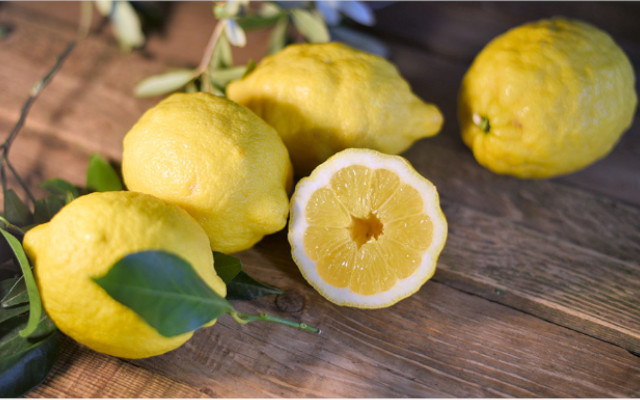
The Lemon of Sorrento PGI (Protected Geographical Indication) is a citrus fruit typical of the Sorrento Peninsula, south of Naples in Campania. (1) A prized Mediterranean lemon to be enjoyed fresh, especially in the organic version. Also famous as the base ingredient of the liqueur ‘limoncello’. (2)
Lemon of Sorrento PGI. History and territory
Frescoes and mosaics found in the excavations of Pompeii and Herculaneum – the nearby cities buried by the eruption of Mount Vesuvius in 79 AD – depict lemons with an oval shape, proving their presence in the territory since the time of the ancient Roman Empire.
The first documents (sale deeds, paintings and botanical treatises) instead date back to the Renaissance.
The cultivations of the Lemon of Sorrento then find precise evidence, in the 17th century, in the registers of the local Jesuit Fathers. Its spread, with exports to various territories even before the Unification of Italy, is reported in 1800 by the historian Bonaventura of Sorrento.
Botanical description
The cultivar of the Lemon of Sorrento PGI – Citrus x limon (L.) Osbeck, cultivar Femminello Ovale di Sorrento – belongs to the family Rutaceae together with citron, lemon and bergamot (3,4). The evergreen tree can reach a height of 3-5 meters, with an irregular globular crown and young spiny branches.
The leaves are evergreen, alternate and largely elliptical, with a serrated margin. The flowers, characterized by a corolla with 5 white petals edged with violet, emit an intense sweetish scent and bloom all year round in favorable climatic conditions.
The fruits They have medium-large dimensions compared to other lemons grown in the Mediterranean. The yellow peel, of medium thickness, emits an intense aroma thanks to the richness of essential oils. The pulp has a sour taste and straw-yellow color. (4)
Production area
The production of the Sorrento Lemon PDO takes place in the various municipalities of the Sorrento Peninsula (including Massa Lubrense, Meta, Piano di Sorrento, Sant’Agnello, Sorrento, Vico Equense) as well as on the island of Capri, which in turn includes the municipalities of Capri and Anacapri.
The steep territories of the Tyrrhenian Sea coasts – here as further north, in Liguria – have led farmers to cultivate on 'terraces', often with sea views, supported by walls built with dry stone.
The cultivated area of Sorrento Lemon PDO is limited to about 400 hectares, with an average annual production of about 8,000 tons. That is, respectively, 60% of the cultivations and half of the lemon production in the province of Sorrento.
Cultivation techniques
The trees of the Sorrento Lemon PDO are protected from the winter wind with straw mats supported by poles, called ‘pagliarelle’, which also favor their characteristic late ripening.
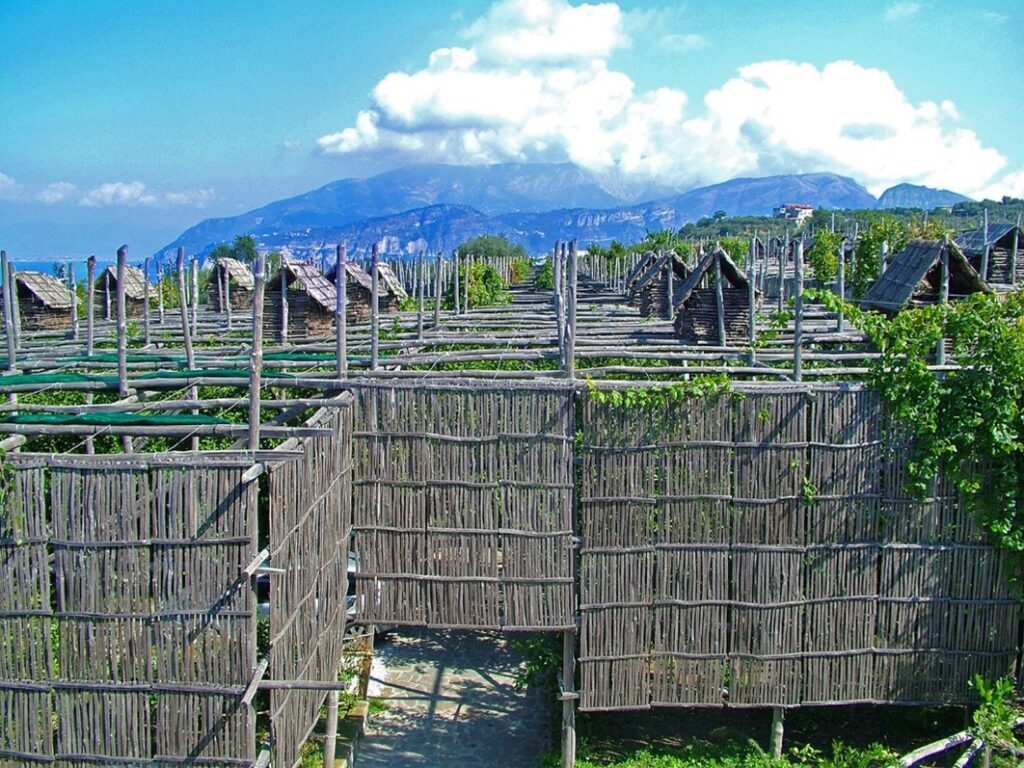
The five blooming periods annually allow the lemons to be harvested over an extended period, from early January to late October. The harvest must be carried out manually to avoid direct contact of the fruit with the soil.
The density of the plantations, according to the regulations of the Sorrento Lemon PDO, must not exceed 850 plants per hectare. This preserves biodiversity and soil conservation.
Uses
The lemons of the Mediterranean, where 98% of European production is concentrated, are mainly destined for the fresh fruit and vegetable market, with deep-rooted traditions of use in Italian cuisine and other countries. The Sorrento Lemon PDO has a generally higher price, compared to others, for various reasons:
– distinctive organoleptic properties, which also characterize the peel and juice of the citrus fruit;
– high production costs, with high labor intensity and reduced mechanization,
– limited availability due to orography, as well as the reduced extent of crops and the boundaries provided in the regulations.
The fresh fruit is used in fresh juices (in combination with sweeter citrus fruits) and other beverages, as well as in numerous dishes of Sorrento cuisine, from appetizers to sorbet (authentic) with lemon. However, the international fame of Limone di Sorrento IGP is due to its unmatched use in the limoncello liqueur.
Geographical Indication, authenticity
The geographical indication 'Limone di Sorrento' has been recognized and protected in the European Union since 2001. The Consortium for the Protection of Limone di Sorrento IGP is committed to enhancing this treasure of the Sorrento Peninsula, also through monitoring initiatives and fighting counterfeiting and food fraud.
Authenticity of Limone di Sorrento IGP – as well as that of the nearby, equally prestigious ‘Limone Costa d’Amalfi IGP’ – can be verified both at the producers registered with the protection Consortia and through innovative analytical methods developed at the University of Naples Federico II (Ruggiero et al., 2022). (5)
Dario Dongo and Gabriele Sapienza
Credit cover Consorzio di Tutela del Limone di Sorrento IGP
Notes
(1) Consorzio di Tutela del Limone di Sorrento IGP https://limonedisorrentoigp.it/
(2) GIFT Editorial Staff. Limoncello di Capri is now a brand of Molinari. GIFT (Great Italian Food Trade). 16.6.17
(3) Dario Dongo and Gabriele Sapienza. Bergamot of Reggio Calabria PGI. GIFT (Great Italian Food Trade). 14.1.24
(4) Citrus x limon (L.) Osbeck. Acta plantarum
(5) Luigi Ruggiero, Carmine Amalfitano, Claudio Di Vaio, Paola Adamo (2022). Use of near-infrared spectroscopy combined with chemometrics for authentication and traceability of intact lemon fruits. Food Chemistry, Volume 375. https://doi.org/10.1016/j.foodchem.2021.131822

Dario Dongo, lawyer and journalist, PhD in international food law, founder of WIISE (FARE - GIFT – Food Times) and Égalité.

Graduated in Agriculture, with experience in sustainable agriculture and permaculture, laboratory and ecological monitoring.


