

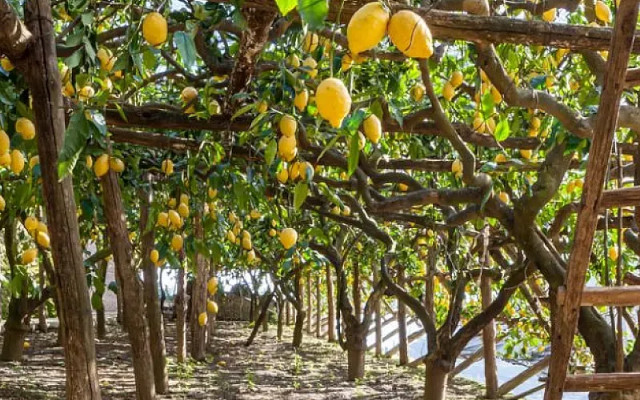
In the heart of the Amalfi Coast – recognized as a UNESCO World Heritage Site in 1997 – the Limone Costa d’Amalfi PDO stands as a jewel of biodiversity and Italian agricultural tradition.
This lemon is distinguished by its elongated shape and intense aromatic fragrance. The PDO (Protected Designation of Origin) highlights the unique qualities deriving from the microclimate and traditional cultivation techniques of the region. (1,2)
Botany
Botanically known as Citrus limon cv (cultivar) Sfusato Amalfitano, this lemon is a small evergreen tree of the family Rutaceae. Characterized by an irregular globose crown, it is distinguished by its erect and branched trunk, with spiny branches and gray-brown bark. (3)
The leaves are evergreen, alternate and broadly elliptical, and range from a reddish color when freshly formed to an intense and glossy green at maturity. The flowers, solitary or in pairs, located at the leaf axils, have white petals edged with violet and an intense sweetish fragrance. (4)
The fruit, the lemon, is the quintessential hesperidium: oval or oblong, with pointed tips and a yellow peel rich in essential oils. The pulp, divided into 8-10 segments, is sour and juicy, perfect for a wide range of uses.
The light yellow of the Sfusato Amalfitano peel is a distinctive trait that brightens the Amalfi Coast.
Like theOvale di Sorrento, another PDO lemon from the Sorrento Peninsula, and all widely cultivated Femminello varieties in Italy, the fruit production occurs throughout the year. Depending on the harvest period, the fruits are called Primofiore (September-November), Limone (December-May), Bianchetto (April-June) and Verdello (May-July). (5)
History and cultivation
The Arabs, during their expansions, introduced the lemon to this region. Cultivation increased in the 11th century, when the Amalfi Republic decreed the importance of having lemon stocks on ships. The consumption of this fruit rich in vitamin C was indeed necessary during long voyages to prevent scurvy.
Since 1400 a thriving maritime lemon trade from Minori (Salerno) to numerous Italian and European ports begins. The limon amalphitanus, later renamed ‘cv sfusato amalfitano’, became known and appreciated as far as America.
The lemon gardens
The terraces along the steep slopes of the coast are a masterpiece of agricultural engineering and represent the distinctive characteristic of lemon cultivation in this area, also playing a key role in the hydrogeological protection of the territory.
Traditional techniques, such as the use of ‘pagliarelle’ (later replaced by shading nets), have helped create an ideal microclimate for lemon growth, giving them unique flavor and aroma characteristics.
400 hectares of Sfusato Amalfitano
Today there are about 400 hectares dedicated to the cultivation of Sfusato Amalfitano. Approximately 100 thousand tons are harvested each year, without the use of innovative technologies, given the difficulty of access in many areas.
Every locality along the coast celebrates this citrus fruit in its own way. In Amalfi, the lemon blends with the blue of the sea, while in Positano and Praiano it lights up the streets and gardens. In Ravello and Scala, it enriches the mountain landscape, offering a unique color contrast.
From Limoncello to babà
The Costa d’Amalfi Lemon PGI is famous as an ingredient of limoncello. This liqueur, infused with lemon peel, is characteristic of the region and appreciated internationally.
Other uses in typical products include lemonades, babà, lemon cakes and other typical desserts that exploit its unmistakable aroma.
Further enhancements of the fruit emerge from research and development of new products, such as dietary supplements or cosmetics. (6)
The cultivation area of the Costa d’Amalfi IGP Lemon
The geographical area The cultivation area defined by the regulations as suitable for the attribution of the Costa d’Amalfi IGP Lemon entirely includes the municipality of Atrani and parts of the territories of Amalfi, Cetara, Conca dei Marini, Furore, Maiori, Minori, Positano, Praiano, Ravello, Scala, Tramonti, and Vietri sul Mare.
The zone extends from west to east, with the southern boundary along the Tyrrhenian Sea. (10)
Gabriele Sapienza
Credit cover Consortium for the Protection of the Costa d’Amalfi IGP Lemon
Notes
(1) Typical Products of Campania. Costa d’Amalfi I.G.P. Lemon http://www.agricoltura.regione.campania.it/tipici/limone-amalfi.html
(2) Consortium for the Protection of the Costa d’Amalfi I.G.P. Lemon https://www.limonecostadamalfiigp.com/lemon/production
(3) Citrus x limon (L.) Osbeck. Acta plantarum https://www.actaplantarum.org/flora/flora_info.php?id=509509
(4) http://scopolia.unipv.it/gis_item.php?id=322&tiposcheda=S
(5) Luigi Ruggiero, Carmine Amalfitano, Claudio Di Vaio, Paola Adamo. Use of near-infrared spectroscopy combined with chemometrics for authentication and traceability of intact lemon fruits. Food Chemistry. Volume 375, 2022. https://doi.org/10.1016/j.foodchem.2021.131822
(6) Dario Dongo, Andrea Adelmo Della Penna. Upcycling of by-products and food waste, brief scientific review. FT (Food Times). 12.1.24

Graduate in Agronomy, with experience in sustainable agriculture and permaculture, laboratory and ecological monitoring.


