

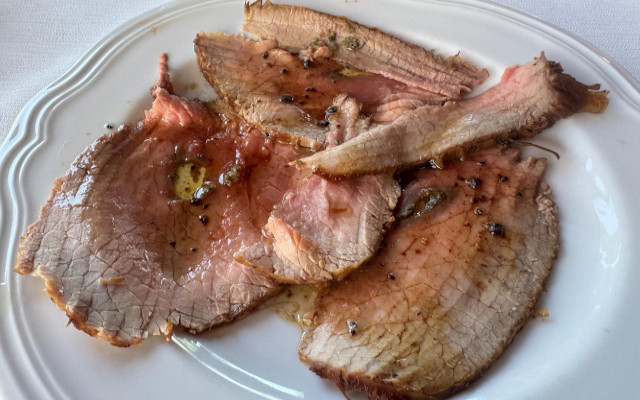
The rosbif is an emblematic case of evolution in Italian cuisine, where the reinterpretation of beef aligns with the principles of the Mediterranean diet and Made in Italy. This autonomous variant, born in Tuscany of the nineteenth century, replaces the animal fats typical of English roast beef with extra virgin olive oil and introduces local aromatic herbs. The analysis of the dish combines cultural aspects with precise biochemical features, such as muscle aging and thermal management of pathogens.
The British roots and Tuscan naturalization
The roots of roast beef sink into English Middle Ages, when large pieces of beef were roasted on a spit for banquets and festivities. Between the 18th and 19th centuries the dish became a national emblem: Henry Fielding dedicated to it the ballad ‘The Roast Beef of Old England’, written in 1731 for the ballad opera ‘The Grub-Street Opera’, and William Hogarth portrayed it in the 1748 painting ‘The Gate of Calais’.
Its arrival in Italy takes place in the first half of the nineteenth century. An anecdotal tradition, taken from numerous gastronomic sources but without direct documentary evidence, attributes the first mention of the dish in a writing from 1837 to Giuseppe Mazzini – an exile in London. documented naturalization, however, it is more solid and verifiable: Pellegrino Artusi, in 'Science in the Kitchen and the Art of Eating Well' (1891), records that the English word had already entered Italian usage in the form 'rosbiffe'.
It was especially the English families residing in Florence and the Tuscan countryside who spread the preparation. Local cooks adapted it to the resources of the territory: extra virgin olive oil instead of butter, Mediterranean aromatic herbs, often shifting the cooking from the oven to the pan. Thus was born Italian-style roast beef, served both hot and cold.
The right cut: eye round, sirloin, and aging
The choice of the cut determines the success of the dish. In Italy the eye round (eye round), a lean muscle from the outer part of the rear thigh, is the classic cut for roast beef: compact, it maintains its shape during cooking and slices precisely when cold. However, its low marbling makes it intolerant to heat excesses, which dry it out quickly. For a juicier result, the sirloin (sirloin), better balanced between lean and intramuscular fat.
A often overlooked factor is aging: in the days following slaughter, endogenous enzymes (calpains and cathepsins) degrade the structural proteins of the muscle, increasing its tenderness. Properly aged meat therefore starts advantaged, regardless of the cooking technique.

The science of cooking: Maillard reaction, temperatures, and safety
The dark and flavorful crust of roast beef arises from the Maillard reaction, the set of non-enzymatic reactions between reducing sugars and amino acids that, above 140 °C, generates hundreds of aromatic compounds. It is the same chemistry that, at higher temperatures (approximately above 150 °C), can form aromatic heterocyclic amines (HAA), compounds with mutagenic potential whose quantity increases with temperature and cooking duration (Gibis, 2016). The practical message aligns with the roast beef style: intense but brief searing on the surface, followed by moderate cooking in the center.
On the front of microbiological safetythe inactivation of pathogens follows a substantially log-linear kinetics: the higher the temperature, the faster the reduction of the bacterial load. In a study on beef, cooking at 71–76 °C reduces Escherichia coli O157:H7 by more than 6 logs, while at lower internal temperatures the resting time contributes to an additional reduction of 1–3 logs (Li et al., 2017).
Here a decisive distinction comes into play between cuts whole pieces and minced meat. In a whole piece like the round, contaminants are essentially found on : surface: the initial browning eliminates them, making even a rosy heart safe. US guidelines indicate an internal temperature of for whole cuts of beef 63 °C (145 °F) with 3 minutes resting time (FoodSafety.gov, 2024; USDA FSIS, n.d.); rare roast beef works just below this threshold, relying on surface sterilization.
The post-cooking rest finally has a precise technical function: during the pause the internal temperature continues to rise by a few degrees (carryover temperature, or )) and the fibers reabsorb part of the juices, reducing losses when cut and improving perceived juiciness (Li et al., 2017).
Nutritional properties of beef: protein, heme iron, and micronutrients
Lean beef is a food with high nutritional density. It provides complete proteins, with all essential amino acids and high digestibility, useful for maintaining muscle mass, particularly in older age (Ruxton & Gordon, 2024). A lean cut like the round concentrates this protein supply with low fat content.
In terms of micronutrients, red meat is an important source of heme iron, absorbed much more efficiently than non-heme iron from plant sources, as well as zinc, selenium, and vitamin B12 in bioavailable form (Kavanaugh et al., 2025). This profile is particularly useful for women of childbearing age, the group with the highest iron requirements, and for covering vitamin B12 which plant foods lack (Ruxton & Gordon, 2024).
Red meat and health, a myth to debunk
The debate on red meat contrasts observational studies – which associate high consumption, especially of processed meats, with increased cardiovascular risk – with randomized controlled trials (RCT), which measure direct effects on risk markers:
- a recent meta-analysis of RCTs found that habitual consumption of unprocessed beef does not significantly affect most lipid parameters nor blood pressure, with only a modest increase in LDL cholesterol (Sanders et al., 2024);
- a previous RCT on subjects at risk of type 2 diabetes also showed that replacing carbohydrates with lean beef in a healthy dietary pattern does not worsen the cardiometabolic profile (Maki et al., 2020).
The balanced interpretation that emerges is that unprocessed lean beef, included in a balanced diet and cooked at moderate temperatures, lies at the favorable end of the spectrum: the points of caution concern excessive consumption of processed meats and very high-temperature cooking. Roast beef – lean cut, whole, with a brief sear on the surface and moderate cooking at the core – meets the three criteria well.

The Italian-style rosbif recipe
Ingredients for 4-6 people: 1 kg of top round (or sirloin) beef; 4 tablespoons of extra virgin olive oil; 2 cloves of garlic; 1 sprig of rosemary; 2 bay leaves; sea salt and freshly ground black pepper; 100 ml of dry white wine (optional, for the sauce).
Preparation:
- temperature. Remove the meat from the refrigerator 60-90 minutes before cooking to even out the internal temperature;
- tying. Tie the piece with kitchen string to keep it compact and facilitate slicing;
- browning. Heat an emulsion of water and oil (50:50) in an ovenproof pan and brown the meat on all sides until a golden crust forms (Maillard reaction);
- cooking. Transfer to an oven at 160°C: about 40-50 minutes for rare, 50-60 for medium, checking the core temperature with a probe thermometer (52-54 °C for rare, 60 °C medium; for full safety on whole cuts, 63 °C with 3 minutes resting);
- resting. Cover with aluminum foil and let rest for 15-20 minutes before slicing against the grain;
- sauce. Pour the white wine into the hot pan scraping the bottom, reduce by half over medium heat and strain with a fine sieve.
Italian rosbif, English and American roast beef: the differences
| Appearance | Italian roast beef | English roast beef | American roast beef |
| Cooking fat | extra virgin olive oil | Butter or beef fat | Butter or neutral oil |
| Flavors | Rosemary, bay leaf, garlic | Thyme, sage, mustard | Garlic and onion powder |
| Sauce | Wine reduction | Gravy from roast pan drippings | Au jus or horseradish sauce |
| Service | Cold or warm | Hot | Hot |
| Typical cut | eye round | Rib roast (ribeye) | Prime rib |
Not just a main course: the second life of rosbif
The versatility is the distinctive feature of Italian roast beef: a main dish served hot, or cold the next day, thinly sliced in sandwiches seasoned with oil and salt. It is the principle of leftover cooking, which maximizes flavor without waste – consistent with a cut, like the top round, that tastes best when cold.
In summary
The trajectory of roast beef highlights the Italian ability to assimilate external influences, integrating them into balanced nutritional models. The choice of lean cuts and the application of measured core temperatures combine microbiological safety and high biological value. The promotion of cold dishes, finally, responds to a logic of efficiency and fight against food waste, useful both to consumers and supply chain operators.
Dario Dongo
Credit cover Dario Dongo. Roast beef at Trattoria La Pazienza, Marcena (Arezzo)
References
Scientific sources (peer-reviewed)
Gibis, M. (2016). Heterocyclic aromatic amines in cooked meat products: Causes, formation, occurrence, and risk assessment. Comprehensive Reviews in Food Science and Food Safety, 15(2), 269–302. https://doi.org/10.1111/1541-4337.12186
Kavanaugh, M., Rodgers, D., Rodriguez, N., & Leroy, F. (2025). Considering the nutritional benefits and health implications of red meat in the era of meatless initiatives. Frontiers in Nutrition, 12, 1525011. https://doi.org/10.3389/fnut.2025.1525011
Li, K., McKeith, A. G., Shen, C., & McKeith, R. (2017). A comparison study of quality attributes of ground beef and veal patties and thermal inactivation of Escherichia coli O157:H7 after double pan-broiling under dynamic conditions. Foods, 7(1), 1. https://doi.org/10.3390/foods7010001
Maki, K. C., Wilcox, M. L., Dicklin, M. R., Buggia, M., Palacios, O. M., Maki, C. E., & Kramer, M. (2020). Substituting lean beef for carbohydrate in a healthy dietary pattern does not adversely affect the cardiometabolic risk factor profile in men and women at risk for type 2 diabetes. The Journal of Nutrition, 150(7), 1824–1833. https://doi.org/10.1093/jn/nxaa116
Ruxton, C. H. S., & Gordon, S. (2024). Animal board invited review: The contribution of red meat to adult nutrition and health beyond protein. Animal, 18(3), 101103. https://doi.org/10.1016/j.animal.2024.101103
Sanders, L. M., Palacios, O. M., Wilcox, M. L., & Maki, K. C. (2024). Beef consumption and cardiovascular disease risk factors: A systematic review and meta-analysis of randomized controlled trials. Current Developments in Nutrition, 8(12), 104500. https://doi.org/10.1016/j.cdnut.2024.104500
Institutional sources
FoodSafety.gov. (2024). Cook to a safe minimum internal temperature. U.S. Department of Health & Human Services. https://www.foodsafety.gov/food-safety-charts/safe-minimum-internal-temperatures
U.S. Department of Agriculture, Food Safety and Inspection Service. (n.d.). Safe minimum internal temperature chart. https://www.fsis.usda.gov/food-safety/safe-food-handling-and-preparation/food-safety-basics/safe-temperature-chart
Historical-gastronomical sources
Artusi, P. (1891). Science in the kitchen and the art of eating well (recipe 521, ‘Roast-beef I’). Printing house of Salvadore Landi.

Dario Dongo, lawyer and journalist, PhD in international food law, founder of WIISE (FARE - GIFT – Food Times) and Égalité.


 tra biologia della frollatura e sicurezza a tavola.)