

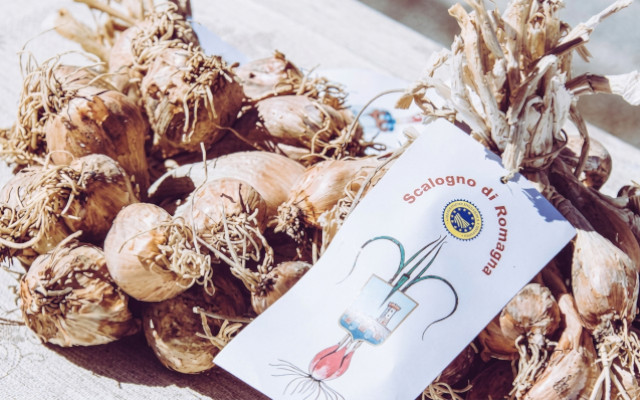
The shallot is a bulb vegetable that Italy cultivates in small quantities and mainly uses as a flavoring ingredient in sautés, sauces, and preserves. Botanically, it is now classified in the species of onion, Allium cepa, in the group Aggregatum, although the name Allium ascalonicum remains in common language use (Major et al., 2022).
On the market coexist the product of commercial varieties, local ecotypes, and a single European denomination, the Romagna Shallot PGI (Protected Geographical Indication). Alongside this, two regions have registered their shallots among Traditional Agri-food Products: Tuscany, with the local Valdarno shallot, and Lazio, with the cipiccia of lower Lazio.
Following, the market, the history of the name, regional productions, culinary uses, the nutritional profile, and the most recent research.
The shallot on the Italian market
The shallot reaches the consumer in different forms. The fresh, harvested in early summer with leaves still green, has a short shelf life. The dry, left to dry after harvesting, can be stored for months. Added to these are shallots frozen in cubes and preserves in oil and in vinegar.
The shallots traditional multiply by bulbils, while in recent decades they have spread hybrids between onion and shallot reproducible from seed, cheaper to grow. In France, their sale under the name ‘shallot’ led to a dispute before the European Court of Justice (This, 2012).
The demand is growing. In autumn 2026, an Emilia-based potato and onion operator reported strong demand for shallots from distribution chains, with prices for first-choice selected and packaged between 2.20 and 2.80 euros per kilogram (Riciputi, 2026). The Romagna Shallot Consortium, established in 2018, has reported growing demand and the search for new producers (Il Resto del Carlino, 2023). The Emilia-Romagna Region dedicates specific technical standards to shallots in the specifications of integrated productionwhich recommend the Conservor and the Romagna ecotype as varieties (Emilia-Romagna Region, 2023).
An ancient name, from Carolingian gardens to Italian countryside
Latin ascalonia (cepa)the ‘onion of Ascalon’, refers to the ancient port city of the eastern Mediterranean, now Ashkelon in Israel. The Treccani dictionary records this traditional etymology and notes that the term might instead derive from a root skal-connected to a Greek word for ‘onion’ (Treccani, n.d.).
One of the strongest pieces of evidence of European cultivation is the Capitulary of the villasthe regulation of the Carolingian crown's farms drafted between the late 8th and early 9th century. In chapter 70, in the list of plants that every royal garden had to cultivate, shallots appear alongside leeksonions and garlic: ‘porros, radices, ascalonicas, cepas, alia’ (Boretius, 1883).
The Romagna Shallot PGI
The Romagna Shallot is the only Italian shallot with a protected geographical indication (PGIIts specification, registered in 1997 (EC reg. 2325/97), was subject to a significant amendment in 2022 (EU implementing reg. 2022/1931). The general framework of Geographical Indications today is the regulation (EU) 2024/1143.
The production area includes sixteen municipalities in the provinces of Ravenna, Forlì-Cesena and Bologna, including Brisighella, Faenza, Riolo Terme and Imola (disciplinary, article 3). The bulbs of theRomagna ecotype they have a flask-shaped form, white-violet pulp, pungent smell and taste ‘sweet and delicate, more similar to onion than garlic’ (disciplinary, article 2). The ecotype does not produce flowers and is propagated, according to tradition, only by hand-selected bulbils (disciplinary, article 9).
The disciplinary requires hilly and drained soils, forbids growing shallots after themselves, garlic, onion, solanaceous plants, beets and cabbages, and imposes at least five years before returning to the same plot. Planting takes place between November and December, harvesting from June, with a maximum yield of 8 tons per hectare (disciplinary, article 4).
The link with the territory is based on the reputation and on soils of the Vena dei Gessi Romagnola, rich in sulfur compounds which the disciplinary links to the aroma (disciplinary, article 9). Controls are entrusted from July 1, 2026 to CSQA Certificazioni, which replaced Check Fruit (Fondazione Qualivita, 2026).
The PAT shallots
I Traditional Agri-food Products (PAT) are registered by the Regions and collected in a national list updated annually by the Ministry of Agriculture. Registration certifies production methods consolidated for at least 25 years, but does not grant exclusive rights on the name – without prejudice to the limits on the registration of homonymous trademarks – nor does it serve as a guarantee of origin.
On the label products cannot bear the qualification 'traditional', but may refer to registration in the national list (Piedmont Region, n.d.). The last revision of the national list was approved by the Ministry of Agriculture decree no. 59360 of February 6, 2026.
On Tuscany, the Tuscan local shallot It is cultivated in the Valdarno area of Arezzo and Florence. According to the regional sheet, it has a yellow color and larger size compared to the shallot on the market. It is propagated from bulbs, planted in February, prefers calcareous soils, and has modest fertilization needs, better if organic. It is more resistant to diseases than the onion, making it even more suitable for organic farming, it is harvested between late July and early August and preserves well. The sheet attributes the typicality to the local cultivar and describes a veryscarce (Tuscany Region, n.d.).
In Lazio, la revisione 2026 dell’elenco ha iscritto la cipiccia, nota anche come cepeccia o scalogna, diffusa tra le province di Latina e Frosinone (ARSIAL, 2026). La stampa locale la descrive come una piccola cipolla saporita e aromatica, poco più pungente della cipolla comune ma dolce (Stramella, 2026). Il nome ‘scalogna’ ne indica la parentela d’uso con lo scalogno, mentre le fonti consultate non ne precisano l’inquadramento botanico. Con le nuove iscrizioni, il Lazio conta 520 Prodotti Agroalimentari Tradizionali (ARSIAL, 2026).
The shallot in regional kitchens
On Romagna lo scalogno è il protagonista delle conserve. Il disciplinare ricorda che il prodotto si consuma fresco o essiccato e che è diffusa la conservazione under oil (regulation, article 2). The recipe book of the protection consortia published by the Emilia-Romagna Region proposes the marinated sardines: fillets of Adriatic sardines layered with a sauce of four or five bulbs of Romagna IGP Shallot, lemon juice, oil, bay leaf, and thyme, left to rest for about 12 hours and served cold with dry white wine (Emilia-Romagna Region, n.d.). The regulation cites the Guide to authentic Romagna cuisine by Corrado Contoli (1963), which describes the shallot in the chapter on pork meats (regulation, article 9).
On Tuscany lo scalogno nostrale veniva cotto sotto la cenere come le cipolle, usato nel coniglio arrosto o messo sott’aceto (Regione Toscana, s.d.). Nel Southern Lazio la cipiccia accompagna le frittate, in particolare con gli asparagi, il baccalà in umido e le alici, e un tempo entrava nelle zuppe di pane raffermo della Quaresima (Stramella, 2026).
The national recipe book indicates it as a base for cooking stocks. Pellegrino Artusi apre il fegato di vitella di latte alla militare con ‘Finely chop a shallot or a spring onion’, sautéed in oil and butter until deep red, then the liver sliced thin, salt, pepper, parsley, and lemon juice when serving (Artusi, recipe no. 337). In French cuisine, shallot is instead the aroma of béarnaise, which comes from a reduction of chopped shallots in vinegar, then bound with egg yolks and whipped with butter. The chemist Hervé This observes that most recipes in French cuisine indicate shallots instead of onions (This, 2012).
In the sautés – which is always recommended to be made with an emulsion of water and oil, to prevent exceeding the smoke point of the latter, and cook on low heat – shallots enrich sauces, ragùs, and fillings, as well as flavor boiled meats, stews, braises, and roasts. The leaves, harvested while still green and finely chopped, complete salads and omelets (Fondazione Qualivita, n.d.). Since it browns quickly, it requires low heat.
The nutritional profile
The food composition tables indicated by CREA — Food and Nutrition Research Center (2019) do not include an entry for shallots. Therefore, the nutritional values from the database FoodData Central of the United States Department of Agriculture, referring to 100 grams of raw shallots (USDA, 2019).
| Values per 100 g | Raw shallot |
| Energy | 301 kJ / 72 kcal |
| Fats | 0.1 g |
| of which saturated fatty acids | 0.02 g |
| Carbohydrates | 13.6 g |
| of which sugars | 7.9 g |
| Fiber | 3.2 g |
| Proteins | 2.5 g |
| Salt | 0.03 g |
| Potassium | 334 mg (16.7% NRV) |
| Vitamin B6 | 0.34 mg (24.3% NRV) |
| Folates | 34 µg (17% NRV) |
Note: carbohydrates are calculated net of fiber, according to the European criterion, since the U.S. database reports carbohydrates ‘by difference’ (16.8 g) including fiber. Percentages refer to reference nutritional values as per Annex XIII of Regulation (EU) No 1169/2011. Among vitamins and minerals, only the following exceed the 15% threshold: potassium, vitamin B6, and folates.
Based on these values – pending analytical verification of the respective values – shallot can display the following nutritional claims in commercial communication within the European Union: ‘source of fiber‘ e 'source of' potassium, vitamin B6, and folates (Reg. EC 1924/2006, Annex).
Phenolic compounds and prebiotic fibers
A study by the Institute of Agriculture and Tourism of Poreč, Croatia, analyzed 34 shallot accessions over two years. The shallots of the group A. cepa AggregatumThe most cultivated in Europe, have a dry matter content between 12% and 18% and a very low pungencywhich makes them suitable for raw consumption. They are rich in phenolic compoundsparticularly quercetin and isorhamnetin glycosides, and contain type fructans inulinsoluble fibers fermented by the intestinal microbiota. The study found that the composition depends on both genotype and cultivation environment. The authors note that, compared to common onion, shallot provides about five times the iron and double the magnesium, phosphorus, potassium, zinc, and manganese (Major et al., 2022).
A systematic review by the University of Medicine and Pharmacy of Cluj-Napoca (Romania) selected 116 studies on the properties of shallot, out of over 2,400 examined publications. The extracts show antioxidant and antimicrobial activityand promising results on cardiovascular and diabetes disease models. The review reports that the antioxidant activity of shallot does not seem to be reduced by cooking. However, authors specify that almost all data come from laboratory and animal studies.
Among the few intervention clinical studies on humans – essential for evaluating any authorization requests for health claim in the European Union, pursuant to Regulation (EC) No. 353/2008 – a trial on 48 women with type 2 diabetes observed a reduction in triglycerides and total cholesterol with yogurt enriched with shallot (Moldovan et al., 2022).
Purchase guidelines
The bulb of the shallot must be firm, dry, with tunica intact and without sprouts, and the vegetable is stored in cool, dry, and ventilated places. The choice of certified products organic is to be preferred, where available, as it guarantees compliance with the highest standards for ecosystem and biodiversity protection (EU Reg. 2018/848).
The indication oforigin is always mandatory Italian – for shallot, as for most fresh horticultural products (EU Reg. 2023/2429, Annex I) – and the ‘Product of Italy’ privilege serves to support agriculture in the Bel Paese. The Romagna Shallot PGI It is recognized by the label with the denomination followed by ‘Protected Geographical Indication’, the logo, the packer's name and the wording ‘Product of Italy’, on sealed packages, bunches or braids (disciplinary regulation, article 7).
For the professional seasonality matters. Fresh Romagna shallot is available in June and dry from July to December (Fondazione Qualivita, n.d.), while Tuscan local shallot is harvested between late July and early August (Regione Toscana, n.d.). Fresh, more tender, is suitable for raw uses and marinades. Dry is more suitable for reductions and long cooking.
Conclusions
Italian shallot is a mosaic of small and diverse productions. The Scalogno di Romagna PGI is its emblem, with a non-flowering ecotype and label-verifiable rules. In the kitchen shallot is the aroma of reductions, marinades and preserved vegetables, from Artusi to béarnaise. The rich profile of fiber, potassium, vitamin B6, folates and quercetin glucosides completes its value, while the growing demand from retailers opens space for new producers.
Dario Dongo
Credit cover Consortium of Scalogno di Romagna
References
European Union regulatory sources
Commission Delegated Regulation (EU) 2023/2429 of 17 August 2023 supplementing Regulation (EU) No 1308/2013 of the European Parliament and of the Council as regards marketing standards for the fruit and vegetables sector, certain processed fruit and vegetable products and the bananas sector, and repealing Commission Regulation (EC) No 1666/1999 and Commission Implementing Regulations (EU) No 543/2011 and (EU) No 1333/2011. Consolidated text: 04/10/2025. http://data.europa.eu/eli/reg_del/2023/2429/2025-10-04
Commission Implementing Regulation (EU) 2022/1931 of 10 October 2022 approving non-minor amendments to the specification for a name entered in the register of protected designations of origin and protected geographical indications (‘Scalogno di Romagna’ (PGI)). OJ L 266, 13.10.2022, p. 16. http://data.europa.eu/eli/reg_impl/2022/1931/oj
Commission Regulation (EC) No 2325/97 of 24 November 1997 supplementing the Annex to Regulation (EC) No 1107/96 on the registration of geographical indications and designations of origin under the procedure laid down in Article 17 of Council Regulation (EEC) No 2081/92. OJ L 322, 25.11.1997, p. 33. http://data.europa.eu/eli/reg/1997/2325/oj
Regulation (EC) No 1924/2006 of the European Parliament and of the Council of 20 December 2006 on nutrition and health claims made on foods. Consolidated text: 13/12/2014. http://data.europa.eu/eli/reg/2006/1924/2014-12-13
Commission Regulation (EC) No 353/2008 of 18 April 2008 establishing implementing rules for applications for authorisation of health claims as provided for in Article 15 of Regulation (EC) No 1924/2006 of the European Parliament and of the Council. Consolidated text: 21/12/2009. http://data.europa.eu/eli/reg/2008/353/2009-12-21
Regulation (EU) No 1169/2011 of the European Parliament and of the Council of 25 October 2011 on the provision of food information to consumers, amending Regulations (EC) No 1924/2006 and (EC) No 1925/2006 of the European Parliament and of the Council, and repealing Commission Directive 87/250/EEC, Council Directive 90/496/EEC, Commission Directive 1999/10/EC, Directive 2000/13/EC of the European Parliament and of the Council, Commission Directives 2002/67/EC and 2008/5/EC and Commission Regulation (EC) No 608/2004. Consolidated text:01/04/2025. Regulation (EU) 2018/848 of the European Parliament and of the Council of 30 May 2018 on organic production and labelling of organic products and repealing Council Regulation (EC) No 834/2007. Consolidated text: 25/03/2025.
Regulation (EU) 2018/848 of the European Parliament and of the Council of 30 May 2018 on organic production and labelling of organic products and repealing Council Regulation (EC) No 834/2007. Consolidated text: 25/03/2025. Regulation (EU) 2024/1143 of the European Parliament and of the Council of 11 April 2024 on geographical indications for wine, spirit drinks and agricultural products, as well as traditional specialities guaranteed and optional quality terms for agricultural products, amending Regulations (EU) No 1308/2013, (EU) 2019/787 and (EU) 2019/1753 and repealing Regulation (EU) No 1151/2012. Consolidated text: 18/03/2026.
Regulation (EU) 2024/1143 of the European Parliament and of the Council of 11 April 2024 on geographical indications for wine, spirit drinks and agricultural products, as well as traditional specialities guaranteed and optional quality terms for agricultural products, amending Regulations (EU) No 1308/2013, (EU) 2019/787 and (EU) 2019/1753 and repealing Regulation (EU) No 1151/2012. Consolidated text: 18/03/2026. Disciplinare, controlli e Prodotti Agroalimentari Tradizionali
Regulations, controls, and Traditional Agri-food Products
ARSIAL. (2026, 11 February). Traditional products: Lazio rises to 520 TSG [Press release]. https://www.arsial.it/wp-content/uploads/2026/05/NuoviPAT_Comunicato_ITA.pdf
ARSIAL. (2026). National list of traditional agri-food products, Lazio Region (no. 161, Cipiccia/Cepeccia/Scalogna). https://www.arsial.it/wp-content/uploads/2026/06/PAT-Lazio_2026.xlsx.pdf
Production specification of the PGI Scalogno di Romagna (current text after implementing regulation (EU) 2022/1931). https://assets.culturabologna.it/16688f52-30c3-4de0-8aa0-7089db4ac39e-disciplinare-scalogno-di-romagna-igp.pdf
Qualivita Foundation. (2026, 1 July). Authorization to CSQA Certificazioni Srl to carry out control activities on Geographical Indications (GIs) entrusted to the control of Check Fruit Srl. https://www.qualivita.it/normativa/autorizzazione-a-csqa-certificazioni-srl-allo-svolgimento-delle-attivita-di-controllo-sulle-indicazioni-geografiche-ig-affidate-al-controllo-di-check-fruit-srl/
Emilia-Romagna Region. (2023). Integrated production specifications. Agronomic technical standards, shallot. https://agricoltura.regione.emilia-romagna.it/produzioni-agroalimentari/temi/bio-agro-climambiente/agricoltura-integrata/Collezione-dpi/dpi_2023/norme/orticole/norme-tecniche-agronomiche-scalogno-2023.pdf
Piedmont Region. (n.d.). Regulations on traditional agri-food productions PAT. https://www.regione.piemonte.it/web/temi/agricoltura/promozione-qualita-educazione-alimentare/normativa-sulle-produzioni-agroalimentari-tradizionali-pat
Tuscany Region. (n.d.). Tuscan local shallot. The Tuscan Traditional Products, product sheet. http://prodtrad.regione.toscana.it/LIB_ProdTrad/Prodotto.php?ID=103
Scientific studies
Major, N., Perković, J., Palčić, I., Bažon, I., Horvat, I., Ban, D., & Goreta Ban, S. (2022). The phytochemical and nutritional composition of shallot species (Allium × cornutum, Allium × proliferum and A. cepa Aggregatum) is genetically and environmentally dependent. Antioxidants, 11(8), 1547. https://doi.org/10.3390/antiox11081547
Moldovan, C., Frumuzachi, O., Babotă, M., Barros, L., Mocan, A., Carradori, S., & Crişan, G. (2022). Therapeutic uses and pharmacological properties of shallot (Allium ascalonicum): A systematic review. Frontiers in Nutrition, 9, 903686. https://doi.org/10.3389/fnut.2022.903686
This, H. (2012). Questions de béarnaises. Chemical News, (366), 8–11. https://new.societechimiquedefrance.fr/wp-content/uploads/2019/12/2012-366-sept.-p8-This-HD.pdf
Nutritional sources
CREA — Food and Nutrition Research Center. (2019). Food composition tables. https://www.alimentinutrizione.it/
U.S. Department of Agriculture, Agricultural Research Service. (2019). FoodData Central: Shallots, raw (FDC ID 170499, SR Legacy). https://fdc.nal.usda.gov/food-details/170499/nutrients
Historical, lexical, and gastronomic sources
Artusi, P. (1911). Science in the kitchen and the art of eating well, Umidi, recipe no. 337, Military style veal liver. Wikisource. https://it.wikisource.org/wiki/Scienza_in_cucina_e_l’arte_di_mangiar_bene/Umidi
Boretius, A. (Ed.). (1883). Capitularies of the Kings of the Franks (Vol. 1, no. 32, Capitulary of the villas, c. 70, p. 90). Hahn. Monumenta Germaniae Historica.
Emilia-Romagna Region. (n.d.). DOP and IGP excellences meet the flavors of the sea. Part II, Consortia recipes. https://agriculture.regione.emilia-romagna.it/dop-igp/publications/excellences-dop-and-igp-meet-flavors-of-the-sea-ii-part-consortia/
Treccani. (n.d.). shallot. Online Dictionary. https://www.treccani.it/vocabulary/scalogno/
Market and sector sources
Qualivita Foundation. (n.d.). Romagna Shallot PGI. Qualigeo. https://www.qualigeo.eu/qualigeo-product/scalogno-di-romagna-igp/
Il Resto del Carlino. (2023). Scalogno di Romagna IGP, demand is growing: we are looking for producers. https://www.ilrestodelcarlino.it/specials/economy/scalogno-di-romagna-igp-demand-is-growing-we-are-looking-for-producers-dd799b30
Riciputi, C. (2026, October 23). For onions, a balanced market, with the uncertainty of preservation. FreshPlaza. https://www.freshplaza.it/article/9885710/for-onions-a-balanced-market-with-the-uncertainty-of-preservation/
Stramella, C. (2026, February 25). Province of Latina, a seafood recipe and an ancient onion officially enter among agri-food excellences. Il Caffè. https://ilcaffe.tv/article/254873/province-of-latina-a-seafood-recipe-and-an-ancient-onion-officially-enter-agri-food-excellences

Dario Dongo, lawyer and journalist, PhD in international food law, founder of WIISE (FARE - GIFT – Food Times) and Égalité.


