

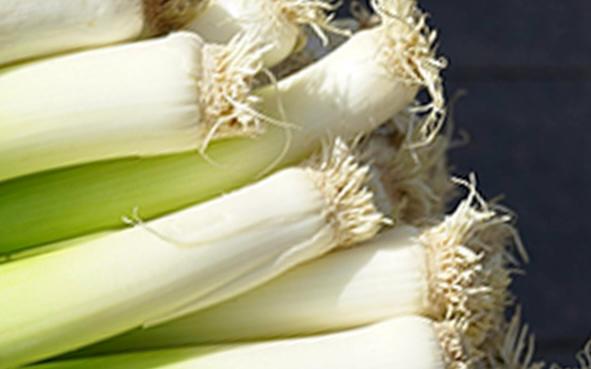
The leek (Allium porrum L., now classified as Allium ampeloprasum var. porrum) is the third main character of Allium in the kitchen, after onion e garlic. Shares the botanical family, the Amaryllidaceae, and part of the chemistry, but plays a different role: it is a portion vegetable more than a seasoning, sweet and fibrous, capable of adding body to soups and risottos without overpowering other flavors.
It is cultivated in many regions of Italy and Piedmont lists two Traditional Agri-food Products (PAT), the Cervere Leek and the long sweet leek of Carmagnola. Following are available data, history, CREA's nutritional profile, scientific evidence, and some original keys for its use compared to onion and garlic.
A vegetable without its own statistics
The National Institute of Statistics (ISTAT) does not publish a series dedicated to leek. In the Italian Statistical Yearbook, leek appears together with onion, under the aggregated entry ‘onion and leek‘. In 2023 about 390 thousand tons were harvested on 13 thousand hectares, compared to 491 thousand tons on 15 thousand hectares in 2019, with a production decrease of about 21% in five years (Istat, 2024). Garlic occupies 4 thousand hectares for 31 thousand tons.
From biblical Egypt to the gardens of Ariccia
Leek has accompanied onion and garlic since the oldest sources. In the Book of Numbers The Israelites, during the desert crossing, miss the food eaten in Egypt and remember, among others, ‘leeks, onions, and garlic’ (Numbers 11:5). The three vegetables are already mentioned together, a sign that they were associated in the daily diet (Old Testament, CEI, 2008).
Pliny the Elder devotes a chapter to leeks in the Naturalis Historia. Reports
to Egypt and – followed by Ostia and to Aricia (today's Ariccia, in the Roman Castles) the most appreciated products, describes the plant's aversion to water stagnation and recalls that Nero, to cure his voice, on some days of the month consumed only leeks with oil, even renouncing bread (Pliny, ed. 1856).
Cervere and Carmagnola, two Piedmontese PATs
The national list of Traditional Agri-food Products (PAT), updated in 2026, includes for Piedmont two ecotypes of leek (MASAF, 2026):
- The Leek of Cervere, in the province of Cuneo, originates from the local massal selection of the variety ‘long winter leek’. It has a thin, tender, and sweet stem, with a white part about 60 centimeters long. It is harvested in autumn, in a staggered way, and sold in bundles from 4 to 10 kg with the green part cut off (Piedmont Region, n.d.);
- The Sweet long leek of Carmagnola, in the province of Turin, owes its sweetness to particular cultivation measures and the characteristics of the soils (City of Carmagnola, 2025).
The white color is obtained by removing the stem from the light and repeatedly drawing soil up to it (earthing up). The stem thus remains tender and less fibrous.
Nutritional profile
The food composition tables indicated by CREA — Food and Nutrition Research Center (2019) refer to raw leeks (code 005650, edible part 77%) the following nutritional values, per 100 g of edible portion.
| Nutrient | Raw leeks, per 100 g
|
| Energy | 145 kJ, 35 kcal |
| Fats | 0.1 g |
| of which saturated fatty acids | n.d. |
| Carbohydrates | 5.2 g |
| of which sugars | 5.2 g |
| Fibre | 2.9 g |
| Proteins | 2.1 g |
| Salt | 0.005 g |
Note: salt is calculated from sodium (2 mg) multiplied by 2.5. No vitamin or mineral exceeds 15% of the reference nutritional values set out in Annex XIII to Regulation (EU) No 1169/2011 per 100 g.
Commercial communication relating to leeks can certainly be accompanied by the nutritional indication ‘high fiber content‘, whose content – 8.3 g of fiber per 100 kcal – exceeds double the threshold of 3 g (Reg. EC 1924/2006, Annex). Potassium (260 mg) and vitamin C (9 mg) reach 13% and 11% of reference values per 100 g, but the standard portion indicated by CREA, 200 g, provides respectively 26% and 22.5%.
Possible health benefits
Leek, onion, and garlic contain sulfur-based substances which remain inactive in intact tissue. When the vegetable is cut or chewed, damaged cells release an enzyme, alliinase, which transforms these substances into sulfur compounds responsible for the typical smell and taste of Allium. La ricerca attribuisce agli stessi composti diverse attività utili, dalla difesa della pianta contro muffe e batteri ai possibili benefici per il cardiovascular system (Yoshimoto & Saito, 2019).
An Australian study followed for 15 years 1,226 women aged at least 70 years. Those who consumed more vegetables of this kind Allium – the botanical family to which garlic, onion, and leek belong – showed a lower risk of death from vascular diseases caused byatherosclerosis. Ogni 5 grammi in più al giorno corrispondevano a una riduzione del rischio del 18% (Blekkenhorst et al., 2017).
Nonetheless, according to EFSA, only intervention studies in humans can demonstrate that a food produces a specific effect; studies on mechanisms of action count only if human studies demonstrate an effect (EFSA NDA Panel, 2021). Therefore, to attribute a defined cardiovascular benefit to leeks, garlic, and onions, appropriate intervention studies, not yet available, are needed (Reg. EC 1924/2006, art. 6.1).
Leek, onion, and garlic: three different roles in the kitchen
CREA indicates for thegarlic a reference portion of 5 g, for onion e leek of 200 g (CREA, 2019). Leeks are in fact used both as a seasoning and as a base for dishes such as gratinated leeks, baked, with Piedmontese fondue, or the potato velouté, known as vichyssoise when it is served cold.
The three vegetables are distinguished primarily by thearoma, produced on cutting by different sulfur compounds:
- in thegarlic alliin generates allicin, with the taste pungent;
- in the onion isoalliin gives rise to the substance that makes you tear up (Yoshimoto & Saito, 2019);
- in the leek about four fifths of the odorous substances released on cutting are dipropyl disulfide, while the diallyl disulfide typical of garlic was not detected (Ascrizzi & Flamini, 2020). The scent of the leek is therefore milder;
- theaglione from Valdichiana, although belonging to the same species as the leek, has an aromatic profile closer to garlic (Ascrizzi & Flamini, 2020).
Different is also the composition:
- per 100 g raw onion contains 92.1 g of water, 5.7 g of sugars and 1 g of fiber; the leek 87.8 g of water, 5.2 g of sugars and 2.9 g of fiber (CREA, 2019). The onion, richer in water and sugars, lends itself to browning and forms the basis of sauces, braises and stews;
- The leek, more fibrous, stewed over low heat melts into a cream that naturally binds soups, veloutés and risottos. For this reason it replaces onion in sautés for fish, eggs and fresh cheeses, where onion would be too strong.
The white stem and the tender green leaves of the leek are consumed, while the tougher ones are used for broths and stocks. The edible part indicated by CREA is 77% (CREA, 2019).
Cut leek, like onion, in the following hours may take on a pinkish color, due to reactions between sulfur compounds similar to those that turn garlic green (Yoshimoto & Saito, 2019).
Guidelines for gourmets and professional buyers
Fresh leeks are subject to the general marketing standards for fruits and vegetables in the European Union: they must be whole, healthy, clean and bear the Country of origin (reg. EU 2023/2429, art. 2.1 and Annex I, part A). The framework of the reform, applicable from 1 January 2025, was presented on Food Times (Dongo, 2023).
At the counter, a fresh leek can be recognized by the leaves bright green color, free of yellowing, and the stem white, firm and long, sign of good earthing up. The season is autumn and winter.
Professional buyers can evaluate, besides the origin, the length of the white part, the size and the yield after cleaning, which CREA estimates around 77% of the bought product and which directly affects the portion cost. The leek certified organic, finally, is cultivated according to European rules that strictly limit the use of production factors obtained by chemical synthesis (reg. EU 2018/848, art. 5).
Conclusions
The leek is theAllium gentle: less pungent than garlic, less sugary than onion, richer in fibers than both relative to the portion. Official statistics still confuse it with onion, but its history spans the Bible, Pliny and the gardens of Ostia and Ariccia. In cooking, it serves as a main vegetable and a natural binder. For the consumer and for the buyer, the difference lies in the origin, the length of the white part and the respect of the season.
Dario Dongo
References
Scientific studies
Ascrizzi, R., & Flamini, G. (2020). Leek or garlic? A chemical evaluation of elephant garlic volatiles. Molecules, 25(9), 2082. https://doi.org/10.3390/molecules25092082
Blekkenhorst, L. C., Bondonno, C. P., Lewis, J. R., Devine, A., Zhu, K., Lim, W. H., Woodman, R. J., Beilin, L. J., Prince, R. L., & Hodgson, J. M. (2017). Cruciferous and allium vegetable intakes are inversely associated with 15-year atherosclerotic vascular disease deaths in older adult women. Journal of the American Heart Association, 6(10), e006558. https://doi.org/10.1161/JAHA.117.006558
Yoshimoto, N., & Saito, K. (2019). S-Alk(en)ylcysteine sulfoxides in the genus Allium: Proposed biosynthesis, chemical conversion, and bioactivities. Journal of Experimental Botany, 70(16), 4123-4137. https://doi.org/10.1093/jxb/erz243
Institutional and statistical sources
City of Carmagnola. (2025). Regional fair of Piedmontese beef cattle and the Giora. Exhibition market of the Long Sweet Leek of Carmagnola [Sponsorship application to the Regional Council of Piedmont]. https://trasparenza.cr.piemonte.it/media/8372/download
CREA, Research Center for Food and Nutrition. (2019). Food composition tables: Leeks, raw (code 005650); Leeks, cooked, boiled (code 005655); Onions, raw (code 005300); Garlic (code 005000). https://www.alimentinutrizione.it/tabelle-nutrizionali/005650
EFSA NDA Panel, EFSA Panel on Nutrition, Novel Foods and Food Allergens. (2021). General scientific guidance for stakeholders on health claim applications (Revision 1). EFSA Journal, 19(3), 6553. https://doi.org/10.2903/j.efsa.2021.6553
Istat. (2024). Italian statistical yearbook 2024, chapter 13 ‘Agriculture’, table 13.2. https://www.istat.it/storage/ASI/2024/capitoli/C13.pdf
MASAF, Ministry of Agriculture, Food Sovereignty and Forests. (2026). Decree 6 February 2026, n. 59360. Update of the national list of traditional agri-food products, twenty-sixth revision. Published in Official Gazette n. 40 of 18/02/2026. https://www.gazzettaufficiale.it/eli/gu/2026/02/18/40/SG/html
Piedmont Region. (n.d.). Leek of Cervere. Piedmont Agri Quality. https://www.piemonteagri.it/qualita/it/prodotti/ortofrutta-e-cereali/249-porro-di-cervere
European Union regulatory sources
Regulation (EC) No 1924/2006 of the European Parliament and of the Council of 20 December 2006 on nutrition and health claims made on foods. Consolidated text: 13/12/2014. http://data.europa.eu/eli/reg/2006/1924/2014-12-13
Regulation (EU) 2018/848 of the European Parliament and of the Council of 30 May 2018 on organic production and labelling of organic products. Consolidated text: 25/03/2025. http://data.europa.eu/eli/reg/2018/848/2025-03-25
Regulation (EU) No 1169/2011 of the European Parliament and of the Council of 25 October 2011 on the provision of food information to consumers. Consolidated text: 01/04/2025. http://data.europa.eu/eli/reg/2011/1169/2025-04-01
Commission Delegated Regulation (EU) 2023/2429 of 17 August 2023 supplementing Regulation (EU) No 1308/2013 of the European Parliament and of the Council as regards marketing standards for the fruit and vegetables sector, certain processed fruit and vegetable products and the bananas sector. Consolidated text: 04/10/2025. http://data.europa.eu/eli/reg_del/2023/2429/2025-10-04
Historical sources
CEI, Italian Episcopal Conference. (2008). The Holy Bible, Numbers 11:5. https://www.scrutatio.it/bibbia/lettura/es/douay/4/11/0/0/cei2008
Pliny the Elder. (1856). The natural history of Pliny (J. Bostock & H. T. Riley, trans.; vol. 4, book XIX, chapter 33). Henry G. Bohn. https://www.gutenberg.org/files/61113/61113-h/61113-h.htm
Insights
Dongo, D. (2023, 22 November). Fruit and vegetables, dried and shelled fruit, mandatory origin in the EU. Food Times. https://www.foodtimes.eu/it/consumatori-e-salute/ortofrutta-frutta-secca-e-a-guscio-origine-obbligatoria-in-ue/

Dario Dongo, lawyer and journalist, PhD in international food law, founder of WIISE (FARE - GIFT – Food Times) and Égalité.


