

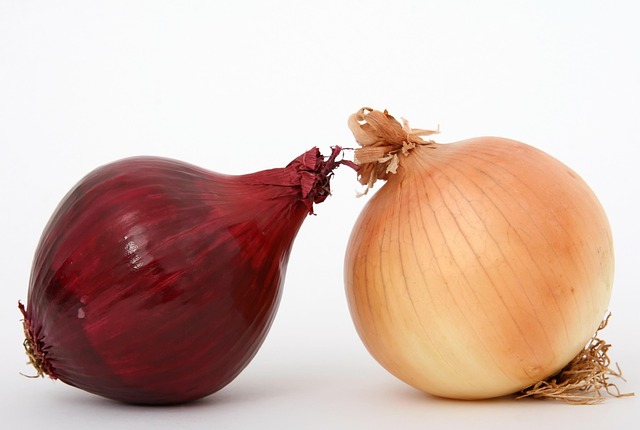
The onion (Allium cepa L.) is the most versatile vegetable in Italian cuisine: the base of soffritti, sauces and soups, guest of honor in salads and preserves, present in the shopping cart every month of the year. Italy cultivates it on about 12,600 hectares and declines it into dozens of local populations, two of which have obtained the Protected Geographical Indication. This article examines the Italian onion supply chain in its main aspects: areas and production, consumption and trade with foreign countries, history, botany, designations of origin, nutritional profile,scientific evidence, Italian cuisine and purchasing criteria for consumers and buyers.
Twelve thousand hectares and four hundred thousand tons
According to Istat estimates on the areas and productions of agricultural crops, in 2024 open-field onion cultivation occupied in Italy 12,628 hectares, a stable figure compared to the previous two years, with a production close to 419,000 tons and an average yield of about 33 tons per hectare. Over 6,100 hectares are located in southern regions and about 3,300 in the Northeast (AgroNotizie, 2025). It is a high unit value crop, concentrated in a few specialized districts: eastern Po Valley, Puglia, Campania, Tyrrhenian Calabria and Sicily.
Stable consumption, imports growing
The analyses of Agroter’s Fruit and Vegetable Monitor on domestic consumption describe a category that withstands the inflation impact better than many others. In hypermarkets and supermarkets, between 2017 and 2025, the average price of onions rose by 44%, but volumes sold increased by 15% and value by 66%. In 2025, compared to 2024, sales increased by 3% in volume and by 4% in value, with the average price slightly down after the previous year's peak.
The packaged at fixed weight represents 71% of volumes in the modern channel; within it, golden onions account for 40%, red ones 21%, white 13%, and shallots 6%. Monthly sales distribution is regular, with a minimum in July (6%) and peaks in March and December (10% each): onion is now a destationalized product (Pattuelli, 2026).
On the foreign trade front, the 2025 final report indicates that onions are the third most imported fruit and vegetable product from Italy, after potatoes and bananas, and the one with the most marked increase in quantities, equal to +42%, against a 21% increase in spending: a sign of declining average import prices (Biffi, 2026). National production therefore only partially covers a constant domestic demand, and the price differential with foreign supply is the competitive knot on which the programming of the next campaigns is played.
From the Decameron to Artusi
Onion has accompanied Italian food history for centuries. Already Pliny the Elder notes that the Egyptians invoked it, together with garlic, in the oath among the deities, and distinguishes the known varieties in the Roman world, including the Ascalon onion, the Tuscolana, and the Amiternina (Pliny, Naturalis Historia, XIX, 32). In the Decameron Giovanni Boccaccio opens the story of Brother Onion recalling that Certaldo, in the Elsa Valley, is a land that produces 'onions famous throughout Tuscany' (Boccaccio, 1349-1353, VI, 10). That same red onion, now a Slow Food Presidium, still appears on the coat of arms of the Municipality of Certaldo, where it is depicted on a white field (Slow Food Foundation, n.d.-a).
Five centuries later Pellegrino Artusi includes in Science in the Kitchen and the Art of Eating Well recipe no. 50, the 'French onion soup', with two large white onions, Gruyère cheese and Parmesan, and does not forego a medical note: 'Because of the onion, those who suffer from digestive issues would do well to abstain from this soup' (Artusi, 1891).
Botany and harvest calendar
The onion is a biennial herbaceous plant of the family Amaryllidaceae. The edible part is the bulb, a storage organ made up of concentric fleshy scales, covered by protective tunics whose color ranges from white to golden to red-violet. In the first year the plant forms the bulb, in the second it flowers and produces seed. Spring onions are harvested in spring, fresh consumption onions in late spring and summer, those for storage at the end of summer: this is the name given to onions left to mature and dry in the field, with dry outer skins, intended to be stored for months, until the following spring. The red onions contain the highest amounts of anthocyanins and flavonols, followed by the golden ones, while the white ones contain less (Zhao et al., 2021).
Where it is grown and under what rules
Coastal sandy soils favor early fresh consumption productions, while the deeper inland soils are suitable for storage onions. The regions adopt regulations of integrated production which set, for onions, variety lists, planting patterns, standard doses of nitrogen, phosphorus and potassium, irrigation and protection criteria, updated every year (Emilia-Romagna Region, 2023). Crop rotation, green manure and organic matter management remain the main tools to contain soil phytopathies. The organic production, regulated by Regulation (EU) 2018/848, is the most consistent choice for the protection of biodiversity and soil: recent studies also indicate that organic farming practices can increase the content of bioactive compounds with antioxidant activity in bulbs (Zhao et al., 2021).
The Italian PGIs
The Red Onion of Tropea Calabria PGI It was registered with Commission Regulation (EC) No 284/2008, and its specification was subject to a minor amendment by Implementing Regulation (EU) No 264/2013. The denomination refers to the bulbs of the local ecotypes Tondo piatta or primaticcia, Mezza campana or medio precoce, and Allungata or tardiva, in the three types cipollotto, fresh consumption onion, and storage onion. The production area includes suitable lands in the provinces of Cosenza, Catanzaro and Vibo Valentia, along the Tyrrhenian coastal strip, and all thephases from sowing to harvesting must take place within the delimited area (specification, article 3). The certified supply chain comprises over 20,000 tons per year, of which about 20% is destined for processing, 170 operators, and an estimated consumer value of 60 million euros; the control body is CSQA, reconfirmed by the Ministry of Agriculture in 2024 (CSQA, 2024).
The Margherita White Onion PGI It was registered with the Commission Implementing Regulation (EU) 2015/1865 of 7 October 2015. It is cultivated in the coastal sands of the municipalities of Margherita di Savoia, Zapponeta and Manfredonia – south of Gargano, in Puglia, province of Foggia – in an environmental area of interest protected by the Ramsar Convention. It is a sweet white onion, for fresh consumption, harvested between late spring and early summer; the protection consortium, recognized in 2016, brings together small producers, cooperatives and packers (Ministryof agricultural, food and forestry policies, 2015).
From 2024, the registration and modification procedures of the specifications follow Regulation (EU) 2024/1143 on geographical indications. In this context lies the path of the Ramata Onion of Montoro, in the province of Avellino, today a Traditional Agri-food Product of Campania: the application for registration as PGI was filed with the Campania Region on January 17, 2025, following a process started in 2012, and the national investigation is underway (FreshPlaza Italia, 2025; Myfruit, 2026).
Presidia and Traditional Agri-food Products
Alongside the two PGIs, dozens of local onion populations are registered in the national list of Traditional Agri-food Products (TAP), which reached its twenty-sixth revision in 2026, with 5,813 entries, most recently updated by the ministerial decree of February 6, 2026, no. 59360 (Ministry of Agriculture, Food Sovereignty and Forests, 2026). Among these the Cannara Onion, in Umbria, cultivated only in the homonymous municipality in the golden and red types, and celebrated every September by one of the oldest festivals in Italy (Umbria Region, n.d.).
Four onions are also Slow Food Presidiums: the Certaldo Onion in Tuscany; the Giarratana Onion, white and of large size, in Ragusa (Sicily); the red onion of Breme, in Lomellina (Lombardy), with bulbs often exceeding half a kilo; the Alife onion, in the Caserta plain (Campania), cultivated in the municipalities of Alife, Piedimonte Matese and San Potito Sannitico (Slow Food Foundation, n.d.-a, n.d.-b, n.d.-c, n.d.-d). To these are added the Emiliano Borettana, small and flat, intended for pickled preserves andin sweet and sour, and the Ramata di Milano, for storage, among the most widespread varieties in large-scale distribution.
The nutritional profile
The food composition tables indicated by CREA — Research Center for Food and Nutrition (2019) refer to raw onions (food code 005300, edible portion 83%, serving size 200 g) the following nutritional values.
| Nutrient | Per 100 g |
| Energy | 118 kJ / 28 kcal |
| Fats | 0.1 g |
| of which saturated fatty acids | not reported |
| Carbohydrates | 5.7 g |
| of which sugars | 5.7 g |
| Fibers | 1.0 g |
| Proteins | 1.0 g |
| Salt | 0.03 g (sodium 10 mg) |
No vitamin or mineral reaches 15% of the reference nutritional values as per Annex XIII of Regulation (EU) no. 1169/2011 per 100 g: potassium (140 mg) stops at 7%, folates (20 µg) at 10%, vitamin C (5 mg) at 6% (CREA, 2019). Raw onion, however, meets the conditions for the nutritional claim 'low calorie content', (Reg. EC 1924/2006, Annex). Its value is mainly due to bioactive compounds: flavonols, primarily quercetin and its glucosides, organosulfur compounds, fructans and, in red varieties, anthocyanins.
Scientific evidence
A review published in Frontiers in Nutrition summarizes the functions attributed to onion and its components in in vitro, animal, and human studies: antioxidant, antimicrobial, anti-inflammatory activity, cardiovascular protection and modulation of glucose and lipid metabolism. The same review notes that onion quercetin is more bioavailable than pure quercetin and that pan cooking does not significantly reduce its content (Zhao et al., 2021).
A second review, on Pharmaceutical Biology, outlines the molecular mechanisms ofanti-inflammatory and immunomodulatory action, from reduction of pro-inflammatory cytokines to increase of endogenous antioxidant defenses (Marefati et al., 2021). The anthocyanins of red onions, mostly concentrated in the outer tunics, are then the subject of a third review describing their stability, bioavailability and experimental effects on oxidative stress and metabolism (Samota et al., 2022).
No request for authorization for the use of health claim associated with onion consumption pursuant to Regulation (EC) No 1924/06 has unfortunately not yet been submitted, in relation to the aforementioned properties of its bioactive compounds. Our team of DO (Food and Agriculture Requirements) is available to operators and consortia, including research ones, who intend to explore such opportunities for product enhancement.
In the kitchen
The Genovese sauce, a Neapolitan Sunday recipe, is the most eloquent example of the role of the onion in Italian cuisine: for four people, the Cucchiaio d’Argento calls for 1.2 kg of golden onions and 800 g of beef pulp, cooked together for about three hours until a white and creamy sauce is obtained to be served with ziti (Cucchiaio d’Argento, 2025). It is curious to note how the same Neapolitan recipe – which refers to an alleged Genoese origin – is completely unknown in Liguria.
Artusi's onion soup, Liguria's stuffed onions, onion frittata, sweet and sour Borettane onions, and raw or marinated Tropea red onion salad complete a repertoire that spans all regions. The choice of onion varieties is also functional for preparations: golden and copper onions for soffritto – recommended to be made over low heat, using an emulsion of water and oil to prevent exceeding the oil's smoke point – as well as for long sauces; white onions for delicate preparations; red ones forraw consumption and for preserves.
Tips for buyers
For consumers, the choice should favor the seasonality and The origin: spring onions and white onions in spring and early summer, red onions for fresh consumption in summer, golden and coppery onions for storage in the rest of the year. The two PGIs guarantee origin and production method through a third-party control system, and the label mark is the only way to distinguish a true Cipolla Rossa di Tropea Calabria PGI from a generic elongated red onion.
For buyer professional buyers, restaurateurs and processors, varietal consistency according to culinary use, storability, and traceability of the supply chain are important, with attention to the declared origin on the label, mandatory for fresh vegetables.
In both cases the organic certification remains the most consistent choice for the protection of soil and biodiversity, with a verified control system along the entire supply chain (EU reg. 2018/848).
Conclusions
The Italian onion condenses in a modest-looking bulb a literary history starting from the Decameron, a varietal heritage distributed throughout all regions, two PGIs with certified supply chains, and a domestic demand that does not decline even in the face of higher prices. The main margin for improvement lies in the programming of the national supply, today integrated by rapidly growing imports. For operators and consumers, the levers are the same: seasonality, variety suitable for use, denominations of origin, and organic.
Dario Dongo
References
European Union regulatory sources
Commission Implementing Regulation (EU) No 264/2013 of 18 March 2013 approving a minor amendment to the specification for a name entered in the register of protected designations of origin and protected geographical indications (Cipolla Rossa di Tropea Calabria (PGI)). Official Journal of the European Union, L 82, 22.3.2013. http://data.europa.eu/eli/reg_impl/2013/264/oj
Commission Implementing Regulation (EU) 2015/1865 of 7 October 2015 entering a name in the register of protected designations of origin and protected geographical indications (Cipolla bianca di Margherita (PGI)). Official Journal of the European Union. http://data.europa.eu/eli/reg_impl/2015/1865/oj
Commission Regulation (EC) No 284/2008 of 27 March 2008 registering certain names in the Register of protected designations of origin and protected geographical indications (Lingot du Nord (PGI), Cipolla Rossa di Tropea Calabria (PGI), Marrone di Roccadaspide (PGI)). Official Journal of the European Union, L 86, 28.3.2008. http://data.europa.eu/eli/reg/2008/284/oj
Regulation (EC) No 1924/2006 of the European Parliament and of the Council of 20 December 2006 on nutrition and health claims made on foods. Consolidated text: 13/12/2014. http://data.europa.eu/eli/reg/2006/1924/2014-12-13
Regulation (EU) No 1169/2011 of the European Parliament and of the Council of 25 October 2011 on the provision of food information to consumers. Consolidated text: 01/04/2025. http://data.europa.eu/eli/reg/2011/1169/2025-04-01
Regulation (EU) 2018/848 of the European Parliament and of the Council of 30 May 2018 on organic production and labelling of organic products. Consolidated text: 25/03/2025. http://data.europa.eu/eli/reg/2018/848/2025-03-25
Regulation (EU) 2024/1143 of the European Parliament and of the Council of 11 April 2024 on geographical indications for wine, spirit drinks and agricultural products, as well as traditional specialities guaranteed and optional quality terms for agricultural products. Consolidated text: 18/03/2026. http://data.europa.eu/eli/reg/2024/1143/2026-03-18
Italian institutional sources
CREA – Research Center for Food and Nutrition. (2019). Food composition tables: Onions, raw (food code 005300). https://alimentinutrizione.it/tabelle-nutrizionali/005300
CSQA Certifications. (2024, 27 February). Cipolla Rossa di Tropea Calabria PGI: from the certified supply chain 60 million in value to consumption. https://www.csqa.it/it-it/press/cipolla-rossa-di-tropea-calabria-igp-dalla-filiera-certificata-60-mln-di-valore-al-consumo
Ministry of Agriculture, Food Sovereignty and Forests. (2026). Update of the National List of Traditional Agri-food Products pursuant to Article 12, paragraph 1, of Law No. 238 of 12 December 2016 (ministerial decree 6 February 2026, no. 59360, twenty-sixth revision; published in Official Gazette no. 40 of 18 February 2026). https://www.masaf.gov.it/flex/cm/pages/ServeBLOB.php/L/IT/IDPagina/24151
Ministry of Agricultural, Food and Forestry Policies. (2015). Registration of the denomination «Cipolla Bianca di Margherita» in the register of protected designations of origin and protected geographical indications (provision 21 October 2015, 15A08398). Official Gazette no. 265 of 13 November 2015. https://www.unionalimentari.com/wp-content/uploads/2024/09/MIPAAF-PROVV-21.10.2015-IGP-Cipolla-Bianca-di-Margherita-COMP.pdf
Emilia-Romagna Region. (2023). Integrated production regulations 2023. Technical cultivation standards, horticultural crops: onion. https://agricoltura.regione.emilia-romagna.it/produzioni-agroalimentari/agricoltura-sostenibile/agricoltura-integrata/Collezione-dpi/dpi_2023/norme/orticole/norme-tecniche-agronomiche-cipolla-2023.pdf/@@download/file
Umbria Region. (n.d.). Traditional agri-food products: Cipolla di Cannara. https://www.regione.umbria.it/documents/18/9035346/cipolla.pdf/79fd9ac7-1d34-4b36-80f9-17c80ded3b60
Scientific studies
Marefati, N., Ghorani, V., Shakeri, F., Boskabady, M., Kianian, F., Rezaee, R., & Boskabady, M. H. (2021). A review of anti-inflammatory, antioxidant, and immunomodulatory effects of Allium cepa and its main constituents. Pharmaceutical Biology, 59(1), 285–300. https://doi.org/10.1080/13880209.2021.1874028
Samota, M. K., Sharma, M., Kaur, K., Sarita, Yadav, D. K., Pandey, A. K., Tak, Y., Rawat, M., Thakur, J., & Rani, H. (2022). Onion anthocyanins: Extraction, stability, bioavailability, dietary effect, and health implications. Frontiers in Nutrition, 9, 917617. https://doi.org/10.3389/fnut.2022.917617
Zhao, X.-X., Lin, F.-J., Li, H., Li, H.-B., Wu, D.-T., Geng, F., Ma, W., Wang, Y., Miao, B.-H., & Gan, R.-Y. (2021). Recent advances in bioactive compounds, health functions, and safety concerns of onion (Allium cepa L.). Frontiers in Nutrition, 8, 669805. https://doi.org/10.3389/fnut.2021.669805
Market data and trade press
AgroNotizie. (2025, February 19). Onion: nutritional needs for excellent harvests (based on Istat data). https://agronotizie.imagelinenetwork.com/fertilizzazione/2025/02/19/cipolla-fabbisogni-nutrizionali-per-raccolti-eccellenti/86696
Biffi, A. (2026, March 11). Fruit and vegetables, Italian export record in 2025: 6.7 billion euros reached. Italiafruit News (Orchardfruit Agroter Monitor based on Istat data). https://www.italiafruit.net/ortofrutta-export-italiano-da-record-nel-2025-toccati-i-67-miliardi-di-euro
FreshPlaza Italy. (2025, January 20). IGP registration requested for Montoro ramata onion. https://www.freshplaza.it/article/9696287/richiesta-la-registrazione-igp-per-la-cipolla-ramata-di-montoro/
Myfruit. (2026). Montoro ramata onion, all ready for the harvest. https://www.myfruit.it/news/cipolla-ramata-di-montoro-tutto-pronto-per-la-raccolta
Pattuelli, F. (2026, June 8). Onions, the basic product that continues to generate value despite price increases. Italiafruit News (Orchardfruit Agroter Monitor). https://www.italiafruit.net/cipolle-il-prodotto-base-che-continua-a-generare-valore-nonostante-i-rincari
Historical, gastronomic and associative sources
Artusi, P. (1891). Science in the kitchen and the art of eating well, recipe no. 50, French onion soup. https://www.pellegrinoartusi.it/50-zuppa-con-le-cipolle-alla-francese/
Boccaccio, G. (n.d.). Decameron, Sixth day, tenth tale. Wikisource. https://it.wikisource.org/wiki/Decameron/Giornata_sesta/Novella_decima
Silver Spoon. (2025). Genovese pasta. https://www.cucchiaio.it/ricetta/pasta-alla-genovese/
Slow Food Foundation. (n.d.-a). Slow Food Presidium: Certaldo Onion. https://www.fondazioneslowfood.com/it/presidi-slow-food/cipolla-di-certaldo/
Slow Food Foundation. (n.d.-b). Slow Food Presidium: Giarratana Onion. https://www.fondazioneslowfood.com/it/presidi-slow-food/cipolla-di-giarratana/
Slow Food Foundation. (n.d.-c). Slow Food Presidium: Red Onion of Breme. https://www.fondazioneslowfood.com/it/presidi-slow-food/cipolla-rossa-di-breme/
Slow Food Foundation. (n.d.-d). Slow Food Presidium: Alife Onion. https://www.fondazioneslowfood.com/it/presidi-slow-food/cipolla-di-alife/
Pliny the Elder. (n.d.). Natural History, book XIX, chapter 32, Varieties of onions (Engl. trans. J. Bostock and H. T. Riley). https://peterburk.github.io/pliny/ChaptersHtml/19.%20Book%20XIX.%20The%20Nature%20And%20Cultivation%20Of%20Flax,%20And%20An%20Account%20Of%20Various%20Garden%20Plants./32.%20Chap.%2032.-Varieties%20Of%20The%20Onion..html

Dario Dongo, lawyer and journalist, PhD in international food law, founder of WIISE (FARE - GIFT – Food Times) and Égalité.


