

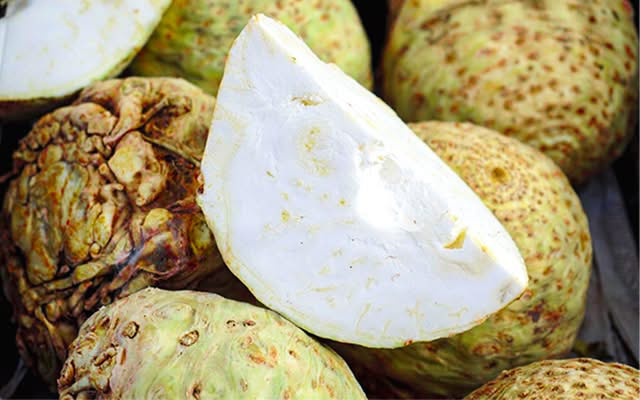
the celeriac is the winter vegetable that almost no one counts in Italy. Rough, irregular, with white and compact pulp and an aroma between celery and hazelnut, it has a historic range in the Veronese area and Val di Gresta, but it does not appear in ISTAT surveys nor, for Italy, in European statistics on plant productions. Yet it crosses our borders in both directions, with its own customs subheading.
This article reconstructs what public data really say about production and the market, and what they do not say. Continuing with history, botany, nutritional value, scientific research, allergen and cuisine of a vegetable that is written about much more than it is measured.
Production and market, what the data say
The European Union recognizes celeriac as an independent crop. The Eurostat database on plant productions has a dedicated entry, Celeriac, to which a production of 394,580 tons, in 2024, in the 27 EU member states. In 2025 the leading producer is Netherlands, with 117,850 tons, followed by Poland with 114,700 (Eurostat, 2026).
At the same entry, for theItaly, Eurostat reports 0,00 thousands of hectares and 0,00 thousands of tonnes in all available years, from 2020 to 2025. It means that the crop is not detected, or remains below the rounding threshold. Not even theISTAT records it: the Italian Statistical Yearbook, in the table on the main agricultural crops, lists the ‘Celery‘ — about 3,000 hectares and just under 100,000 tonnes — but does not distinguish celeriac, which does not appear in that entry (Istat, 2020).
The figure that has been circulating for years in the trade press, 11,500 tonnes, is not a statistical datum. It is a estimate by OPO Veneto referring to 2014, attributed to commercial manager Sergio Tronchin and reported by Italiafruit News in November of that year, then by Agronotizie in 2020, which correctly states the source (Italiafruit News, 2014; Agronotizie, 2020). It is now twelve years old and with no published methodology: it must be cited for what it is, not as a current snapshot.
I trade flows can instead be measured accurately, because the combined nomenclature assigns to celeriac a specific subheading, the 0706 90 10, described in European statistics as ‘fresh or chilled celeriac, rooted celery or German celery‘. Heading 0706 groups carrots, turnips, salad beets, salsify, celeriacs, radishes and similar edible roots, fresh or chilled; but celeriac, unlike radish, does not end up in the residual subheading (EU Regulation 2025/1926, Annex I).
On that subheading, in 2025, data onItaly report 5,932 tonnes of import, worth 3.45 million, and 4,828 tonnes By export worth 5.53 million (Eurostat Comext, 2026). This last data includes re-exports of imported goods, which explains how a country without detected production can still export celeriac abroad.
The contradiction is instructive: Italy exports celeriac without the crop existing in national production statistics. It is the limit of a detection system calibrated on major crops, which leaves niche productions invisible.
The European market, between overproduction and rebound
The European production center is in North. In 2025, the areas planted with celeriac increased by about 10% in the Netherlands and Europe, and theexcess supply caused prices to collapse: at the end of January, fresh market prices hovered around 0.06 euro/kg, compared to an estimated production cost of about 0.20 euro/kg. The 2024 harvest, by contrast, had reached up to 0.60 euro/kg. Operators therefore expect the expansion of the 2025 area to be absorbed in 2026 (FreshPlaza, 2026a).
L‘adjustment It arrived the following autumn, with a wide demand after a season described as disastrous by Dutch producers (FreshPlaza, 2026b).
In Germany celeriac is a commonly consumed vegetable, at the base of Selleriesalat: a salad that exists in two traditional versions, one with the root boiled and sliced, marinated in one vinaigrette with vinegar, and a raw one, cut into julienne with apple and seasoned with yogurt, mayonnaise, and lemon. The quest for foreign markets by Venetians was mainly directed first towards the Netherlands, then Belgium and Germany (Agronotizie, 2020).
History, and a misunderstanding to clarify
Celeriac is often described as an ancient plant. It is not.
Homerin theOdysseycites the σέλινον (selinonin the meadows surrounding Calypso's cave, among violets (OdysseyV, 72-73): it is the wild celery that grows wild in damp environments, not the variety with a swollen hypocotyl. Pliny the Elder devotes toapium pages on cultivation and therapeutic use, distinguishes helioselinum, hipposelinum and the varieties ‘for the foliage’, describes its sowing and medicinal uses, from ophthalmology to diuresis (Natural HistoryXIX, 123-124 and 158; XX, 44). Nowhere does a swollen root appear: on the contrary, theapium is listed among ordinary root vegetables.
The variety with swollen hypocotyl is a modern selectionthe first descriptions date back to around 1600work by Italian and Swiss botanists, and European diffusion in the following century. The basionym, Apium rapaceum Mill., dates back to 1768. The most recent genomic analysis confirms the reconstruction: cultivated celery derives from Mediterranean wild celery, and artificial selection has headed in one direction towards the enlargement of the hypocotylgiving celeriac, and in the other direction towards the strengthening of the petiole, giving celery stalks (Lai et al., 2025)
The ancient history of selinon, in short, belongs to celery. That of celeriac begins in the seventeenth century.
In Italy, cultivation takes root in the Verona area, and particularly in Ronco all’Adige, where according to the sheet of the Atlas of traditional agri-food products of Veneto dates back to the 1930s. To the Veronese dialect poet Berto Barbarani (1872-1945) is attributed a locally handed down recipe: slices of celeriac as thick as a coin, paired around a slice of cooked ham and tied with string, browned in butter with onion, then seasoned with tomato sauce, half a glass of old Marsala and half a tablespoon of flour, served hot with plenty of parmesan (Paesi del Gusto, 2019; Tibaldi, 2022).
Botanical characteristics and seasonality
The accepted name in reference taxonomic databases is Celery L., family of Apiaceae. Celeriac is not an autonomous taxon, but a horticultural variety of the same species as the celery stalk: the basionym is Apium rapaceum Mill., 1768, and the most common combination in nomenclatural databases is Celery L. var. rapaceum (Mill.) DC. The Portal of the Flora of Italy records only the species, Celery L., present in several regions as naturalized or casual, without distinguishing infraspecific ranks (Portal of the Flora of Italy, n.d.; POWO, n.d.).
The edible part, often called root, is actually a swollen hypocotyl: a globe 15-20 centimeters in diameter, with gray-brown rough skin and whitish, tender and crunchy pulp, which can reach one kilogram (Paesi del Gusto, 2019; Lai et al., 2025).
The plant is biennial, but is cultivated as an annual, because the underground part is harvested in the first year. Sowing takes place directly in the field between February and May, or in seedbeds with transplanting after 40-50 days; harvesting begins in October. Under suitable conditions, the product can be preserved for up to four months, which extends its presence on the market well beyond the harvest (Agronotizie, 2020).
Production areas and agronomic practices
The national list of Traditional Agri-food Products — which in its twenty-fifth revision counts 5,717 products (MASAF, 2025) — reports two characteristic celeriac productions, both in Northern Italy:
- the ‘Celeriac of Ronco all’Adige’, in the province of Verona, is among the Traditional Agri-food Products of Veneto. The Veneto Region has established its own regional list by adopting the 413 Venetian products already registered in the national list, with the resolution of the Regional Council no. 340 of April 1, 2025;
- the ‘Celeriac of Val di Gresta’, in the province of Trento, is itself registered among the Traditional Agri-food Products of the autonomous Province. The provincial sheet specifies that no native varieties exist and that the vegetable ‘is cultivated according to the methods of agriculture integrated e organic‘, and recalls the historical destination to the Sant’Andrea fair, in Riva del Garda, on November 30 (Trentino Agriculture, n.d.).
The varieties cultivated are commercial hybrids — Balena, Cisko, Monarch among the most common — on medium-textured, deep and well-drained soils, with neutral reaction (Agronotizie, 2020). As for all Apiaceae, crop rotation that avoids the return of umbellifers on the same plot is the first tool of preventive defense.
As for the sustainability of the crop, the general considerations on horticulture apply organic e integrated, already dealt with on these pages, as for other winter vegetables of Northern Italy — from radicchios to the spinach, from chard to lettuce.
Nutritional properties
The food composition tables indicated by CREA - Research Centre for Food and Nutrition (2019) report for raw celeriac (code 005690, edible part 72%, portion 200 g) the following nutritional values, per 100 g:
- energy 121 kJ, 29 kcal;
- fat 0.1 g, of which saturated fatty acids n.d.;
- carbohydrates 3.8 g, of which sugars 3.8 g;
- fiber 3.1 g;
- proteins 1.9 g;
- salt n.d.
No micronutrient reaches 15% of the reference nutritional values listed in Annex XIII of Regulation (EU) No 1169/2011: phosphorus 90 mg (12.9%), vitamin C 6 mg (7.5%), calcium 52 mg (6.5%), riboflavin 0.11 mg (7.9%), thiamine 0.07 mg (6.4%), iron 0.5 mg (3.6%).
Celeriac in the kitchen
The traditional Veronese preparation is the one passed down under the name Barbarani, with cooked ham, butter, Marsala wine, and tomato. In contemporary cuisine, celeriac moves on three registers:
- raw, cut julienne or into thin slices, in salad, where the hazelnut note remains intact and the pulp is crunchy. This is the register of rémoulade French and of Selleriesalat German;
- cooked and pureed, in cream or velouté, often with almonds or walnuts. Il Cucchiaio d’Argento proposes several versions, from simple cream to maltagliati with celeriac velouté and almonds, as well as a foam with toasted walnuts and curry;
- instead of potato, in purée or cutlet: same velvety consistency, lower carbohydrate content — 3.8 g versus about 18 for a potato — and an aroma that potato does not have. Celeriac thus also enters the fish main courses of fine dining, as in the turbot with celeriac by Gianfranco Pascucci.
In Val di Gresta the typical transformation is preserved in oil, thin marinated slices, with vegetable percentages that vary significantly from one producer to another.
The (scarce) scientific research
Scientific research on celeriac is unfortunately scarce. A review of literature from the last ten years returns almost exclusively agronomic, phytopathological, and technological studies, without any clinical study referring to its dietary contribution. The few laboratory studies on the vegetable and clinical studies conducted on extracts and seeds moreover suggest the opportunity for further investigations, in a perspective of matrix biodiversity that also appears useful for the development of dietary supplements:
- phytochemistry and inflammation. A study in vitro published in 2025 on Food Science & Nutrition profiled 31 compounds in the aerial and underground parts of celeriac. Apinine, a glycosylated flavone, is almost five times more concentrated in the leaves than in the underground part (3,232 vs 697 mg/kg); sedanolide, on the other hand, is the only marker more abundant in the underground part (33 vs 8 mg/kg). The extracts reduce the production of nitric oxide, prostaglandin E₂ and proinflammatory cytokines in murine macrophages stimulated with lipopolysaccharide (Kwak et al., 2025);
- sedanolide and antioxidant defenses. A previous study (Tabei et al., 2023) found the ability of sedanolide to activate the KEAP1-NRF2 pathway in cultured human liver cells and protect them from hydrogen peroxide-induced apoptosis;
- pressure, glycemia and lipids. A meta-analysis of nine randomized clinical trials on 511 adults found statistically significant, though modest, reductions in systolic and diastolic blood pressure, fasting glucose and triglycerides, with no effect on total cholesterol, LDL and HDL. The authors report substantial heterogeneity and note that the greatest effects come from seeds and extracts concentrated over 1,000 mg per day (Liu et al., 2025).
This implies a rule of caution, for both writers and communicators: apigenin — the flavone attributed, in laboratory and animal model studies, with inhibition of the NF-κB pathway and reduction of proinflammatory cytokines (Nicholas et al., 2007) — is present in minimal amounts in celeriac, 0.10 mg/kg in the underground part. The prospects for enhancement therefore lie in the area of concentrated extracts, between phytotherapy and dietary supplements, where moreover the health claims related to botanicals remain still suspended, pending the scientific evaluation by EFSA (Dongo, 2025).
Celery allergen and insufficiency of cooking
Celery is among the allergens with mandatory declaration in the European Union, on the label as well as in the serving, together with celery-based products (EU Reg. 1169/2011, Annex II, point 9). Note that celeriac is for all intents and purposes celery — Celery, the same species as stalk celery — and as such falls within the provision. Its presence must always be declared: on the label, with graphic highlighting of the allergen name in the list of ingredients, and in mandatory information on non-prepackaged foods, such as those served in catering and collective settings (EU reg. 1169/2011, art. 21.1 and art. 44.1, lett. ‘a’).
Theallergen major content both in celery and celeriac is Api g 1. A protein of the PR-10 family homologous to Bet v 1, the major allergen of birch pollen, with a sequence identity of 40-41% and a similarity of 61%. It is present in 59-80% of patients allergic to celery and explains oral allergic syndrome in subjects sensitized to birch. Api g 1 is heat-labile and loses its structure after thirty minutes at 100 °C (Kosztulska et al., 2025).
However, it would be a mistake to infer that cooked celeriac is safe for people allergic to celery. In a double-blind, placebo-controlled oral challenge, six out of eleven patients reacted to celery cooked at 110 °C for fifteen minutes, and all tested reacted to powdered celery used as a spice (Ballmer-Weber et al., 2002).
Advice for buyers
For gourmets. The optimal size is between 600 and 700 grams, up to one kilogram: very large globes tend to become fibrous and have internal cavities (Italiafruit News, 2014). The skin must be compact and free of soft parts, the cuts at the base and apex fresh, the globe heavy and firm in hand. Once cut, the pulp oxidizes quickly: it should be immersed in water acidified with lemon juice. Whole and kept cool, it lasts for months. Prefer organic products for the best guarantee of environmental andbiodiversity.
For professional buyers. The Italian supply is concentrated from October to the beginning of winter and linked to two specific areas, the Veronese and the Val di Gresta. Those who supply or process it must finally manage celery as a mandatory allergen declaration throughout the entire supply chain, including cooked preparations and spices.
Conclusions
Celeriac is a textbook case. It has its own customs subheading, two registrations in the lists of Traditional Agri-food Products, a European market of nearly 400,000 tons, and a distinctive gastronomic profile. However, it does not have Italian production statistics, clinical literature, or an authorized health claim.
It is a horticultural selection from the seventeenth century, low in calories and rich in fiber, with a small and ancient Italian area, which deserves to be considered as a differentiating element within a balanced and above all varied diet, for health and taste.
The European demand, after the difficult 2025 season, has returned strong, and contemporary cuisine has rediscovered it from raw to purée: there is room for the two Italian areas registered among Traditional Agri-food Products to make themselves felt, starting with a catering sector that knows how to tell its story.
Dario Dongo
References
Peer-reviewed scientific studies
Ballmer-Weber, B. K., Hoffmann, A., Wüthrich, B., Lüttkopf, D., Pompei, C., Wangorsch, A., Kästner, M., & Vieths, S. (2002). Influence of food processing on the allergenicity of celery: DBPCFC with celery spice and cooked celery in patients with celery allergy. Allergy, 57(3), 228-235. https://doi.org/10.1034/j.1398-9995.2002.1o3319.x
Kwak, S. A., Lee, J. J., Park, J. H., & Joo, N. (2025). Phytochemical profiling and anti-inflammatory effects of aerial and underground parts of Celery var. rapaceum (celeriac): Potential health benefits of discarded aerial parts. Food Science & Nutrition, 13(10), e71011. https://doi.org/10.1002/fsn3.71011
Lai, E., Guo, S., Wu, P., Qu, M., Yu, X., Hao, C., Li, S., Peng, H., Yi, Y., Zhou, M., Fu, G., Li, X., Liu, H., Zheng, Y., Wang, X., Fei, Z., & Gao, L. (2025). Genome of root celery and population genomic analysis reveal the complex breeding history of celery. Plant Biotechnology Journal, 23(3), 946-959. https://doi.org/10.1111/pbi.14551
Liu, D., Zhao, H., Xu, H., & Hu, J. (2025). Effects of celery (Celery) on blood pressure, glycemic and lipid profile in adults: A systematic review and meta-analysis of randomized controlled trials. Frontiers in Nutrition, 12, 1597680. https://doi.org/10.3389/fnut.2025.1597680
Nicholas, C., Batra, S., Vargo, M. A., Voss, O. H., Gavrilin, M. A., Wewers, M. D., Guttridge, D. C., Grotewold, E., & Doseff, A. I. (2007). Apigenin blocks lipopolysaccharide-induced lethality in vivo and proinflammatory cytokines expression by inactivating NF-κB through the suppression of p65 phosphorylation. The Journal of Immunology, 179(10), 7121-7127. https://doi.org/10.4049/jimmunol.179.10.7121
Tabei, Y., Abe, H., Suzuki, S., Takeda, N., Arai, J.-i., & Nakajima, Y. (2023). Sedanolide activates KEAP1-NRF2 pathway and ameliorates hydrogen peroxide-induced apoptotic cell death. International Journal of Molecular Sciences, 24(22), 16532. https://doi.org/10.3390/ijms242216532
Publications by institutions and bodies
CREA — Research Centre for Food and Nutrition. (2019). Food composition tables: Celeriac, raw (code 005690). https://www.alimentinutrizione.it/tabelle-nutrizionali/005690
Eurostat. (2026). Crop production in EU standard humidity [apro_cpsh1], item V4400 Celeriac. https://ec.europa.eu/eurostat/databrowser/view/apro_cpsh1/default/table
Eurostat Comext. (2026). EU trade since 1988 by HS2-4-6 and CN8 [DS-045409], code 0706 90 10, Italy. https://ec.europa.eu/eurostat/comext/newxtweb/
Istat. (2020). Italian Statistical Yearbook 2020, chapter 13 — Agriculture, table 13.2. https://www.istat.it/it/files/2020/12/C13.pdf
Masaf — Ministry of Agriculture, Food Sovereignty and Forests. (2025). Twenty-fifth revision of the list of traditional agri-food products. https://www.masaf.gov.it/elenco-pat-2025
Plants of the World Online. (n.d.). Apium graveolens L. Royal Botanic Gardens, Kew. https://powo.science.kew.org/taxon/urn:lsid:ipni.org:names:838067-1
Portal of the Flora of Italy. (s.d.). Apium graveolens L. University of Trieste. https://dryades.units.it/floritaly/index.php?procedure=taxon_page&tipo=all&id=3575
Region of Veneto. (2025). Resolution of the Regional Council no. 340 of April 1, 2025: Establishment of the List of Traditional Agri-food Products of Veneto and approval of the procedures for registration. Official Bulletin of the Veneto Region no. 47 of April 11, 2025. https://bur.regione.veneto.it/BurvServices/pubblica/DettaglioDgr.aspx?id=553036
Trentino Agriculture. (n.d.). Celeriac of the Val di Gresta. Autonomous Province of Trento. http://www.trentinoagricoltura.it/Trentino-Agricoltura/Prodotti/Prodotti-agroalimentari-tradizionali/Prodotti-vegetali-allo-stato-naturale-o-trasformati/Sedano-Rapa-della-Val-di-Gresta
Industry press and recipes
Agronotizie. (2020, December 3). Celeriac, rediscovery of tradition. https://agronotizie.imagelinenetwork.com/agronomia/2020/12/03/sedano-rapa-riscoperta-della-tradizione/68544
FreshPlaza. (2026a, March 24). The cards have been dealt, but the game’s not over. https://www.freshplaza.com/north-america/article/9822581/the-cards-have-been-dealt-but-the-game-s-not-over/
FreshPlaza. (2026b, September 10). High demand for celeriac after a disastrous season. https://www.freshplaza.it/article/9870558/ampia-domanda-per-il-sedano-rapa-dopo-una-stagione-disastrosa/
Il Cucchiaio d’Argento. (n.d.). Celeriac cream. https://www.cucchiaio.it/ricetta/crema-di-sedano-rapa/
Il Cucchiaio d’Argento. (n.d.). maltagliati with celeriac velouté and almonds. https://www.cucchiaio.it/ricetta/maltagliati-con-vellutata-di-sedano-rapa-e-mandorle/
Il Cucchiaio d’Argento. (n.d.). Celeriac mousse with diced celeriac, toasted walnuts and curry. https://www.cucchiaio.it/ricetta/spuma-sedano-rapa-cubetti-noci-tostate-curry/
Italiafruit News. (2014, November 5). Opo Veneto: celeriac keeps pace. https://www.italiafruit.net/DettaglioNews/28541/mercati-e-imprese/opo-veneto-il-sedano-rapa-mantiene-il-passo
Red Shrimp. (s.d.). Turbot and celery root by Gianfranco Pascucci. https://www.gamberorosso.it/ricette/secondi/rombo-e-sedano-rapa-di-gianfranco-pascucci/
Countries of Taste. (2019, January 10). Celeriac of Ronco all’Adige. https://www.paesidelgusto.it/sedano-rapa-di-ronco-alladige/
Tibaldi, E. (2022, 10 January). Unusual roots, a pleasant re-discovery for the palate. Passion in green, Edagricole. https://passioneinverde.edagricole.it/radici-insolite-una-piacevole-ri-scoperta-per-il-palato/
Historical sources
Homer. Odyssey, book V, 72-73.
Pliny the Elder. Natural History, books XIX and XX.
Regulatory sources of the European Union
Regulation (EC) No 1924/2006 of the European Parliament and of the Council of 20 December 2006 on nutrition and health claims made on foods. Consolidated text: 13/12/2014. http://data.europa.eu/eli/reg/2006/1924/2014-12-13
Regulation (EU) No 1169/2011 of the European Parliament and of the Council of 25 October 2011 on the provision of food information to consumers. Consolidated text: 01/04/2025. http://data.europa.eu/eli/reg/2011/1169/2025-04-01
Commission Regulation (EU) No 432/2012 of 16 May 2012 establishing a list of permitted health claims made on foods, other than those referring to the reduction of disease risk and to children’s development and health. Consolidated text: 20/08/2025. http://data.europa.eu/eli/reg/2012/432/2025-08-20
Commission Implementing Regulation (EU) 2025/1926 of 22 September 2025 amending Annex I to Council Regulation (EEC) No 2658/87 on the tariff and statistical nomenclature and on the Common Customs Tariff. Applicable from 1 January 2026. http://data.europa.eu/eli/reg_impl/2025/1926/oj
In-depth articles
Dongo, D. (2025, 1 May). The EU Court ruling on botanicals highlights the urgency to reform the NHCR. FT (Food Times). https://www.foodtimes.eu/it/consumatori-e-salute/corte-ue-botanicals-riforma-nhcr/

Dario Dongo, lawyer and journalist, PhD in international food law, founder of WIISE (FARE - GIFT – Food Times) and Égalité.


