

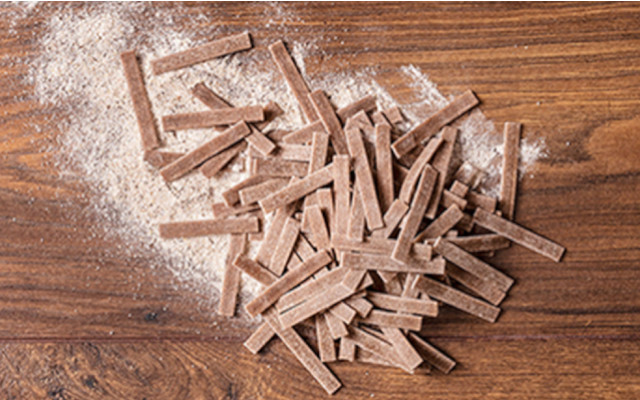
I Pizzoccheri della Valtellina PGI they are a pasta made from buckwheat and wheat flour, produced both in dry and fresh form in the province of Sondrio, in Lombardy. Recognized with the Protected Geographical Indication (PGI) designation by the European Union in 2016, this specialty boasts a tradition documented for over three centuries. Following is a complete analysis of the rules of the specification updated to 2024, the supply chain data, the historical sources and the traditional recipe.
Production regulations: rules and permitted ingredients
The Protected Geographical IndicationPizzoccheri from Valtellina' is reserved for pasta, dry or fresh, obtained from buckwheat dough (Fagopyrum esculentum) and flours from other cereals (regulation, article 1).
There recipe stands out for the essentiality of its ingredients:
- dry pasta: the mixture includes durum wheat semolina (alone or with semolina) up to a maximum of 80%, e at least 20% buckwheat flour;
- fresh pasta: the share of wheat (within 80%) is made up of flour soft wheat, alone or mixed with durum wheat semolina;
- waterfall: it is the only other ingredient allowed. The disciplinary Not involves the use of salt or eggs (disciplinary, article 5.1).
All production phases must take place in delimited area from the administrative borders of the province of Sondrio, which includes Valtellina and Valchiavenna.
The connection with the territory is historically based on the reputation of the product. The local cultivation of buckwheat, once widespread at a widespread level, is today limited to around twenty hectares intended for self-consumption and direct sale (regulations, articles 3 and 6).
The manufacturing process
In the dry version the flours are dry mixed, hydrated, kneaded and extruded. The pastry is then laminated and cut into the classic tagliatello format, while the gnocchetto is only cut after extrusion. The typical phases of drying and packaging in cardboard cases or bags follow.
There fresh version it goes through dough, pastry and moulding, and can be sold loose or packaged in a protective atmosphere (regulation, article 5.2).
New features of the 2024 specification and labelling
The ordinary modification approved in 2024 by decree of the Ministry of Agriculture, Food Sovereignty and Forestry abolished the constraint on the typographical character to be used for the name.
In labeling - in addition to the mandatory information established by Regulation (EU) no. 1169/11 – it is mandatory to report:
- The name 'Pizzoccheri della Valtellina';
- The wording PGI (in acronym or in full);
- The official symbol of the European Union.
The indication of the format is optional and any additional qualification that could mislead the consumer is prohibited. Controls on the supply chain are entrusted to the CSQA Certification body (regulations, articles 7 and 8).
Formats and dimensional requirements of Pizzoccheri PGI
The specification distinguishes three dry formats and one fresh, with well-defined dimensional indices:
| Format | Length (mm) | Width (mm) | Thickness (mm) |
| Spread tagliatelle (dry) | 30-60 | 7-8 | 1.1-1.7 |
| Dumpling (dry) | 16-22 | 7-11 | 1.5-2 |
| Wrapped noodle / noodle (dry) | – | 3-11 | 1-2.5 |
| Tagliatelle (fresh) | – | 5-11 | 1.3-5.5 |
The pasta looks like brown colour more or less dark, characterized by visible fragments of hazelnut or gray integument typical of buckwheat. After cooking in salted water, the taste it appears delicate. The water content must not fall below 24% in the fresh product nor exceed 12.5% in the dried one (regulation, article 2).
The numbers of the supply chain: how much Pizzoccheri della Valtellina PGI are worth
The data describes a denomination with stable production volumes over the last few years, from 1,758 tonnes in 2019 to 1,745 tonnes in 2023 (Qualigeo database / Qualivita Foundation).
The dry product represents over 90% of the total volume: for 2019 the Consortium indicated around 1,600 tonnes of dried pasta and 140 of fresh pasta (AIS Lombardia, 2020). There supply chain it is short and concentrated: there are four certified operators and in 2022 as many as 99.4% of the controlled pasta obtained certification (Lombardy Region, 2023).
The protection consortium, recognized by the ministry in 2020 and confirmed at the end of 2023, brings together the main pasta factories in the province.
In the national sector, Pizzoccheri belong to the small family of pasta with geographical indication (six names in total, including the famous Gragnano PGI pasta). In 2024 this sector expressed a production value of 307 million euros (+11%) and a consumer value of 443 million (+13.5%), counting 40 operators in total (Ismea & Qualivita Foundation, 2025).
Brand protection, catering and international events
The Milan Cortina 2026 Winter Olympic Games, with several competitions hosted in Valtellina, offered the denomination a showcase of global prominence. The Quality Agri-Food District brings together the Consortia of the nine PDOs and PGIs of the valley — from Bresaola della Valtellina PGI to Bitto DOP and Valtellina Casera DOP cheeses — under the brand 'Valtellina Taste of Emotion', attracting the attention of international newspapers such as New York Times (Consortium for the Protection of Bresaola della Valtellina, 2026).
Name protection in the restaurant industry
There legal protection it also acts rigorously outside the sales points. European Union law protects geographical indications against any illegitimate commercial use for non-compliant products, including usurpation, imitation and evocation (EU regulation 2024/1143, art. 26.1).
The Consortium also carries out systematic checks in Catering: the full name can only appear on restaurant menus when certified pasta is actually used (Qualivita Foundation, 2021).
History and origins: over four centuries of documents
The presence of buckwheat in Valtellina it has been documented since 1616 in a report drawn up by the Graubünden governor of the Adda Valley, who placed its cultivation mainly on the Rhaetian side and in the Teglio district. The first written traces relating to the preparation of Pasta instead they appear in two testamentary inventories of 1750 and of 1775, which mention the tools dedicated to its packaging (regulation, article 6).
Among the main historical testimonies are:
- 1797: H.L. Lehmann describes the 'Perzockel’, defined as buckwheat tagliatelle mixed with two eggs, cooked in water and seasoned with butter and cheese;
- 1834: Giuseppe Filippo Massara (Prodrome of the Valtellina flora) notes that they used fagopiro (buckwheat) flour to prepare 'gnocchi and tagliatelli, both called the same pizzoccheri'. This is an important detail: the gnocchetto today recognized by the specification has documented roots born in peasant homes and in mountain pastures without a table for rolling out the pastry (Maestroni & Cortesi, s.d.).
- 1883: The agricultural investigation describes pizzoccheri as a 'meat dish' for the wealthy and an inviting dish for farmers.
- 1894: There are 11 pasta factories in the province of Sondrio and 611 water mills.
A literary curiosity comes from the dialect poetry of the Tellino doctor Bruno Besta (1966): his verses recommended the use of local flour and mountain butter, at the same time recording the start of the first imports of buckwheat from outside the region, a symptom of a demand now greater than the valley harvest. In 1970 Zingarelli inserted the entry 'pizzocchero' and in 2000 pasta entered the first Lombard list of Traditional Agri-Food Products (PAT).
Buckwheat, gluten and nutritional information on the label
Buckwheat is not a cereal but one pseudocereal of the family of Polygonaceae, gluten-free at source. It has a nutritional profile characterized by balanced proteins (rich in lysine), resistant starch, fiber and antioxidants such as rutin (Dongo & Della Penna, 2023).
In the Pizzoccheri della Valtellina PGI, however, the buckwheat is mixed with wheat flour to ensure that it stays cooked. Consequentially, PGI certified pasta contains gluten.
As for the claim nutritional information (for example indications relating to the content of fiber or protein), European legislation establishes that they must refer to the food ready for consumption, i.e. to the cooked pasta according to the manufacturer's instructions (EC reg. 1924/2006, art. 5.3).
How to prepare Pizzoccheri: the traditional recipe from Teglio
The Accademia del Pizzocchero di Teglio establishes the official doses for 4 people:
- 400 g of buckwheat flour and 100 g of white flour;
- 250 g of potatoes and 200 g of cabbage (replaceable in season with Swiss chard o green beans);
- 250 g of Valtellina Casera DOP and 150 g of parmesan cheese grated;
- 200 g of butter, 1 clove of garlic and pepper.
Preparation: Roll the dough to 2-3 mm and cut it into tagliatelle about 0.5 cm wide. Cook the vegetables in salted water and, after 5 minutes, add the pizzoccheri. After another 10 minutes of cooking, drain everything with a slotted spoon and arrange in alternating layers with the cheeses. Finally, pour in the hot fried butter browned with garlic, without stirring (Accademia del Pizzocchero di Teglio, s.d.).
Conclusions
Pizzoccheri della Valtellina PGI represent a perfect synthesis between protection regulations, a stable supply chain of 1,750 tonnes per year and a historical heritage dating back to the seventeenth century. For operators and buyers international markets, the main guarantee remains the PGI certification on the label, while for catering the fundamental rule lies in respecting the codified recipe and the certified raw material.
Dario Dongo
Credit cover: Consortium for the protection of Pizzoccheri della Valtellina PGI
References
European Union regulatory sources
Commission Implementing Regulation (EU) 2016/1730 of 22 September 2016 entering a name in the register of protected designations of origin and protected geographical indications [Pizzoccheri della Valtellina (PGI)]. OJ L 262, 29.9.2016. http://data.europa.eu/eli/reg_impl/2016/1730/oj
Publication of an approved standard amendment to a product specification of a protected designation of origin or protected geographical indication in the sector of agricultural products and foodstuffs, as referred to in Article 6b(2) and (3) of Commission Delegated Regulation (EU) No 664/2014 (‘Pizzoccheri della Valtellina’). OJ C, C/2024/5271, 27.8.2024. https://eur-lex.europa.eu/legal-content/EN/TXT/?uri=OJ:C_202405271
Regulation (EC) No 1924/2006 of the European Parliament and of the Council of 20 December 2006 on nutrition and health claims made on foods. Consolidated text: 12/13/2014. http://data.europa.eu/eli/reg/2006/1924/2014-12-13
Regulation (EU) 2024/1143 of the European Parliament and of the Council of 11 April 2024 on geographical indications for wine, spirit drinks and agricultural products, as well as traditional specialties guaranteed and optional quality terms for agricultural products, amending Regulations (EU) No 1308/2013, (EU) 2019/787 and (EU) 2019/1753 and repealing Regulation (EU) No 1151/2012. Consolidated text: 03/18/2026. http://data.europa.eu/eli/reg/2024/1143/2026-03-18
Italian regulatory sources
Ministry of Agriculture, Food Sovereignty and Forestry. (2024). Decree of 23 January 2024. Ordinary changes to the production specifications of the protected geographical indication 'Pizzoccheri della Valtellina'. Official Journal, General series n. 25 of 31 January 2024. https://www.gazzetta ufficio.it/eli/id/2024/01/31/24A00435/sg
Ministry of Agricultural, Food and Forestry Policies. (2016). Measure of 4 October 2016. Registration of the denomination 'Pizzoccheri della Valtellina' in the register of protected designations of origin and protected geographical indications. Official Journal, General series n. 245 of 19 October 2016. https://www.gazzetta ufficio.it/eli/id/2016/10/19/16A07519/sg
Market data and consortium sources
AIS Lombardy. (2020, November). Pizzoccheri della Valtellina PGI. Viniplus of Lombardy, 19. https://www.aislombardia.it/viniplus/non-solo-vino/pizzoccheri-della-valtellina-igp.htm
Valtellina Bresaola Protection Consortium. (2026). Milano Cortina 2026, 'Valtellina Taste of Emotion': pizzoccheri and the territory conquer the New York Times. https://bresaolavaltellina.it/news/milano-cortina-2026-valtellina-taste-of-emotion-i-pizzoccheri-e-il-territorio-conquistano-il-new-york-times-le-due-nuove-ricette-dello-chef-negrini-in-omaggio-alla-valtellina/
Qualivita Foundation. (2021, June 30). Pasta, five GIs of the typical Italian dish. Consortium, 2021(2). https://www.qualivita.it/news/pasta-cinque-ig-del-piatto-tipico-italiano/
Qualivita Foundation. (s.d.). Pizzoccheri della Valtellina PGI. Qualigeo. https://www.qualigeo.eu/prodotti-qualigeo/pizzoccheri-della-valtellina-igp/
Ismea & Qualivita Foundation. (2025). Ismea-Qualivita 2025 report on Italian agri-food and wine production DOP, IGP and TSG (XXIII ed.). Qualivita Editions. https://www.qualivita.it/attivita/rappello-ismea-qualivita-2025/
Lombardy Region. (2023). The DOP and IGP food products of Lombardy. Report 2023. https://www.regione.lombardia.it/wps/wcm/connect/b3dee065-30b2-4a3a-95f2-2d8cceedaf58/DOP+e+IGP+Lombardia+2023.pdf
Historical and gastronomic sources
Pizzocchero Academy of Teglio. (s.d.). The original Pizzoccheri recipe. https://accademiadelpizzocchero.it/la-ricetta/
Maestroni, G., & Cortesi, G. (s.d.). History and tradition of the Pizzoccheri. Pizzocchero Academy of Teglio. https://accademiadelpizzocchero.it/storia-e-leggenda/
Insights
Dongo, D., & Della Penna, A. A. (2023). Buckwheat, a resilient plant for gluten-free nutrition. FoodTimes. https://www.foodtimes.eu/it/?p=72011

Dario Dongo, lawyer and journalist, PhD in international food law, founder of WIISE (FARE - GIFT – Food Times) and Égalité.


