

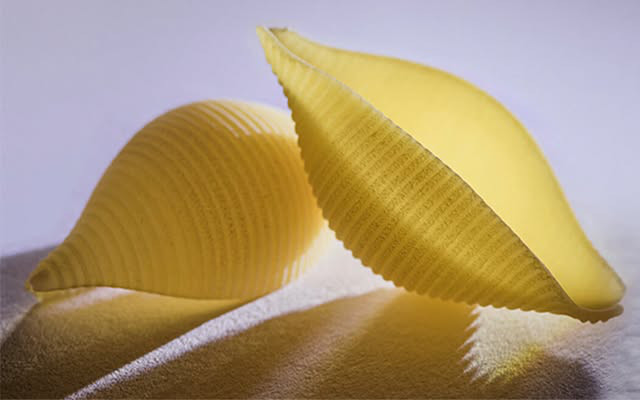
Italy is the world's leading producer and exporter of Pasta. In 2025, national production reached 4.2 million tonnes, 60% of which was destined abroad, for a supply chain with a turnover of 13.5 billion euros (TEHA Group, 2026). At the base there is the durum wheat, the primary raw material of pasta and one of the country's main crops, which the industry integrates with imported wheat to serve markets around the world.
Below is the overview of the supply chain: the production of wheat, the rules on the origin on the label, the quality of the raw material, exports and the environmental footprint of the pasta.
Italian durum wheat and imports
The durum wheat remains one of the main national crops, with over 1.1 million hectares, and the Italy expresses the 43,2% of the production of European Union. Over the last twenty years, the cultivated area has reduced by 15.5% and production by 9.3%, while the yield per hectare has grown by 7.4%. According to Istat, durum wheat maintains relative stability thanks to the strong link with the pasta industry, one of the most export-oriented Italian agri-food sectors (Istat, 2026).
However, Italian wheat production is not enough to meet needs. In 2025 the imports of wheat, both hard and soft, were approx 9.7 million tons, against one production national of approx 6 million (Istat, 2026).
For pasta the decisive factor is the export: since most of the production is sold abroad, pasta factories combine national wheat with foreign batches, selected on the basis of protein quality and the technological characteristics required by the different formats.
Alongside pasta produced with blends of grains, the offer of lines with is growing 100% Italian wheat, often supported by supply chain contracts between farmers, mills and pasta factories. These are voluntary choices of the producers, which add to the legal obligations and enhance the connection with the territory.
The origin of the wheat on the label
For semolina pasta produced and marketed in Italy, there is a national regime for the mandatory indication of the origin of wheat. The label must contain two words:
- The 'Wheat growing country', i.e. the country in which the durum wheat was grown, and
- The 'Milling town', i.e. the country in which the semolina was obtained (interministerial decree of 26 July 2017, art. 2).
When operations take place in multiple countries, the words 'EU', 'non-EU' And 'EU and non-EU'; if at least 50% of the wheat was grown in a single country, the name of that country can be indicated followed by 'and other countries' EU, non-EU or EU and non-EU (interministerial decree 26 July 2017, art. 3). The rules do not apply to products legally manufactured or marketed in another member state or in a third country (interministerial decree 26 July 2017, art. 6).
The scheme is experimental in nature – in theory, at least – and is extended from year to year. The latest extension decree, signed on 26 December 2025 by the ministers of Agriculture, Business and Health, set the deadline for 31 December 2026, in the declared expectation of the revision of the European regulation on food information which, moreover, falls outside the programs of the European Commission. It applies to durum wheat pasta of the Presidential Decree. 187/2001, with the exception of fresh pasta and those provided for in article 12 of the same decree (interministerial decree of 26 December 2025, articles 1-2).
Furthermore, at European level there is a specific rule for indicating the origin or provenance of the primary ingredient. When the label indicates on a voluntary basis - even with flags, symbols or other images - the origin of the food (e.g. 'Made in Italy') and it does not coincide with the origin of its primary ingredient, it must report in the same field of vision the information of this diversity or the origin of the latter (EU Reg. 1169/2011, art. 26.3; EU Executive Reg. 2018/775, art. 2).
The quality of the raw material and the controls
Italian law sets precise requirements for durum wheat semolina intended for pasta, with a maximum humidity of 14.50% and proteins at least 10.50% on the dry substance (Presidential Decree 187/2001, art. 2). These requirements apply to any semolina, regardless of the origin of the grain.
Likewise, the maximum levels of contaminants like mycotoxins, they apply to all cereals placed on the European Union market, whether national or imported (EU regulation 2023/915). The system of official controls verifies compliance along the entire supply chain, from imports to processing (EU regulation 2017/625).
Pasta companies integrate public controls with their own sampling plans for each batch of wheat, a prerequisite for the safety and consistent quality of the product.
The export of Italian pasta in 2025
In 2025 the exports of Italian pasta have achieved 2.457 million tons, growing by 2.1% over 2024, for a value of 3,969 million euros. Approximately 1.3 million tonnes were destined for European Union countries, the rest for third countries. The first market is Germany with 466,422 tonnes (+3.7%), followed by the United States with 315,018 tonnes (+4.3%), France with 292,341 tonnes (+4.7%) and the United Kingdom with 279,342 tonnes (-1.4%) (Teleborsa, 2026, based on Unione Italiana Food processing of Istat data).
THE'Italy is the first exporter to the world of pasta, with a share of 27,7% of the global market, (MAECI, 2026). Success rests on the reputation of Italian pasta and on an offer that extends from classic semolina pastas to lines wholemeal and semi-wholemeal, organic and from ancient grains. Complete supply chain data is collected in the GIFT analysis on World Pasta Day 2026.
The carbon footprint of pasta
There carbon footprint of dried pasta was measured with life cycle analysis. In environmental product declarations, the footprint from the cultivation of wheat until it leaves the pasta factory varies from 0.57 to 1.72 kg of CO₂ equivalent per kilo of pasta. A study on an organic pasta produced by a pasta factory in southern Italy, extended to domestic consumption and disposal of the packaging, estimated a minimum value of 1.74 kg of CO₂ equivalent per kilo (Cimini et al., 2019).
The same study identifies two key phases: up to the pasta factory, the cultivation of wheat is especially important; throughout the entire life cycle, domestic cooking and the end of life of packaging weigh more heavily. More efficient cooking, wheat grown with lower impact techniques and renewable energy in the pasta factory have reduced the footprint by around 58%, and the transition from road to rail transport has reduced it by a further 5% (Cimini et al., 2019). Part of the improvement therefore depends on the consumer, who can also contain energy consumption with cooking with the heat off.
A supply chain open to the world
The Italian pasta supply chain combines an agriculture that produces almost half of European durum wheat, an industry that transforms and exports over half of its production and labeling rules that inform the consumer about the origin of the raw material. Supply chain contracts, measurement of the environmental footprint and transparency on origin are the tools with which the sector strengthens the value of Made in Italy on international markets.
Companies that intend to enhance the origin of the grain, the supply chains and the environmental performance of their products on the label and in commercial communication can count on the consultancy activities of our team of DO (Food and Agriculture Requirements) for the strategic planning of compliance, also with support for the development of systems governance company and operating procedures.
Dario Dongo
Credit cover Granoro
References
Scientific sources
Cimini, A., Cibelli, M., & Moresi, M. (2019). Cradle-to-grave carbon footprint of dried organic pasta: Assessment and potential mitigation measures. Journal of the Science of Food and Agriculture, 99, 5303-5318. https://doi.org/10.1002/jsfa.9767
Statistical and market sources
Istat (2026, 4 September). Agricultural and livestock production. Year 2025. Press release. https://www.istat.it/comunicato-stampa/produzioni-agricole-e-zootecniche-anno-2025/
MAECI, Ministry of Foreign Affairs and International Cooperation (2026). Cibus Tec joint infographic. MAECI Economic Observatory based on Istat data. https://www.esteri.it/wp-content/uploads/2026/10/InfograficaCongiunta_CibusTec.pdf
TEHA Group (2026). Pasta Value. What contribution of the pasta industry supply chain to Made in Italy. Presentation by Benedetta Brioschi for Unione Italiana Food, Milan, 28 September 2026
Teleborsa (2026, April 23). Italian pasta: 2025 exports at 2.46 million tonnes. https://www.teleborsa.it/News/2026/04/23/pasta-italiana-export-2025-a-2-46-milioni-di-tonnellate-215.html
European Union regulatory sources
Commission Implementing Regulation (EU) 2018/775 of 28 May 2018 laying down rules for the application of Article 26(3) of Regulation (EU) No 1169/2011 of the European Parliament and of the Council on the provision of food information to consumers, as regards the rules for indicating the country of origin or place of provenance of the primary ingredient of a food. OJ L 131, 29.5.2018. http://data.europa.eu/eli/reg_impl/2018/775/oj
Commission Regulation (EU) 2023/915 of 25 April 2023 on maximum levels for certain contaminants in food. Consolidated text: 08/10/2025. http://data.europa.eu/eli/reg/2023/915/2025-10-08
Regulation (EU) 2017/625 of the European Parliament and of the Council of 15 March 2017 on official controls and other official activities. Consolidated text: 05/01/2025. http://data.europa.eu/eli/reg/2017/625/2025-01-05
Regulation (EU) No 1169/2011 of the European Parliament and of the Council of 25 October 2011 on the provision of food information to consumers. Consolidated text: 04/01/2025. http://data.europa.eu/eli/reg/2011/1169/2025-04-01
Italian regulatory sources
Decree of the Minister of Agricultural, Food and Forestry Policies and of the Minister of Economic Development 26 July 2017. Indication of the origin, on the label, of durum wheat for durum wheat semolina pasta. Official Journal no. 191 of 08/17/2017
Decree of the Minister of Agriculture, Food Sovereignty and Forestry, in agreement with the Minister of Business and Made in Italy and with the Minister of Health, 26 December 2025. Extension of the experimental regimes of the indication of origin to be reported on food labels. Official Journal no. 34 of 11/02/2026
Decree of the President of the Republic 9 February 2001, n. 187. Regulation for the revision of the legislation on the production and marketing of flours and pasta, pursuant to article 50 of law 22 February 1994, n. 146. Regulatory. Latest consolidated version: 12/14/2018. https://www.normattiva.it/uri-res/N2Ls?urn:nir:presidente.repubblica:decreto:2001-02-09;187
GIFT Insights
Dongo, D. (2026, October 29). World Pasta Day 2026, the pasta supply chain in numbers. GIFT. https://www.greatitalianfoodtrade.it/pasta/world-pasta-day-2026-filiera/

Dario Dongo, lawyer and journalist, PhD in international food law, founder of WIISE (FARE - GIFT – Food Times) and Égalité.


