

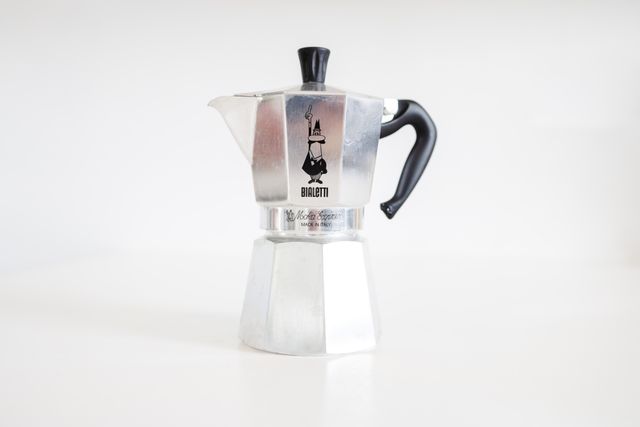
There mocha it is the stovetop coffee maker patented by Alfonso Bialetti in 1933, in which the pressure of the air and steam in the boiler pushes the hot water through the ground coffee to the upper collector. It replaced the Neapolitan coffee maker and is today present in approximately nine out of ten homes in Italy, according to Bialetti, with over 500 million pieces sold (Farina, 2026).
This guide reconstructs the history of the Italian moka, explains how it works and how to best prepare it, what changes between aluminum and steel, which models have marked the design and innovation, how much it is worth on the market and how much a cup costs compared to capsules and pods.
From Neapolitan to moka
Before the moka, the most common coffee maker in Italian homes was the Neapolitan, in Naples called cuccumella (Crippa & Di Prete, s.d.; S. F., 2023). Despite her name and historical celebrity, she is Neapolitan born in Paris: The Mémorial universel de l’industrie française of 1820 describes the 'double filter coffee maker without evaporation' patented by the tinsmith Morize, active in rue Boucher, near the Louvre (Linkiesta, 2020).
There Neapolitan work by gravity: when the water boils in the boiler, the coffee maker is turned upside down and the water drops, passing through the coffee, without pressure. In the moka, however, the water rises, rather than falls, driven by the pressure, and the coffee is prepared without turning the coffee maker upside down.
The Cusio and the birth of the Moka Express
The moka was born in a district that had been producing household objects for almost a century. Around Omegna, on Lake Orta, in Piedmont, Calderoni was founded in 1851 in Casale Corte Cerro as the first housewares company in the Cusio district, Lagostina started production in 1901 and Alessi was born in 1921 as FAO, Fratelli Alessi Omegna (Crippa & Di Prete, s.d.). Alfonso Bialetti (1888-1970), born in Montebuglio, worked as a young man in French foundries - where he learned aluminum shell casting - and in 1919 opened a workshop for semi-finished aluminum products in Crusinallo (Il Post, 2013; Pratesi, 2025).
In 1933 Bialetti patented the Moka Express, developed with the contribution of the inventor Luigi De Ponti; the octagonal shape of the original patent has remained substantially unchanged (Pratesi, 2025). The name recalls Mokha, the Yemeni port on the Red Sea linked for centuries to the coffee trade, and the most widespread story attributes the idea to his observation of his wife doing the laundry with her lisciveuse, where the boiling water pushed by the steam rose from a central pipe and fell onto the laundry (Pratesi, 2025). Between 1936 and 1940 the foundry produced around ten thousand coffee pots a year, sold by Alfonso personally at fairs and markets (Pratesi, 2025).
The mass diffusion arrives in the post-war period with the son Renato Bialetti: under his leadership, since 1946, production went from around ten thousand coffee pots a year to eighteen thousand a day (S. F., 2023). In 1953 Paul Campani designed the little man with a mustache, a caricature of Renato himself that the Carosello television commercials made popular (AGI, 2016). From the 1950s to 2013, it is estimated that around 300 million moka pots were sold (Il Post, 2013). And still the Forum of Omegna, home of the Arts and Industry Museum Foundation, preserves objects, patents and advertising from the district (Crippa & Di Prete, s.d.).
How the moka works
The moka is made up of three parts:
- There water heater lower, with the safety valve;
- The funnel filter which contains ground coffee;
- The collector superior.
By heating the boiler, the temperature of the water and the pressure of the air and steam mixture in the space above the liquid increase. When this pressure overcomes the resistance of the coffee panel inserted in the filter, the water rises up the funnel, passes through the powder and flows into the collector.
Gianino (2007) described the process with the liquid-vapor state equation of water and with Darcy's law on filtration: the flow rate depends on the pressure difference and the resistance of the coffee cake, and this is why a coffee pressed or ground too finely slows down or blocks the delivery.
King (2008) then showed that the pressure in the boiler grows more slowly than the saturated vapor pressure of water and identified the filling conditions that allow coffee to be extracted at 90-95 °C.
Navarini et al. (2009) verified that extraction begins at relatively low temperatures - even before boiling, depending on the air present in the boiler at the beginning - and that the permeability of the coffee cake decreases during brewing.
There pressure it remains anyway modest compared to that of espresso at the bar, which the Istituto Nazionale Espresso Italiano sets at 9 bar ± 2, with water at 88 °C ± 2 and percolation of 25 seconds ± 5 (Istituto Nazionale Espresso Italiano, 2006). The moka therefore produces a full-bodied coffee but different from expressed, without cream except in models with valve.
How to prepare coffee with the moka
The mixture and the grinding
Bialetti recommends a mixture toasted in a slow and controlled way and a medium-coarse grind, to avoid the burnt taste; and it's important store the coffee in a cool, dry place, away from air, humidity and heat (Muraca, 2024). Quality is not always associated with price: in the Altroconsumo test on 15 ground coffees for moka, sold between 10.92 and 28.81 euros per kg, the most expensive obtained 72 points and one of the cheapest 70; none of the packaging precisely indicated the origin of the beans nor the proportion between arabica and robusta (Altroconsumo, 2026). To orient yourself among the blends, GIFT has dedicated an in-depth analysis to types of coffee in Italian blends.
How much coffee and how much water
The filter it must be filled to the brim, forming a small pile just above the edge, without pressing dust (Altroconsumo, 2022): a panel that is too compact increases the resistance to the passage of water (Gianino, 2007). Altroconsumo calculates approximately 7 g of ground coffee per cup (Altroconsumo, 2026). There water heater it must be filled up to just below the safety valve, which should never be covered.
It also matters the type of water. Bialetti indicates water low in calcium and magnesium, to limit limescale. Giovanni Ballarini, professor emeritus of the University of Parma, suggests medium hard water, free of chlorine and odors: calcium gives body to the coffee, while an excess of magnesium can make it bitter; a natural mineral water type oligomineral (with fixed residue less than 500 mg/l), non-carbonated, or tap water if necessary filtered and left to rest in the refrigerator in an open container, so that the chlorine disperses (Ballarini, 2021).
On the initial water temperature the indications differ. Bialetti recommends water at room temperature. King's experiments (2008) indicate that preheating the water to around 70 °C and leaving at least 100 ml of air in the boiler allows for a hotter extraction, closer to the 90-95 °C that the author indicates as the objective. Starting from cold water, the extraction begins before boiling, at lower temperatures (Navarini et al., 2009).
Cooking
There flame must be kept low and constant and must not exceed the base of the coffee maker, so as to heat uniformly and protect the handle (Altroconsumo, 2022). The moka should be removed from the heat when the bubbling begins to subside and the container is almost full.
The final puff of steam – also called the 'Strombolian phase', from the name of the Stromboli volcano, on the Aeolian islands in the province of Messina – gives the coffee a bitter and burnt aftertaste (Domus, 2015). Before pouring, the coffee must be mixed in the collector with a teaspoon, since the part released first is more concentrated than the final one (Altroconsumo, 2022).
Cleanliness
The moka can be washed by hand - not in the dishwasher - with very hot water, without abrasive sponges, separating the pieces and leaving them to dry before reassembling it; Altroconsumo recommends a non-scented detergent only if the water is not enough, while Bialetti advises against detergents and dishwashers (Altroconsumo, 2022; Bialetti, s.d.). Upon first use, the manufacturer recommends preparing and discarding at least three coffees (Bialetti, s.d.). The gasket and filter must be replaced when they lose their seal or become deformed.
Aluminium, steel and induction
The first models were in aluminum, light metal that heats quickly; Bakelite handle and knob do not retain heat (S. F., 2023). THE'stainless steel, more resistant and less subject to corrosion (S. F., 2023), enters the design of the moka with the 9090 by Richard Sapper for Alessi from 1979, in 18/10 steel, with a wider conical base that collects and distributes the heat better (Museo Tattile Statale Omero, s.d.). La Conica by Aldo Rossi, from 1984, then combines steel with a copper background (Ghianda, 2018).
The choice of metal today depends above all on the stove. THE induction hobs require a ferromagnetic bottom, which aluminum alone does not have: for this reason there are mokas made entirely of steel, aluminum models with a steel bottom and the Bialetti Induction Moka with anodized aluminum boiler (S. F., 2023). Bialetti has also brought the original octagonal shape to induction, with the Moka Exclusive Octagonal Induction (Beverfood, 2026).
The innovations: electric moka, valves and new geometries
The moka has also changed in its mechanisms. Between 1950 and 1954 Bialetti filed the patents for an automatic coffee maker and a lever closure (Crippa & Di Prete, s.d.). Already in 1963 Girmi, another company from Omegna, presented the Espresso con stakbloc, an electric coffee maker with a patented automatic plug designed not to burn the aroma (Crippa & Di Prete, s.d.). There electric version of the moka is today in the catalog with the Moka Elettrika by Bialetti, which maintains the shape of the Moka Express on a 230 V heating base for offices, travel, campers and boats (Bialetti, s.d.-a).
Other innovations concerned the extraction:
- the Bialetti Brikka features a valve on the column that delivers the coffee at approximately double the pressure compared to the traditional moka, with a layer of cream of approximately 3 mm (Bialetti, s.d.);
- the Pulcina by Michele De Lucchi for Alessi (2015), developed with the illycaffè laboratory, has an internal geometry that completes dispensing by avoiding the final puff of steam and a V-shaped spout that does not drip (Domus, 2015; Beverfood, 2015).
The moka in Italian design
The Moka Express entered the collection of the Museum of Modern Art in New York, with an example donated by the manufacturer in 2008 (Museum of Modern Art, n.d.). For designer Giulio Iacchetti, 1979 marked the turning point in the design of coffee makers (Design Diffusion, 2019), with two models:
- There 9090 by Richard Sapper, Alessi's first product for the kitchen and the company's first Compasso d'Oro, which opens and closes by grasping the handle and rotating, with a tooth above the valve and a pin on the opposite side in place of the thread (Museo Tattile Statale Omero, s.d.; Dezeen, 2016); Alberto Alessi defined it as a tribute to his maternal grandfather, Alfonso Bialetti (Dezeen, 2016);
- There Carmencita by Marco Zanuso for Lavazza, cone-shaped (Corigliano, 2023; Museimpresa, s.d.).
Aldo Rossi's coffee makers were born from the Tea & Coffee Piazza project, started in 1979 by Alessandro Mendini for Alessi: The Conic (1984), a cylinder surmounted by a cone that recalls his Teatro del Mondo for the Venice Biennale, and The Dome (1988) (Acorn, 2018). This is followed by, among others, Vesuvius in resin by Gaetano Pesce (1992), La Zaniezani by Ettore Sottsass (1998) and Ossidiana by Mario Trimarchi for Alessi (2014), with faceted surfaces inspired by volcanic stone (Corigliano, 2023).
Iacchetti brought together twenty-four designer coffee makers in the exhibition 'The coffee makers of the masters', held in Milan in 2019 (Design Diffusion, 2019), which became a book published by Corraini in 2026 (Giossi, 2026).
Uses and markets in Italy and abroad
In Italy The ground coffee in bag, the typical moka format, remains the first in terms of volumes. In modern distribution, according to the processing of Beverfood.com on Circana data, in 2024 approximately 113.9 thousand tons of coffee (-2%) for 1.806 billion euros (+9%): ground coffee in bags is worth around 65% of the volumes but 43% of the value, at an average price of 10.55 euros per kg, while capsules and pods account for 23% of the volumes and 46% of the value, at over 31 euros per kg (Beverfood.com, 2025). At the end of 2024, 50.6% of families in Italy owned a capsule machine and 26.4% a pod machine (YouGov, 2025): the moka coexists with single-portion machines, often in the same kitchen. Since 2026 Bialetti has been promoting the Mocha Day, on April 21st, coinciding with the closing of the Milan Design Week (Farina, 2026).
Abroad the market is more difficult to measure. Estimates from private market research firms diverge: Verified Market Research estimates the world market of moka pots at 318.6 million dollars in 2025, with Europe around 38% (Verified Market Research, 2026), while DataHorizzon Research estimates it at 851.2 million dollars in 2024 (DataHorizzon Research, 2024). The marked difference reflects different perimeters and methods, and the two data must be read as orders of magnitude. The numbers of Bialetti, the main manufacturer, are more concrete: in 2025 the group's revenues grew by 10.8%, with +11% in the moka and coffee maker segment, +12.5% in Europe and +13% in the United States despite the duties (Beverfood, 2026).
In April 2025 Nuo Octagon, a company attributable to New Capital, a Luxembourg-based fund controlled by Chinese entrepreneur Stephen Cheng and linked to family office World-Wide Investment Company of Hong Kong (Pulcini, 2025), has signed the agreements to acquire 78.567% of Bialetti Industrie as part of the debt refinancing (Il Sole 24 Ore, 2025). After the mandatory public takeover offer at 0.467 euros per share, Octagon BidCo, controlled by Nuo Capital and the Guerrand-Hermès family, rose to 96.431% of the capital (Vercesi, 2025) and Bialetti shares exited Euronext Milan on 7 August 2025 (SoldiOnline, 2025). In 2025, net financial debt fell from 114.5 to 69.6 million euros (Beverfood, 2026).
How much does a coffee with mocha cost
The economic advantage of the moka derives from the price of powdered coffee compared to portioned coffee. Altroconsumo estimates an average cost of around 12 euro cents per cup for the mocha - between 8 and 20 cents, depending on the blend - compared to around 28 cents for the capsules, between 14 and 47 cents (Altroconsumo, 2026). With the average price of ground coffee in modern distribution, 10.55 euros per kg (Beverfood.com, 2025), 7 g of coffee costs just over 7 cents. At the bar, in 2026, an espresso in Italy generally costs between 1.20 and 1.40 euros (Di Mario, 2026).
On an annual basis the difference is significant: for a family that drinks six coffees a day, ai average costs indicated by Altroconsumo, the moka costs around 263 euros a year compared to around 613 euros for capsules (GIFT processing on Altroconsumo data, 2026). The advantage remains even after the price increases: according to Istat data reported by Altroconsumo, the price of coffee for domestic use increased by 21% in 2025 and by 44% from 2021 (Di Mario, 2026).
A home ritual in Italy
The presence of the moka pot in almost all Italian homes is explained by practical reasons and by the habit handed down for generations. The cost per cup is modest, the operation is simple as is the supply, the maintenance is limited to the periodic replacement of the seal and filter. With the advantage of being able to prepare multiple cups at once, with a tailor-made moka for family breakfast.
Purchases of coffee for the home are more widespread among mature consumers: penetration reaches 90% between 55 and 64 years of age and 88% over 64, compared to 76% under 34 years of age (YouGov, 2025). The mocha can be used with any ground coffee, too decaffeinated, and GIFT delved into the potential effects of regular consumption in the article about coffee and longevity.
Frequently asked questions about the moka
Does the moka make espresso?
No. Espresso requires a pressure of around 9 bar, generated by a pump (Istituto Nazionale Espresso Italiano, 2006), while in the moka the water is pushed only by the steam from the boiler, at much lower pressures (Navarini et al., 2009). The result is a concentrated but different coffee, without cream except in models with a valve such as the Brikka (Bialetti, s.d.).
How much caffeine is there in a coffee made with a mocha?
It depends on the mixture, dose and volume. A study comparing Neapolitan, mocha, espresso and American coffee measured, for a mocha prepared with 11.3 g of arabica, approximately 1.68 g of caffeine per liter (equal to approximately 67 mg in a 40 ml cup), compared to 2.44 g per liter (+45%) for espresso and 1.30 g per liter (-23%) for Neapolitan (Caporaso et al., 2014; Olechno et al., 2021). A more recent review places mocha and espresso among the methods with the highest caffeine content (Mystkowska et al., 2024).
How much coffee is needed for a cup?
Approximately 7 g of ground coffee per cup (Altroconsumo, 2026), with the filter filled to the brim and without pressing (Altroconsumo, 2022).
Can the moka be used on induction?
Only if the bottom is ferromagnetic: stainless steel moka, aluminum models with steel bottom or dedicated versions such as the Moka Induction and the Moka Exclusive Octagonal Induction by Bialetti (S. F., 2023; Beverfood, 2026).
Can the moka be washed with detergent?
Better not: Bialetti indicates hot water and no dishwasher (Bialetti, s.d.), Altroconsumo allows a non-scented detergent only if the water is not enough (Altroconsumo, 2022).
Conclusions
The moka replaced the Neapolitan coffee maker thanks to a simple principle, a material suitable for industrial production and television communication that made it familiar. It is prepared well with little attention: medium-coarse grinding, full but not pressed filter, slightly calcareous water up to the valve, low flame and coffee pot removed from the heat before the final puff. It costs less than half of the cup capsules, is suitable for induction with steel and continues to inspire designers: this is why it remains the home coffee maker of Italians.
Dario Dongo
References
Technical and institutional documents
Bialetti. (s.d.). Brikka: instructions for use. https://cdn.shopify.com/s/files/1/1656/1527/files/Bialetti_Brikka_User_Guide.pdf
Bialetti. (s.d.-a). Moka Elettrika. https://www.bialetti.com/it_it/moka-elettrika.html
National Italian Espresso Institute. (2006). The Certified Italian Espresso and Cappuccino (Supplement to L'Assaggio, n. 16). Taster Study Center. https://www.nespressoguide.com/files/File/istituzionale_inei_hq_en.pdf
Scientific studies
Caporaso, N., Genovese, A., Canela, M. D., Civitella, A., & Sacchi, R. (2014). Neapolitan coffee brew chemical analysis in comparison to espresso, moka and American brews. Food Research International, 61, 152-160. https://doi.org/10.1016/j.foodres.2014.01.020
Gianino, C. (2007). Experimental analysis of the Italian coffee pot 'moka'. American Journal of Physics, 75(1), 43-47. https://doi.org/10.1119/1.2358157
King, W. D. (2008). The physics of a stove-top espresso machine. American Journal of Physics, 76(6), 558-565. https://doi.org/10.1119/1.2870524
Mystkowska, I., Dmitrowicz, A., & Sijko-Szpańska, M. (2024). Quantitative analysis of caffeine in roasted coffee: A comparison of brewing methods. Applied Sciences, 14(23), 11395. https://doi.org/10.3390/app142311395
Navarini, L., Nobile, E., Pinto, F., Scheri, A., & Suggi-Liverani, F. (2009). Experimental investigation of steam pressure coffee extraction in a stove-top coffee maker. Applied Thermal Engineering, 29(5-6), 998-1004. https://doi.org/10.1016/j.applthermaleng.2008.05.014
Olechno, E., Puścion-Jakubik, A., Zujko, M. E., & Socha, K. (2021). Influence of various factors on caffeine content in coffee brews. Foods, 10(6), 1208. https://doi.org/10.3390/foods10061208
Guides and consumer tests
Altroconsumo. (2022, July 18). How to prepare an excellent coffee with the moka. https://www.altroconsumo.it/alimentazione/caffe/consigli/come-preparare-un-ottimo-caffe-con-la-moka
Altroconsumo. (2026, October 8). Ground coffee compared: is the most expensive really the best? https://www.altroconsumo.it/alimentazione/capsule-caffe/news/caffe-macinato-per-moka
Ballarini, G. (2021, September 24). Coffee, to make it good you need the right water: which one to choose? The Food Fact. https://ilfattoalimentare.it/caffe-acqua.html
Di Mario, M. (2026, October 1). Coffee: it costs more and more, at the bar and at home. Prices city by city. Altroconsumo. https://www.altroconsumo.it/alimentazione/fare-la-spesa/news/aiuto-costo-caffe
History, design and culture
AGI. (2016, February 11). Moka Pot 'ambassador' Renato Bialetti dies aged 93. https://www.agi.it/international/2016/02/11/news/moka_pot_ambassador_renato_bialetti_dies_aged_93-513265
Beverfood. (2015, June 27). Alessi and illy present Pulcina, the innovative moka capable of enhancing the aroma of coffee. https://www.beverfood.com/alessi-e-illy-presentano-pulcina-linnovativa-moka-in-grado-di-esaltare-laroma-del-caffe-wd48023/
Corigliano, N. (2023, March 10). The absolutes: 21 coffee makers that made the history of design... and coffee. Domus. https://www.domusweb.it/it/speciali/assoluti-del-design/gallery/2023/design-caffettiere-che-fatto-storia-caff%C3%A8.html
Crippa, D., & Di Prete, B. (eds.). (s.d.). Permanent collection of the Museum of Arts and Industry (The Ecomuseum notebooks, n. 5). Ecomuseum of Lake Orta and Mottarone. https://forumomegna.it/wp-content/uploads/2022/04/catalogo-forum.pdf
Design Diffusion. (2019, September 30). Giulio Iacchetti: architects and the coffee ritual. https://designdiffusion.com/en/?p=19461
Dezeen. (2016, January 5). Remembering Richard Sapper: 9090 espresso maker for Alessi. https://www.dezeen.com/2016/01/05/remembering-richard-sapper-9090-espresso-maker-alessi/
Domus. (2015, July 3). Michele De Lucchi: Pulcina. https://www.domusweb.it/it/notizie/2015/07/03/michele_de_lucchi_pulcina.html
Acorn, M. L. (2018, July 22). The Conica coffee maker by Aldo Rossi. Doublezero. https://www.doppiozero.com/la-caffettiera-conica-di-aldo-rossi
Giossi, G. (2026, May 9). Once the coffee is made, let's make the mocha. The challenge of every designer, in a book by Giulio Iacchetti. The Sheet. https://www.ilfoglio.it/terrazzo/2026/05/09/news/fatto-il-caffe-si-faccia-la-moka-la-sfida-di-ogni-designer-in-un-libro-di-giulio-iacchetti–389494
Museimpresa. (s.d.). Carmencita coffee maker, Marco Zanuso, 1979. Google Arts & Culture. https://artsandculture.google.com/asset/caffettiera-carmencita-marco-zanuso-balzano/lQFt-cHQzmVz_g
Homer State Tactile Museum. (s.d.). 9090. https://museoomero.it/en/opere/9090/
Museum of Modern Art. (s.d.). Alfonso Bialetti, Moka Express, 1933 (431.2008). https://www.moma.org/collection/works/118645
Pratesi, L. (2025, April 13). The forgotten of art. The story of the entrepreneur Alfonso Bialetti who invented the Moka. Artribune. https://www.artribune.com/?p=1149654
S. F. (2023, January 16). The Bialetti Moka: the design object of the last romantics. Windows on Art. https://www.finestresullarte.info/opere-e-artisti/moka-bialetti-oggetto-design-ultimi-romantici
Market and business
Beverfood. (2026, May 8). Bialetti closes 2025 with growth, revenues at +10.8% and debt almost halved. https://www.beverfood.com/bialetti-chiude-2025-growth-ricavi-debito-dimezzato/
Beverfood.com. (2025, October 8). Beverfood.com: Italian coffee market 2024; channels intended for domestic consumption. https://www.beverfood.com/caffe-italiano-mercato-domestico-2024-tendenze/amp
DataHorizzon Research. (2024, October 29). Moka pots market. https://datahorizzonresearch.com/moka-pots-market-21232
Farina, F. (2026, April 14). Moka Day is born, the first day dedicated to the icon of Italian design. The Voice of New York. https://lavocedinewyork.com/new-york/2026/04/14/nasce-il-moka-day-la-prima-giornata-dedicata-allicona-del-design-italiano/
Il Sole 24 Ore. (2025, April 16). Bialetti passes to the Chinese, agreement with Nuo Capital. https://en.ilsole24ore.com/art/bialetti-passes-chinese-agreement-nuo-capital-AHSGR4L
Pulcini, A. (2025, April 16). Bialetti, the Italian mocha is Chinese. Another farewell for Piazza Affari. Fortune Italy. https://www.fortuneita.com/?p=356542
MoneyOnline. (2025, July 29). Bialetti Industrie takeover bid, the definitive results. Delisting on August 7, 2025. https://www.soldionline.it/notizie/azioni-italia/opa-bialetti-industrie-risultati
Vercesi, F. (2025, July 28). Opa Bialetti closes with Octagon Bidco at 96.431%. Delisting soon. BeBeez. https://bebeez.it/crisi-rilanci/opa-bialetti-chiude-con-octagon-bidco-al-96431-a-breve-il-delisting/
Verified Market Research. (2026). Moka pots market size and forecast. https://www.verifiedmarketresearch.com/product/moka-pots-market/
YouGov. (2025, September 25). Coffee in Italy: an evolving daily ritual. https://yougov.com/it-it/articoli/53049-il-caffe-in-italia-un-quotidiano-ritual-in-evolution

Dario Dongo, lawyer and journalist, PhD in international food law, founder of WIISE (FARE - GIFT – Food Times) and Égalité.


