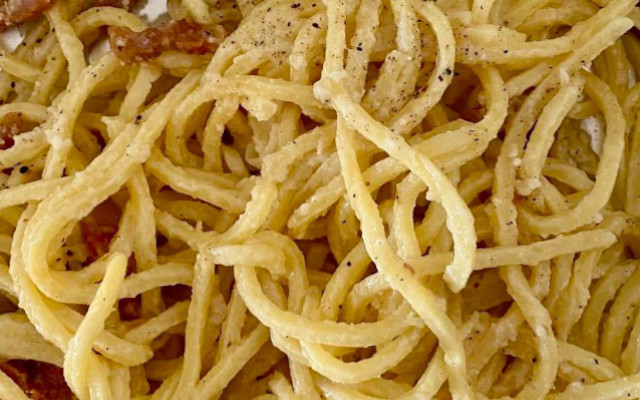
For those visiting Rome, the encounter with pasta alla Carbonara and Gricia is an essential cultural rite, a genuine immersion in Italian cuisine celebrated by UNESCO. These iconic Made in Italy dishes stem from a precise historical evolution of popular recipes and from a rigorous chemical-physical balance. Understanding the material culture that brings together guanciale, Pecorino Romano PDO and durum wheat pasta makes it possible to turn a meal into an act of awareness and to distinguish genuine tradition from tourist imitations.
From the transhumance of the Apennines to the sets of Roman cinema
The Gricia is generally considered the oldest of the great Roman pasta dishes. Its origin is linked to the transhumant shepherds of the central Apennines — particularly the area between Lazio and Abruzzo — who travelled the seasonal droving trails carrying with them storable, nourishing foods: dried pasta, cured guanciale, pecorino and black pepper. The name may derive from Grisciano, a small hamlet in the municipality of Accumoli (Rieti), where on 18 August the ‘griscia’ festival is still celebrated today, with the dialect term having prevailed over time over the original form. There is, however, a second, equally documented hypothesis: from the fifteenth century onwards, the term ‘gricio’ designated in Rome the street vendors of bread and foodstuffs from the Swiss canton of Grisons, recognisable by the characteristic grey dustcoat known as griscium.
The Carbonara has more controversial and decidedly more recent origins. The dish does not appear in the main Italian recipe books predating the Second World War. Ada Boni does not mention it in the first edition of La cucina romana of 1930, and Pellegrino Artusi's own Scienza in cucina ignores it altogether. The first mention of the name in a public context dates back to 1949, in the film Yvonne la nuit con Totò, where a waiter from a restaurant Trastevere orders ‘spaghetti alla carbonara for three’. Two years later, in 1951, it was Aldo Fabrizi who consecrated its burgeoning fame in the comedy Cameriera bella presenza cercasi (directed by Giorgio Pastina, with a story by Federico Fellini among others): in the role of Commendator Marchetti, Fabrizi questions the maid Maria — an innocently clueless Elsa Merlini — asking her whether she knows how to make spaghetti alla carbonara. The woman’s negative answer was, at that time, plausible: unlike amatriciana, Carbonara was still anovelty.
The first published recipe in Italy appeared in August 1954 in the magazine La Cucina Italiana, with ingredients that today would horrify purists: spaghetti, eggs, pancetta, gruyère and garlic. The modern recipe — guanciale, Pecorino Romano, egg yolks, black pepper, nothing else — only became established between the 1960s and 1970s, through a process of progressive purification from post-war contaminations.
Seventy years later, the whole world would try to find itself at the table through Roman recipes: in 2010, in Eat Pray Love (Ryan Murphy), a Julia Roberts in existential crisis arrives in Rome and surrenders to the pleasures of the capital’s cuisine — cacio e pepe, spaghetti, red wine — as therapy for the soul. The film is steeped in clichés, but it captures something true: there is in the radical simplicity of Roman dishes something that resembles a promise of authenticity, in an age in which the authentic is a rare commodity.
The historical path that consolidated the modern recipe
The Gricia is often described as the ‘white ancestor’ of Amatriciana and Carbonara. Its structure è essential: durum wheat semolina pasta, guanciale, Pecorino Romano PDO, black pepper. The absence of tomato and eggs makes the technique particularly demanding: the creaminess depends exclusively on the emulsion between the guanciale fat, the cheese and the starchy cooking water. There are no corrective measures.
Italian gastronomic literature — from Il Cucchiaio d’Argento (Editoriale Domus, 2024) to La Cucina Italiana (Condé Nast Italia, 2024) — now converges on a number of shared principles:
- absolute exclusion of cream;
- preference for Guanciale over pancetta (which is instead favoured for pasta all’Amatriciana);
- creaming strictly off the heat, to avoid the coagulation of the eggs.
The modern codification of Carbonara reflects an evolutionary historical process rather than an immutable recipe: it is the result of decades of collective practice, not of a single specific invention.
The physical and structural properties of Made in Italy ingredients
As is the case with the great traditional Italian preparations, the final quality depends largely on strictly Made in Italy ingredients.
Durum wheat semolina pasta. The pasta must be made from durum wheat semolina, preferably bronze-drawn, with a high cooking resistance. The rough surface promotes the adhesion of the sauce and the starchy emulsion. Spaghetti (more recently replaced by tonnarelli) remains the symbolic shape of Carbonara; rigatoni and mezze maniche are frequently used for both Carbonara and Gricia.
Guanciale. The cured guanciale is the signature ingredient of traditional Roman pasta dishes. Obtained from the pig's cheek, it has a lipid composition distinct from pancetta (obtained from the belly): the cheek is richer in monounsaturated fatty acids, in particular oleic acid, with a lower melting point. The more fluid melting of the fat releases volatile aromatic compounds that form the aromatic base of the sauce.
Pecorino Romano PDO. The cheese historically associated with Roman and Lazio cuisine, produced exclusively with fresh whole sheep's milk from Sardinia, Lazio and the province of Grosseto, secondo il disciplinare di produzione. Its intense savouriness, emulsifying capacity and high protein content make it a technical as well as an aromatic ingredient.
Fresh eggs. In Carbonara the quality of the eggs is decisive. The yolks provide structure, colour, emulsifying capacity and aromatic richness. The predominant use of yolks rather than whole eggs ensures greater creaminess and a lower risk of coagulation during the stirring stage.
Extra virgin olive oil. In the traditional recipes for Gricia and Carbonara, the fat released by the guanciale during cooking is the only lipid base of the preparation: extra virgin olive oil is not included in the codified formulations. In current practice, however, a small amount of EVOO is sometimes added raw before serving, generally to make the condiment more fluid; in this case an oil with a neutral or delicate sensory profile is preferable, so as not to overlap with the aromas of the cured guanciale and the pecorino.
Protecting Italian agri-food authenticity worldwide
The international popularity of Carbonara has generated a proliferation of reinterpretations that would take long to list: cream, bacon, onion, garlic, mushrooms, chicken, vegetables, vegan variants. These contaminations testify to the global success of the dish, but at the same time highlight the cultural value of the original recipes and of the agri-food supply chain that sustains them.
Carbonara and Gricia represent a food model based on simplicity, quality of raw materials, nutritional balance and the valorisation of certified typical productions. In this sense, protecting authentic Made in Italy also involves a proper knowledge of traditional preparations and of their identity-defining ingredients — and the ability to distinguish, without snobbery but with firmness, between a dish and its imitation.
Marta Strinati
References
Boni, A. (1929). La cucina romana: Piatti tipici e ricette dimenticate di una cucina genuina e ricca di fantasia (repr. 2017). Newton Compton. ISBN 9788822772688
Cesari, L. (2019, 7 April). Carbonara: la sua popolarità è merito del cinema. Gambero Rosso. https://www.gamberorosso.it/attualita/carbonara-la-sua-popolarita-e-merito-del-cinema/
Editoriale Domus. (2025). Il Cucchiaio d’Argento (12th ed., 75th anniversary). Editoriale Domus. ISBN 9788833334110
La Cucina Italiana. (1954, August). La Cucina Italiana. [Gosetti sisters’ edition]

A professional journalist since January 1995, she has worked for daily newspapers (Il Messaggero, Paese Sera, La Stampa) and magazines (NumeroUno, Il Salvagente). Author of journalistic investigations on food, she published the book 'Leggere le etichette per sapere cosa mangiamo'.


