

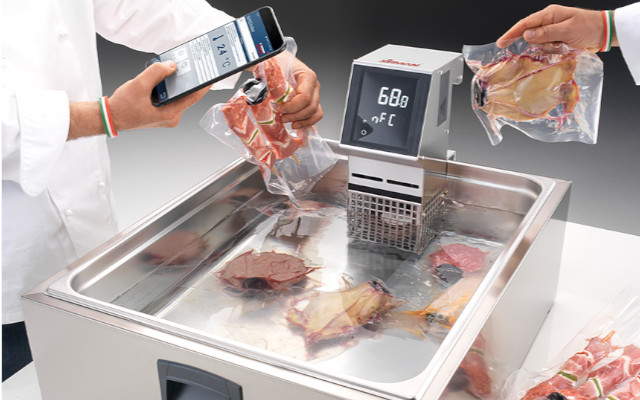
The sous vide cooking — literally 'under vacuum' — at low temperature represents the scientific evolution of conventional heat treatments. This technology preserves the authentic sensory qualities of food and redefines the parameters of modern nutrition, optimizing protein bioaccessibility and protecting bioactive lipids. Through the exact control of the time-temperature combination, sous vide transforms cooking into an exact science, capable of guaranteeing the highest standards of food safety and micronutrient retention.
From the kitchens of Pralus to the laboratories of Goussault: a history of applied science
The sous vide technique was developed in France in 1974 by Georges Pralus — chef consultant for the restaurant Troisgros in Roanne — and initially applied to foie gras, achieving a significant improvement in texture and yield (weight losses
The physicist and researcher in food sciences Bruno Goussault He in turn contributed to the scientific standardization of the method, introducing time-temperature models aimed at ensuring microbiological safety. Goussault took sous vide out of starred kitchens, collaborating with collective catering companies and defining the pasteurization curves which still today constitute the scientific foundation of the technique.
Starting from the 1990s, with the spread ofmolecular haute cuisine — from Heston Blumenthal to Ferran Adrià — sous vide entered the menus of signature restaurants worldwide. A technical revision fundamental one was proposed by Schellekens (1996), who systematized the process parameters and the microbiological and sensory implications of the technology.
In the 2000s and 2010s, the reduction in costs of electronic temperature control devices opened the domestic market. Today immersion circulators (so-called roner) in the consumer segment make sous vide cooking accessible to anyone with a pot of water and a heat-resistant bag. In professional settings, the Italian manufacturer Sirman (Padua) is a consolidated reference with the Softcooker line, appreciated in quality catering.
Meats: tenderness, juiciness, and collagen control
In muscle matrices, sous vide cooking allows fine management of the denaturation of myofibrillar proteins and of the collagen. Temperatures between 54°C and 65°C allow you to obtain tender and juicy meat, reducing water loss compared to conventional methods. Studies on beef have shown that sous vide treatments improve tenderness without compromising nutritional value, thanks to lower thermal degradation of vitamins water-soluble (Vaudagna et al., 2002). Roldán et al. (2013) demonstrated that the controlled combination of time and temperature positively influences the collagen structure and the sensory perception of tenderness in cattle and lambs, with treatments at 60–80 °C for 6–24 hours.
From a physico-chemical point of view, temperature control reduces the contraction of muscle fibers and limits the expulsion of intracellular juices, improving perceived juiciness. A systematic review of ‘low temperature long time’ (LTLT) mechanisms (Dominguez-Hernandez et al., 2018) clarified that denaturation, aggregation, and degradation of myofibrillar, sarcoplasmic, and connective tissue proteins depend on the time-temperature interaction: complete collagen gelatinization occurs at temperatures above 65 °C, while at lower temperatures enzymatic proteolysis, which equally contributes to tenderness.
Protein digestibility: an emerging nutritional advantage
One of the most interesting aspects emerging from recent research concerns the effect of sous vide on digestibility of meat proteins. Unlike high-temperature cooking methods — which induce massive protein aggregation and formation of cross-linked structures that are difficult for digestive enzymes to attack — the LTLT treatment preserves a more accessible protein profile during gastrointestinal digestion.
Bhat et al. (2020) subjected samples of Semitendinosus (knuckle or eye round) beef to sous vide cooking (60 °C for 4.5 and 10 hours) and in vitro simulated gastrointestinal digestion, comparing them with conventionally cooked meat at 80 °C until reaching 75 °C at the core. The sous vide samples showed values significantly higher protein digestibility, soluble proteins and free amino acids released during the gastric and intestinal phases of the simulation, without negative effects on the myofibrillar protein profile or lipid oxidation. This evidence suggests that sous vide cooking, modulating protein denaturation more gradually, promotes greater and faster enzymatic hydrolysis during digestion.
Chian et al. (2021) in turn demonstrated that sous vide cooking at 60 °C for 24 hours results in improved in vitro protein digestibility of beef brisket, with an increase in the release of free amino nitrogen at the end of simulated digestion. These results are particularly relevant for populations with high protein requirements — elderly, athletes, patients in recovery — for whom greater bioavailability of amino acids represents a potential nutritional advantage.
The review by Latoch et al. (2023) confirms that LTLT treatments improve the in vitro digestibility of pork cooked at 58 °C, with greater proteolytic activity of endogenous cathepsins compared to higher temperatures, providing a biochemical mechanism consistent with experimental data.
Fish and seafood: thermal delicacy and protection of Omega 3
In Fish products, characterized by a significantly lower thermal stability of proteins compared to mammal meat, sous vide allows a extremely gentle cooking. Fish myosin denatures around 40–45 °C, sarcoplasmic proteins progressively aggregate between 50 and 65 °C, while actin remains stable up to about 70–75 °C. Typically operating between 50 °C and 60 °C, sous vide allows precise modulation of these transformations, limiting excessive protein coagulation and maintaining ahigh water retention capacity.
Recent research has added a relevant nutritional dimension. Redfern et al. (2021) demonstrated that sous vide cooking of salmon at moderate temperatures (52–65 °C, 15 minutes) effectively preserves bioactive polar lipids — in particular phospholipids rich in Omega 3 (EPA and DHA) — and their properties platelet anti-aggregating and cardioprotective. Treatments at higher temperatures (80 °C) significantly reduce antithrombotic properties and levels of polyunsaturated fatty acids, suggesting that thermal control in the fish domain has implications not only sensory but also physiological.
Nutritional profile: sous vide as a micronutrient preservation technique
One of the most scientifically relevant aspects of sous vide is its ability to reduce micronutrient degradation compared to conventional methods. Cooking in an oxygen-free environment, at controlled temperatures and without direct contact with water, limits losses from lipid oxidation, water-soluble leaching and thermal degradation of vitamins and bioactive compounds.
The critical review by Misu et al. (2024) confirms that sous vide is particularly effective in preserving vitamin C e i minerals in vegetables, with levels close to the raw product compared to boiling and steaming. In meats, reduced lipid oxidation results in better fatty acid profile stability and lower formation of undesirable oxidation products.
Tools for professional and domestic use
Temperature control systems
The technological heart of sous vide is thermal control. The devices ‘roner’ (immersion circulator) ensure uniform water circulation and thermal precision typically within ±0.1 °C. In a professional context, they also use static or combined heating tanks, often integrated into GN systems (Gastronorme, the European standard EN 631 which defines the dimensions of pans, trays, containers, and equipment for professional catering). The latest generation consumer models connect via Bluetooth or Wi-Fi to dedicated apps, allowing scheduled management of recipes and cooking cycles remotely.
Vacuum machines
The vacuum packaging is essential to eliminate air and ensure efficient thermal transfer between water and food:
- the chamber machines are preferred in catering for their ability to handle liquids and ensure more stable seals;
- the external suction machines are common in domestic use due to lower cost and reduced bulk;
- a variant for vegetables and delicate preparations is cold vacuum compression, which modifies the cellular structure without cooking and improves marinating.
Cooking bags
I cooking bags must comply with requirements for food contact suitability, thermal stability, and low gas permeability. The multilayer polymers most common — such as the PA/PE (polyamide/polyethylene) combination — meet these requirements due to mechanical resistance and effective oxygen barrier. In domestic use, it is necessary to verify that the bags are explicitly declared suitable for cooking, to avoid migration of unwanted compounds into the food at operating temperatures.
Operational phases: from raw to finishing
The sous vide process follows these established operational phases:
- Food preparation: portioning and possible pre-conditioning (e.g., salting, marinating, flavoring with herbs, spices and/or fats);
- vacuum packaging: removal of air to improve heat transfer and reduce oxidation and cross-contamination;
- Setting the time-temperature pair: calibrated choice based on the food matrix, the cut, the thickness and the desired structural effect;
- Controlled cooking: immersion in a thermostatic bath or steam oven at controlled temperature;
- Optional finishing: brief high-temperature searing (searing) for the development of Maillard reactions and the improvement of the surface aromatic profile;
- Cooling and storage: in professional contexts, rapid cooling to ensure microbiological safety and shelf-life; in domestic settings, immediate consumption after cooking.
Food safety: factors to consider
The definition of time-temperature parameters must consider the microbiological risks associated with raw materials — including pathogenic bacteria and viruses (e.g. Norovirus in seafood, hepatitis A virus in bivalve mollusks) — with particular attention to vulnerable consumers (children, pregnant women, elderly, immunocompromised).
In sous vide, microbiological safety is based on cumulative pasteurization: the reduction of pathogen load does not depend on a single thermal threshold, but on the integrated product of time and exposure. Baldwin's tables (2012), based on Goussault's models, quantify the logarithmic reductions of Listeria monocytogenes, Salmonella spp. and Clostridium botulinum non-proteolytic depending on different time-temperature combinations:
- in the range 54–60 °C pasteurization is conditional and requires cooking times calculated on the logarithmic reduction of the most relevant resistant pathogen (see table);
- above 63 °C safety is guaranteed in significantly shorter times, in line with the main guidelines for professional catering. This threshold was confirmed by Latoch et al. (2023) as the optimal reference for poultry meat and ground or restructured products.
The main risk is concentrated in the danger zone (4–54 °C): the anaerobic vacuum environment promotes the proliferation of pathogens if process parameters are not correctly set or the cold chain is not maintained. Professional protocols require rapid cooling to ≤ 3 °C within 90 minutes after cooking is completed.
Table – Time-temperature combinations for sous vide pasteurization (Sources: USDA-FSIS, Revised Appendix A, 2021; Baldwin, 2012)
| Internal temperature | Time (reduction ≥ 6.5–7 log) | Reference pathogen | Notes |
| 54.4 °C | ≥ 4 hours | Salmonella spp. | Poultry; very long time |
| 55.0 °C | ≈ 1 hour 20 min | Salmonella spp. | Poultry |
| 57.2 °C | ≈ 16–20 min | Salmonella spp. | Poultry; red meats (shorter times) |
| 60.0 °C | ≈ 5–8 min | Salmonella spp. | Poultry; fish (species-specific verification) |
| 62.8 °C | ≈ 1–2 min | L. monocytogenes | Red meats, cold cuts |
| 63.0 °C | < 1 min | Salmonella / Listeria | Standard threshold for professional catering |
| 68.0 °C | instantaneous | All vegetative pathogens | Safe target for vulnerable consumers |
| 70.0 °C | instantaneous | All vegetative pathogens | WHO recommendation for poultry and ground meat |
Notes to the table:
- the times refer to the temperature at the core of the product, not to the bath temperature;
- the spores of C. botulinum non-proteolytic (types B, E, F) are not inactivated below 90 °C. Post-cooking risk is controlled exclusively by rapid cooling to ≤ 3 °C within 90 minutes;
- for seafood products the parasitic risk (Anisakis spp.) requires 60 °C for ≥ 1 minute or preventive freezing at –20 °C for ≥ 24 hours;
- for vulnerable consumers do not go below 70 °C (internal temperature);
- the residence time in the 4–54 °C range during heating must be ≤ 6 hours (USDA-FSIS, 2021).
Conclusions
Sous vide today represents a mature technological paradigm, capable of integrating food science, process engineering, and microbiological control into a single reproducible procedure. Scientific literature data confirm advantages in terms of sensory quality, nutritional retention, protein bioavailability, and food safety, provided that process parameters are rigorously defined and adapted to the specific matrix.
Its progressive spread — from haute cuisine to home kitchens — makes it not only a gastronomic tool but also an active research field for food science and technology, with emerging applications in collective catering, functional food, and industrial production of products ready-to-eat with high nutritional value.
Dario Dongo
Credit cover Sirman
Bibliography
- Baldwin, D. E. (2012). Sous vide cooking: A review. International Journal of Gastronomy and Food Science, 1(1), 15–30. https://doi.org/10.1016/j.ijgfs.2011.11.002
- Bhat, Z. F., Morton, J. D., Zhang, X., Mason, S. L., & Bekhit, A. E.-D. A. (2020). Sous-vide cooking improves the quality and in-vitro digestibility of Semitendinosus from culled dairy cows. Food Research International, 127, 108708. https://doi.org/10.1016/j.foodres.2019.108708
- Chian, F. M., Kaur, L., Oey, I., Astruc, T., Hodgkinson, S., & Boland, M. (2021). Effects of pulsed electric field processing and sous vide cooking on muscle structure and in vitro protein digestibility of beef brisket. Foods, 10(3), 512. https://doi.org/10.3390/foods10030512
- Dominguez-Hernandez, E., Salaseviciene, A., & Ertbjerg, P. (2018). Low-temperature long-time cooking of meat: Eating quality and underlying mechanisms. Meat Science, 143, 104–113. https://doi.org/10.1016/j.meatsci.2018.04.032
- Latoch, A., Głuchowski, A., & Czarniecka-Skubina, E. (2023). Sous-vide as an alternative method of cooking to improve the quality of meat: A review. Foods, 12(16), 3110. https://doi.org/10.3390/foods12163110
- Misu, G. A., Canja, C. M., Lupu, M., & Matei, F. (2024). Advances and drawbacks of sous-vide technique — A critical review. Foods, 13(14), 2217. https://doi.org/10.3390/foods13142217
- Redfern, S., Dermiki, M., Fox, S., Lordan, R., Shiels, K., Saha, S. K., Tsoupras, A., & Zabetakis, I. (2021). The effects of cooking salmon sous-vide on its antithrombotic properties, lipid profile and sensory characteristics. Food Research International, 139, 109976. https://doi.org/10.1016/j.foodres.2020.109976
- Roldán, M., Antequera, T., Martín, A., Mayoral, A. I., & Ruiz, J. (2013). Effect of different temperature–time combinations on physicochemical, microbiological, textural and structural features of sous-vide cooked lamb loins. Meat Science, 93(3), 572–578. https://doi.org/10.1016/j.meatsci.2012.11.014
- Romeo, M., Lavilla, M., & Amárita, F. (2024). Microbial food safety of sous vide cooking processes of chicken and eggs. Foods, 13(19), 3187. https://doi.org/10.3390/foods13193187
- Schellekens, M. (1996). New research issues in sous-vide cooking. Trends in Food Science & Technology, 7(8), 256–262. https://doi.org/10.1016/0924-2244(96)10027-3
- Tornberg, E. (2005). Effects of heat on meat proteins — Implications on structure and quality of meat products. Meat Science, 70(3), 493–508. https://doi.org/10.1016/j.meatsci.2004.11.021
- United States Department of Agriculture – Food Safety and Inspection Service (USDA-FSIS). (2021). Cooking guideline for meat and poultry products (Revised Appendix A). http://www.fsis.usda.gov/guidelines/2021-0014
- Vaudagna, S. R., Sánchez, G., Neira, M. S., Insani, E. M., Picallo, A. B., Gallinger, M. M., & Lasta, J. A. (2002). Sous vide cooked beef muscles: Effects of low temperature–long time (LT–LT) treatments on their quality characteristics and storage stability. International Journal of Food Science & Technology, 37, 425–441. https://doi.org/10.1046/j.1365-2621.2002.00581.x
- World Health Organization (WHO). (2006). Five keys to safer food manual. https://www.who.int/publications/i/item/9789241594639

Dario Dongo, lawyer and journalist, PhD in international food law, founder of WIISE (FARE - GIFT – Food Times) and Égalité.


