

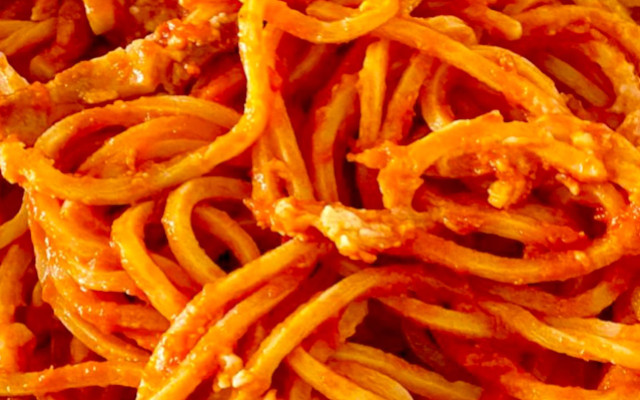
The ‘Matriciana, Roman expression to designate the Amatriciana pasta, represents an exemplary model of gastronomic evolution and legal protection of Made in Italy. Born along the routes of the Apennine transhumance as an evolution of Gricia pasta, this icon of Italian cuisine obtained in 2020 the European recognition of Traditional Specialty Guaranteed (TSG).
The dish is defined today by three key elements:
- history and philology: the passage from the ‘white’ formula to the introduction of tomato (late 18th century) outlines the historical link between the shepherds of Amatrice, the Kingdom of Naples, and the restaurateurs in Rome;
- the EU regulation: the official codification defines the recipe of Traditional Amatriciana TSG, excluding the use of onion or pancetta, mandating the exclusive use of selected guanciale and pecorino;
- the social value: having become a symbol of national solidarity after the 2016 earthquake, Amatriciana has been celebrated since 2026 on its International Day on March 6, supporting the economic rebirth of the territory.
Following is the documentary analysis of historical sources, the constraints of the TSG regulation, and the preparation rules.
The geographical roots, from transhumance to the arrival of the tomato
The genealogy of ‘Matriciana begins, like that of Gricia and Carbonara, from the pastures of theCentral Apennines. Amatrice — today in the province of Rieti, Lazio, but administratively in Abruzzo until 1927 — was the center of a pastoral civilization structured around seasonal transhumance towards the Lazio plains and the Roman countryside. The original recipe, as attested by the Municipal Designation (De.Co.) regulations approved by the Municipality of Amatrice in 2015, was Gricia: durum wheat semolina pasta, pork cheek, pecorino cheese, black pepper. No tomato.
The tomato enters the dish ‘at the end of the eighteenth century‘, as the same regulations specify: it was theinfluence Neapolitan influence that introduced it into the territory of Amatrice, then part of the Kingdom of Naples, where the Neapolitans were among the first in Europe to recognize its organoleptic qualities. The recipe traveled towards Rome along the same transhumance routes: it was Amatrice shepherds, and then the innkeepers who settled in the capital between the 19th and early 20th centuries, who spread it until it became a classic of Roman cuisine, so much so that the term ‘matriciano’ ended up meaning in the Roman dialect the proprietor of a tavern with a kitchen.
The romantic narrative of 18th-century shepherds seasoning pasta with pork cheek during transhumance is however not supported by historical sources: in the 18th century, the consumption of pasta as a daily rural food practice was almost exclusively widespread in Naples and a few southern areas (Cesari, 2021). The first verifiable recipe of a pasta resembling the ‘Matriciana is that of 1914 Amedeo Pettini, head chef of the royal house of Savoy, with pancetta (belly) instead of pork cheek. The most widely disseminated written codification is instead that of Ada Boni in the Talisman of Happiness (first edition 1929), which included onion, chopped bacon, lard and fresh tomatoes.
The earthquake and solidarity with Amatrice
The tradition of ‘Matriciana is essentially associated with the taverns of Rome, in the once popular neighborhoods of Trastevere e Testaccio.
However, there is a date that changed the cultural meaning of this dish: On August 24 2016 a earthquake of magnitude 6.2 razed the historic center of Amatrice. In the hours and days that followed, restaurants throughout Italy decided to include Amatriciana on their menus, with a free donation for the earthquake victims. The dish thus became an instrument of solidarity and collective memory.
In 2020, the European Commission then recognized theTraditional Amatriciana as a Guaranteed Traditional Specialty (STG), after Mozzarella and the Neapolitan Pizza.
The codified recipe: the STG specification
The specification of theTraditional Amatriciana STG (European Commission, 2019) defines in detail the mandatory and optional ingredients of the sauce for immediate seasoning and that ‘for delayed seasoning’:
- jowl bacon Amatriciana type from 18 to 30%: obtained from the fresh cheek of heavy pig, trimmed into a triangle shape with a rounded base starting from the throat, white color streaked with red with prevalence of the fatty part, seasoning minimum of 90 days from salting;
- tomato puree and/or peeled tomatoes in pieces from 69 to 81%; the addition of acidifying agents is prohibited in both cases;
- extra virgin olive oil: from 0.5% to 1%;
- white wine: as needed;
- Salt: as needed;
- chili pepper (dried or fresh) and/or pepper: optional, as needed.
The pecorino cheese — from Amatrice (cylindrical shape with flat faces, dough color: from white to straw; minimum aging 6 months) o Pecorino Romano PDO from Lazio — is a recommended ingredient to be added at serving time.
‘The «Traditional Amatriciana» unlike other similar sauces does not include ingredients such as garlic, onion, or bacon used in most pasta sauces/condiments’.
On closer inspection, most of the 25 recipes published between 1914 and 1964 and cited by Cesari in the book History of Pasta in Ten Dishes consider the use of onion: its exclusion is therefore the result of recent codification, not of a uniform centuries-old tradition.
On the pasta shape the regulations impose no constraints but indicate the traditional use of spaghetti or bucatini, or also short pasta.
The preparation method
The method of preparation is divided into the following stages:
– the jowl bacon, cleaned of rind and cut into strips, is browned over low heat with a drizzle of extra virgin olive oil until the ‘foam’ produced by cooking disappears, then deglazed with white wine. Once the golden-yellow color is reached, the strips are removed and kept aside;
– in the same pan, tomato puree and/or pulp are added tomato, a pinch of Salt and possibly chili pepper and/or pepper, cooking on high heat for 10-20 minutes from boiling until the desired thickness; the pork cheek strips are then added back for a further 5-10 minutes of final cooking.
The ready sauce ‘for deferred seasoning’ it is packaged and subjected to heat treatment. The regulations also allow freezing at the origin. Packages may not exceed 5 kg.
The International Day of Amatriciana
On 2026 the first ‘International Amatriciana Day’ was held in Amatrice (Rieti, Lazio). The 6 March was chosen as a symbolic date because it is the day when Amatriciana pasta obtained the European recognition of Traditional Specialty Guaranteed (TSG). The initiative is promoted by the Association of restaurateurs and hoteliers of Amatrice (ARAM) with the patronage of the Municipality of Amatrice and the Lazio Region, Roma Tre University and the Chambers of Commerce of Rieti and Viterbo.
The program, extended for three days, included conferences on the identity of the famous dish and on the tourist revival of the territory, culinary workshops with tastings of amatriciana (including in the version gluten-free), visits to post-earthquake reconstruction sites, e excursions on foot and by e-bike in the territory of Amatrice and surroundings. This new international day complements the historic ‘Sagra degli spaghetti’ of Amatrice, on August 30-31, and aims to promote the socio-economic rebirth of the area after the earthquake.
‘Matriciana, identity and Made in Italy
The issues of onion and bacon — which often spark lively debates among cooks and enthusiasts of Italian cuisine — are examples of a broader debate between the official codification of tradition and the freedom to recover older recipes, or to innovate them.
The TSG does not resolve this divergence, but rather governs it: anyone can prepare ‘Matriciana’ pasta with onion, or with bacon instead of guanciale, but in these cases cannot present it as ‘Traditional Amatriciana TSG’.
‘Matriciana’ pasta is in any case the symbol of a popular dish that crossed the Apennine trails to be celebrated in Rome and registered in Brussels. Besides being among the protagonists of Italian cuisine, recognized by UNESCO on 10 December 2025.
Dario Dongo
Bibliographic references
- Boni, A. (1929). Roman cuisine: Typical dishes and forgotten recipes of a genuine and rich-in-imagination cuisine (reprint 2017). Newton Compton. ISBN 9788822772688
- Cesari, L. (2021). History of pasta in ten dishes. From tortellini to carbonara. Il Saggiatore. ISBN 9788842828457
- Commission Implementing Regulation (EU) 2020/395 of 6 March 2020 entering a name in the register of traditional specialities guaranteed ‘Amatriciana Tradizionale’ (TSG). http://data.europa.eu/eli/reg_impl/2020/395/oj
- Comune di Amatrice. (2015). Specification of the Amatriciana Sauce De.C.O. Deliberation of the Council 6.3.2015 No. 27 https://www.cucinaregionaleitaliana.it/wp-content/uploads/2019/03/disciplinare_salsa.pdf
- European Commission (2019). Publication of an application for registration of a name pursuant to Article 50(2)(b) of Regulation (EU) No 1151/2012 of the European Parliament and of the Council on quality schemes for agricultural products and foodstuffs2019/C 393/04. https://eur-lex.europa.eu/legal-content/EN/TXT/?uri=oj:JOC_2019_393_R_0004
- Gosetti della Salda, A. (1967). Italian regional recipes. La Cucina Italiana
- Pettini, A. (1914). Cookery and pastry manual. [Rome]

Dario Dongo, lawyer and journalist, PhD in international food law, founder of WIISE (FARE - GIFT – Food Times) and Égalité.


